From Surf Wiki (app.surf) — the open knowledge base
Carbylamine reaction
Method of synthesizing an isocyanide
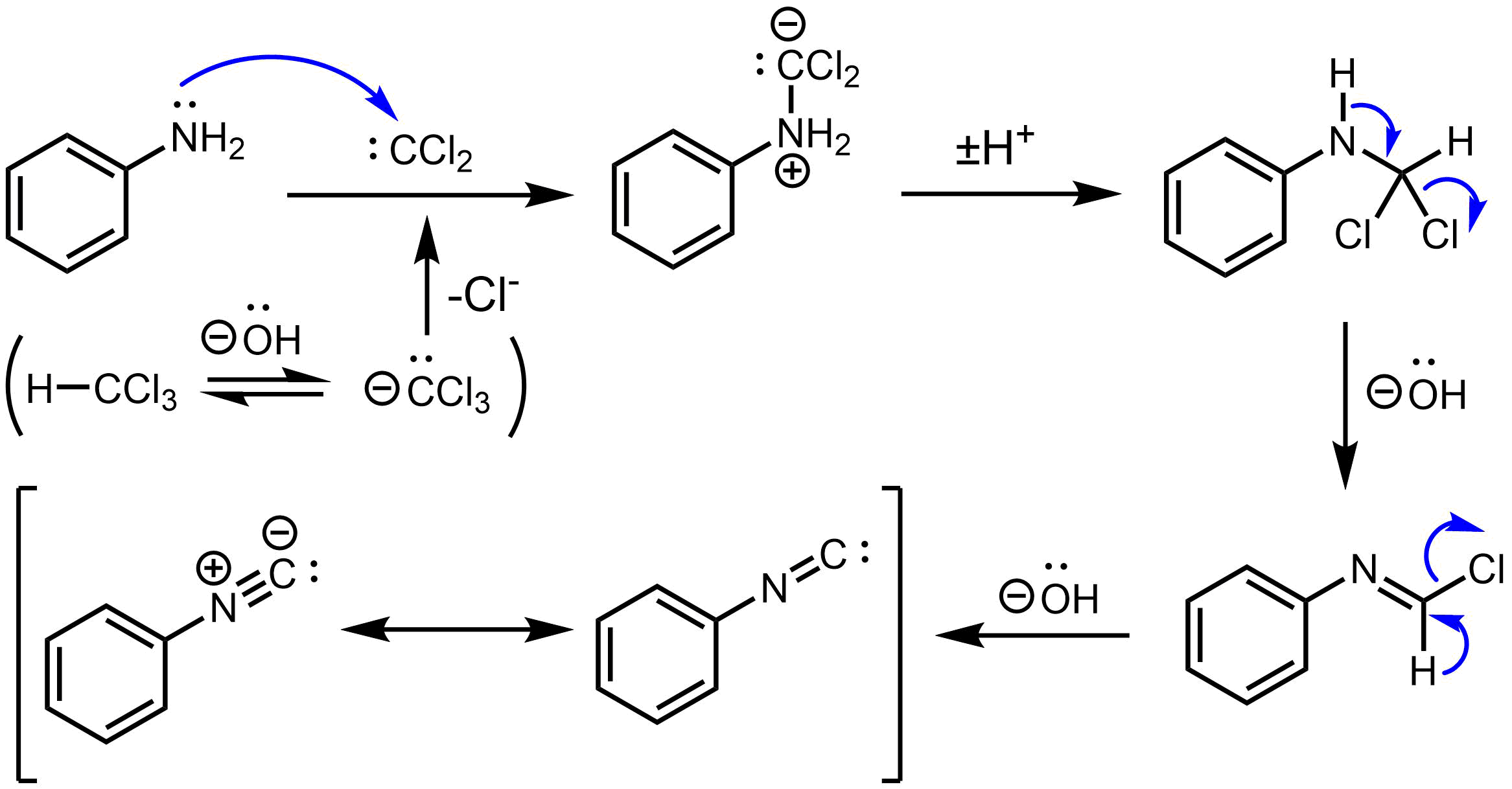
Method of synthesizing an isocyanide
The carbylamine reaction (also known as the Hoffmann isocyanide synthesis) is the synthesis of an isocyanide by the reaction of a primary amine, chloroform, and base. The conversion involves the intermediacy of dichlorocarbene.
Illustrative is the synthesis of tert-butyl isocyanide from tert-butylamine in the presence of catalytic amount of the phase transfer catalyst benzyltriethylammonium chloride. :Me3CNH2 + CHCl3 + 3 NaOH → Me3CNC + 3 NaCl + 3 H2O
Similar reactions have been reported for aniline. It is used to prepare secondary amines.
Test for primary amines
As it is only effective for primary amines, the carbylamine reaction can be used as a chemical test for their presence. In this context, the reaction is also known as Saytzeff's isocyanide test. In this reaction, the analyte is heated with alcoholic potassium hydroxide and chloroform. If a primary amine is present, the isocyanide (carbylamine) is formed, as indicated by a foul odour. The carbylamine test does not give a positive reaction with secondary and tertiary amines.
Mechanism
The mechanism involves the addition of amine to dichlorocarbene, a reactive intermediate generated by the dehydrohalogenation of chloroform. Two successive base-mediated dehydrochlorination steps result in formation of the isocyanide.
References
References
- (1988). "Phase-transfer Hofmann Carbylamine Reaction: tert-Butyl Isocyanide". Organic Syntheses.
- [http://www.books-about-california.com/Pages/Experimental_Organic_Chemistry/Ex_Organic_Chem_Chap_09.html Carbylamine reaction]
This article was imported from Wikipedia and is available under the Creative Commons Attribution-ShareAlike 4.0 License. Content has been adapted to SurfDoc format. Original contributors can be found on the article history page.
Ask Mako anything about Carbylamine reaction — get instant answers, deeper analysis, and related topics.
Research with MakoFree with your Surf account
Create a free account to save articles, ask Mako questions, and organize your research.
Sign up freeThis content may have been generated or modified by AI. CloudSurf Software LLC is not responsible for the accuracy, completeness, or reliability of AI-generated content. Always verify important information from primary sources.
Report