From Surf Wiki (app.surf) — the open knowledge base
Carbon emission trading
Approach to limit climate change
Approach to limit climate change
Emissions trading sets a quantitative total limit on the emissions produced by all participating emitters, which correspondingly determines the prices of emissions. Under emission trading, a polluter having more emissions than their quota has to purchase the right to emit more from emitters with fewer emissions. This can reduce the competitiveness of fossil fuels, which are the main driver of climate change. Instead, carbon emissions trading may accelerate investments into renewable energy, such as wind power and solar power.{{cite web
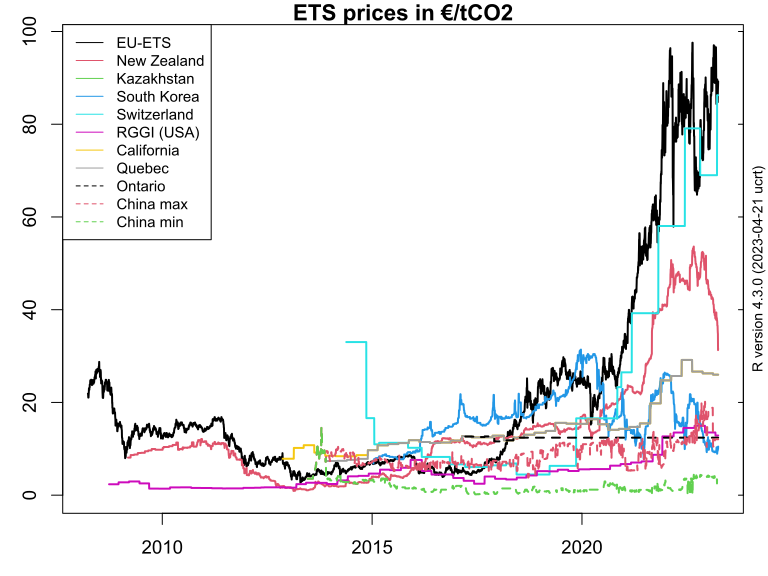
However, such schemes are usually not harmonized with defined carbon budgets that are required to maintain global warming below the critical thresholds of 1.5 °C or "well below" 2 °C, with oversupply leading to low prices of allowances with almost no effect on fossil fuel combustion. Emission trade allowances currently cover a wide price range from €7 per tonne of CO2 in China's national carbon trading scheme to €63 per tonne of CO2 in the EU-ETS (as of September 2021).
Other greenhouse gases can also be traded but are quoted as standard multiples of carbon dioxide with respect to their global warming potential.
An international coalition to create a global carbon market, including a global, gradually declining, cap on emissions began to form in COP30. It can speed up emissions reduction seven-fold in all participating countries, while delivering $200 billion per year for clean-energy and social programs.
Purpose
The economic problem with climate change is that the emitters of greenhouse gases (GHGs) do not face the external costs of their actions, which include the present and future welfare of people, the natural environment, and the social cost of carbon. This can be addressed with the dynamic price model of emissions trading.
An emissions trading scheme for greenhouse gas emissions (GHGs) works by establishing property rights for the atmosphere. The atmosphere is a global public good, and GHG emissions are an international externality. In the cap-and-trade variant of emissions trading, a cap on access to a resource is defined and then allocated among users in the form of permits. Compliance is established by comparing actual emissions with permits surrendered. The setting of the cap affects the environmental integrity of carbon trading, and can result in both positive and negative environmental effects.
Emissions trading programmes such as the European Union Emissions Trading System (EU-ETS) complement the country-to-country trading stipulated in the Kyoto Protocol by allowing private trading of permits, coordinating with national emissions targets provided under the Kyoto Protocol. Under such programmes, a national or international authority allocates permits to individual companies based on established criteria, with a view to meeting targets at the lowest overall economic cost.
History
Carbon emission trading began in Rio de Janeiro in 1992, when 160 countries agreed the UN Framework Convention on Climate Change (UNFCCC). The necessary detail was left to be settled by the UN Conference of Parties (COP).
In 1997, the Kyoto Protocol was the first major agreement to reduce greenhouse gases. 38 developed countries committed themselves to targets and timetables. The resulting inflexible limitations on GHG growth could entail substantial costs if countries have to solely rely on their own domestic measures.
Carbon emissions trading increased rapidly in 2021 with the start of the Chinese national carbon trading scheme. The increasing costs of permits on the EU ETS have had the effect of increasing costs of coal power.
A 2019 study by the American Council for an Energy Efficient Economy finds that efforts to put a price on greenhouse gas emissions are growing in North America. In 2021, shipowners said they were against being included in the EU ETS.
Global Carbon Market Statistics
The global carbon market has experienced significant growth in recent years. In 2023, the value of the global carbon market reached a record high of 881 billion euros (approximately $949 billion), representing a 2% increase from the previous year. The European Union Emissions Trading System (EU ETS) remains the largest carbon market based on value, accounting for approximately 87% of the global market size in 2023.
In terms of trading volume, approximately 12.5 billion metric tons of carbon dioxide (GtCO2) were traded in global carbon markets in 2022, which represented a decline of over 20% from the previous year but still an 18.2% increase compared to 2019 levels. Europe dominated the carbon trading volume, accounting for roughly 74% of the traded volume of CO2 worldwide in 2022.
Economic aspects and tools
Economists generally agree that to regulate emissions efficiently, all polluters need to face the full marginal social costs of their actions. Regulation of emissions applied only to one economic sector or region drastically reduces the efficiency of efforts to reduce global emissions. There is, however, no scientific consensus over how to share the costs and benefits of reducing future climate change, or the costs and benefits of adapting to any future climate change.
Carbon offsets and credits
Carbon leakage
A domestic carbon emissions trading scheme is constrained in its regulatory jurisdiction. GHG emissions may thus leak to another region or sector with less regulation. Generally, leakages reduce the effectiveness of domestic emission abatement efforts. Notwithstanding, leakages may also be negative in nature, increasing the effectiveness of domestic abatement efforts. For example, a carbon tax applied only to developed countries might lead to a positive leakage to developing countries. However, a negative leakage might also occur due to technological developments driven by domestic regulation of GHGs, helping to reduce emissions even in less regulated regions.
The current state of carbon emissions trading shows that roughly 22% of global greenhouse emissions are covered by 64 carbon taxes and emission trading systems as of 2021. Energy intensive industries that are covered by such instruments may view the regulatory disparity between jurisdictions as a loss of competitiveness. They may therefore make strategic production decisions that involve carbon leakage. To mitigate carbon leakage and its effects on the environment, policymakers need to harmonize international climate policies and provide incentives to prevent companies from relocating production to regions with more lenient environmental regulations.
Free emission permits, given to sectors vulnerable to international competition, are one way of addressing carbon leakage by acting as a subsidy for the sector in question. The Garnaut Climate Change Review considered the free allocation of permits unjustified in any circumstances, arguing that governments could deal with market failure or claims for compensation more transparently with the revenue from full auctioning of permits.
Border Adjustment
Another economically efficient solution to carbon leakage is border adjustment, where tariffs are set on imported goods from less regulated countries. A problem with border adjustments is that they might be used as a disguise for trade protectionism. Some types of border adjustment may also not prevent emissions leakage. The EU Carbon Border Adjustment Mechanism takes in effect for 6 sectors in 2026.
Relevance to climate justice
Carbon trading can be helpful to achieve climate justice. It can transfer money from rich countries, which tend to have higher emissions, to countries with lower incomes and lower emissions for improved climate action.
Cap-and-trade systems have also been linked to causing environmental justice as low-income communities receive less benefits from reduced emissions and are often located near the emitters. Companies under emission trading systems will often emit more pollutants not covered by the system and disproportionately affect low-income communities.
Potential global carbon market
The Paris Agreement provided a legal base for the creation of a global carbon market, which has a potentially significant role in stopping climate change. In the beginning of 2024, the idea made some progress with the Bonn meeting where new tools and supervisory bodies were created.
The rules of the European Union Emissions Trading System include the possibility of connecting it with other trading systems. This has already happened with the Switzerland emissions trading system. China expressed a support for a global carbon market, saying it is better than the EU Carbon Border Adjustment Mechanism.
In 2023 the global value of carbon markets was $948.75 billion. It is expected to reach 2.68 trillion dollars by 2028 and 22 trillion by 2050.
Merging the ETC of China and the EU can be something that sends "a powerful signal to the rest of the world and catalyzes international buy-in" while strongly increasing the efficiency of the system and allowing both countries to attain higher results with less spending.
A global carbon market can speed up emissions reduction seven-fold in all participating countries, while delivering $200 billion per year for clean-energy and social programs. An international coalition for creating it began to form in COP 30. The plan is to create a global emissions cap beginning with a level close to current emissions rate, and then reducing it until reaching net-zero by 2050. For any activity which causes emissions, people would buy allowances. As the cap decreases, the cost of the allowances will increase, creating an incentive for decarbonization. There will be a border adjustment mechanism governed by all participants. Poorer countries can not pay or pay less and part of the revenue will be spent on helping them address the climate crisis.
Allocation of permits
Tradable emissions permits can be issued to firms within an ETS by two main ways: by free allocation of permits to existing emitters or by auction. In the first case, the government receives no carbon revenue. In the second it receives the full value of the permits, on average. In either case, permits will be equally scarce and just as valuable to market participants, such that the price at sale will be the same in either case.
Generally, emitters will profit from permits allocated to them for free. But if they must pay, their profits will be reduced. If the carbon price equals the true social cost of carbon, then long-run profit reduction will reflect the consequences of paying this new cost. If having to pay this cost is unexpected, then there will likely be a one-time loss due to the change in regulations and not simply due to paying the real cost of carbon. However, if there is advanced notice of this change, or if the carbon price is introduced gradually, this one-time regulatory cost will be minimized. There has now been enough advance notice of carbon pricing that this effect should be negligible on average.
Grandfathering
Allocating permits based on past emissions is called "grandfathering". Grandfathering permits can lead to perverse incentives, such as a firm being given fewer permits in the future for aiming to cut emissions drastically. Another method of grandfathering is to base allocations on current production of economic goods rather than historical emissions. Under this method of allocation, the government will set a benchmark level of emissions for each good deemed to be sufficiently trade exposed and allocate firms units based on their production of this good. However, allocating permits in proportion to output implicitly subsidises production.
The Garnaut Climate Change Review noted that grandfathered permits are not free of cost. As the permits are scarce, they have value, and the benefit of that value is acquired in full by the emitter. The cost is imposed elsewhere in the economy, typically on consumers who cannot pass on the costs: The cost of a grandfathered permit may be regarded as the opportunity cost of not selling the permit at full value. As a result, profit-maximising firms receiving free permits will raise prices to customers because of the new, non-zero cost of emissions. This gives permit-liable polluters an incentive to reduce their emissions. However, if a firm sells the same amount of output as before that cap, with no change in production technology, the full value of permits received for free becomes windfall profits. However, since the cap reduces output and often causes the company to incur costs to increase efficiency, windfall profits will be less than the full value of its free permits.
Grandfathering may also slow down technological development towards less polluting technologies. The Garnaut Report noted that any method for free permit allocation will have the disadvantages of high complexity, high transaction costs, value-based judgements, and the use of arbitrary emissions baselines. Garnaut also noted that the complexity of free allocation and the large amounts of money involved encourage non-productive rent-seeking behaviour and lobbying of governments — activities that dissipate economic value.
At the same time, allocating permits can be used as a measure to protect domestic firms who are internationally exposed to competition. This happens when domestic firms compete against other firms that are not subject to the same regulation. This argument in favor of allocation of permits has been used in the EU ETS, where industries that have been judged to be internationally exposed have been given permits for free.
The International Air Transport Association, whose 230 member airlines comprise 93% of all international traffic, argue that emissions levels should be based on industry averages rather than using individual companies' previous emissions levels to set their future permit allowances, stating that "would penalise airlines that took early action to modernise their fleets, while a benchmarking approach, if designed properly, would reward more efficient operations".
Auctioning
Hepburn et al. state that, empirically, businesses tend to oppose auctioning of emissions permits, while economists almost uniformly recommend auctioning permits. Auctioning permits provides the government with revenues, which can be used to fund low-carbon investment and cuts in distortionary taxes. Auctioning permits can therefore be more efficient and equitable than allocating permits. Garnaut stated that full auctioning will provide greater transparency and accountability and lower implementation and transaction costs as governments retain control over the permit revenue. Auctions of units are more flexible in distributing costs, provide more incentives for innovation, lessen the political arguments over the allocation of economic rents, and reduce tax distortions. Recycling of revenue from permit auctions could also offset a significant proportion of the economy-wide social costs of a cap and trade scheme.
The perverse incentive of grandfathering can be alleviated through auctioning.
Permit supply level
Regulatory agencies run the risk of issuing too many emission credits, which can result in a very low price on emission permits. This reduces the incentive that permit-liable firms have to cut back their emissions. On the other hand, issuing too few permits can result in an excessively high permit price. An argument has been made for a hybrid instrument having a price floor and a price ceiling. However, a price-ceiling safety value removes the certainty of a particular quantity limit of emissions.
.png)
]]
Criticisms

Emissions trading has been criticized for a variety of reasons. For one, it has been argued that climate change requires more radical solutions than pollution trading schemes, and that systemic changes must be made to reduce fossil fuel usage. At the same time, carbon credits have been seen as enabling large companies to pollute the environment at the expense of local communities. Carbon trading has also been criticised as a form of colonialism, in which rich countries maintain their levels of consumption while getting credit for carbon savings in inefficient industrial projects.
Groups such as the Corner House have argued that the market will choose the easiest means to save a given quantity of carbon in the short term, which may be different from the means to reduce climate change. In September 2010, campaigning group FERN released "Trading Carbon: How it works and why it is controversial"{{Cite web |access-date=December 17, 2010 |archive-date=April 27, 2011 |archive-url=https://web.archive.org/web/20110427190546/http://www.fern.org/tradingcarbon |url-status=live
Some groups have claimed that non-existent emission reductions can be recorded under the Kyoto Protocol due to the surplus of allowances that some countries possess. For example, Russia had a surplus of allowances due to its economic collapse following the end of the Soviet Union. Other countries could have bought these allowances from Russia, but this would not have reduced emissions. In practice, as of 2010, Kyoto Parties had not yet chosen not to buy these surplus allowances.{{Cite web |access-date=April 26, 2010 |url-status=dead |archive-url=https://web.archive.org/web/20100409000327/http://www.pbl.nl/en/dossiers/COP13Bali/moreinfo/Industrialised-countries-will-collectively-meet-2010-Kyoto-target.html |archive-date=April 9, 2010
The complexity of cap and trade schemes around the world has resulted in the uncertainties around such schemes in Australia, Canada, China, the EU, India, Japan, New Zealand, and the US. As a result, some organizations have had little incentive to innovate and comply, resulting in an ongoing battle of stakeholder contestation for the past two decades.
Proposals for alternative schemes to avoid the problems of cap-and-trade schemes include Cap and Share, which was considered by the Irish Parliament in 2008, and the Sky Trust schemes.
Carbon emission trading without border adjustments for exports leads to reduced global competitiveness for carbon-intensive products.
Some critics in the EU blamed the EU ETS for contributing to the 2021 global energy crisis. In August 2022, Polish Prime Minister Mateusz Morawiecki called for a temporary suspension of the EU ETS to stabilize electricity prices, saying the "price increase [on the ETS] is out of control and hitting the household budgets of EU citizens."
Abuses
The Financial Times published an article about cap-and-trade systems, which argued that "Carbon markets create a muddle" and "...leave much room for unverifiable manipulation". Emissions trading schemes have also been criticised for the potential of creating a new speculative market through the commodification of environmental risks through financial derivatives.
Annie Leonard's 2009 documentary The Story of Cap and Trade criticized carbon emissions trading for the free permits to major polluters giving them unjust advantages, cheating in connection with carbon offsets, and as a distraction from the search for other solutions.
In China, some companies started artificial production of greenhouse gases with sole purpose of recycling and gaining carbon credits. Similar practices happened in India. Earned credit were then sold to companies in US and Europe.
Corporate and governmental carbon emission trading schemes have been modified in ways that have been attributed to permitting money laundering to take place.
Examples by country
Australia
Main article: Garnaut Climate Change Review, Carbon Pollution Reduction Scheme, Clean Energy Bill 2011
In 2003 the New South Wales (NSW) state government unilaterally established the New South Wales Greenhouse Gas Abatement Scheme to reduce emissions by requiring electricity generators and large consumers to purchase NSW Greenhouse Abatement Certificates (NGACs). This has prompted the rollout of free energy-efficient compact fluorescent lightbulbs and other energy-efficiency measures, funded by the credits. This scheme has been criticised by the Centre for Energy and Environmental Markets (CEEM) of the University of New South Wales (UNSW) because of its lack of effectiveness in reducing emissions, its lack of transparency and its lack of verification of the additionality of emission reductions.
Prior to the 2007 federal election, both the incumbent Howard Coalition government and the Rudd Labor opposition promised to implement an emissions trading scheme (ETS). Labor won the election, and the new government proceeded to implement an ETS. The new Rudd government introduced the Carbon Pollution Reduction Scheme, which the Liberal Party of Australia (now led by Malcolm Turnbull) supported. Tony Abbott questioned an ETS, advocating a "simple tax" as the best way to reduce emissions. Shortly before the carbon vote, Abbott defeated Turnbull in a leadership challenge (December 1, 2009), and from there on the Liberals opposed the ETS. This left the Rudd Labor government unable to secure passage of the bill, and it was subsequently withdrawn.
Julia Gillard defeated Rudd in a leadership challenge, becoming Federal Prime Minister in June 2010. She promised that she would not introduce a carbon tax, but would look to legislate a price on carbon when taking the government to the 2010 election. In the first Australian hung-parliament result in 70 years, the Gillard Labor government required the support of crossbenchers - including the Greens. One requirement for Greens' support was a carbon price, which Gillard proceeded with in forming a minority government. A fixed carbon-price would proceed to a floating-price ETS within a few years under the plan. The fixed price lent itself to characterisation as a "carbon tax", and when the government proposed the Clean Energy Bill in February 2011, the opposition denounced it as a broken election promise.
The Lower House passed the bill in October 2011 and the Upper House in November 2011. The Liberal Party vowed to repeal the bill if elected. The bill thus resulted in passage of the Clean Energy Act, which possessed a great deal of flexibility in its design and uncertainty over its future.
The Liberal/National coalition government elected in September 2013 promised to reverse the climate legislation of the previous government. In July 2014, the carbon tax was repealed - as well as the Emissions Trading Scheme (ETS) that was to start in 2015.
Canada
The Canadian provinces of Quebec and Nova Scotia operate an emissions trading scheme. Quebec links its program with the US state of California through the Western Climate Initiative.
China
The Chinese national carbon trading scheme is the largest in the world. It is an intensity-based trading system for carbon dioxide emissions by China, which started operating in 2021. The initial design of the system targets a scope of 3.5 billion tons of carbon dioxide emissions that come from 1700 installations. It has made a voluntary pledge under the UNFCCC to lower CO2 per unit of GDP by 40–45% in 2020 when comparing to the 2005 levels.
In November 2011, China approved pilot tests of carbon trading in seven provinces and cities—Beijing, Chongqing, Shanghai, Shenzhen, Tianjin, as well as Guangdong Province and Hubei Province, with different prices in each region. The pilot is intended to test the waters and provide valuable lessons for the design of a national system in the near future. Their successes or failures will, therefore, have far-reaching implications for carbon market development in China in terms of trust in a national carbon trading market. Some of the pilot regions can start trading as early as 2013/2014. National trading is expected to start in 2017, latest in 2020.
The effort to start a national trading system has faced some problems that took longer than expected to solve, mainly in the complicated process of initial data collection to determine the base level of pollution emission. According to the initial design, there will be eight sectors that are first included in the trading system: chemicals, petrochemicals, iron and steel, non-ferrous metals, building materials, paper, power and aviation, but many of the companies involved lacked consistent data. Therefore, by the end of 2017, the allocation of emission quotas have started but it has been limited to only the power sector and will gradually expand, although the operation of the market is yet to begin. In this system, Companies that are involved will be asked to meet target level of reduction and the level will contract gradually.
European Union
India
Trading is set to begin in 2014 after a three-year rollout period. It is a mandatory energy efficiency trading scheme covering eight sectors responsible for 54 per cent of India's industrial energy consumption. India has pledged a 20 to 25 per cent reduction in emission intensity from 2005 levels by 2020. Under the scheme, annual efficiency targets will be allocated to firms. Tradable energy-saving permits will be issued depending on the amount of energy saved during a target year.
Japan
Japan as a country does not have a compulsory emissions trading scheme. The government in 2010 (the Hatoyama cabinet) had planned to introduce one, but the plan lost momentum after Hatoyama resigned as prime minister, due partly from industrial opposition, and was eventually shelved. Japan has a voluntary scheme. Furthermore, the Kyoto Prefecture has a voluntary emissions trading scheme.
Two regional mandatory schemes exist however, in Tokyo and Saitama Prefecture. The city of Tokyo consumes as much energy as "entire countries in Northern Europe, and its production matches the GNP of the world's 16th largest country". A cap-and-trade carbon trading scheme launched in April 2010 covers the top 1,400 emitters in Tokyo, and is enforced and overseen by the Tokyo Metropolitan Government. Phase 1, which was similar to Japan's voluntary scheme, ran until 2015. Emitters had to cut their emissions by 6% or 8% depending on the type of organization; from 2011, those who exceed their limits were required to buy matching allowances, or invest in renewable-energy certificates, or offset credits issued by smaller businesses or branch offices. Polluters that failed to comply were liable up to 500,000 yen in fines plus credits for 1.3 times excess emissions. In its fourth year, emissions were reduced by 23% compared to base-year emissions. In phase 2 (FY2015–FY2019), the target was expected to increase to 15–17%. The aim was to cut Tokyo's carbon emissions by 25% from 2000 levels by 2020.
One year after Tokyo launched its cap-and-trade scheme, the neighbouring Saitama Prefecture launched a highly similar scheme. The two schemes are connected.
New Zealand
South Korea
South Korea's national emissions trading scheme officially launched on January 1, 2015, covering 525 entities from 23 sectors. With a three-year cap of 1.8687 billion tCO2e, it now forms the second-largest carbon market in the world, following the EU ETS. This amounts to roughly two-thirds of the country's emissions. The Korean emissions trading scheme is part of the Republic of Korea's efforts to reduce greenhouse gas emissions by 30% compared to the business-as-usual scenario by 2020.
United Kingdom
United States
The American Clean Energy and Security Act (H.R. 2454), a greenhouse gas cap-and-trade bill, was passed on June 26, 2009, in the House of Representatives by a vote of 219–212. The bill originated in the House Energy and Commerce Committee. It was introduced by Representatives Henry A. Waxman and Edward J. Markey. The political advocacy organizations FreedomWorks and Americans for Prosperity, funded by brothers David and Charles Koch of Koch Industries, encouraged the Tea Party movement to focus on defeating the legislation. Although cap and trade also gained a significant foothold in the Senate via the efforts of Republican Lindsey Graham, Independent and former Democrat Joe Lieberman, and Democrat John Kerry, the legislation died in the Senate.
President Barack Obama's proposed 2010 United States federal budget wanted to support clean energy development with a 10-year investment of US$15 billion per year, generated from the sale of greenhouse gas emissions credits. Under the proposed cap-and-trade program, all GHG emissions credits would have been auctioned off, generating an estimated $78.7 billion in additional revenue in FY 2012, steadily increasing to $83 billion by FY 2019. The proposal was never made law. Failing to get congressional approval for such a scheme, President Barack Obama instead acted through the United States Environmental Protection Agency to attempt to adopt the Clean Power Plan, which does not feature emissions trading. The plan was subsequently challenged by the administration of President Donald Trump.
In 2006, the California State Legislature adopted the California Assembly Bill 32 (AB32), the Global Warming Solutions Act that let to a statewide cap-and-trade program that began in 2012. California and Quebec linked their cap-and-trade programs in 2014, sharing one carbon market.
In 2021, Washington state instituted its own emissions trading system, which it called "cap-and-invest." Revenue from the auctioning of carbon allowances is directly invested in programs intended to address climate change.
In the United States, most polling shows large support for emissions trading.
References
References
- "Emissions Trading Worldwide: Status Report 2021". International Carbon Action Partnership (ICAP).
- "Policy Brief: EU emissions trading". Mercator Research Institute on Global Commons and Climate Change.
- (July 22, 2021). "China's national carbon market exceeds expectations".
- "Carbon Price Viewer". EMBER.
- (2025-09-16). "Building a Climate Coalition: Aligning Carbon Pricing, Trade, and Development".
- "Carbon Market Coalition Welcomes 18 Member Countries at COP30".
- (2025-09-12). "Ministry of Finance proposes global coalition for carbon market".
- IMF. (March 2008). "Fiscal Implications of Climate Change". International Monetary Fund, Fiscal Affairs Department.
- Halsnæs, K.. (2007). "Framing issues.". Cambridge University Press, Cambridge, UK, and New York, N.Y., U.S.A..
- Toth, F.L.. (2005). "Decision-making Frameworks.". Print version: Cambridge University Press, Cambridge, UK, and New York, N.Y., U.S.A.. This version: GRID-Arendal website.
- Goldemberg, J.. (1996). "Climate Change 1995: Economic and Social Dimensions of Climate Change. Contribution of Working Group III to the Second Assessment Report of the Intergovernmental Panel on Climate Change". Cambridge University Press, Cambridge, U.K., and New York, N.Y., U.S.A..
- Tietenberg, Tom. (2003). "The Tradable-Permits Approach to Protecting the Commons: Lessons for Climate Change". Oxford Review of Economic Policy.
- David M. Driesen. "Capping Carbon". Environmental Law.
- "Tax Treaty Issues Related to Emissions Permits/Credits". OECD.
- (17 March 2011). "Key points: Update Paper 6: Carbon pricing and reducing Australia's emissions". Garnaut Climate Change Review.
- Grimeaud, D, 'An overview of the policy and legal aspects of the international climate change regime' (2001) 9(2) Environmental Liability 39.
- Stewart, R, "Economic incentives for environmental protection: opportunities and obstacles", in Revesz, R; Sands, P; Stewart, R (eds.), ''Environment Law, the Economy and Sustainable Development'', 2000, Cambridge University Press.
- (July 16, 2021). "China's carbon market scheme too limited, say analysts". Financial Times.
- (June 24, 2021). "Study: EU emission trading system makes coal more expensive".
- (January 2, 2019). "State and Provincial Efforts to Put a Price on Greenhouse Gas Emissions, with Implications for Energy Efficiency".
- Meredith, Sam. (July 12, 2021). "The world's largest carbon market is set for a historic revamp. Europe's shipowners are concerned".
- "Global carbon market size 2023".
- "Global carbon market emissions trading volume 2022".
- Goldemburg et al., 1996, pp. 29, 37
- Goldemburg et al., 1996, p. 30
- IPCC. (2007). "Annex I: Glossary". Print version: Cambridge University Press, Cambridge, U.K., and New York, N.Y., U.S.A.. This version: IPCC website.
- Goldemberg ''et al.'', 1996, pp. 27–28
- Barker, T.. (2007). "Mitigation from a cross-sectoral perspective". Print version: Cambridge University Press, Cambridge, U.K., and New York, N.Y., U.S.A.. This version: IPCC website.
- World Bank. (May 25, 2021). ''State and trends of carbon pricing 2021''. https://openknowledge.worldbank.org/handle/10986/35620
- Carbon Market Watch. (2017). Carbon Leakage: A short history of an industry lobbying buzzword. Retrieved from https://carbonmarketwatch.org/2017/02/28/carbon-leakage-a-short-history-of-an-industry-lobbying-buzzword/{{Dead link. (November 2025)
- Carbon Trust. (March 2009). "The role of carbon markets in preventing dangerous climate change". UK Parliament House of Commons Environmental Audit Select Committee. The fourth report of the 2009-10 session.
- Garnaut, Ross. (2008). "The Garnaut Climate Change Review". Cambridge University Press.
- Neuhoff, K.. (February 22, 2009). "The role of carbon markets in preventing dangerous climate change". UK Parliament House of Commons Environmental Audit Select Committee. The fourth report of the 2009-10 session.
- Grubb, M.. (August 3, 2009). "Climate Policy and Industrial Competitiveness: Ten Insights from Europe on the EU Emissions Trading System". Climate Strategies.
- (May 10, 2023). "cbam regulation".
- "Carbon Justice for All: How Carbon Markets Can Advance Equitable Climate Action Globally".
- Lambert, Lea. “Trading Rights for Greenhouse Gases: The Dilemma of Cap-And-Trade and Environmental Justice.” ''George Mason University Civil Rights Law Journal'', vol. 24, no. 2, Mar. 2014, pp. 205–31. ''EBSCOhost'', research.ebsco.com/linkprocessor/plink?id=9774996b-9033-3e6b-89ce-9799d4ead71b.
- "International carbon market". European Union.
- (March 4, 2024). "Paris agreement carbon crediting mechanism advances".
- "Will International Carbon Markets Finally Deliver?".
- (February 26, 2024). "China Objects to EU's Border Carbon Tax, Backs Global Market".
- (February 12, 2024). "Global carbon markets value hit record $949 bln last year - LSEG". Reuters.
- (April 19, 2023). "Global Carbon Credit Market 2023: Sector to Reach $2.68 Trillion by 2028 at a CAGR of 18.23%".
- (September 1, 2023). "Energy Traders See Big Money in Carbon-Emissions Markets".
- "East Meets West: Linking the China and EU ETS's". University of Pennsylvania.
- (2025-09-16). "Building a Climate Coalition: Aligning Carbon Pricing, Trade, and Development".
- "Carbon Market Coalition Welcomes 18 Member Countries at COP30".
- (2025-09-12). "Ministry of Finance proposes global coalition for carbon market".
- Ainger, John. (2025-09-23). "Brazil Lobbies EU, China to Join COP30 Carbon Market Coalition". Bloomberg.com.
- Gupta, S.. (2007). "Chapter 13: Policies, instruments, and co-operative arrangements". Cambridge University Press, Cambridge, U.K., and New York, N.Y., U.S.A..
- Goldemberg ''et al.'', 1996, p. 38
- (March 2008). "Fiscal Implications of Climate Change". International Monetary Fund.
- (2007). "Output-based allocation of emissions permits for mitigating tax and trade interactions". Land Economics.
- Don Fullerton & Gilbert E. Metcalf. (1997). "Environmental Taxes and the Double-Dividend Hypothesis". NBER.
- (2006). "The Economics of Climate Change". Resources for the Future.
- Fisher, B.S.. (1996). "Climate Change 1995: Economic and Social Dimensions of Climate Change. Contribution of Working Group III to the Second Assessment Report of the Intergovernmental Panel on Climate Change". Cambridge University Press, Cambridge, U.K., and New York, N.Y., U.S.A..
- Hepburn, C.. (2006). "Regulating by prices, quantities or both: an update and an overview". Oxford Review of Economic Policy.
- Cambridge Centre for Climate Change Mitigation Research. (June 19, 2008). "The Revision of the EU's Emissions Trading System". UK Parliament.
- "What You Need to Know About Emissions Trading". International Air Transport Association.
- (2006). "Auctioning of EU ETS Phase II allowances: why and how?". Climate Policy.
- (January 25, 2007). "Climate change; The greening of America". The Economist.
- Fisher, B.S.. (1996). "Climate Change 1995: Economic and Social Dimensions of Climate Change. Contribution of Working Group III to the Second Assessment Report of the Intergovernmental Panel on Climate Change". IPCC.
- Hepburn, C.. (2006). "Regulating by prices, quantities or both: an update and an overview". Oxford Review of Economic Policy.
- (1998). "Tradable Carbon Permit Auctions: How and Why to Auction Not Grandfather". Resources For the Future..
- Stavins, Robert N.. (2008). "Addressing climate change with a comprehensive US cap-and-trade system". Oxford Review of Economic Policy.
- (December 2008). "Building a low-carbon economy – The UK's contribution to tackling climate change". Committee on Climate Change.
- Bashmakov, I.. (2001). "Climate Change 2001: Mitigation. Contribution of Working Group III to the Third Assessment Report of the Intergovernmental Panel on Climate Change". IPCC.
- (2024). "State and Trends of Carbon Pricing 2024". [[World Bank]].
- "Carbon Trade Watch".
- Lohmann, Larry. (December 5, 2006). "A licence to carry on polluting?". New Scientist.
- Liverman, D.M.. (2008). "Conventions of climate change: constructions of danger and the dispossession of the atmosphere". Journal of Historical Geography.
- Carbon Trade Watch. (November 2009). "Carbon Trading – How it works and why it fails". Dag Hammarskjöld Foundation.
- (2016). "Constraining or Enabling Green Capability Development? How Policy Uncertainty Affects Organizational Responses to Flexible Environmental Regulations". British Journal of Management.
- Ray Barrell, Alan Barrett, Noel Casserly, Frank Convery, Jean Goggin, Ide Kearney, Simon Kirby, Pete Lunn, Martin O'Brien and Lisa Ryan. 2009. ''Budget Perspectives'', Tim Callan (ed.)
- (March 16, 2021). "Border carbon adjustments and industrial competitiveness in a European Green Deal". Climate Policy.
- (October 6, 2021). "European Energy Crisis Fuels Carbon Trading Expansion Concerns". Bloomberg.
- (October 20, 2021). "The Green Brief: East-West EU split again over climate". [[Euractiv]].
- (August 31, 2022). "EU's von der Leyen rebuffs Polish call to suspend carbon market". Euractiv.
- (April 26, 2007). "Carbon markets create a muddle". Financial Times.
- link. (February 16, 2010 and [http://www.thecornerhouse.org.uk/pdf/document/NPE2high.pdf full text] {{Webarchive). link. (December 21, 2009)
- Annie Leonard. (2009). "The Story of Cap and Trade". The Story of Stuff Project.
- "Carbon-Credits System Tarnished by WikiLeaks Revelation".
- (November 24, 2010). "Imminent EU proposals to clamp down on fridge gas scam".
- [http://www.saigon-gpdaily.com.vn/International/2010/7/83958/ "Carbon trading used as money-laundering front: experts" www.saigon-gpdaily.com.vn] {{webarchive. link. (August 28, 2010)
- I. Lippert. [http://opus.bibliothek.uni-augsburg.de/opus4/files/2199/Lippert2013Enacting_Environments.pdf Enacting Environments: An Ethnography of the Digitalisation and Naturalisation of Emissions] {{Webarchive. link. (January 17, 2023. University of Augsburg, 2013.)
- (January 4, 2010). "The Greenhouse Gas Reduction Scheme". Greenhouse Gas Reduction Scheme Administrator.
- (2007). "The NSW Greenhouse Gas Reduction Scheme: An analysis of the NGAC Registry for the 2003, 2004 and 2005 Compliance Periods". The UNSW Centre for Energy and Environmental Markets (CEEM).
- (June 7, 2011). "Abbott defends carbon tax interview". ABC News.
- link. (March 18, 2015, ''The Australian'', August 20, 2010.)
- Leslie, Tim. (February 24, 2011). "Gillard unveils Carbon Price Details". ABC News.
- Hudson, Phillip. (February 26, 2011). "Tony Abbott calls for election on carbon tax". Herald Sun.
- Johnston, Matt. (October 12, 2011). "Carbon tax bills pass lower house of federal Parliament". Herald Sun.
- (November 8, 2011). "Carbon tax gets green light in Senate". Sydney Morning Herald.
- (October 2, 2011). "Opposition vows to repeal carbon tax". Sydney Morning Herald.
- [http://indymedia.org.au/2013/09/20/abbott-governments-first-actions-trash-climate-change-education-carbon-pricing "Abbott Government's first actions: trash climate change education, carbon pricing"] {{Webarchive. link. (September 23, 2021, ''Indymedia Australia'', September 20, 2013. Accessed November 8, 2013.)
- (July 7, 2014). "Carbon tax scrapped: PM Tony Abbott sees key election promise fulfilled after Senate votes for repeal". ABC News.
- "China National ETS".
- (January 18, 2018). "China Looks Towards Next Steps For Implementing National Carbon Market".
- (September 2014). "China could launch national carbon market in 2016".
- Andrews-Speed, Philip. (November 2014). "China's Energy Policymaking Processes and Their Consequences". The National Bureau of Asian Research Energy Security Report.
- (July 11, 2011). "Factbox: Carbon trading schemes around the world". Reuters.
- Feng, Emily. (December 19, 2017). "China moves towards launch of carbon trading scheme".
- (December 19, 2017). "China to Launch World's Largest Emissions Trading System".
- Watanabe, Rie. (January 1, 2012). "14. Northeast Asia: A. Japan". Yearbook of International Environmental Law.
- "Japan: Greenhouse gas emissions trading schemes {{!}} White & Case LLP".
- [http://www.sei-international.org/mediamanager/documents/Publications/china-cluster/SEI-FORES-2012-China-Carbon-Emissions.pdf China's Carbon Emission Trading] {{Webarchive. link. (October 30, 2017, 2012.)
- (February 11, 2010). "Tokyo CO2 credit trading plan may become a model". Reuters.
- (April 8, 2010). "Tokyo kicks off carbon trading scheme". The Guardian.
- "Urban Environment and Climate Change – Publications".
- "Emissions Trading Worldwide ICAP Status Report 2015".
- (June 1, 2009). "The American Clean Energy and Security Act (H.R. 2454)". Energycommerce.house.gov.
- (2011). "The Oxford Handbook of Climate Change and Society". Oxford University Press.
- Mayer, Jane. (August 30, 2010). "Covert Operations: The billionaire brothers who are waging a war against Obama".
- Lizza, Ryan. (October 11, 2010). "As the World Burns: How the Senate and the White House missed their best chance to deal with climate change".
- Turin, Dustin R.. (2012). "The Challenges of Climate Change Policy: Explaining the Failure of Cap and Trade in the United States With a Multiple-Streams Framework". Student Pulse.
- "President's Budget Draws Clean Energy Funds from Climate Measure". Renewable Energy World.
- Bang, Guri, et al. “California’s Cap-and-Trade System: Diffusion and Lessons.” ''Global Environmental Politics'', vol. 17, no. 3, Aug. 2017, pp. 12–30. ''EBSCOhost'', https://doi-org.lib-e2.lib.ttu.edu/10.1162/GLEP_a_00413.
- "[https://www.washingtonpost.com/wp-dyn/content/article/2009/06/24/AR2009062403648.html Majority of Poll Respondents Say U.S. Should Limit Greenhouse Gases] {{Webarchive. link. (January 31, 2021", ''The Washington Post''. June 25, 2009.)
- "[https://blogs.wsj.com/environmentalcapital/2009/08/11/poll-position-new-zogby-poll-shows-71-support-for-waxman-markey/ Poll Position: New Zogby Poll Shows 71% Support for Waxman-Markey] {{Webarchive. link. (July 31, 2020", ''The Wall Street Journal''. August 11, 2009)
- "[http://climate.yale.edu/news/poll-americans-support-strong-climate-energy-policies Poll: Americans Support Strong Climate, Energy Policies]", Yale Climate & Energy Institute {{webarchive. link. (January 28, 2012)
- "[http://www.politifact.com/truth-o-meter/statements/2009/sep/03/ibdeditorialscom/ibd-editorial-board-claims-cap-and-trade-unpopular/ IBD editorial board claims that cap-and-trade is unpopular in America] {{Webarchive. link. (May 3, 2019", PolitiFact)
This article was imported from Wikipedia and is available under the Creative Commons Attribution-ShareAlike 4.0 License. Content has been adapted to SurfDoc format. Original contributors can be found on the article history page.
Ask Mako anything about Carbon emission trading — get instant answers, deeper analysis, and related topics.
Research with MakoFree with your Surf account
Create a free account to save articles, ask Mako questions, and organize your research.
Sign up freeThis content may have been generated or modified by AI. CloudSurf Software LLC is not responsible for the accuracy, completeness, or reliability of AI-generated content. Always verify important information from primary sources.
Report