From Surf Wiki (app.surf) — the open knowledge base
Carambola
Fruit

Fruit
the fruit


Carambola, also known as star fruit, is the fruit of Averrhoa carambola, a species of tree native to tropical Southeast Asia.
Carambola fruits contain oxalic acid and the neurotoxin caramboxin. Consuming large quantities of the fruit, especially for individuals with some types of kidney disease, can result in serious adverse health effects.
Origins and distribution
Main article: Averrhoa carambola

The center of diversity and the original range of Averrhoa carambola is tropical Southeast Asia, where it has been cultivated for centuries. It was introduced to the Indian subcontinent and Sri Lanka by Austronesian traders, along with ancient Austronesian cultigens like langsat, noni, and santol. They remain common in those areas and in East Asia and throughout Oceania and the Pacific Islands. They are cultivated commercially in India, Southeast Asia, southern China, Taiwan, and the southern United States. They are also grown in Central America, South America, and the U.S. state of Hawaii, the Caribbean, and parts of Africa. They are grown as ornamentals. Carambola is considered to be at risk of becoming an invasive species in many world regions.
Description
The carambola tree has a short trunk with many branches, reaching up to 30 ft in height. Its deciduous leaves are 6 - long, with 5 to 11 ovate leaflets medium-green in color. Flowers are lilac in color, with purple streaks, and are about 1/4 in wide.
The showy fruits have a thin, waxy pericarp, orange-yellow skin, and crisp, yellow flesh with juice when ripe.
Like the closely related bilimbi, there are two main types of carambola: the small sour (or tart) type and the larger sweet type. The sour varieties have a higher oxalic acid content than the sweet type. Several cultivars have been developed in recent years. The most common cultivars grown commercially include the sweet types "Arkin" (Florida), "Yang Tao" (Taiwan), "Ma fueng" (Thailand), "Maha" (Malaysia), and "Demak" (Indonesia) and the sour types "Golden Star", "Newcomb", "Star King", and "Thayer" (all from Florida). Some sour varieties, like "Golden Star", can become sweet if allowed to ripen.
Common names
Carambola is known by many names across its regions of cultivation, including khế in Vietnam, balimbing in the Philippines, belimbing in Indonesia and Malaysia, ma fen in China, kamaranga in India, and carambolo in Spanish-speaking countries.
Culinary

The entire fruit is edible, including the slightly waxy skin. The flesh is crunchy, firm, and extremely juicy.
Ripe, sweet-type carambolas are sweet without being overwhelming, as they rarely have more than 4% sugar content. They have a tart, sour undertone. The taste is difficult to match, but it has been compared to a mix of apple, pear, grape, and citrus family fruits. Unripe star fruits are firmer and sour, and taste like green apples.
Ripe carambolas may also be used in cooking. In Southeast Asia, they are usually stewed in cloves and sugar, sometimes with apples. In China, they are cooked with fish. They may be cooked as a vegetable, pickled, or made into jams in Australia. In Jamaica, they are sometimes dried.
Unripe and sour type carambolas can be mixed with other chopped spices to make relishes in Australia. In the Philippines, unripe carambolas are eaten dipped in rock salt. In Thailand, they are cooked together with shrimp.
The juice from carambolas is also used in iced drinks, particularly the juice of the sour varieties. In the Philippines, they can be used as a seasoning. In India, the juice is bottled for drinking.
Nutrition
Raw carambola is 91% water, 7% carbohydrates, 1% protein, and has negligible fat (table). A 100-gram reference amount of raw fruit supplies 128 kJ of food energy and a rich content of vitamin C (41% of the Daily Value), with no other micronutrients in significant content (table).
Health risks
Carambolas contain caramboxin and oxalic acid. Both substances are harmful to individuals suffering from kidney failure, kidney stones, or those under kidney dialysis treatment. Caramboxin is a neurotoxin which is structurally similar to phenylalanine, and is a glutamatergic agonist.
Drug interactions
Like the grapefruit, carambola is considered to be a potent inhibitor of seven cytochrome P450 isoforms. These enzymes are significant in the first-pass elimination of many medications, and, thus, the consumption of carambola or its juice in combination with certain prescription medications can significantly increase their effective dosage within the body.
Cultivation
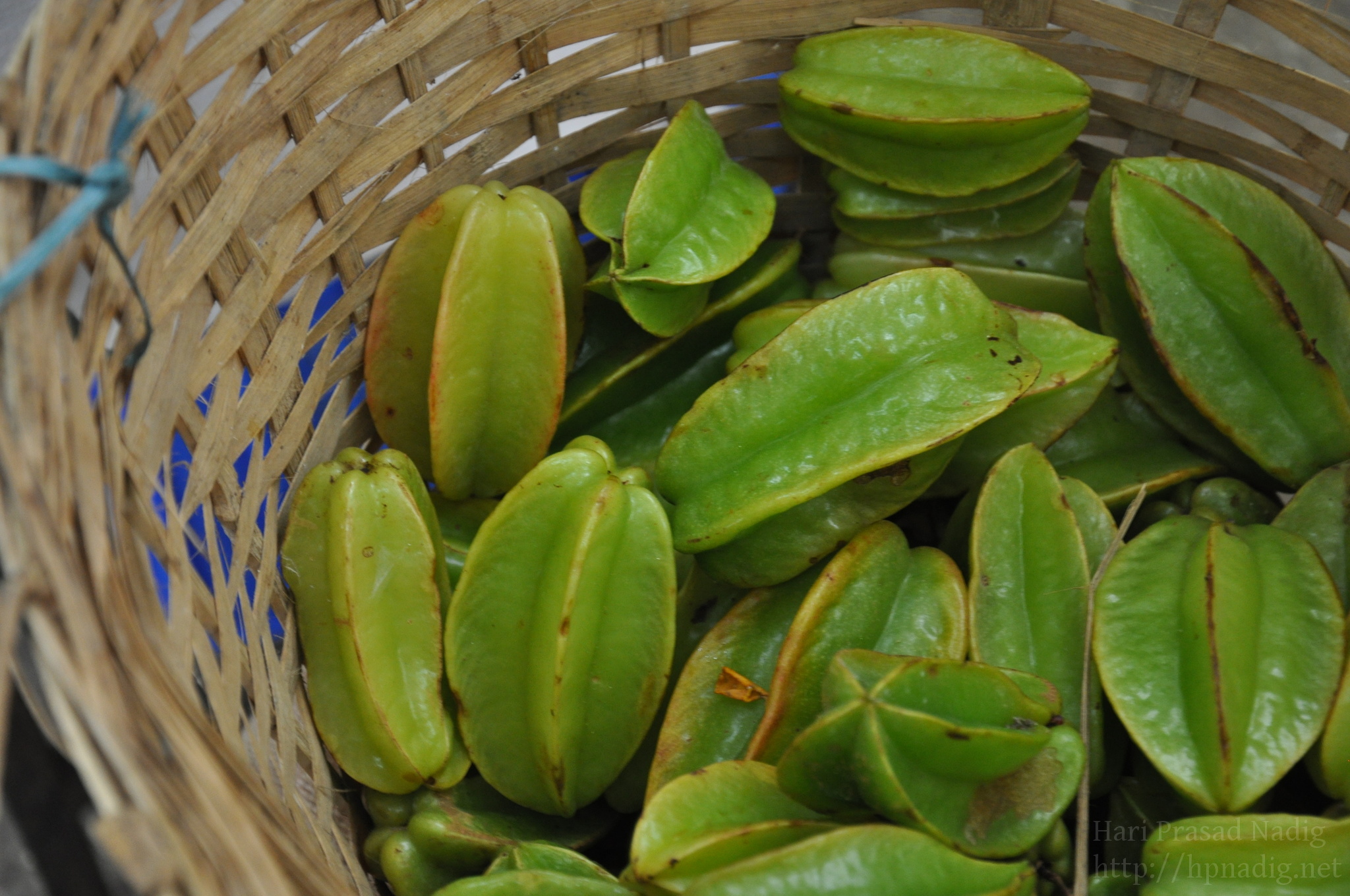

The carambola is a tropical and subtropical fruit which can be grown at elevations up to 4,000 ft. It prefers full sun exposure, but requires enough humidity and annual rainfall of at least 70 in. It does not have a soil type preference, but will thrive in loam and requires good drainage. Moderate irrigation supports its growth during dry seasons. Heavy rains may inhibit fruit production.
Carambola trees are planted at least 20 ft from each other and typically are fertilized three times a year. The tree grows rapidly and typically produces fruit at four or five years of age. The large amount of rain during spring actually reduces the amount of fruit, but, in ideal conditions, carambola can produce from 200 to of fruit a year. The carambola tree flowers throughout the year, with main fruiting seasons from April to June and October to December in Malaysia, for example, but fruiting also occurs at other times in some other locales, such as South Florida.
Growth and leaf responses of container-grown 'Arkin' carambola (Averrhoa carambola L.) trees to long-term exposure of 25%, 50%, or 100% sunlight showed that shading increased rachis length and leaflet area, decreased leaflet thickness, and produced more horizontal branch orientation.
Major pests are carambola fruit flies, fruit moths, ants, and birds. Crops are also susceptible to frost.
Top producers of carambola in the world market include Australia, Guyana, India, Israel, Malaysia, the Philippines, Taiwan, and the United States. Malaysia is a global leader in star fruit production by volume and ships the product widely to Asia and Europe. Due to concerns over pests and pathogens, however, whole star fruits cannot yet be imported to the US from Malaysia under current United States Department of Agriculture regulations. In the United States, carambolas are grown in tropical and semitropical areas, including parts of Florida and Hawaii.
In the United States, commercial cultivation and broad consumer acceptance of the fruit only date to the 1970s, attributable to Morris Arkin, a backyard horticultuarlist, in Coral Gables, Florida. The 'Arkin' variety represented 98% of the acreage in South Florida in the early 21st century.
In popular culture

The trees are also grown as ornamentals for their abundant, brightly colored and unusually shaped fruits, as well as for their attractive dark green leaves and their lavender to pink flowers.
Like the bilimbi, the juice of the more acidic sour types can be used to clean rusty or tarnished metal (especially brass) as well as bleach rust stains from cloth. They may also be used as a mordant in dyeing.
The farming video game Stardew Valley allows the player to cultivate and grow carambola, in this setting known as "starfruit". They are one of the most valuable crops in the game. The in-game icon erroneously depicts the fruit as resembling its real-life cross-section, and the plant itself as a single-harvest crop instead of a tree.
The Filipino word for the starfruit, balimbing, due to its many-faced shape, has acquired the meaning in Philippine political discourse of a turncoat, someone who switches political allegiances not out of principle but for their own self-interest.
References
References
- Julia F. Morton. (1987). "Carambola (''Averrhoa carambola''); In: Fruits of Warm Climates". NewCROP, New Crop Resource Online Program, Center for New Crops & Plant Products, Purdue University.
- (27 September 2018). "''Averrhoa carambola'' (carambola)". CABI.
- (2008). "Genomics of Tropical Crop Plants". Springer.
- (1993). "CRC Handbook of Alternative Cash Crops". CRC Press.
- (2014). "Diversity in Underutilized Plant Species – An Asia-Pacific Perspective". Bioversity International.
- (2009). "Discovering history through language: Papers in honour of Malcolm Ross". Research School of Pacific and Asian Studies, Australian National University.
- "Star Fruit". Fruitsinfo.
- "Carambola or Star Fruit". FloridaGardener.com.
- (21 November 2006). "Balimbing / Carambola / Star Fruit". Market Manila.
- Tint Khine Aye, Moet Moet Khaing, Thin Ei Ei Zaw. "A Study on Preliminary Phytochemical Investigation and Nutritional Values of Averrhoa carambola L.". 2nd Myanmar Korea Conference Research Journal.
- (2013). "Elucidating the Neurotoxicity of the Star Fruit". Angewandte Chemie International Edition.
- (2002). "Star fruit (''Averrhoa carambola'') intoxication: an important cause of consciousness disturbance in patients with renal failure". Ren Fail.
- (2003). "Intoxication by star fruit (''Averrhoa carambola'') in 32 uraemic patients: treatment and outcome". Nephrol Dial Transplant.
- Titchenal A & Dobbs J. (2003-04-28). "Kidney patients should avoid star fruit". Nutrition ATC.
- "Abstracts: Metabolism and metabolic enzymes studies for the 8th National Congress on Drug and Xenobiotic Metabolism in China".
- [http://www.theannals.com/cgi/content/full/40/7/1472-a Potential Drug-Food Interactions with Pomegranate Juice] {{webarchive. link. (March 21, 2007)
- Crop Protection & Plant Quarantine Services Division. (2004). "Technical Document for Market Access on Star Fruit (Carambola)". The Ministry of Agriculture and Agro-based Industry, Malaysia.
- (1994-07-01). "Developmental Light Level Affects Growth, Morphology, and Leaf Physiology of Young Carambola Trees". Journal of the American Society for Horticultural Science.
- Hein Bijlmakers. "Star Fruit". Tropical Fruits.
- (July 2017). ["The 'Arkin' Carambola in Florida"](http://www.fshs.org/Proceedings/Password%20Protected/2002%20Vol.%20115/92-93(Knight).pdf}}{{dead link). Proc. Fla. State Hort. Soc..
- "Starfruit". Stardew Valley Wiki.
- Now You Know PH. "ML@50: Martial Law Word of the Day — "Balimbing"". [[Rappler]].
This article was imported from Wikipedia and is available under the Creative Commons Attribution-ShareAlike 4.0 License. Content has been adapted to SurfDoc format. Original contributors can be found on the article history page.
Ask Mako anything about Carambola — get instant answers, deeper analysis, and related topics.
Research with MakoFree with your Surf account
Create a free account to save articles, ask Mako questions, and organize your research.
Sign up freeThis content may have been generated or modified by AI. CloudSurf Software LLC is not responsible for the accuracy, completeness, or reliability of AI-generated content. Always verify important information from primary sources.
Report