From Surf Wiki (app.surf) — the open knowledge base
Capitol Park Historic District
Historic district in Michigan, United States
Historic district in Michigan, United States
| Field | Value |
|---|---|
| name | Capitol Park Historic District |
| nrhp_type | hd |
| nocat | yes |
| image | Capitol Park Detroit MI.jpg |
| caption | Capitol Park, from the north |
| location | Detroit, Michigan, U.S. |
| coordinates | |
| built | 1877 |
| architect | Albert Kahn Associates et al. |
| architecture | Italianate, Romanesque Revival |
| added | March 18, 1999 |
| refnum | 99000338 |
| designated_other1 | Michigan State Historic Site |
| designated_other1_num_position | bottom |
| designated_other1_color | CornflowerBlue |
The Capitol Park Historic District is a historic district located in downtown Detroit, Michigan. It is roughly bounded by Grand River, Woodward and Michigan Avenues, and Washington Boulevard. The district was listed on the National Register of Historic Places in 1999.
Description
Capitol Park itself is a triangular plot of land (now a public park) bounded by Shelby Street, Griswold Street, and State Street. The plot is an artifact of Augustus Woodward's 1805 plan for the city of Detroit. The Historic District includes the park and seventeen surrounding buildings for a block in each direction. Buildings within the district include the Farwell Building, the Griswold Building, the David Stott Building, the Detroit Savings Bank Building and the Industrial Building.
History

In 1823, the population of Detroit had increased to the point that the US Congress transferred governance of what was then the Territory of Michigan to the governor and legislative council. To house the new government, a courthouse was built in Capitol Park in 1823–28. When Michigan became a state in 1837, the building became the state capitol, and functioned so until 1847 when the governmental seat was moved to Lansing. The building was then used as a public high school until 1893, when it was destroyed by fire. The land was then converted to a park, and it has remained a public space up to the present.
The buildings within the Historic District surrounding the park were built primarily during the first three decades of the 20th century for commercial and business purposes. Several famous architects, including Albert Kahn and Gordon W. Lloyd, contributed buildings in a range of styles, from Victorian to Beaux-Arts to Art Deco. The buildings demonstrate the transformation of Detroit from a prospering 19th century commercial center to a modern city.
In addition to the present buildings, Capitol Park has a historic connection to the Underground Railroad. In 1850, Seymour Finney purchased a plot of land near the park and erected a tavern with a large barn. Finney was strongly sympathetic to the abolitionist cause, and used his barn to hide escaping slaves before their final trek across the river into Canada. A State of Michigan historical marker has been erected in the park to commemorate Finney's Barn.
In 1905, the remains of Michigan's first governor Stevens T. Mason were transferred from New York City where he died 1843 and interred in Capitol Park in a ceremony attended by sitting governor Fred M. Warner and mayor George P. Codd among other officials. A statue of Mason by sculptor Albert Weinert was later erected over the grave. When plans were announced in 2009 to reconfigure the park, they included relocating the monument and grave. However, the burial vault was not where earlier plans indicated and crews searched for four days before it was located on June 29, 2010. It was believed the grave was moved from its 1905 location in 1955 to make room for a bus terminal. On the 199th anniversary of his birth, October 27, 2010, Mason was reburied for 4th time in a newly built vault in the pedestal the bronze statue. The current dean of the Cathedral Church of St. Paul, where funeral services were held for Mason in 1843, officiated at the ceremony.
Transit hub & redevelopment
The park has also served as a major downtown transit center. Two years after the destruction of the state capitol by fire, multiple streetcar lines were looped around the new park with large boarding platforms constructed on Griswold and Shelby streets, transforming it into a major transfer station. In 1955, the Department of Street Railways (DSR) constructed the $280,000 (~$ in ) Capitol Park Bus Terminal at the north end of the park which facilitated the moving of Stevens T. Mason's tomb to the south end of the park. The new facility was constructed using steel and reinforced concrete, with plastic skylights throughout the concrete canopy. Not long after the restructuring of the DSR as the Detroit Department of Transportation (DDOT), the station was demolished in 1979, though the area around the park continued to be used as a major bus terminal.
In 2001, the area was named as the Capitol Park Transit Center, and was used as a temporary terminal until the completion of the Rosa Parks Transit Center.
Gallery
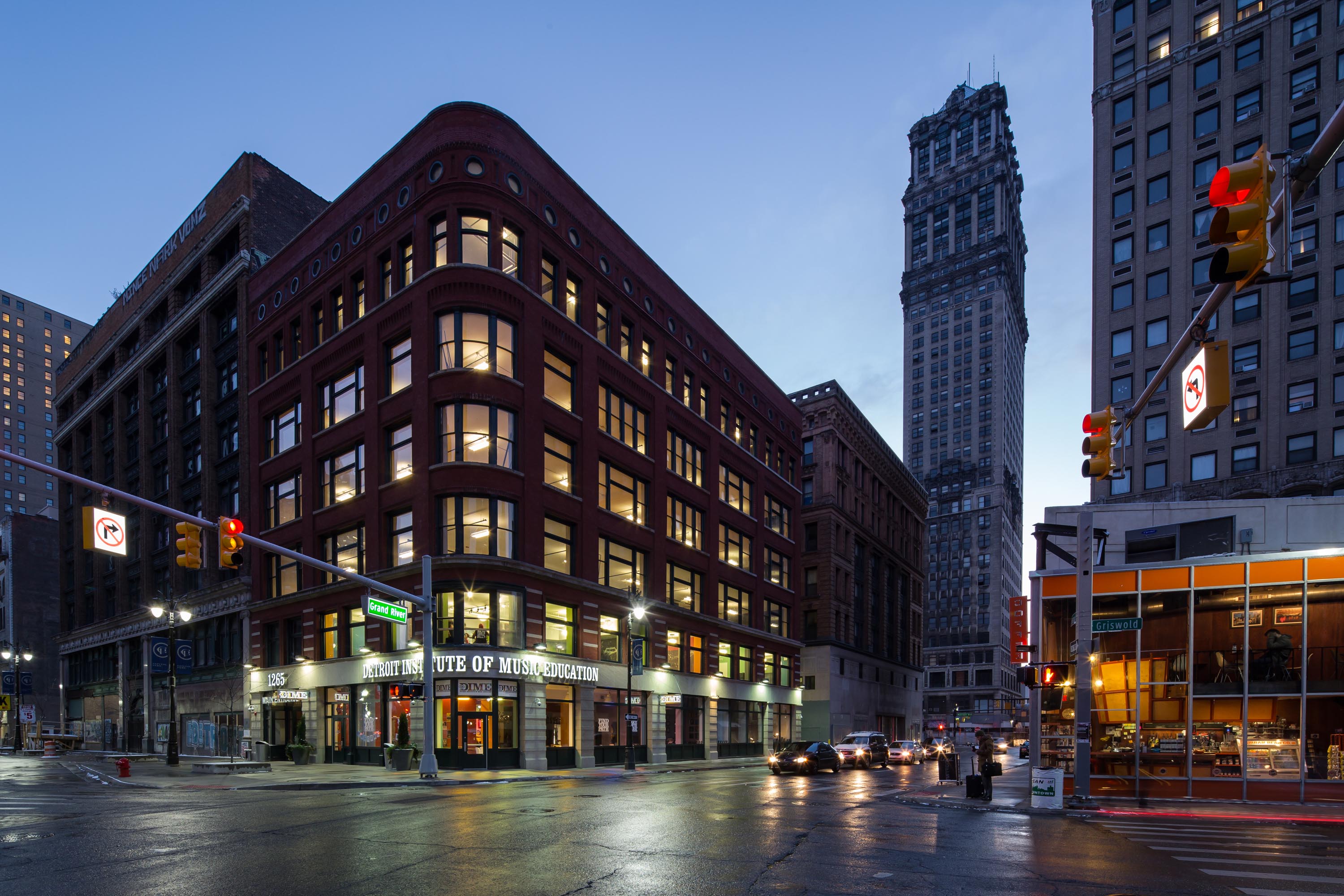
Image:Capitol Park 1942.jpg|Capitol Park in 1942, looking north Image:FarwellBuildingDetroit.jpg|Farwell Building, looking through Capitol Park Image:CapitolParkDetroit.jpg|Looking south on Griswold at State, with The David Stott Building on the left Image:GriswoldBuildingDetroit.jpg|Griswold Building Image:Capitol Park 2011.JPG|Capitol Park in 2011 Image:Stevens T Mason Monument.JPG|Stevens T. Mason Monument in 2011 Image:Detroit December 2021 60 (Capitol Park).jpg|Capitol Park at night Image:DIME building exterior.jpg|The Detroit Institute of Music Education (DIME) and Urban Bean at Grand River and Griswold St in Capitol Park
References
References
- {{NRISref. 2008a
- "Capitol Park Historic District". City of Detroit.
- (2003). "AIA Detroit". Wayne State University Press.
- "Finney Hotel Underground Railway Informational Site".
- Austin, Dan. (July 1, 2010). "'Boy Governor' Mason unearthed". [[Detroit Free Press]].
- Catlin, George Byron. (2005). "The story of Detroit". University of Michigan Library.
- Steele, Micki. (October 27, 2010). "Michigan's first governor buried again". The Detroit News.
- Anderson, Elisha. (October 28, 2010). "Michigan's 1st governor is reburied in aboveground vault at park". Detroit Free Press.
- "The Former D.S.R. Capitol Park Bus Station".
- (September 15, 2009). "Development Promises New Life for Historic Capitol Park".
This article was imported from Wikipedia and is available under the Creative Commons Attribution-ShareAlike 4.0 License. Content has been adapted to SurfDoc format. Original contributors can be found on the article history page.
Ask Mako anything about Capitol Park Historic District — get instant answers, deeper analysis, and related topics.
Research with MakoFree with your Surf account
Create a free account to save articles, ask Mako questions, and organize your research.
Sign up freeThis content may have been generated or modified by AI. CloudSurf Software LLC is not responsible for the accuracy, completeness, or reliability of AI-generated content. Always verify important information from primary sources.
Report