From Surf Wiki (app.surf) — the open knowledge base
Cape Verdean Creole
Portuguese-based creole of Cape Verde
Portuguese-based creole of Cape Verde
| Field | Value |
|---|---|
| name | Cape Verdean Creole |
| nativename | kabuverdianu, kriolu, kriol |
| states | Cape Verde |
| nationality | Cape Verdeans |
| speakers | 871,000 |
| date | 2017 |
| ref | e19 |
| familycolor | Creole |
| fam1 | Portuguese Creole |
| fam2 | Afro-Portuguese Creole |
| fam3 | Upper Guinea Creole |
| script | Latin (ALUPEC) |
| iso3 | kea |
| glotto | kabu1256 |
| glottorefname | Kabuverdianu |
| lingua | 51-AAC-aa |
| notice | IPA |
| ethnicity | Cape Verdeans |
Cape Verdean Creole is a Portuguese-based creole language spoken on the islands of Cape Verde. It is the native creole language of virtually all Cape Verdeans and is used as a second language by the Cape Verdean diaspora.
The creole has particular importance for creolistics studies since it is the oldest living creole. It is the most widely spoken Portuguese-based creole language.
Name
The full formal name of this creole is Cape Verdean Creole (crioulo cabo-verdiano in Portuguese, kriolu kabuverdianu / kriol kabverdian in Cape Verdean Creole), but in everyday usage the creole is simply called ‘Creole’ (crioulo in Portuguese, kriolu / kriol in Cape Verdean Creole) by its speakers. The names Cape Verdean (cabo-verdiano in Portuguese, kabuverdianu / kabverdian in Cape Verdean Creole) and Cape Verdean language (língua cabo-verdiana in Portuguese, linga / língua kabuverdianu / kabverdian in Cape Verdean Creole) have been proposed for whenever the creole will be standardized.
Origins
The history of Cape Verdean Creole is hard to trace due to a lack of written documentation and to ostracism during the Portuguese administration of Cape Verde.
There are presently three theories about the formation of Cape Verdean Creole. The monogenetic theory claims that the creole was formed by the Portuguese by simplifying the Portuguese language in order to make it accessible to enslaved African people. That is the point of view of authors like Prudent, Waldman, Chaudenson and Lopes da Silva. Authors like Adam and Quint argue that Cape Verdean Creole was formed by enslaved African people using the grammar of Western African languages and replacing the African lexicon with the Portuguese one. Linguists like Chomsky and Bickerton argue that Cape Verdean Creole was formed spontaneously, not by enslaved people from continental Africa, but by the population born in the islands, using universal grammar.
According to A. Carreira, Cape Verdean Creole was formed from a Portuguese pidgin, on the island of Santiago, starting from the 15th century. That pidgin was then transported to the west coast of Africa by the lançados. From there, that pidgin diverged into two proto-creoles, one that was the base of Cape Verdean Creole, and another that was the base of the Guinea-Bissau Creole.
Cross-referencing information regarding the settlement of each island with the linguistic comparisons, it is possible to form some conjectures. The spreading of Cape Verdean Creole within the islands was done in three phases:
- In a first phase, the island of Santiago was occupied (2nd half of the 15th century), followed by Fogo (end of the 16th century).
- In a second phase, the island of São Nicolau was occupied (mostly in the 2nd half of the 17th century), followed by Santo Antão (mostly in the 2nd half of the 17th century).
- In a third phase, the remaining islands were occupied by settlers from the first islands: Brava was occupied by people from Fogo (mostly in the beginning of the 18th century), Boa Vista by people from São Nicolau and Santiago (mostly in the 1st half of the 18th century), Maio by people from Santiago and Boa Vista (mostly in the 2nd half of the 18th century), São Vicente by people from Santo Antão and São Nicolau (mostly in the 19th century), Sal by people from São Nicolau and Boa Vista (mostly in the 19th century).
Status
In spite of Creole being the first language of nearly all the population in Cape Verde, Portuguese is still the official language. As Portuguese is used in everyday life (at school, in administration, in official acts, in relations with foreign countries, etc.), Portuguese and Cape Verdean Creole live in a state of diglossia, and code switching occurs between the creole and standard Portuguese in informal speech. Due to this overall presence of Portuguese, a decreolization process occurs for all the different Cape Verdean Creole variants.
Check in this fictional text: : Santiago variant: :: Kel mudjer ku ken N nkontra ónti staba priokupada purki el skesi di ses mininus na skóla, i kandu el bai prokura-s el ka olia-s. Algen lenbra-l ki ses mininus sa-ta prisizaba di material pa un piskiza, enton, el bai nkontra-s na bibliotéka ta prokura u-ki es kria. Pa gradesi a tudu ken djuda-l, el kumesa ta fala, ta fla kómu el staba konténti di fundu di kurasãu. : São Vicente variant: :: Kel amdjer ke ken N nkontrá onte tava priokupada purke el sksê de ses mnins na skóla, i kónde el bai prokurá-s el ka oliá-s. Algen lenbra-l ke ses mnins tava ta prisizá de material pa un piskiza, ento, el bai nkontrá-s na bibliotéka ta prokurá u-ke es kria. Pa gradesê a tude ken jdá-l, el kmesá ta fala, ta dze kóm el tava konténte de funde de kurasãu*.* : Translation to Portuguese: :: Aquela mulher com quem eu encontrei-me ontem estava preocupada porque ela esqueceu-se das suas crianças na escola, e quando ela foi procurá-las ela não as viu. Alguém lembrou-lhe que as suas crianças estavam a precisar de material para uma pesquisa, então ela foi encontrá-las na biblioteca a procurar o que elas queriam. Para agradecer a todos os que ajudaram-na, ela começou a falar, dizendo como ela estava contente do fundo do coração. : Translation to English: :: That woman with whom I met yesterday was worried because she forgot her children at school, and when she went to seek them she didn't see them. Someone reminded her that her children were needing some material for a research, and so she found them at the library searching what they needed. To thank to everyone who helped her, she started speaking, telling how she was glad from the bottom of her heart.
In this text, several cases of decreolization / Portuguese intromission can be noted:
- ku ken / ke kenPortuguese order of words com quem;
- nkontra / nkontráPortuguese lexicon, in Creole it would be more commonly atxa / otxá;
- priokupadaPortuguese lexicon, in Creole it would be more commonly fadigada;
- purki / purkePortuguese lexicon, in Creole it would be more commonly pamodi / pamode;
- ses mininus / ses mninsPortuguese influence (plural marker on both words);
- prokura-s / prokurá-sPortuguese lexicon, in Creole it would be more commonly spia-s / spiá-s;
- olia-s / oliá-sPortuguese phonetics (intromission of the phoneme );
- ki / kePortuguese lexicon, the integrant conjunction in Creole is ma;
- sa-ta prisizaba / tava ta prisizáPortuguese lexicon, in Creole it would be more commonly sa-ta mesteba / tava ta mestê;
- u-ki / u-keintromission of Portuguese o que;
- gradesi a / gradesê awrong preposition, the Portuguese preposition "a" does not exist in Creole;
- falathis form (from contemporary Portuguese falar) is only used in São Vicente and Santo Antão, in the other islands the word is papiâ (from old Portuguese papear);
- kómu / kómintromission of Portuguese como;
- kurasãuPortuguese phonetics (reduction of the phoneme to and Portuguese pronunciation instead of Creole );
The same text "corrected": : Santiago variant: :: Kel mudjer ki N nkontra ku el ónti staba fadigada pamodi el skesi ses mininu na skóla, i kantu ki el bai spia-s el ka odja-s. Algen lenbra-l ma ses mininu sa-ta mesteba material pa un piskiza, anton, el bai atxa-s na biblotéka ta spia kusé ki es kria. Pa gradesi pa tudu ken ki djuda-l, el kumesa ta pâpia, ta fla modi ki el staba konténti di fundu di kurason. : São Vicente variant: :: Kel amdjer ku N nkontrá ma el aonte tava fadigada pamode el sksê ses mnin na skóla, i kónde el bai spia-s el ka oiá-s. Algen lenbra-l ma ses mnin tava ta mestê material pa un piskiza, unton, el bai otxá-s na biblotéka ta spiá kzé ke es kria. Pa gradesê pa tude ken ke jdá-l, el kmesá ta fala, ta dze ke manera k'el tava konténte de funde de kurasan.
As a consequence there is a continuum between basilectal and acrolectal varieties.
In spite of Creole not being officialized, a 2005 government resolution put forth the necessary conditions for the officialization of Creole, which in turn has been superseded by a 2015 resolution. This officialization has not yet occurred, mostly because the language is not yet standardized, for several reasons:
- There is significant dialectal fragmentation. Speakers are reluctant to speak a variant that is not their own.
- Absence of rules to establish which is the right form (and also the right spelling) to be adopted for each word. For example, for the word corresponding to the Portuguese word algibeira ("pocket"), A. Fernandes records the forms aljibera, ajibera, albijera, aljubera, aljbera, jilbera, julbera, lijbera.
- Absence of rules to establish which are the lexical limits to be adopted. It is frequent for speakers of Creole, when writing, to join different grammatical classes. For ex.: pam... instead of pa N... "for me to...".
- Absence of rules to establish which are the grammatical structures to be adopted. It is not just about dialectal differences; even within a single variant there are fluctuations. For ex.: in the Santiago variant, when there are two sentences and one is subordinated to the other, there is a tense agreement in the verbs (bu kria pa N daba "you wanted me to give"both kria and daba are past tense), but some speakers do not practice it (bu kria pa N dapast then presentor bu kre pa N dabapresent then past).
- The writing system (ALUPEC) has not been well accepted by all Creole users.
- The language levels (formal, informal, scientific, slang, etc.) are not well differentiated yet.
That is the reason why each speaker when speaking (or writing) uses their own dialect, their own sociolect, and their own idiolect.
To overcome these problems, some Creole advocates propose the development of two standards: a North (Barlavento) standard, centered on the São Vicente variant, and a South (Sotavento) standard, centered on that of Santiago. If so, Creole would become a pluricentric language.
There exists no complete translation of the Bible. However, the "Asosiason Kabuverdianu pa Traduson di Bíblia" was established with the goal of translating the entire Bible in Kabuverdianu-Sotaventu and Kabuverdianu-Barlaventu. They have translated approximately 40% of the New Testament in the Kabuverdianu-Sotaventu, and they have published Luke and Acts. The publication of Luke has won two awards in Cape Verde. Sérgio Frusoni translated Bartolomeo Rossetti's version of the Romanesco Italian poem Er Vangelo Seconno Noantri, which is a poem based on the Four Gospels. Frusoni translated the poem in the São Vicente Creole, Vangêle contód d'nôs móda.
Writing system
Main article: ALUPEC
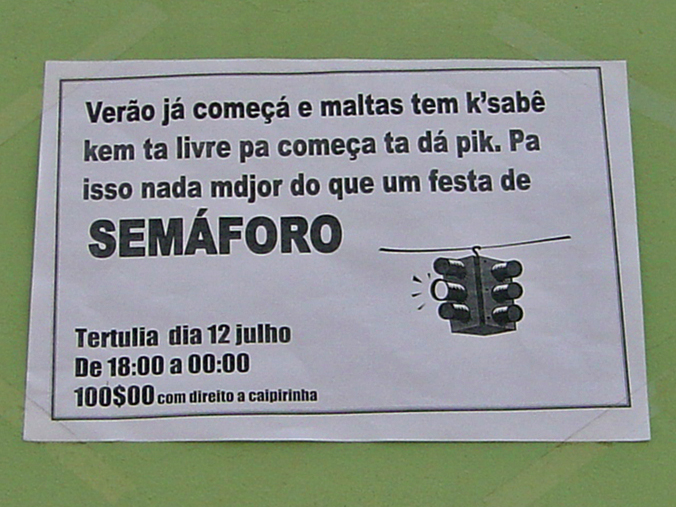
The only writing system officially recognized by the authorities in Cape Verde is called the Alfabeto Unificado para a Escrita da Língua Cabo-verdiana (ALUPEC, ), which was approved for official use on an experimental basis in 1998 by Decree-Law No. 67/98. In 2009, Decree-Law No. 8/2009 officially institutionalized the use of the ALUPEC. In spite of having been officially recognized by the government, the ALUPEC is neither required nor mandatorily used.
In spite of being the only system officially recognized, the same law allows the use of alternative writing models, "as long as they are presented in a systematic and scientific way". As not all users are familiarized with ALUPEC or the IPA, in this article a slightly different system will be used to make it easier for the reader:
- The sound will be represented in an etymological way ("s" when in Portuguese is "s", "ss" when in Portuguese is "ss", "c" when in Portuguese is "c", "ç" when in Portuguese is "ç") instead of ALUPEC always "s".
- The sound will be represented in an etymological way ("s" when in Portuguese is "s", "z" when in Portuguese is "z") instead of ALUPEC always "z".
- The sound will be represented by "tch" instead of ALUPEC "tx".
- The sound will be represented in an etymological way ("x" when in Portuguese is "x", "ch" when in Portuguese is "ch") instead of ALUPEC always "x".
- The sound will be represented in an etymological way ("j" when in Portuguese is "j", "g" when in Portuguese is "g") instead of ALUPEC always "j".
- The sound will be represented in an etymological way ("c" when in Portuguese is "c", "qu" when in Portuguese is "qu") instead of ALUPEC always "k".
- The sound will be represented in an etymological way ("g" when in Portuguese is "g", "gu" when in Portuguese is "gu") instead of ALUPEC always "g".
- The nasality of the vowels will be represented by an "m" after the vowel, when this vowel is at the end of the word or before the letters "p" and "b". In the other cases the nasality will be represented by the letter "n".
- The words will always have a graphic accent. This will be an overwhelming use of accents, but it is the only way to effectively represent both the stressed syllable and vowel aperture.
- To show an elided vowel in certain variants an apostrophe **** will be used.
Vocabulary
The vocabulary of Cape Verdean Creole comes mainly from Portuguese. Although several sources do not agree, the figures oscillate between 90 and 95% of words from Portuguese. The remaining comes from several languages from Western Africa (Mandingo, Wolof, Fulani, Temne, Balanta, Mandjak, etc.), and the vocabulary from other languages (English, French, Latin) is negligible.
Phonology
Cape Verdean Creole's phonological system comes mainly from 15th-through-17th-century Portuguese. In terms of conservative features, Creole has kept the affricate consonants and [written "j" (in the beginning of words) and "ch", in old Portuguese] which are not in use in today's Portuguese, and the pre-tonic vowels were not reduced as in today's European Portuguese. In terms of innovative features, the phoneme (written "lh" in Portuguese) has evolved to and the vowels have undergone several phonetic phenomena.
Vowels
There are eight oral vowels and their corresponding nasal counterparts, making a total of sixteen vowels:
| colspan=2 | Front | colspan=2 | Central | colspan=2 | Back | oral | nasal | oral | nasal | oral | nasal | Close | Close-mid | Open-mid | Open |
|---|
Descriptions
| Phoneme | Example | Translation to English | Description | |||
|---|---|---|---|---|---|---|
| ̃/ | ||||||
| ̃/ |
Consonants and semi-vowels
| Labial | Dental/ | |||||||||||
|---|---|---|---|---|---|---|---|---|---|---|---|---|
| Alveolar | Postalveolar/ | |||||||||||
| Palatal | Velar | Uvular | Nasal | Plosive | Affricate | Fricative | Tap | Trill | Approximant | Lateral | ||
| () | ||||||||||||
| () |
- Note: The sounds , and are variants of the same phoneme .
Descriptions
| Phoneme | Example | Translation to English | Description | |||
|---|---|---|---|---|---|---|
--
First-person singular
The personal pronoun that represents the subject form of the first person singular has a variable pronunciation according to the islands.
This pronoun comes from the object form of the first person singular in Portuguese mim, and it is phonetically reduced to the sound .
This pronunciation is nowadays found in the Barlavento variants. In the Sotavento variants that consonant was reduced to a simple nasality . For example: N anda ('I have walked'), N sta ta sintí ('I am feeling'), N lababa ('I had washed'). Before plosive or affricate consonants this nasality becomes homorganic nasal of the following consonant. For ex.: N ben ('I came'), N ten ('I have'), N txiga ('I arrived'), N kre ('I want').
Speakers who are strongly influenced by the Portuguese language tend to pronounce this pronoun as a nasal vowel úm instead of N .
Before some forms of the verb ser this pronoun takes back its full form mi , in whatever variant: mi é ('I am'), mi éra ('I was').
In this article and in formal cabo verdean language, this pronoun is conventionally written N, with capital letter, no matter the variant.
Semivowels
| Phoneme | Example | Translation to English | Description | |||
|---|---|---|---|---|---|---|

Grammar
Even though over 90% of Cape Verdean Creole words are derived from Portuguese, the grammar is very different, which makes it extremely difficult for an untrained Portuguese native speaker even to understand a basic conversation. On the other hand, the grammar shows a lot of similarities with other creoles, Portuguese-based or not (see syntactic similarities of creoles).
Sentence structure
The basic sentence structure in Creole is SubjectVerbObject. Ex.:
- El ta kume pexi. "He eats fish."
When there are two objects, the indirect object comes first while the direct object comes after, and the sentence structure becomes SubjectVerbIndirect ObjectDirect Object. Ex.:
- El ta da pexi kumida. "He gives food to the fish."
A feature that makes Cape Verdean Creole closer to other creoles is the possibility of double negation (ex.: Nada N ka atxa. liter. "Nothing I didn't find."), or sometimes even triple negation (ex.: Nunka ningen ka ta baba la. liter. "Never nobody didn't go there."). Although double negation is common in Portuguese (e.g. "Nunca ninguém foi lá"), triple negation is a little bit uncommon.
Nouns
Gender inflection
Only the animated nouns (human beings and animals) have gender inflection. Ex.:
- inglês / ingléza "Englishman / Englishwoman"
- porku / pórka "pig (male) / pig (female)"
In some cases the distinction between sexes is made putting the adjectives matxu "male" and fémia "female" after the nouns. Ex.:
- fidju-matxu / fidju-fémia "son / daughter"
- katxor-matxu / katxor-fémia "dog (male) / dog (female)"
Number inflection
The nouns in Creole have number inflection (plural marks) only when they are well determined or known in the context. Ex.:
- Mininus di Bia é ben konportadu. ("The children of Bia are well behaved.")
When the noun refers to something in general that noun does not have number inflection. Ex.:
- Mininu debe ruspeta algen grandi. ("Children must respect grown up people.")
If in a sentence there are several grammatical categories, only the first bears the plural marker. Ex.:
- mininus ("boys")
- nhas minina ("my girls")
- mininus bunitu ("beautiful boys")
- nhas dos minina bunita i sinpátika ("my two kind and beautiful girls")
:Further reading:
Personal pronouns
According to their function, the pronouns can be subject pronouns or object pronouns. Furthermore, in each of these functions, according to the position within the sentence the pronouns can be unstressed or stressed.
The unstressed subject pronouns generally bear the function of the subject and come before the verb. Ex.:
- Nu kre. "We want."
The stressed subject pronouns bear the function of some kind of vocative and usually are separated from the verb (disjunctive pronouns). Ex.:
- Mi, N sta li, i bo, bu sta la. "Me, I am here, and you, you are there."
The object pronouns, as the name shows, bear the function of the object (direct or indirect). The unstressed object pronouns are used with the present-tense forms of verbs. Ex.:
- N odja-l. "I have seen it."
- N ta beja-bu. "I kiss you."
The stressed object pronouns are used with the past-tense forms of verbs, when they are the second pronoun in a series of two pronouns, and after prepositions (prepositional pronouns). Ex.:
- Es ta odjaba-el. "They saw it."
- Bu da-m el. "You gave it to me."
- N sta fartu di bo! "I'm fed up of you!"
When there are two object pronouns, the indirect pronoun comes first while the direct pronoun comes after, and the sentence structure becomes SubjectVerbIndirect PronounDirect Pronoun.
There are no reflexive pronouns. To indicate reflexivity, Creole uses the expression cabéça ("head") after the possessive determiner. Ex.:
- Es morde ses kabésa. "They have bitten themselves."
There are no reciprocal pronouns. To indicate reciprocity, Creole uses the expression cumpanhêru ("companion"). Ex.:
- Es morde kunpanheru. "They have bitten each other."
Verbs
The verbs have only minimal inflection (two forms). They have the same form for all the persons, and the notions of tense, mood and aspect are expressed through the presence (or absence) of certain morphemes (called "verbal actualizers" by Veiga), as in the majority of creoles.
The verbs are generally reduced to two base forms, one for the present, another for the past. The form for the present is the same as the form for the infinitive (exception: ser "to be"), that in turn comes, in the majority of the verbs, from the infinitive in Portuguese but without the final r. Ex.: kanta (from Portuguese cantar), mexe (from Portuguese mexer), parti (from Portuguese partir), konpo (from Portuguese compor), *lunbu (from Portuguese lombo). The form for the past is formed from the infinitive to which is joined the particle for the past -ba. Ex.: kantaba , mexeba , partiba , konpoba , *lunbuba (in the Barlavento variants, the particle for the past -va (or -ba) is joined to the imperfective actualizer, and not to the verb). It is noteworthy that the Upper Guinea creoles (Cape Verdean Creole and Guinea-Bissau Creole) put the past tense marker after the verbs, and not before like the majority of creoles (check syntactic similarities of creoles).
It is important to mention that in the Santiago variant, the stress goes back to before the last syllable in the present tense forms of the verbs. Therefore, we have (accents here are only to position the stress): kánta instead of kantá , méxe or méxi instead of mexê , párti instead of partí , kônpo or kônpu instead of konpô , búnbu instead of bunbú . In the pronominal forms, however, the stress remains on the last syllable (again, accents used only to position the stress): kantá-m , mexê-bu , partí-l , konpô-nu , bunbú-s .
Regular verbs
As said before, the regular verbs are reduced to a form for the present tense and a form for the past tense, and the notions of mood and aspect are expressed through verbal actualizers.
The following table shows a paradigm of the indicative mood with the verb da "to give" in the first-person singular:
| Present Tense | Past Tense | |||
|---|---|---|---|---|
| Perfective aspect | ||||
| Imperfective aspect | ||||
| Progressive aspect |
The perfective aspect of the present is used when the speech refers to present situations, but that are finished, that are complete. Ex.: :N da. "I gave. / I have given." :It corresponds roughly, according to context, to the past tense or present perfect in English.
The imperfective aspect of the present is used when the speech refers to present situations, but that are not finished yet, that are incomplete. Ex.: :N ta da. "I give." :It corresponds roughly to the present tense in English.
The progressive aspect of the present is used when the speech refers to present situations that are happening in a continuous, uninterrupted way. Ex.: :N sta ta da. "I am giving." :It corresponds roughly to the present continuous tense in English.
There is no specific form for the future. The future of the present may be expressed through three resources:
- Using the imperfective of the present but bearing the function of the future. Ex.: N ta da manhan. liter. "I give tomorrow."
- Using the auxiliary verb "to go". Ex.: N ta bai da. liter. "I go to give."
- Using a periphrasis showing an eventuality. Ex.: *N al da. * "I will give." :It corresponds roughly to the future tense in English.
The perfective aspect of the past is used when the speech refers to past situations that were finished, or complete. Ex.: :N daba. "I had given." :It corresponds roughly to the past perfect in English.
The imperfective aspect of the past is used when the speech refers to past situations that were not finished yet, or incomplete. Ex.: :N ta daba. "I gave. / I used to give." :It corresponds roughly to the past tense in English.
The progressive aspect of the past is used when the speech refers to past situations that were happening in a continuous and uninterrupted way. Ex.: :N staba ta da. "I was giving." :It corresponds roughly to the past continuous tense in English.
There is no specific form for the future. The future of the past may be expressed through three resources:
- Using the imperfective of the past but bearing the function of the future. Ex.: N ta daba manhan. liter. "I gave tomorrow."
- Using the auxiliary verb "to go". Ex.: N ta baba da. liter. "I went to give."
- Using a periphrasis showing an eventuality. Ex.: *N al daba. * [m al "I would give." :It corresponds roughly to the conditional in English.
The remaining moodssubjunctive, conditional (not the same as "conditional" in English), eventualdo not have different aspects, only present and past tense, except the injunctive (imperative) mood which has only the present tense.
Irregular verbs
There is a group of verbs that do not follow the paradigmatic model presented above. They are the auxiliary verbs ser "to be", sta "to be", ten "to have" and tene "to have", and the modal verbs kre "to want", sabe "to know", pode "can", debe "must" and mestê "to need". : Note.: The designation "auxiliary verbs" is not consensual.
There exist two registers for these verbs.
In the first register (in older speakers, in rural areas speakers or in speakers with little exposure to Portuguese) there are only two forms for the verbs: one for the present (é , sta , ten , tene , kre , sabe , pode , debe , meste ) and one for the past (éra , staba , tenba /tẽ, teneba , kreba , sabeba , podeba , debeba , mesteba ). However, on the contrary of regular verbs, when the base form is used alone it represents the imperfective aspect and not the perfective aspect. Therefore, mi é, N ten, N kre, N sabe mean "I am, I have, I want, I know", and not "I've been, I've had, I've wanted, I've known", as it would be expected. Parallelly, mi éra, N tenba, N kreba, N sabeba mean "I was, I had, I wanted, I knew", and not "I had been, I had had, I had wanted, I had known", as would be expected.
In the second register (among younger speakers, in urban areas or in speakers with more exposure to Portuguese) the system has been enriched with other forms influenced by Portuguese. Therefore, we have:
- é , sta , ten , kre , sabe , pode , debe , meste for the imperfective of the present;
- foi , stevi evi/, tevi vi/, kris , sobi bi/, pudi di/ for the perfective of the present;
- éra , staba , tinha , kria , sabia , pudia , divia , mistia for the imperfective of the past;
- serba , staba , tenba ẽ, kreba , sabeba , podeba , debeba , mesteba for the perfective of the past; :Note.: Some authors call these verbs "stative verbs" and to these verbs they add others: gosta, konxe, merese, mora, txoma, bale. However that designation is contested: not all those verbs are in fact stative; not all those verbs are irregular (for ex. morâ); some of those verbs are regular in some variants (N ta gostaimperfective of the present with ta), and irregulars in other variants (N gostaimperfective of the present but without ta).
There is a parallelism between the pair of the verbs ser / sta "to be" and the pair of the verbs ten / tene "to have".
- The verb ser is a copulative verb that expresses a permanent quality. Ex.: ::Mi é un ómi. "I am (I've always been and I will always be) a man."
- The verb sta is a copulative verb that expresses a temporary state. Ex.: ::El sta tristi. "He is (in this precise moment) sad."
- The verb ten is a possessive verb that expresses a permanent quality. Ex.: ::N ten péli sukuru. "I have (I had and I will always have) dark skin."
- The verb tene is a possessive verb that expresses a temporary possession. Ex.: ::N tene un kanéta na bolsu. "I have (in this precise moment) a pen in the pocket."
| possessive verbs | ten | tene |
|---|
:Note.: The verbs sta and tene do not have the progressive aspect: forms like N sta ta sta or *N sta ta tene do not exist. The verb tene does not exist in the Barlavento variants. In São Vicente and Santo Antão the verb sta has the form stóde for the infinitive, ta for the imperfective of the present, tive for the perfective of the present, and tava for the imperfective of the past.
Passive
Cape Verdean Creole has two voices. The active voice is used when the subject is explicit. The passive voice is used when the subject is indeterminate or unknown. There is also two forms for the passive. The form for the present is made with the infinitive to which is joined the particle -du. The form for the past is made with the infinitive to which is joined the particle -da. Ex.:
- Ta papiadu inglês na Mérka. "English is spoken in America."
- N nxinadu ta anda. "I was taught to walk."
- Un bes, ta kumeda txeu midju. "Once, one used to eat a lot of corn." :Note.: In the Barlavento variants the form for the past does not exist.
Negative
To negate a verb, the negative adverb ka is used after the subject and before any verbal actualizer. Ex.:
- Nu ka ta bibe. "We don't drink."
- El ka ta odjaba. "He didn't see."
- Bu ka bai. "You haven't gone."
In the Santo Antão variant, the negative adverb is n . Ex.:
- No n' da bibe. "We don't drink."
- El n' dava oa. "He didn't see."
- Bo n' be. "You haven't gone."
In imperative sentences the negative adverb ka is always in the beginning. Ex.:
- Ka bu bai! "Don't go!" (yousingular)
- Ka nhos fase! (Sotavento), Ka bzote faze! (Barlavento) "Don't do!" (you-plural)
And in the Santo Antão variant:
- N' bo be! /n bo "Don't go!" (yousingular)
- N' bzote feze! "Don't do!" (youplural)
Adjectives
Adjectives in Creole almost always come after the noun. Only the animated nouns (human beings and animals) demand gender inflection in their adjectives. Ex.:
- ómi feiu / mudjer feia "ugly man / ugly woman"
- bódi prétu / kabra préta "black buck / black goat"
The adjectives for unanimated nouns have the same form as the masculine adjectives. Ex.:
- bistidu branku "white dress"
- kamisa branku "white shirt"
In general the plural marker does not appear on adjectives since it comes in a preceding grammatical category.
Determiners
In Creole there are no definite articles. If it is absolutely necessary to determine the noun, the demonstrative determiners are used instead.
For the indefinite articles there are two forms, one for the singular, another for the plural:
- un... "a, an (singular)", uns... "a, an (plural)"
The possessive determiners have number inflexion, but the plural refers to the objects possessed, and not to the owners. Ex.:
- nha karu "my car"
- nhas karu "my cars"
- nos karu can be either "our car" or "our cars"
The demonstrative determiners have only two degrees of proximity: close to the speaker (es "this, these") and away from the speaker (kel "that", kes "those"). :Note.: Only the São Vicente and Santo Antão Creoles make a phonetic distinction between the singular es ("this") and the plural es ("these").
Designatives
Creole possesses a special grammatical category for presenting or announcing something. It appears in two forms, one to present something near, (ali... ) and another to present something far (ala... ). Ex.:
- Ali nha fidju. "Here is my son."
- Ala-l ta bai. "There he goes."
Dialects
In spite of Cape Verde's small size, each island has developed its own way of speaking Creole. Each of these nine ways (there are 10 islands, one of which is uninhabited) is justifiably a different dialect, but the scholars in Cape Verde usually call them "variants". These variants can be classified into two branches: in the South there are the Sotavento Creoles, which comprise the Brava, Fogo, Santiago and Maio variants; in the North there are the Barlavento Creoles, which comprise the Boa Vista, Sal, São Nicolau, São Vicente and Santo Antão variants.
Since some lexical forms of Cape Verdean Creole can be different according to each variant, the words and the sentences in this article will be presented in compromise model, a kind of "middle Creole", in order to ease the understanding and in order not to favor any variant. Whenever it will be necessary the phonemic transcription (or sometimes the phonetic transcription) will be shown immediately after the word.
For the writing system, check the section Writing system.
From a linguistic point of view, the most important variants are the Fogo, Santiago, São Nicolau and Santo Antão ones, and any deep study of Creole should approach at least these four. They are the only islands that have received slaves directly from the African continent, that possess the most conservative linguistic features, and that are the most distinct from each other.
From a social point of view, the most important variants are the Santiago and São Vicente ones, and any light study of Creole should approach at least these two. They are the variants of the two bigger cities (Praia and Mindelo), the variants with the greatest number of speakers, and the variants with a glottophagist tendency over the neighboring ones.
These variants have significant literature:
- Brava: Eugénio Tavares
- Fogo: Elsie Clews Parsons
- Santiago: Carlos Barbosa, Tomé Varela da Silva, Daniel Spínola
- São Vicente: Sérgio Frusoni, Ovídio Martins
- Santo Antão: Luís Romano Madeira de Melo
Dialectal differences
| Sotavento Creoles | colspan="3" | Barlavento Creoles | rowspan="2" | English | Fogo | Santiago | São Nicolau | São Vicente | Santo Antão | ||
|---|---|---|---|---|---|---|---|---|---|---|---|
| Es fra-m. | |||||||||||
| Es fla-m. | |||||||||||
| Es flo-m. | |||||||||||
| Es dze-m. | |||||||||||
| Es dze-m. | |||||||||||
| They told me. | |||||||||||
| Bu ka é bunitu. | |||||||||||
| Bu ka é bunitu. | |||||||||||
| Bo ka é bnite. | |||||||||||
| Bo ka é bnite. | |||||||||||
| Bo n' é bnite. | |||||||||||
| You are not beautiful. | |||||||||||
| N ka sabe. | |||||||||||
| N ka sabi. | |||||||||||
| N ka sabe. | |||||||||||
| N ka sabe. | |||||||||||
| Mi n' sebe. | |||||||||||
| I don't know. | |||||||||||
| Kumó k'é bu nómi? | |||||||||||
| 'Modi k'é bu nómi? | |||||||||||
| Ke manera k'é bo nóm? | |||||||||||
| Ke manera k'é bo nóm? | |||||||||||
| Ke menera k'é bo nóm? | |||||||||||
| What is your name? | |||||||||||
| Bu pode djuda-m? | |||||||||||
| Bu podi djuda-m? | |||||||||||
| Bo pode jdo-m? | |||||||||||
| Bo pode jda-m? | |||||||||||
| Bo pode jde-m? | |||||||||||
| Can you help me? | |||||||||||
| Spia li! | |||||||||||
| Spia li! | |||||||||||
| Spia li! | |||||||||||
| Spia li! | |||||||||||
| Spia li! | |||||||||||
| Look at here! | |||||||||||
| E kanta. | |||||||||||
| E kanta. | |||||||||||
| El kanta. | |||||||||||
| El kanta. | |||||||||||
| El kanta. | |||||||||||
| He/she sang. | |||||||||||
| Bu ta kanta. | |||||||||||
| Bu ta kanta. | |||||||||||
| Bo ta kanta. | |||||||||||
| Bo ta kanta. | |||||||||||
| Bo ta kanta. | |||||||||||
| You sing. | |||||||||||
| N sta kanta. | |||||||||||
| N sa-ta kanta. | |||||||||||
| N ta ta kanta. | |||||||||||
| N ti ta kanta. | |||||||||||
| N ti ta kanta. | |||||||||||
| I am singing. | |||||||||||
| Skrebe | |||||||||||
| Skrebi | |||||||||||
| Skrebe | |||||||||||
| Skreve | |||||||||||
| Skreve | |||||||||||
| To write | |||||||||||
| Gosin | |||||||||||
| Gósi | |||||||||||
| Grinhasin | |||||||||||
| Grinhasin | |||||||||||
| Grinhesin | |||||||||||
| Now | |||||||||||
| Porku | |||||||||||
| Porku | |||||||||||
| Porku | |||||||||||
| Txuke | |||||||||||
| Txuke | |||||||||||
| Pig | |||||||||||
| Konxe | |||||||||||
| Konxi | |||||||||||
| Konxe | |||||||||||
| Konxe | |||||||||||
| Konxe | |||||||||||
| To know | |||||||||||
| Dixa | |||||||||||
| Dexa | |||||||||||
| Txa | |||||||||||
| Txa | |||||||||||
| Txa | |||||||||||
| To leave | |||||||||||
| Dixa-m kétu! | |||||||||||
| Dexa-m kétu! | |||||||||||
| Txo-m kete! | |||||||||||
| Txa-m kete! | |||||||||||
| Txe-m kete! | |||||||||||
| Leave me alone! | |||||||||||
| Dosi | |||||||||||
| Dóxi | |||||||||||
| Dos | |||||||||||
| Dos | |||||||||||
| Dos | |||||||||||
| Sweet | |||||||||||
| Papia | |||||||||||
| Papia | |||||||||||
| Papia | |||||||||||
| Fala | |||||||||||
| Fala | |||||||||||
| To speak | |||||||||||
| Kurpa | |||||||||||
| Kulpa | |||||||||||
| Kulpa | |||||||||||
| Kulpa | |||||||||||
| Kulpa | |||||||||||
| Fault | |||||||||||
| Nhos amigu | |||||||||||
| Nhos amigu | |||||||||||
| Bzote amigu | |||||||||||
| Bzote amige | |||||||||||
| Bzote emige | |||||||||||
| Your (plural) friend | |||||||||||
| Skuru | |||||||||||
| Sukuru | |||||||||||
| Skur | |||||||||||
| Skur | |||||||||||
| Skur | |||||||||||
| Dark | |||||||||||
| Karru | |||||||||||
| Karu | |||||||||||
| Kór | |||||||||||
| Kór | |||||||||||
| Kór | |||||||||||
| Car | |||||||||||
| Lébi | |||||||||||
| Lébi | |||||||||||
| Lebe | |||||||||||
| Leve | |||||||||||
| Leve | |||||||||||
| Light (Weight) |
Sotavento
The Sotavento Creoles are spoken in the Sotavento Islands. Some characteristics:
- The imperfective aspect of the past is formed joining the particle for the past -ba to the verb: ta + V+ba.
- The personal pronoun for the second person of the plural is nhos.
- The subject form of the personal pronoun for the first person of the singular is represented by a nasalization. Ex.: N anda pronounced instead of "I have walked", N sta ta sinti pronounced instead of "I am feeling", N lababa pronounced instead of "I had washed".
- The object form of the personal pronoun for the first person of the singular disappears but nasalizes the preceding vowel. Ex.: leba-m pronounced instead of "take me", mete-m pronounced instead of "put me", kudi-m pronounced instead of "answer me", konpo-m pronounced instead of "fix me", bunbu-m pronounced instead of "put me on the back".
Brava
Brava Creole is spoken mainly on Brava Island. One of the least spoken being seventh place and one of the firsts to have written literature, in which Eugénio Tavares wrote some of his poems.
Besides the main characteristics of Sotavento Creoles, Brava Creole has the following:
- The progressive aspect of the present is formed by putting sta before the verbs: sta + V.
- The sound that originates from Portuguese (written ão) is rather than . For example, kurasan , not kurason "heart"; man , not mon "hand"; razan , not razon "reason".
Fogo
Fogo Creole is spoken mainly in the Fogo of Cape Verde.
Besides the main characteristics of Sotavento Creoles, Fogo has the following:
- The progressive aspect of the present is formed by putting stâ before the verbs: sta + V.
- The sound that originates from Portuguese (written ão) is represented by instead of . Ex. kurasan instead of kurason "heart", man instead of mon "hand", razan instead of razon "reason".
- The sound switches to when it is at the end of syllables. Ex. artu instead of altu "tall", kurpa instead of kulpa "to blame", burkan instead of bulkon "volcano".
- The sound disappears when it is at the end of words. Ex.: lugá instead of lugar "place", midjó instead of midjór "better", mudje instead of mudjer "woman".
- The diphthongs (oral or nasal) are in general pronounced as vowels. Ex.: man instead of mai "mother", nan instead of nau "no", pa instead of pai "father", re instead of rei "king", txapé instead of txapéu "hat".
- The pre-tonic sound is velarized near labial or velar consonants. Ex.: badjâ "to dance" pronounced , kabelu "hair" pronounced , katxo "dog" pronounced .
Maio
Maio Creole is spoken mainly on Maio Island. It numbers the entire island population which includes a small part which also speaks Portuguese.
It is one of the least spoken Cape Verdean Creole and is after Brava and ahead of Boa Vista.
Besides the main characteristics of Sotavento Creoles, Maio Creole has the following:
- The progressive aspect of the present is formed by putting sta before the verbs: sta + V.
- The unstressed final vowels and frequently disappear. Ex.: kumadre instead of kumadri "midwife", vilude instead of viludu "velvet", bunite instead of bunitu "beautiful", kantade instead of kantadu "sung".
- The sound (that originates from old Portuguese, written j in the beginning of words) is partially represented by . Ex. janta instead of djanta "to dine", joge instead of djogu "game", but in words like dja "already", Djo "John" the sound remains.
Santiago
Santiago Creole is spoken mainly on the Santiago Island of Cape Verde, including the capital of the country, Praia.
Besides the main characteristics of Sotavento Creoles, Santiago Creole has the following:
- The progressive aspect of the present is formed by putting sa-ta before the verbs: sa-ta + V.
- In the verbs, the stress goes back to the before the last syllable in the forms for the present. Ex. (the accents are used only to show the stress, they don't exist in formal written of these words used in Santiago): kánta instead of kantá "to sing", méxe or méxi instead of mexê "to move", párti instead of partí "to leave", kônpo or kônpu instead of konpô "to fix", búnbu instead of bunbú "to put on the back".
- Some speakers pronounce the voiced sibilants as voiceless. Ex. kása instead of káza "house", oxi instead of oji "today".
- Some speakers pronounce the sound as . Ex.: karu instead of karru "car", féru instead of férru "iron", kural instead of kurral "corral".
- The sound is slightly aspirated .
- The sounds , and are pronounced as alveolars , , and not as dentals , ,
- The nasal diphthongs are de-nasalized. Ex.: mai instead of mãi "mother", nau instead of nãu "no".
- The stressed sound is pronounced when it is before the sound at the end of words. Ex.: kural instead of kurral "corral", mâl instead of mál "bad", Tarafâl instead of Tarrafál "Tarrafal" (place name).
Barlavento
The Barlavento Creoles are spoken in the Barlavento Islands. Some characteristics:
- The imperfective aspect of the past is formed joining the particle for the past -va to the verbal actualizer ta: tava + V. Note: In São Nicolau, along with tava + V also subsists the older form ta V+ba.
- The personal pronoun for the second person of the plural is bzote.
- The unstressed vowels and frequently disappear. Ex.: kmadre for kumadri "midwife", vlude for viludu "velvet", kdi for kudi "to answer", txga for txiga "to arrive".
- Raising of the stressed sound (oral or nasal) to in words that used to end with the sound . Ex.: ólte from altu "tall", kónde from kantu "when", makóke from makaku "monkey". Also with pronouns: bto-be from bota-bu "throw you".
Boa Vista
Boa Vista Creole is spoken mainly in the Boa Vista Island. It is the least spoken form of Creole in the language. Literature is rarely recorded but one of the speakers who was born on the island is Germano Almeida.
Besides the main characteristics of Barlavento Creoles, Boa Vista Creole has the following:
- The progressive aspect of the present is formed by putting ta ta before the verbs: ta + ta + V.
- In the verbs that end by ~a, that sound is replaced by when the verb is conjugated with the first person of the singular pronoun. Ex.: panho-m instead of panha-m "to catch me", libo-m instead of liba-m "to take me", koso-m instead of kosa-m "to scratch me".
- The stressed e is always open . Ex.: busé instead of bosê "you (respectful form), dréte instead of drete "right", txobe instead of txove "to rain". The stressed o is always open . Ex.: bó instead of bô "you" (but it is written bo - without accent, konpó instead of konpô "to fix", tórte instead of torte "crooked".
- The sound at the end of syllables is pronounced . Ex.: furrtâ instead of furta "to steal", mdjér instead of mdjer "woman", pórte instead of porte "harbor".
- A originating from the junction of and is replaced by . Ex.: kár instead of kaze "which ones", er or ar instead of es "they", kér instead of kes "those".
- A Portuguese (written j in the beginning of words) is partially replaced by . Ex. janta instead of djanta "to dine", joge instead of djogu "game", but in words like dja "already" and Djo "John", the sound remains.
Sal
Sal Creole is spoken mainly in the island of Sal.
Besides the main characteristics of Barlavento Creoles, Sal Creole has the following:
- The progressive aspect of the present is formed by putting ta ta before the verbs: ta + ta + V.
- In the verbs that end by ~a, that sound is represented by when the verb is conjugated with the first person of the singular pronoun. Ex.: panho-m instead of panha-m "to catch me", levo-m instead of leva-m "to take me", koso-m /koˈsɔm/ instead of kosa-m "to scratch me".
- The sound (that originates from old Portuguese, written j in the beginning of words) is partially represented by . Ex. janta instead of djanta /dʒɐ̃ˈtɐ/ "to dine", joge instead of djogu "game", but in words like dja "already", Djo "John" the sound remains.
Santo Antão
Santo Antão Creole is spoken mainly in the Santo Antão Island. It is ranked third of nine in the number of speakers and it is before Fogo and after the neighbouring São Vicente.
Besides the main characteristics of Barlavento Creoles, Santo Antão Creole has the following:
- The progressive aspect of the present is formed by putting ti ta before the verbs: ti + ta + V.
- The adverb of negation used with verbs, adverbs and adjectives is n. Ex.: Mi n' kre instead of N ka kre "I don't want".
- The sounds and are palatalized to and when they are at the end of syllables. Ex.: fésta "party" pronounced instead of , gósga "tickles" pronounced instead of , més "more" pronounced instead of .
- The stressed final sound is pronounced . Ex.: já instead of djâ "already", lá instead of lâ "there" (accents only to show the stress, because the words ja, dja and la don't nees accent in Cape Verdean); and all the verbs that end by ~â, kalká instead of kalka "to press", pintxá instead of pintxâ "to push", etc.
- Palatalization of the stressed sound (oral or nasal) to in words that use to end by the sound . Ex.: ents instead of ants "before", grende instead of grande "big", verdede instead of verdade "truth". Also with pronouns: penhe-m instead of panha-m "to catch me".
- Palatalization of the pre-tonic sound (oral or nasal) to when the stressed syllable possesses a palatal vowel. Ex.: esin instead of asin "like so", kebésa instead of kabésa "head". Velarization of the pre-tonic sound (oral or nasal) to when the stressed syllable possesses a velar vowel. Ex.: kotxor instead of katxor "dog", otun instead of atun "tuna".
- The diphthong (oral or nasal) is pronounced . Ex.: pé instead of pai "father", mén instead of mai "mother". The diphthong (oral or nasal) is pronounced . Ex.: pó instead of pau "stick", no instead of nau "no".
- The sound (that originates from Portuguese , written "lh") is represented by the sound : bói instead of bódje "dance (noun)", oi instead of odje "eye", spei instead of spedje "mirror". Between vowels that sound disappears: véa instead of bédja "old (feminine)", oá instead of odja "to see", páa instead of pádja "straw". When it is immediately after a consonant, it is represented by : mlior instead of mdjor "better", klier instead of kdjer "spoon".
- The sound disappears when it is between vowels. Ex.: goava instead of goiaba "guava fruit", mea instead of meia "sock", papaa instead of papaia "papaw".
- The sound (that originates from old Portuguese, written "j" in the beginning of words) is totally represented by . Ex. ja instead of dja "already", janta instead of djanta "to dine", Jo instead of Djo "John".
- Some speakers pronounce the phonemes and as labialized and .
- Existence of a certain kind of vocabulary (also existing in São Vicente) that does not exist in the other islands. Ex.: dansa instead of badja "to dance", dze instead of fla "to say", fala instead of papia "to speak", guita instead of djube "to peek", rufna instead of fulia "to throw", stóde instead of sta "to be", txoka instead of furta "to steal", txuke instead of porke "pig", etc.
São Nicolau
São Nicolau Creole is spoken mainly in the São Nicolau Island.
Besides the main characteristics of Barlavento Creoles, São Nicolau Creole has the following:
- The progressive aspect of the present is formed by putting ta ta before the verbs: ta + ta + V.
- In the verbs that end by ~a, that sound is represented by when the verb is conjugated with the first person of the singular pronoun. Ex.: panho-m instead of panha-m "to catch me", levo-m instead of leva-m "to take me", koso-m instead of kosa-m "to scratch me".
- The sounds and are pronounced by some speakers as and when they are before palatal vowels. Ex.: fdjera instead of fgera "fig tree", patxe instead of pake "because", Pridjisa instead of Prigisa "Preguiça" (place name), txin instead of ken "who".
- The sound (that originates from old Portuguese, written j in the beginning of words) is partially represented by . Ex. janta instead of djanta "to dine", joge instead of djogu "game", but in words like dja "already", Djo "John" the sound remains.
- The unstressed final vowel does not disappear when it follows the sounds or . Ex.: tabaku instead of tabóke "tobacco", frangu instead of frónge "chicken".
São Vicente
São Vicente Creole is spoken mainly in the São Vicente Island. It is spoken primarily in the São Vicente island, but also in a large segment of the Cape Verdean diaspora population. It is the second most widely spoken Cape Verdean dialect. It has produced literature from many writers and musicians including Sergio Frusoni and many more.
Besides the main characteristics of Barlavento Creoles, São Vicente Creole has the following:
- The progressive aspect of the present is formed by putting ti ta before the verbs: ti + ta + V.
- The sounds and are palatalized to and when they are at the end of syllables. Ex.: fésta "party" pronounced instead of , gósga "tickles" pronounced instead of , más "more" pronounced instead of .
- The stressed final sound is pronounced . Ex.: já instead of djâ "already", lá instead of lâ "there" (accents only to show stress, because ja, dja and la don't need accent in Cape Verdean language); and all the verbs that end by ~â, kalká instead of kalka "to press", pintxá instead of pintxa "to push", etc.
- The sound (that originates from Portuguese , written "lh") is represented by the sound : bói instead of bódje "dance (noun)", oi instead of odje "eye", spei instead of spedje "mirror". When it is after the sound , the sound remains: fidje "son", midje "corn". When it is immediately after a consonant, the sound remains: amdjor "better", kdjer "spoon".
- The sound (that originates from old Portuguese, written "j" in the beginning of words) is totally represented by . Ex. ja instead of dja "already", janta instead of djanta "to dine", Jo instead of Djo "John".
- Existence of a certain kind of vocabulary (also existing in Santo Antão) that does not exist in the other islands. Ex.: dansa instead of badja "to dance", dze instead of fla "to say", fala instead of papia "to speak", guita instead of djobe "to peek", rufna instead of fulia "to throw", stóde instead of sta "to be", txoka instead of furta "to steal", txuke instead of porke "pig", etc.
For more examples, see the Swadesh List of Cape Verdean Creole (in Portuguese).
Cape Verdean Creole examples
Example 1 (Santiago variant)
| Creole | IPA transcription | translation to English |
|---|---|---|
| *Oi, Kabuverdi, | ||
| Bo k'é nha dor más sublimi | ||
| Oi, Kabuverdi, | ||
| Bo k'é nha ngústia, nha paxan | ||
| Nha bida nanse | ||
| Di dizafiu di bu klima ngratu | ||
| Vontadi féru é bo na nha petu | ||
| Gostu pa luta é bo na nhas brasu | ||
| Bo k'é nha géra, | ||
| Nha dóxi amor* | Oh Cape Verde, | |
| It is you who are my most sublime pain | ||
| Oh Cape Verde, | ||
| It is you who are my anguish, my passion | ||
| My life was born | ||
| From the challenge of your ungrateful climate | ||
| The will of iron is you in my chest | ||
| The taste for the fight is you in my arms | ||
| It is you who are my war, | ||
| My sweet love | ||
| Stretch your arms, | ||
| Take my blood, | ||
| Water your ground, | ||
| And blossom! | ||
| In order to distant land | ||
| Come to an end for us | ||
| You with the sea, the sky and your sons | ||
| In a sweet hug of peace |
Excerpt of the lyrics of Dôci Guérra from Antero Simas, with small changes in order to adequate it to the Santiago variant. The full lyrics may be found (with a different orthography and some different words) in CABOINDEX » Blog Archive » Doce Guerra.
Example 2 (São Vicente variant)
| Creole | IPA transcription | translation to English |
|---|---|---|
| *Papai, ben dze-m ki rasa ki nos é, ó, pai | ||
| Nos rasa é prete má brónke burníde na vénte | ||
| Burníde na tenporal di skravatura, ó, fidje | ||
| Un jerason di tuga ku afrikan* | Daddy, come tell me which race are we, oh dad | |
| Our race is blacks and whites melted in the wind | ||
| Melted in the storm of slavery, oh son | ||
| A generation of Portuguese with Africans | ||
| They came from Europe to scent richness | ||
| They sold sons of Africa in slavery | ||
| Loaded deep in the hold of their ships | ||
| Under the whip and colonial yoke | ||
| Some that remained by here hidden in the mountains, oh son | ||
| Mixed with the Portuguese, and created this Cape Verdean people | ||
| This people that has suffered five hundred years of torture, oh, oh | ||
| This people that has rebelled completely |
Excerpt of the lyrics of Nôs Ráça from Manuel d' Novas. The full lyrics may be found (with a different orthography) in Cap-Vert :: Mindelo Infos :: Musique capverdienne: Nos raça Cabo Verde / Cape Verde.
Example 3
| Creole | IPA transcription | translation to English |
|---|---|---|
| Tudu algen ta nise libri i igual na si diginidadi i na sis diretu. Es é dotadu ku razon i ku kunsiénsa, i es debe aji pa kunpanheru ku spritu di fraternidadi. | All human beings are born free and equal in dignity and rights. They are endowed with reason and conscience and should act towards one another in a spirit of brotherhood. |
Free translation of the 1st article of the Universal Declaration of Human Rights.
References
Bibliography
;Linguistic books and texts
- Os dialectos românicos ou neo-latinos na África, Ásia e América (Coelho, F. Adolpho1880; capítulo 1: "Crioulo da Ilha de Santiago")
- O crioulo de Cabo Verde. Breves estudos sobre o crioulo das ilhas de Cabo Verde (Botelho da Costa, Joaquim Vieira & Custódio José Duarte1886)
- A Parábola do Filho Pródigo no crioulo de Santiago, do Fogo, da Brava, de Santo Antão, de S. Nicolau e da Boavista: O crioulo de Cabo Verde (Botelho da Costa, Joaquim Vieira & Custódio José Duarte1886)
- Dialectos crioulos-portugueses. Apontamentos para a gramática do crioulo que se fala na ilha de Santiago de Cabo Verde (Brito, A. de Paula1887)
- O dialecto crioulo de Cabo Verde (Silva, Baltasar Lopes da1957)
- Cabo Verde. Contribuição para o estudo do dialecto falado no seu arquipélago (Duarte, Dulce Almada1961)
- O dialecto crioulo – Léxico do dialecto crioulo do Arquipélago de Cabo Verde (Fernandes, Armando Napoleão Rodrigues1969)
- The Creole dialect of the island of Brava (Meintel, Deirdre1975) in Miscelânea luso-africana coord. Marius F. Valkhoff
- A linguistic approach to the Capeverdean language (Macedo, Donaldo Pereira1979)
- O crioulo de Cabo Verde – surto e expansão (Carreira, António1982)
- Left-dislocation and topicalization in Capeverdean creole (Braga, Maria Luiza: PhD Dissertation, University of Pennsylvania1982)
- Variation and change in the verbal system of Capeverdean crioulo (Silva, Izione Santos —1985)
- O crioulo da ilha de S. Nicolau de Cabo Verde (Cardoso, Eduardo Augusto1989)
- Kabuverdianu: Elementaria seiner TMA-Morphosyntax im lusokreolischen Vergleich (Thiele, Petra. Kabuverdianu1991)
- "O princípio da parcimónia em crioulo de Cabo Verde" (Pereira, Dulce1992: in Actas do II. Colóquio sobre Crioulos de base lexical portuguesa, pp. 141–151)
- O crioulo de Cabo Verde: Introdução à gramática (Veiga, Manuel1995)
- Dicionário Caboverdiano–Português, Variante de Santiago (Quint(-Abrial), Nicolas, Lisboa: Verbalis1998)
- Bilinguismo ou Diglossia (Duarte, Dulce Almada1998)
- Le créole du Cap-Vert. Etude grammaticale descriptive et contrastive (Veiga, Manuel2000)
- Le Cap-Verdien: Origines et devenir d'une langue métisse (Quint, Nicolas2000)
- Grammaire de la langue cap-verdienne: Étude descriptive et compréhensive du créole afro-portugais des Iles du Cap-Vert (Quint, Nicolas2000)
- Dictionnaire Cap-Verdien–français (Quint, Nicolas2000)
- Dicionário do Crioulo da Ilha de Santiago (Cabo Verde) com equivalentes de tradução em alemão e português (ed. por Jürgen Lang: Tübingen2002)
- Kurze Skizze der Grammatik des Kreols von Santiago (Kapverde) (Jürgen Lang – 2000 in: Neue Romania 23, 15–43)
- The syntax of Cape Verdean Creole. The Sotavento Varieties (Baptista, Marlyse2002)
- Dicionário Prático Português-Caboverdiano/Disionári Purtugés-Berdiánu Kiriolu di Santiagu Ku Splikasom di Uzu di Kada Palábra (M. Mendes, N. Quint, F. Ragageles, A. Semedo, Lisboa: Verbalis2002)
- O Cabo-verdiano em 45 Lições (Veiga, Manuel2002)
- Parlons capverdien : Langue et culture (Nicolas Quint, Aires Semedo2003)
- Le créole capverdien de poche (Nicolas Quint, Aires Semedo, Chennevières-sur-Marne: Assimil2005)
- Crioulos de base portuguesa (Pereira, Dulce2006)
- Crioulo de Cabo VerdeSituação Linguística da Zona do Barlavento (Delgado, Carlos Alberto; Praia: IBNL2008)
- A Grammar of Santiago Creole (Cape Verde) = Gramática do Crioulo da Ilha de Santiago (Cabo Verde) (Jürgen Lang; Erlangen 2012 http://opus4.kobv.de/opus4-fau/frontdoor/index/index/docId/2372)
- A variação geográfica do crioulo caboverdiano (Jürgen Lang, Raimundo Tavares Lopes, Ana Karina Tavares Moreira, Maria do Céu dos Santos Baptista; Erlangen: FAU University Press, 2014 http://opus4.kobv.de/opus4-fau/frontdoor/index/index/docId/5537
- Les langues des autres dans la créolisation : théorie et exemplification par le créole d'empreinte wolof à l'île Santiago du Cap Vert (Jürgen Lang; Tübingen: Narr, 2009)
;Literature
- Os Lusíadas (estâncias 8 e 9 do Canto V) Teixeira, A. da Costa1898
- Folk-Lore from the Cape Verde Islands (Parsons, Elsie Clews1923: Capeverdian Stories; book 1: English, book 2: Creole)
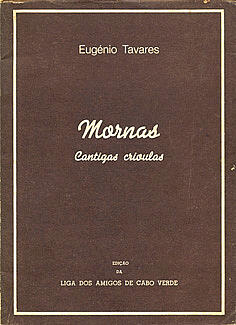
- Mornas – Cantigas Crioulas, Tavares, eugénio1932
- Renascença de uma civilização no Atlântico médio (Melo, Luís Romano de Madeira1967: Collection of poems and stories in Portuguese and in Creole)
- 100 PoemasGritarei, Berrarei, Matarei, Não vou para pasárgada Martins, Ovídio, 1973Poems in Portuguese and in Creole
- Negrume/Lzimparin (Melo, Luís Romano de Madeira1973: Stories in Creole with Portuguese translation)
- "Textos crioulos cabo-verdianos" (Frusoni, Sérgio1975) in Miscelânea luso-africana coord. Valkhoff, Marius F.
- Vangêle contód d'nôs móda (Frusoni, Sérgio : Fogo1979; Novo Testamento)
- A Poética de Sérgio Frusoni – uma leitura antropológica (Lima, Mesquitela; Lisboa1992)
References
- "Kabuverdianu {{!}} Ethnologue Free".
- (1982). "Diskrison strutural di lingua kabuverdianu". Institutu Kabuverdianu di Livru.
- Steve and Trina Graham. (10 August 2004). "West Africa Lusolexed Creoles Word List File Documentation". [[SIL International]].
- Dulce Pereira. (October 2006). "Crioulos de Base Portuguesa". Caminho.
- Santos, C., "Cultura e comunicação: um estudo no âmbito da sociolinguística"
- Carreira, A. (1982)
- Pereira, D. (2006)
- Duarte, D. A. (1998)
- Resolução n.º 48/2005 (published in the [https://kiosk.incv.cv/V/2005/11/14/1.1.46.491/p6 Boletim Oficial da República de Cabo Verde No. 46 of 14 November 2005], pages 1242–1243)
- Resolução n.º 32/2015 (published in the [https://kiosk.incv.cv/V/2015/4/15/1.1.25.2001/p33 Boletim Oficial da República de Cabo Verde No. 25 of 15 April 2015], page 817)
- Fernandes, A. N. Rodrigues (1969)
- link. (18 September 2007 »)
- Veiga, M. (2000)
- see https://web.archive.org/web/20161002192858/http://aktb.org/
- [http://alupec.kauberdi.org/decreto-lei-67-98.html Decreto-Lei n.º 67/98] {{Webarchive. link. (13 January 2013 (published in the Boletim Oficial da República de Cabo Verde – 1998))
- Decreto-Lei n.º 8/2009 (published in the [https://kiosk.incv.cv/V/2009/3/16/1.1.11.194/p1 Boletim Oficial da República de Cabo Verde No. 11 of 16 March 2009], pages 74–76)
- Quint, N.{{spaced ndash2000
This article was imported from Wikipedia and is available under the Creative Commons Attribution-ShareAlike 4.0 License. Content has been adapted to SurfDoc format. Original contributors can be found on the article history page.
Ask Mako anything about Cape Verdean Creole — get instant answers, deeper analysis, and related topics.
Research with MakoFree with your Surf account
Create a free account to save articles, ask Mako questions, and organize your research.
Sign up freeThis content may have been generated or modified by AI. CloudSurf Software LLC is not responsible for the accuracy, completeness, or reliability of AI-generated content. Always verify important information from primary sources.
Report