From Surf Wiki (app.surf) — the open knowledge base
Canton of Linth
| Field | Value | ||
|---|---|---|---|
| native_name | Kanton Linth | ||
| conventional_long_name | Canton of Linth | ||
| common_name | Linth | ||
| subdivision | Canton | ||
| nation | Helvetic Republic | ||
| status_text | Canton of the Helvetic Republic | ||
| year_start | 1798 | ||
| year_end | 1803 | ||
| event_pre | Helv. Rep. proclaimed | ||
| date_pre | April 12, 1798 | ||
| event_start | Canton established | ||
| date_start | June 17 | ||
| event_end | Helv. Rep. disestablished | ||
| date_end | February 19, 1803 | ||
| p1 | Canton of Glarus | ||
| image_p1 | [[Image:Flag of Canton of Glarus.svg | 20px | Glarus]] |
| p2 | Canton of Schwyz | ||
| image_p2 | [[Image:Flag of Canton of Schwyz.svg | 20px | Schwyz]] |
| p3 | County of Uznach | ||
| image_p3 | [[Image:CHE Uznach Flag.svg | 20px | Uznach]] |
| p4 | County of Toggenburg | ||
| image_p4 | [[Image:Fahne Toggenburger1.svg | 20px | Toggenburg]] |
| p5 | County of Werdenberg | ||
| image_p5 | [[Image:Wappen Werdenberger1.svg | 20px | Werdenberg]] |
| p6 | County of Sargans | ||
| image_p6 | [[Image:Wappen Grafschaft Sargans.svg | 20px | Sargans]] |
| p7 | Imperial Abbey of Pfäfers | ||
| image_p7 | [[Image:Wappen Pfaefers.png | 20px | Pfäfers Abbey]] |
| p8 | Lordship of Sax | ||
| image_p8 | [[Image:Sin escudo.svg | 20px]] | |
| p9 | Vogtei of Gams | ||
| image_p9 | [[Image:Wappen Gams.png | 20px | Gams / Hohensax]] |
| p10 | Vogtei of Windegg | ||
| image_p10 | [[Image:Wappen Vogtei Windegg.svg | 20px | Windegg]] |
| s1 | Canton of St. Gallen | ||
| image_s1 | [[Image:Flag of Canton of Sankt Gallen.svg | 20px | Canton of St. Gallen]] |
| s2 | Canton of Glarus | ||
| image_s2 | [[Image:Flag of Canton of Glarus.svg | 20px | Glarus]] |
| s3 | Canton of Schwyz | ||
| image_s3 | [[Image:Flag of Canton of Schwyz.svg | 20px | Schwyz]] |
| image_map | Kantone Linth und Saentis.png | ||
| image_map_caption | Cantons of Säntis (orange) and Linth (green) | ||
| capital | Glarus |
| | | |
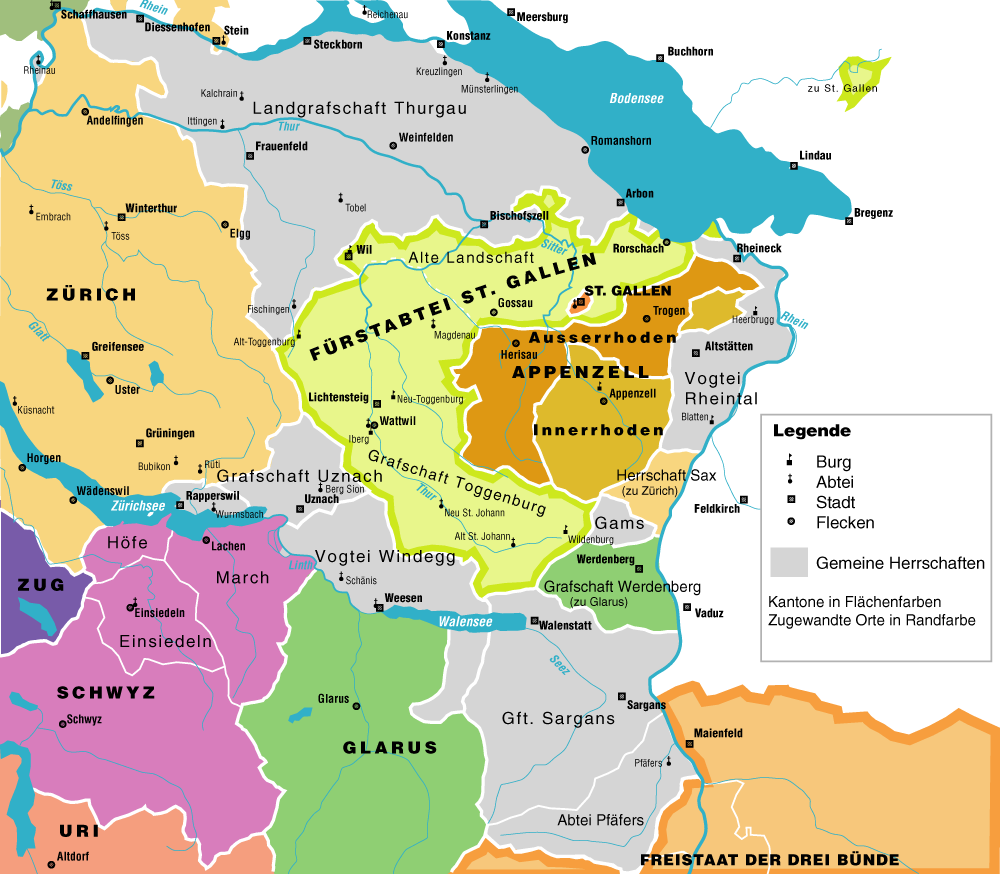
| | Linth was a canton of the Helvetic Republic from 1798 to 1803, consisting of Glarus and its subject County of Werdenberg, the Höfe and March districts of Schwyz and the Züricher subject Lordship of Sax, along with a handful of shared territories. Its capital was Glarus. The canton was named after the Linth river.
Administration
The canton contained approximately 78,500 inhabitants. Like all the cantons of the Helvetic Republic, Linth was established and administered on a French Revolutionary model. Linth and was divided administratively into seven districts
- Werdenberg:
- Neu St. Johann:
- Mels:
- Schwanden:
- Glarus:
- Schänis (Gaster):
- Rapperswil:
Chronology
The brief tenure of office of the cantonal heads Joachim Heer (1798), Johann Jakob Heussi (1798–99), Felix Christoph Cajetan Fuchs (1799), Niklaus Heer (1799–1802), and Franz Josef Büeler (1802–03) reflected the military and political turmoil plaguing the region, which was under French occupation from 1799, during the War of the Second Coalition, with serious effects on the local economy.
The mainly-Roman Catholic canton acquired a strong aversion to the centralised nature of the government of the Helvetic Republic, even though the canton was mainly composed of territories previously subject to the Old Swiss Confederation, rather than any of the Dreizehn Orte, and even though all citizens of the republic had equal rights. The canton sided only very reluctantly with the French Revolutionary Army. Initial fervour for public education waned as the pressure from the central government was relaxed.
Upper Toggenburg was transferred to the canton of Säntis in 1801, but the canton as a whole existed until the Act of Mediation on March 10, 1803.
]]
References
This article was imported from Wikipedia and is available under the Creative Commons Attribution-ShareAlike 4.0 License. Content has been adapted to SurfDoc format. Original contributors can be found on the article history page.
Ask Mako anything about Canton of Linth — get instant answers, deeper analysis, and related topics.
Research with MakoFree with your Surf account
Create a free account to save articles, ask Mako questions, and organize your research.
Sign up freeThis content may have been generated or modified by AI. CloudSurf Software LLC is not responsible for the accuracy, completeness, or reliability of AI-generated content. Always verify important information from primary sources.
Report