From Surf Wiki (app.surf) — the open knowledge base
Cannone da 47/32
Italian infantry gun / anti-tank gun during World War II

Italian infantry gun / anti-tank gun during World War II
| Field | Value |
|---|---|
| name | Cannone da 47/32 mod. 1935 |
| image | 47mm 47-32 anti tank gun cfb borden 1.jpg |
| image_size | 300 |
| type | Infantry gun / Anti-tank gun |
| origin | Austria |
| is_ranged | yes |
| is_explosive | yes |
| is_artillery | yes |
| used_by | See ** |
| wars | World War II |
| designer | Böhler |
| manufacturer | Böhler |
| number | Italy: 3000+ |
| variants | 47/32 Mod. 39 |
| 47/40 Mod. 38 | |
| weight | Travel: 315 kg |
| Combat: 277 kg | |
| part_length | bore: 1.525 m L/32 |
| overall: 1.680 m | |
| cartridge | {{bulleted list |
| L/32 gun:<br/>47×195mmR<ref name | "quarryhs1" |
| L/40 gun:<br/>47×328mmR<ref name | "quarryhs1" / |
| cartridge_weight | 1.5 kg AP |
| caliber | 47 mm |
| velocity | 630 m/s AP |
| 250 m/s (820 ft/s) HE | |
| 755 m/s AP L/40 AFV | |
| max_range | 7000 m |
| breech | Horizontal sliding-wedge |
| carriage | Split-trail |
| elevation | -15° to +56° |
| traverse | 62° |
47/40 Mod. 38 Combat: 277 kg overall: 1.680 m | L/32 gun: 47×195mmR | L/40 gun: 47×328mmR 250 m/s (820 ft/s) HE 755 m/s AP L/40 AFV
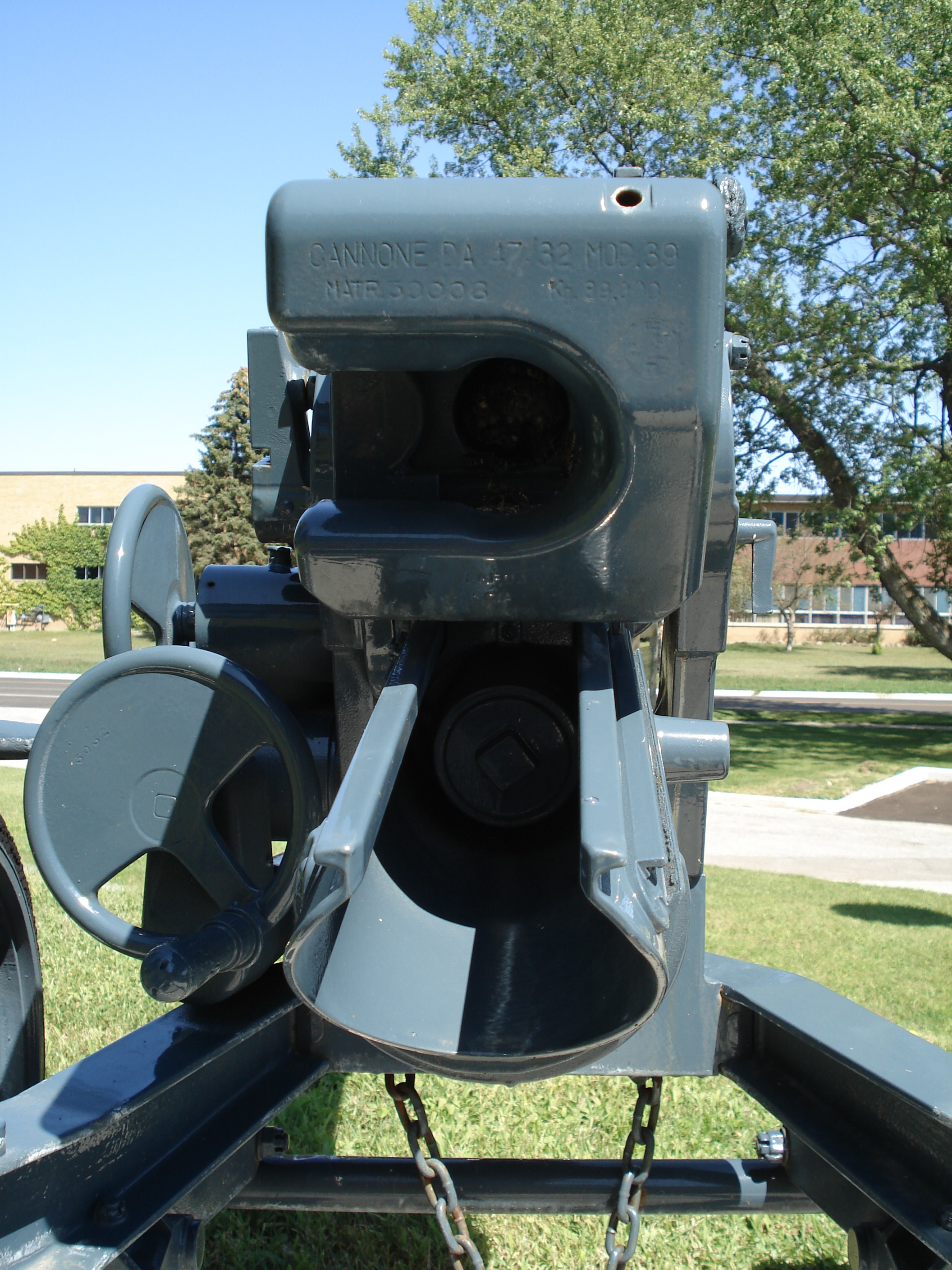
The Cannone da 47/32 mod. 1935 was an Italian artillery piece that saw service during World War II. It was originally designed by Austrian firm Böhler, and produced in Italy under license. The Cannone da 47/32 was used both as an infantry gun and an anti-tank gun at which it was effective against light to medium armored tanks.
History

The Austrian firm of Böhler originally designed and manufactured the gun. In the 1930s Italy bought some of these guns from Böhler, and then began to produce the weapon under license, continuing its development. The Cannone da 47/32 M35 was the main armament in the M13/40 medium tank, the M14/41 medium tank, and experimentally on the AB 41 armored car (see photograph), and the 47/32 self-propelled gun.
The 47/32 was built in two versions, the first with semi-pneumatic disk wheels, and the second (in 1939, from which the name 47/32 mod. 39) with improved barrel and suspension (in some series also light-alloy wheels with semi-pneumatic tires). To tow this piece, the Fiat-OCI 708 CM tractor and the L3 tankette were used, but these projects were soon abandoned as the gun was subjected to breaking at the axles spindles and shanks. Due to its shape, the 47/32 was commonly called "elefantino" (little elephant) by the troops.
The 47/32 was primarily an anti-tank gun but was also used as a close support weapon. In 1940 it had roughly the same degree of armor penetration of its contemporaries such as the British 2-pounder gun, the German PaK 36 and the Soviet 45 mm gun. It outperformed the French 25 mm gun and a High Explosive shell was available unlike the 2-Pounder. Its major drawbacks were the inadequacy of the gun to be towed by truck, and the lack of a gun shield. The failure of the Italian Army to produce and deploy a more powerful gun in numbers meant that by 1942 the 47/32 gun was still seeing frontline service despite being ineffective against the heavier tanks it had to face.
For use in the M15/42 tank the 47/32 gun was redesigned with a longer L/40 barrel and an enlarged ammunition chamber. The larger amount of propellant combined with the longer barrel greatly increased the armour penetration capability of the 47/40 gun.
Service with other nations
The original Böhler and license-produced versions were also used in the Austrian, Chinese, Dutch, Finnish, Romanian, Estonian, Latvian, Soviet (Captured ex-Latvian guns) and Swiss armies. Romania purchased 545 Austrian-made pieces and 275 Italian-made pieces in 1941. While not an original user, the German army captured several of these guns during their annexation of Austria (4.7 cm Pak 35/36(ö)), and their conquest of the Netherlands (4.7 cm PaK 187(h)) and the Soviet Union (4.7 cm PaK 196(r)) and took them into service. Some of these guns were donated to the Italians. After their surrender, these were recaptured along with Italian models (4.7 cm PaK 177(i)). These guns were then reassigned to German and RSI (Axis-aligned Italian) units or donated to Croatia. The British also made use of some captured guns which inlcluded shipping them over from North Africa to Malaya.
Characteristics
- Caliber: 47 mm
- Barrel length: 1.68 m
- Length of Bore: 1.525 m
- Length of Rifling: 1.33 m
- Travelling Weight: 315 kg
- Weight in Action: 277 kg
- Elevation: -15 degrees to +56 degrees
- Traverse: 62 degrees
- Muzzle Velocity: 630 m/s (2,067 ft/s) for AP; 250 m/s (820 ft/s) HE (L/40 Variant: 755 m/s for AP and 364 m/s for HE)
- Range: 7,000 m - HE
- Shell Weight: 1.44 kg AP; 2.37 kg HE
- Armor Penetration AP (L/32): 58 mm at 100 m; 43 mm at 500 m
- Armor Penetration AP (L/40 Variant for Medium tank M15/42): 70 mm at 100 m, 50 mm at 500 m, 38 mm at 1000 m, 25 mm at 1500 m, 20 mm at 2000 m
- Armor Penetration HEAT: 55 mm at 90 degrees contact
Users
- First Austrian Republic
- Republic of China (1912–1949)
- Estonia
- Finland
- Kingdom of Italy
- Nazi Germany
- Latvia
- Netherlands
- Kingdom of Romania
- Soviet Union
References
Sources
References
- "CANNONE ANTICARRO DA 47/32 MODELLO 35".
- "38-37 MM CALIBRE CARTRIDGES".
- (February 2013). "L'Esercito Italiano nel 1943". Storia Militare Dossier.
- Mark Axworthy, London: Arms and Armour, 1995, ''Third Axis, Fourth Ally: Romanian Armed Forces in the European War, 1941–1945'', p. 30
- [https://www.awm.gov.au/collection/C153363 Australian War Memorial] Retrieved 20 May 2025
- Bundesarchiv, RH 10/366, 1943-1944, ''Bildmappen, z. T. mit Angaben der technischen Daten.- Rumänische, französische, italienische, englische, amerikanische und russische Panzerkampfwagen und Fahrzeuge''
This article was imported from Wikipedia and is available under the Creative Commons Attribution-ShareAlike 4.0 License. Content has been adapted to SurfDoc format. Original contributors can be found on the article history page.
Ask Mako anything about Cannone da 47/32 — get instant answers, deeper analysis, and related topics.
Research with MakoFree with your Surf account
Create a free account to save articles, ask Mako questions, and organize your research.
Sign up freeThis content may have been generated or modified by AI. CloudSurf Software LLC is not responsible for the accuracy, completeness, or reliability of AI-generated content. Always verify important information from primary sources.
Report