From Surf Wiki (app.surf) — the open knowledge base
Cannabis flower essential oil
Essential oil obtained from the hemp plant
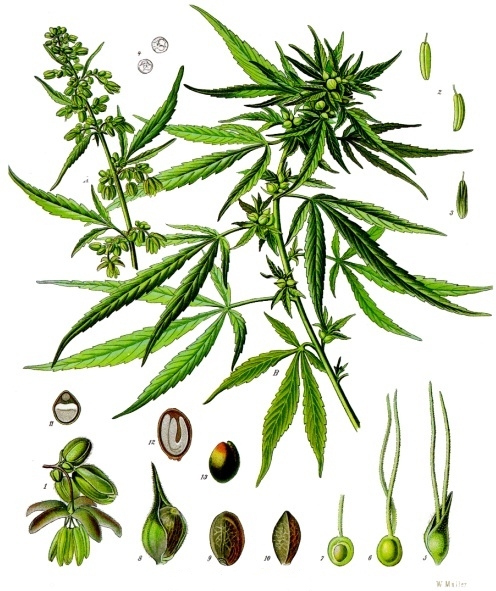
Essential oil obtained from the hemp plant
Cannabis flower essential oil, also known as hemp essential oil, is an essential oil obtained by steam distillation from the flowers, panicles (flower cluster), stem, and upper leaves of the hemp plant (Cannabis sativa L.). Hemp essential oil is distinct from hemp seed oil (hemp oil) and hash oil: the former is a vegetable oil that is cold-pressed from the seeds of low-THC varieties of hemp, the latter is a THC-rich extract of dried female hemp flowers (marijuana) or resin (hashish).
A pale yellow liquid, cannabis flower essential oil is a volatile oil that is a mixture of monoterpenes, sesquiterpenes, and other terpenoid compounds. Beyond terpenes, there exist a number of other minor compounds that can drastically influence the aroma, such as volatile sulfur compounds, esters, and the heterocyclic compounds indole and skatole. The essential oil is manufactured from both low-THC ("fibre-type") and high-THC ("drug-type") varieties of hemp. As most of the phytocannabinoids are nearly insoluble in water, hemp essential oil contains only traces of cannabinoids. Most of the material is produced in Canada, as well as small scale cultivations in Switzerland and Germany.
Hemp essential oil is used as a scent in perfumes, cosmetics, soaps, and candles. It is also used as a flavoring in foods, primarily candy and beverages.
Constituents
Another report said there were 140 terpenoids, dominated by α-pinene and limonene which together often comprise 75% of the live plant's volatiles. However, extracted essential oils can change in composition, and the live plant, dried plant and essential oil can smell rather different.
| Compound | Chemical | ||
|---|---|---|---|
| structure | % of total | ||
| Myrcene | [[Image:Myrcene beta acsv.svg | 60px]] | 29.4–65.8 |
| α-Pinene | [[Image:Alpha-pinen.svg | 75px]] | 2.3–31.0 |
| β-Pinene | [[Image:Beta-pinen.svg | 75px]] | 0.9–7.8 |
| delta-3-Carene | [[Image:(+)-3-carene.svg | 110px]] | trace–3.5 |
| Limonene | [[Image:Limonene-2D-skeletal.svg | 50px]] | 0.2–6.9 |
| β-phellandrene | [[Image:Phellandrene beta.svg | 60px]] | 0.2–0.6 |
| cis-Ocimene | [[Image:Ocimene - cis.png | 140px]] | trace–0.3 |
| trans-Ocimene | [[Image:Ocimene.png | 160px]] | 0.3–10.2 |
| α-Terpinolene | [[File:terpinolene.svg | 50px]] | trace–23.8 |
| α-Bergamotene | [[File:α-bergamotene.svg | 150px]] | trace–0.8 |
| trans-Caryophyllene | [[Image:Caryophyllene.svg | 130px]] | 3.8–37.5 |
| α-Humulene | [[Image:Humulene.png | 130px]] | 0.7–7.4 |
| β-Farnesene | [[Image:B-Farnesene.svg | 180px]] | trace–1.4 |
| β-Selinene | [[File:Beta-selinene.svg | 140px]] | trace–0.5 |
| Selina-3,7(11)-diene | trace–0.7 | ||
| Caryophyllene oxide | [[File:Caryophyllene oxide.svg | 100px]] | trace–11.3 |
| Total monoterpenes | 47.9–92.1 | ||
| Total sesquiterpenes | 4.0–47.5 |
Uses
The various terpenes in cannabis have antifungal, antimicrobial, antiviral and insect repellent functions that could be commercially valuable when used externally.
Cannabis essential oils that are cannabinoid-free have been tested for central nervous effects. Natural monoterpenes and sesquiterpenes from cannabis flowers have relaxing, sedative and anti-depressant effects when inhaled. Their application in aromatherapy is increasing, but the high price of the natural oil (50$ per milliliter) is a limiting factor.
In Switzerland and Austria, specific landraces with high essential oil content but no discernible amounts of cannabinoids have been developed for the purpose of flavoring beverage products. For those applications, oils with high monoterpene percentages (but a low alpha-humulene or caryophyllene oxide concentration) are desirable.
Terpenes used in THC vaping products, legal in some jurisdictions in the United States, are not true cannabis terpenes, but synthetic and racemic with potential health hazards. Due to health promoting effects, natural THC-free cannabis flower oil is the preferred ingredient in the legal European market. Unregulated additives in US vaping products have led to serious health consequences, including fatal outcomes.
References
Sources
References
- (2005). "Steam Distillation of Essential Oils from Hemp Panicles". Journal of Natural Fibers.
- Winstock, Adam R.. (2012-01-01). "29 - Psychoactive drug misuse". W.B. Saunders.
- (2021-11-30). "Identification of a New Family of Prenylated Volatile Sulfur Compounds in Cannabis Revealed by Comprehensive Two-Dimensional Gas Chromatography". ACS Omega.
- (2023-10-12). "Minor, Nonterpenoid Volatile Compounds Drive the Aroma Differences of Exotic Cannabis". ACS Omega.
- (1997). "Essential oil of Cannabis sativa L. strains". Journal of the International Hemp Association.
- (2019). "Yield and Quality of Essential Oils in Hemp Varieties in Different Environments". Agronomy.
- (2018). "Cannabis Essential Oil: A Preliminary Study for the Evaluation of the Brain Effects". Evid Based Complement Alternat Med.
- [https://www.about-drinks.com/cswiss-der-cannabis-eistee/ CSWISS – der Cannabis Eistee.] aboutdrinks.com. Retrieved September 1st 2019.
- Mediavilla V. & Steinemann S. [http://www.internationalhempassociation.org/jiha/jiha4208.html Essential oil of Cannabis sativa L. strains]. Swiss Federal Research Station for Agroecology and Agriculture, Zurich. Retrieved September 1st 2019.
- "E-cigarettes: Facts, stats and regulations".
This article was imported from Wikipedia and is available under the Creative Commons Attribution-ShareAlike 4.0 License. Content has been adapted to SurfDoc format. Original contributors can be found on the article history page.
Ask Mako anything about Cannabis flower essential oil — get instant answers, deeper analysis, and related topics.
Research with MakoFree with your Surf account
Create a free account to save articles, ask Mako questions, and organize your research.
Sign up freeThis content may have been generated or modified by AI. CloudSurf Software LLC is not responsible for the accuracy, completeness, or reliability of AI-generated content. Always verify important information from primary sources.
Report