From Surf Wiki (app.surf) — the open knowledge base
Canine discoid lupus erythematosus
Autoimmune disease
Autoimmune disease
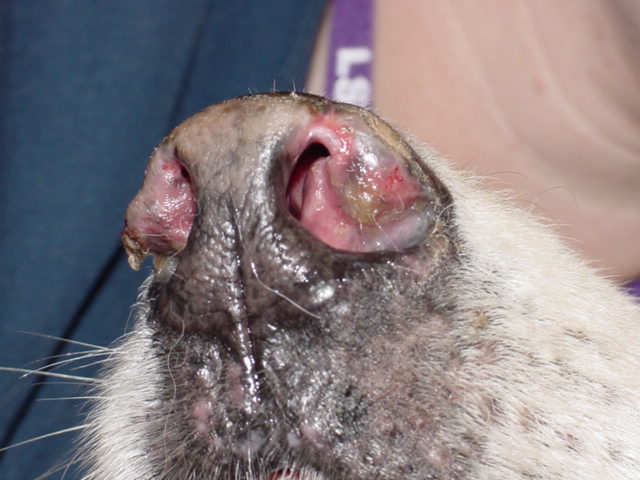
discoid lupus erythematosus in dogs
Discoid lupus erythematosus (DLE) is an uncommon autoimmune disease of the basal cell layer of the skin. It occurs in humans and cats, more frequently occurring in dogs. It was first described in dogs by Griffin and colleagues in 1979. DLE is one form of cutaneous lupus erythematosus (CLE). DLE occurs in dogs in two forms: a classical facial predominant form or generalized with other areas of the body affected. Other non-discoid variants of CLE include vesicular CLE, exfoliative CLE and mucocutaneous CLE. It does not progress to systemic lupus erythematosus (SLE) in dogs. SLE can also have skin symptoms, but it appears that the two are either separate diseases. DLE in dogs differs from SLE in humans in that plasma cells predominate histologically instead of T lymphocytes. Because worsening of symptoms occurs with increased ultraviolet light exposure, sun exposure most likely plays a role in DLE, although certain breeds (see below) are predisposed. After pemphigus foliaceus, DLE is the second most common autoimmune skin disease in dogs.
Symptoms
Diagnosis
DLE is easily confused with solar dermatitis, pemphigus, ringworm, and other types of dermatitis. Biopsy is required to make the distinction. Histopathologically, there is inflammation at the dermoepidermal junction and degeneration of the basal cell layer. Unlike in SLE, an anti-nuclear antibody test is usually negative.
Treatment
Avoiding sun exposure and the use of sunscreens (not containing zinc oxide as this is toxic to dogs) is important. Topical therapy includes corticosteroid and tacrolimus use. Oral vitamin E or omega-3 and omega-6 fatty acids are also used. More refractory cases may require the use of oral niacinamide and tetracycline or immuno-suppressive medication such as corticosteroids, azathioprine, or chlorambucil. Treatment is often lifelong, but there is a good prognosis for long-term remission.
Commonly affected dog breed
- Alaskan Malamute
- Collie
- German Shepherd Dog
- Shetland Sheepdog
- Siberian Husky
- Brittany
- German Shorthaired Pointer
- Africanis
- Rottweilers
References
References
- [http://www.aocd.org/skin/dermatologic_diseases/discoid_lupus_eryt.html American Osteopathic College of Dermatology, "Discoid Lupus Erythematosus"].
- (November 1979). "Canine discoid lupus erythematosus". Veterinary Immunology and Immunopathology.
- (December 2018). "Cutaneous lupus erythematosus in dogs: a comprehensive review". BMC Veterinary Research.
- Banovic, Frane. (January 2019). "Canine Cutaneous Lupus Erythematosus". Veterinary Clinics of North America: Small Animal Practice.
- (1995). "Textbook of Veterinary Internal Medicine". W.B. Saunders Company.
- Griffin, Craig E.. (2001). "Small Animal Dermatology". W.B. Saunders Company.
- Mueller, Ralf S.. (2005). "Immune-mediated skin diseases". Proceedings of the 50° Congresso Nazionale Multisala SCIVAC.
- Osborn, S.. (2006). "Autoimmune Diseases in the Dog". Proceedings of the North American Veterinary Conference.
- (2006). "A case of interface perianal dermatitis in a dog: is this an unusual manifestation of lupus erythematosus?". Vet Pathol.
- Kiriluk, Ellaine. (2019-07-17). "Protect your dog from the extreme heat of summer". [[Daily Herald (Arlington Heights, Illinois).
- Devera, Carina. (2019-07-08). "Beware the hidden toxins that seem harmless but can be deadly". [[Marin Independent Journal]].
- (August 2002). "Topical 0.1% tacrolimus for the treatment of discoid lupus erythematosus and pemphigus erythematosus in dogs". Veterinary Dermatology.
- (2004). "Topical 0.1% tacrolimus for the treatment of discoid lupus erythematosus and pemphigus erythematosus in dogs". J Am Anim Hosp Assoc.
This article was imported from Wikipedia and is available under the Creative Commons Attribution-ShareAlike 4.0 License. Content has been adapted to SurfDoc format. Original contributors can be found on the article history page.
Ask Mako anything about Canine discoid lupus erythematosus — get instant answers, deeper analysis, and related topics.
Research with MakoFree with your Surf account
Create a free account to save articles, ask Mako questions, and organize your research.
Sign up freeThis content may have been generated or modified by AI. CloudSurf Software LLC is not responsible for the accuracy, completeness, or reliability of AI-generated content. Always verify important information from primary sources.
Report