From Surf Wiki (app.surf) — the open knowledge base
Cangzhou

| Field | Value |
|---|---|
| name | Cangzhou |
| settlement_type | Prefecture-level city |
| native_name | 沧州市 |
| native_name_lang | zh-Hans |
| other_name | Tsangchow |
| nickname | Lion City (狮城) |
| image_skyline | {{Photomontage |
| photo1a | 狮城广场_铁狮子_-_panoramio.jpg |
| photo1b | 沧州体育馆.jpg |
| photo2a | 201606_Cangzhou.jpg |
| photo3a | 阿尔卡迪亚大酒店 - panoramio.jpg |
| photo3b | 黄骅港航拍_DJI_0105.jpg |
| color_border | white |
| spacing | 2 |
| color | white |
| size | 280 |
| foot_montage | }} |
| image_caption | Clockwise from the top: Iron Lion, Cangzhou Arena, Skyline of Cangzhou, Port of Huanghua, Arcadia Hotel |
| mapframe | yes |
| mapframe-zoom | 7 |
| mapframe-point | none |
| map_caption1 | Location of Cangzhou City jurisdiction in Hebei |
| pushpin_map | China Hebei#China Northern Plain#China |
| pushpin_map_caption | Location of the city centre in Hebei |
| subdivision_type | Country |
| subdivision_name | People's Republic of China |
| subdivision_type1 | Province |
| subdivision_name1 | Hebei |
| seat_type | Municipal seat |
| seat | Yunhe District |
| leader_title1 | |
| established_title | Settled |
| established_date | 517 |
| established_title2 | Established |
| established_date2 | 15 November 1983 |
| area_total_km2 | 14383.46 |
| population_footnotes | |
| population_as_of | 2020 census |
| population_total | 7300783 |
| population_density_km2 | auto |
| population_density_metro_km2 | auto |
| population_density_urban_km2 | auto |
| area_metro_km2 | 1,750.7 |
| area_urban_km2 | 206.2 |
| population_metro | 1421843 |
| population_urban | 795832 |
| demographics_type2 | GDP |
| blank_info_sec1 | 2022 |
| demographics2_title1 | Prefecture-level city |
| demographics2_info1 | CN¥ 332 billion |
| US$ 53.3 billion | |
| demographics2_title2 | Per capita |
| demographics2_info2 | CN¥ 44,819 |
| US$7,196 | |
| timezone | China Standard |
| utc_offset | +8 |
| coordinates | |
| coor_pinpoint | Cangzhou municipal government |
| elevation_footnotes | |
| elevation_m | 13 |
| elevation_ft | 42 |
| postal_code_type | Postal code |
| postal_code | 061000 |
| area_code | 0317 |
| iso_code | CN-HE-09 |
| website | cangzhou.gov.cn |
| blank_name | Licence plate prefixes |
| blank_info | 冀J |
| mapframe-zoom = 7 | mapframe-point = none US$ 53.3 billion US$7,196 (locally )
Cangzhou is a prefecture-level city in China forming the southeastern extension of Hebei Province to the coast of the Bohai Sea between Tianjin and Shandong. At the 2020 census, Cangzhou's built-up (or metro) area made of Yunhe district, Xinhua district, and Cang County is largely conurbated with a population of 1,421,843 inhabitants, while the prefecture-level administrative unit in total has a population of 7,300,783. The resident population at the end of 2024 was 7,227,700, a decrease of 36,900 from the end of the previous year. It lies approximately 90 km from the major port city of Tianjin, and 180 km from Beijing.
History
Cangzhou is said to have been founded during the 5th- and 6th-century Southern and Northern Dynasties era of Chinese history. It is named for the former imperial Cang Prefecture. During the late Tang and following Five Dynasties era, it formed part of the territory of the de facto independent of Yiwu Province.
Administrative divisions
Cangzhou City comprises 2 districts, 4 county-level cities, 9 counties and 1 autonomous county.
| Map | Name | Hanzi | Hanyu Pinyin | Population | ||
|---|---|---|---|---|---|---|
| (2020) | Area (km2) | Density | ||||
| (/km2) | ||||||
| Yunhe District | 运河区 | Yùnhé Qū | 511,086 | 138 | 1,957 | |
| Xinhua District | 新华区 | Xīnhuá Qū | 284,746 | 89 | 2,472 | |
| Botou City | 泊头市 | Bótóu Shì | 573,842 | 977 | 563 | |
| Renqiu City | 任丘市 | Rénqiū Shì | 816,401 | 1,023 | 753 | |
| Huanghua City | 黄骅市 | Huánghuá Shì | 652,401 | 1,545 | 317 | |
| Hejian City | 河间市 | Héjiān Shì | 795,198 | 1,333 | 578 | |
| Cang County | 沧县 | Cāng Xiàn | 626,011 | 1,527 | 432 | |
| Qing County | 青县 | Qīng Xiàn | 420,878 | 968 | 403 | |
| Dongguang County | 东光县 | Dōngguāng Xiàn | 340,288 | 710 | 493 | |
| Haixing County | 海兴县 | Hǎixīng Xiàn | 189,273 | 836 | 263 | |
| Yanshan County | 盐山县 | Yánshān Xiàn | 411,356 | 795 | 503 | |
| Suning County | 肃宁县 | Sùníng Xiàn | 341,919 | 497 | 664 | |
| Nanpi County | 南皮县 | Nánpí Xiàn | 347,473 | 794 | 441 | |
| Wuqiao County | 吴桥县 | Wúqiáo Xiàn | 217,986 | 603 | 464 | |
| Xian County | 献县 | Xìàn Xiàn | 568,418 | 1,191 | 479 | |
| Mengcun Hui Autonomous County | 孟村回族自治县 | Mèngcūn Huízú | ||||
| Zìzhìxiàn | 203,507 | 393 | 458 |
Economics
Cangzhou's urban center is a heavily industrial city, but the city's administrative territory also includes strongly agricultural areas, and is well known in China for its Chinese jujubes (Chinese dates), apples and pear (widely known under the export name of Tianjin Ya Pear). The North China Oil Field is within Cangzhou City's jurisdiction. Cangzhou also encompasses a large fishing port and the coal-exporting Huanghua Harbour. Notable International Companies located in Cangzhou Hyundai (Japan), Hage Fittings und Flanschen GmbH (Germany) (Hage Fluid Control Technology (Hebei) Co., Ltd Joint Venture).
Geography and transportation
| Cangzhou | -7.1 | 2.5 | 3.2 | -4.7 | 5.4 | 4.2 | 1.1 | 12.3 | 8.5 | 8.7 | 21.0 | 19.7 | 14.5 | 26.9 | 36.6 | 19.7 | 31.1 | 85.1 | 22.4 | 31.4 | 219.6 | 21.6 | 30.3 | 139.9 | 16.1 | 26.6 | 48.5 | 9.4 | 20.3 | 22.4 | 1.4 | 11.4 | 12.8 | -4.8 | 4.2 | 4.5
Cangzhou is located in eastern Hebei, immediately to the south of Tianjin, near the coast of the Bohai Sea of the Pacific Ocean. Bordering prefecture-level cities are Hengshui to the southwest, Baoding to the west, and Langfang to the north. It lies on the Beijing–Shanghai Railway.
The G1811 Huanghua–Shijiazhuang Expressway connects Cangzhou to Shijiazhuang, the provincial capital, and is linked to Beijing via both the G2 Beijing–Shanghai Expressway and G3 Beijing–Taipei Expressway, which are concurrent within the province, and to Shanghai via G2. Cangzhou's Huanghua Harbour is the end of a main Chinese coal shipping railway, the Shuohuang Railway. Other major highways serving Cangzhou's urban area are China National Highway 104 and 307.
Major airports located closest to Cangzhou include Beijing Capital Airport and Tianjin Airport.
The Grand Canal passes directly through Cangzhou, and a district of Cangzhou (Yunhe District) is named after it.
Climate
Cangzhou has a four-season, monsoon-influenced humid continental climate/semi-arid climate (Köppen BSk/Dwa), with cold, dry winters, and hot, humid summers. The monthly 24-hour average temperature ranges from −3.2 °C in January to 27.2 °C in July, while the annual mean is 13.25 °C. A majority of the annual precipitation of 541 mm occurs in July and August alone. With possible monthly percent possible sunshine ranging from 49% in July to 65% in October, the city receives 2,663 hours of bright sunshine annually.
|Jan record high C = 15.1 |Jan record low C = -22.1 |Feb record high C = 18.7 |Feb record low C = -14.6 |Mar record high C = 30.9 |Mar record low C = -11.3 |Apr record high C = 32.7 |Apr record low C = -1.2 |May record high C = 37.7 |May record low C = 5.1 |Jun record high C = 40.3 |Jun record low C = 12.5 |Jul record high C = 42.0 |Jul record low C = 17.1 |Aug record high C = 36.6 |Aug record low C = 14.1 |Sep record high C = 35.0 |Sep record low C = 6.8 |Oct record high C = 30.4 |Oct record low C = -2.3 |Nov record high C = 24.2 |Nov record low C = -8.3 |Dec record high C = 14.6 |Dec record low C = -20.3
Culture
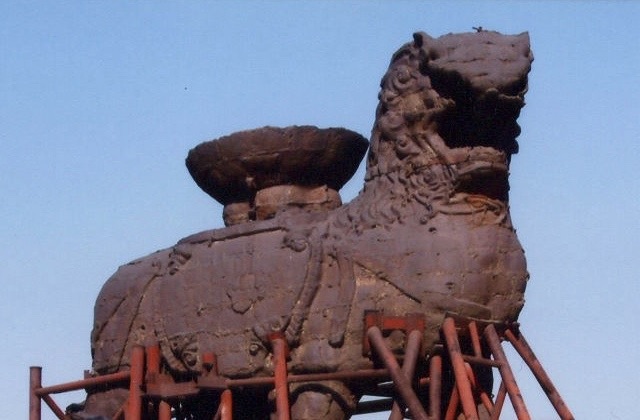
The city has historically been known in China for its wushu (Chinese martial arts) and acrobatics (specifically, the Wu Qiao school). Cangzhou is also famed for its historic thousand-year-old 40-ton sculpture, the Iron Lion of Cangzhou. The sculpture is reportedly the largest cast-iron sculpture in the world, cast in 953 in the Five Dynasties and Ten Kingdoms period. The famed lion has even given its name to a locally brewed beer (iron lion beer, 铁狮啤酒) and is a symbol of the city.
Cangzhou is home to a traditional Chinese form of musical performing arts, Kuaiban Dagu.
The city hosts seven mosques for Muslim adherents (mostly Hui). One of them, the West Mosque, has collected at its museum one of China's best collections of Islamic manuscripts and artefacts.
Demographics and society
Cangzhou, though predominated by the Han Chinese majority, is home to a sizable population of the Muslim Hui minority. Intermarriage occasionally occurs between the majority Han and the Hui, but stereotypes of Hui still exist among Cangzhou's Han residents, and some tensions remain. Migration to Hebei province and Cangzhou by Xinjiang Muslim minorities (generally ethnic Uighurs) is increasing.
Language
The dominant first language of Cangzhou's population is a variety of the northeastern Mandarin dialect continuum termed Cangzhou, which is a variety of Ji Lu Mandarin. There are some similarities with the Tianjin variety and the Baoding variety of Mandarin, but both are considered distinct groups from that of Cangzhou http://www.glossika.com/en/dict/classification/mandarin/jilu/canghui/huangle/index.php. Dialects of the Cangzhou area vary between localities and counties, though are generally intelligible among each other.
Municipal government
The city, like all other Chinese administrative divisions, has a party committee, the People's government, the People's Congress, and the Political consultative conference.
Military
Cangzhou is home to the Cangzhou Airbase of the People's Liberation Army Air Force.
Sports
Shijiazhuang Ever Bright moved to Cangzhou and changed their name to Cangzhou Mighty Lions, they play at the Cangzhou Stadium.
Education
Cangzhou Normal University (): now it has 871 teacher staff, including 607 full-time teachers, 233 people with the title of deputy senior or above, and 405 people with master's and doctor's degrees. The school motto is "knowing, morality, knowledge and behaviour, innovation" ().
There is one international school in Cangzhou, the Cangzhou Zhenhua Korean International School ().
Notable residents
- Sun Yue (1985), fifth Chinese national to play in the NBA
- Wang Zi-Ping (1881–1973), Chinese martial arts grandmaster
- Jia Qinglin (1940), former member of Politburo Standing Committee and Chairman of CPPCC
- Zhang Lichang (1939–2008), former member of Politburo and Party Secretary of Tianjin.
Notes
References
- DuBois, Thomas. The Sacred Village: Social Change and Religious Life in Rural North China. Honolulu: University of Hawaii Press, 2005.
References
- "China: Hébĕi (Prefectures, Cities, Districts and Counties) – Population Statistics, Charts and Map".
- 河北省统计局、国家统计局河北调查总队. (2016). "《河北经济年鉴-2018》". [[China Statistics Press]].
- "(河北省)沧州市2024年国民经济和社会发展统计公报-红黑统计公报库".
- "China: Hébĕi (Prefectures, Cities, Districts and Counties) - Population Statistics, Charts and Map".
- link. [[China Meteorological Administration]]
- Wagner, Donald B. [http://donwagner.dk/CANGZHOU/CANGZHOU.html "The cast iron lion of Cangzhou"], ''Needham Research Institute newsletter'', no. 10, June 1991, pp. 2-3.
- Steinhardt, Nancy Shatzman. (2015). "China's Early Mosques". Edinburgh University Press.
- 1833-8461).
- "Mandarin Jilu Canghui Huangle Chinese Dialect Classification".
- "[http://ncct.moe.edu.cn/2014/EnglishTAB_1209/3393.html Schools Approved by the Ministry of Education For Enrolling Children of Foreign Nationals]" ([https://web.archive.org/web/20170814215952/http://ncct.moe.edu.cn/2014/EnglishTAB_1209/3393.html Archive]). [[Ministry of Education of China]]. Retrieved on 17 August 2015.
This article was imported from Wikipedia and is available under the Creative Commons Attribution-ShareAlike 4.0 License. Content has been adapted to SurfDoc format. Original contributors can be found on the article history page.
Ask Mako anything about Cangzhou — get instant answers, deeper analysis, and related topics.
Research with MakoFree with your Surf account
Create a free account to save articles, ask Mako questions, and organize your research.
Sign up freeThis content may have been generated or modified by AI. CloudSurf Software LLC is not responsible for the accuracy, completeness, or reliability of AI-generated content. Always verify important information from primary sources.
Report