From Surf Wiki (app.surf) — the open knowledge base
Canary Wharf railway station
National rail station in East London, England
National rail station in East London, England
| Field | Value |
|---|---|
| name | Canary Wharf |
| symbol | elizabeth |
| image_name | Crossrailplace2024.jpg |
| caption | Crossrail Place seen in April 2024 |
| manager | Elizabeth line |
| fare_zone | 2 |
| owner | Transport for London |
| locale | Canary Wharf |
| borough | London Borough of Tower Hamlets |
| railcode | CWX |
| railexits2223 | 9.925 |
| railexits2324 | 14.787 |
| railexits2425 | 15.928 |
| years1 | 24 May 2022 |
| events1 | Opened |
| platforms | 2 |
| coordinates | |
| interchange | Canary Wharf |
| interchange2 | Canary Wharf |
| interchange3 | Poplar |
| interchange4 | West India Quay |
| interchange_note |

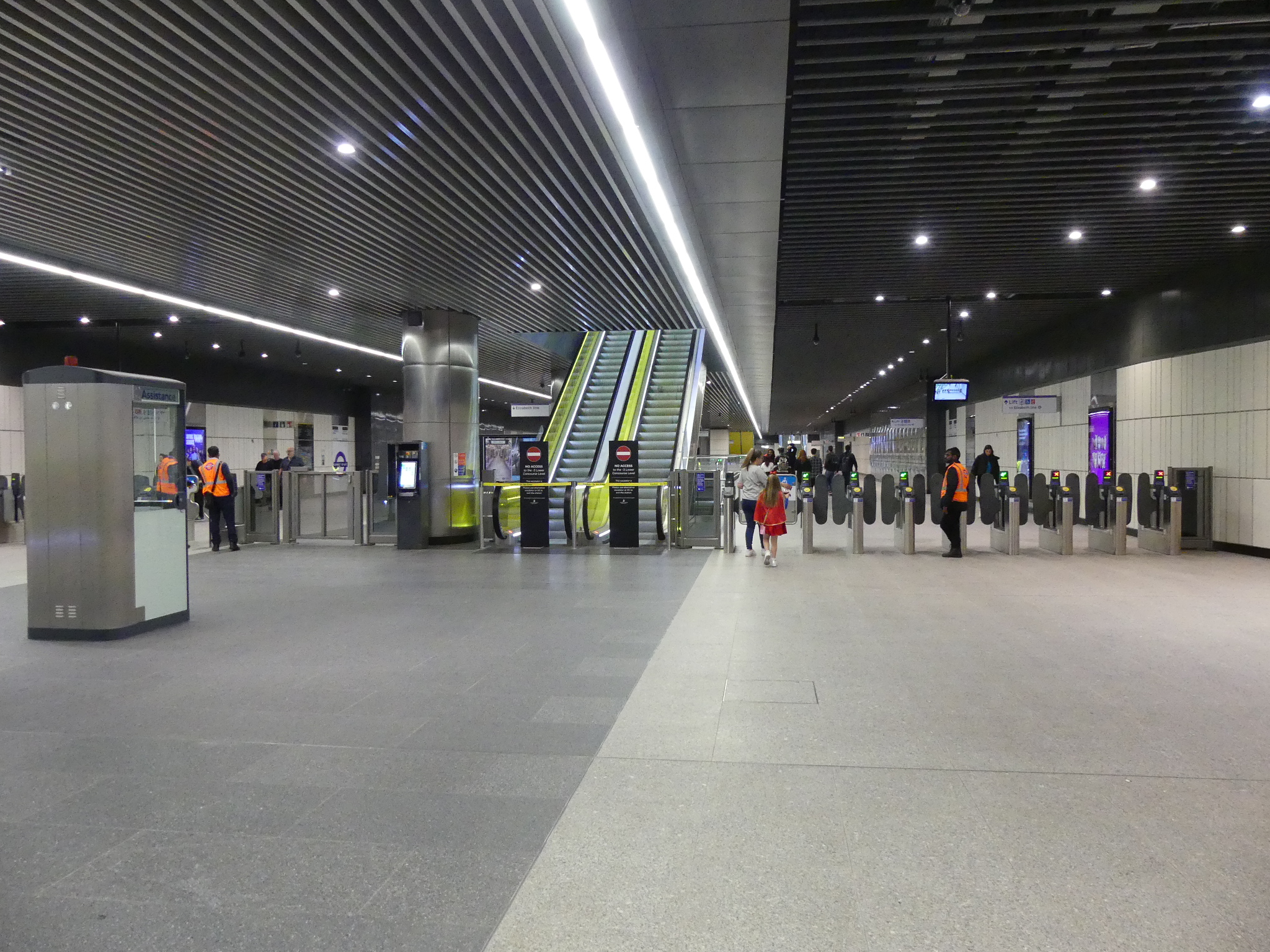
Canary Wharf is an Elizabeth line station in Canary Wharf on the Isle of Dogs in east London, England. The station forms an artificial island in the West India Docks (North Dock). The five upper levels of the station are a mixed-use development known as Crossrail Place. It is on the Abbey Wood branch of the Elizabeth line between and Custom House. Construction began in May 2009, and the station opened on 24 May 2022 when the section between Paddington and Abbey Wood stations began services. During the project's development the station was named Isle of Dogs, before the current name was adopted. The station was developed under a fixed price contract of £500 million with £350 million provided from the Crossrail budget and £150 million from the Canary Wharf Group with Crossrail spending an additional £80 million on safety improvements before it was opened.
The station is one of the largest on the Elizabeth line, providing Canary Wharf with a connection to the Crossrail network and additionally an interchange with Canary Wharf station on the London Underground as well as Canary Wharf, West India Quay and Poplar stations on the Docklands Light Railway.
Design and construction
The station is located beneath and within the West India North Dock on an artificial island and extends from east of the Docklands Light Railway bridge to the east end of the dock. It stands within a 475 m long concrete box with a 245 m long island platform. It is fitted out to 210 m with the potential for extension should the need to operate longer trains arise.
Original design
The main access point for the Crossrail station was initially going to be the rebuilt Great Wharf Bridge. From this entrance there would have been a set of escalators to the concourse level, which would have been located underwater. Another bank of escalators would take passengers to the platforms.
Construction of the station was to predominantly take place on Hertsmere Road, which runs parallel to the West India North Dock. This would have involved digging a 9 m wide shaft to the station depth of 30 m below the dock water-level to enable crew and equipment to begin boring the box that would form the station. The construction including fit-out and commissioning of the Hertsmere Road shaft was expected to take approximately four years whilst the same would take five years for the station.
Redesign and construction
In December 2008 an extra £150 million of funding from the Canary Wharf Group was announced for the station with work due to commence in January 2009. As part of the deal Canary Wharf Group substantially redesigned the station, incorporating a large shopping centre and a park above the platforms situated in the middle of the dock. |archive-url=https://web.archive.org/web/20091230195117/http://www.canarywharf.com/media/media_news_t.asp?id=398 |archive-date=30 December 2009
A ground-breaking ceremony for the station development was held on 15 May 2009.
Throughout 2009 the main focus was on installing 293 interlocking steel piles 18.5 m high and 1.2 m wide into the dock floor using ten-storey high piling cranes and Giken piling machines to form a cofferdam. As part of this, 38 m deep reinforced concrete piles were placed through each of the 293 tubes.
On 11 February 2010 Sadiq Khan, then Transport Minister, activated pumps designed to drain nearly 100 million litres (100000000 L) from the work site over the following six weeks. The pumps transferred water from inside the site's cofferdam to the North Dock at a maximum rate of 13500 L per minute.
A station 'box' was constructed in a dry environment in a similar technique to that used in the construction of the nearby Canary Wharf Underground station. Crossrail Place is the structure above the platforms and was partly opened on 1 May 2015. In September 2015, the station construction was completed and the focus has shifted to fitting the station screen doors, ticket machines and other things before the station is scheduled for opening.

The station project became the subject of a dispute between Crossrail and developer Canary Wharf Group after Crossrail chief executive Mark Wild said work was inadequate. The station "had to have a wholesale retrofit, particularly in the safety systems," and Wild said the station required an extra £80m to fix. Canary Wharf Group dismissed the comments as "an attempt to pass blame for the delays on Crossrail". Wild said: "The key issues [at Canary Wharf] have been the quality of the electrical installation [redacted phrase] and the extensive safety critical upgrade work that has been required." The work was completed and handed over in January 2022, ahead of the official opening as part of the beginning of services between Paddington and Abbey Wood on 24 May 2022.
Ownership
Whilst the Elizabeth line operates services at the station as a train operating company and forms a part of National Rail, all infrastructure is owned and maintained by Transport for London and not by Network Rail.
Services

All services at Canary Wharf are operated by the Elizabeth line using EMUs.
The typical off-peak service in trains per hour is:
- 8 tph to
- 4 tph to of which 2 continue to
- 4 tph to
Additional services call at the station during the peak hours, increasing the service to up to 12 tph in each direction.
References
References
- {{Citation London station interchange May 2022
- "Canary Wharf". Crossrail.
- (4 May 2022). "Crossrail opening date finally announced". Evening Standard.
- "Canary Wharf becomes the penultimate Elizabeth line station transferred to TfL". Crossrail.
- (June 2024). "Capital's key services protected, says Johnson". The Press Association.
- (13 November 2012). "Rail Station Harbors A Grand Design". Civil Engineer.
- "Construction of Crossrail begins as foundations laid for new Canary Wharf station".
- Lydall, Ross. (2022-05-23). "Elizabeth line is 'game changer' for Canary Wharf, says estate boss".
- [https://web.archive.org/web/20051030081611/http://billdocuments.crossrail.co.uk/files/Home/Home3/01.Environmental%20Statement/Volume_02/Chapter_08_pt09.pdf Route Window C11: Isle of Dogs station] ''Crossrail'' Retrieved 1 November 2008
- (27 February 2018). "First Elizabeth line train tests through Crossrail Tunnels".
- (24 December 2008). "Crossrail given £150m fund boost". BBC News.
- (17 September 2015). "New images of Canary Wharf station-released as station construction completes". Crossrail.
- (16 February 2010). "Pumping starts at Canary Wharf Crossrail station site".
- (14 May 2015). "Norman conquest: Lord Foster's Crossrail Place garden". The Standard.
- Brookes, Andrew. (2022-01-26). "Crossrail project nearing completion".
- "Elizabeth line's Canary Wharf station transferred to Transport for London".
- (18 February 2022). "Problems that held up Crossrail's Canary Wharf station revealed". Building.
- (5 November 2007). "The future of Crossrail". House of Commons.
- "Elizabeth Line Timetable: May 2023". [[Transport for London]].
This article was imported from Wikipedia and is available under the Creative Commons Attribution-ShareAlike 4.0 License. Content has been adapted to SurfDoc format. Original contributors can be found on the article history page.
Ask Mako anything about Canary Wharf railway station — get instant answers, deeper analysis, and related topics.
Research with MakoFree with your Surf account
Create a free account to save articles, ask Mako questions, and organize your research.
Sign up freeThis content may have been generated or modified by AI. CloudSurf Software LLC is not responsible for the accuracy, completeness, or reliability of AI-generated content. Always verify important information from primary sources.
Report