From Surf Wiki (app.surf) — the open knowledge base
Canada Day
Canadian national holiday on July 1

Canadian national holiday on July 1
| Field | Value |
|---|---|
| image | {{multiple image |
| border | infobox |
| total_width | 250 |
| image_style | border:1; |
| perrow | 1/2/1/2 |
| image2 | Ottawa fireworks 49 (27768773120).jpg |
| image3 | Canada Day in Toronto - 2018 (42229729285) (cropped).jpg |
| image4 | Défilé du Canada à Montréal (48651194312).jpg |
| image5 | A First Nations representative carries the Union Jack during Canada Day celebrations in Calgary, Alberta - 2022.jpg |
| footer | From top, left to right: Canada Day Fireworks display on Parliament Hill, in Ottawa; a young woman celebrates Canada Day in Toronto; a Canada Day parade in Montreal; a member of Canada's First Nations with a national flag and Royal Union Flag at Canada Day celebrations in Calgary |
| holiday_name | Canada Day |
| nickname | Fête du Canada |
| Dominion Day (1879–1982) | |
| observedby | Canada |
| date | July 1st |
| mdy | no |
| duration | 1 day |
| frequency | Annual |
| celebrations | Fireworks, parades, barbecues, concerts, carnivals, fairs, picnics |
| type | national |
| longtype | Historical, cultural, national |
| significance | Anniversary of Canadian Confederation on July 1, 1867 |
| firsttime | July 1, 1867 ( years ago) |
Dominion Day (1879–1982)
Canada Day is the national day of Canada. A federal statutory holiday, it celebrates the anniversary of Canadian Confederation which occurred on July 1, 1867, when the three separate colonies of the United Canadas (Ontario and Quebec), Nova Scotia, and New Brunswick were united into a single dominion within the British Empire called Canada.
Originally called Dominion Day, the holiday was renamed in 1982, the same year that the Canadian constitution was patriated by the Canada Act, 1982, which severed the vestiges of legal dependence on the Parliament of the United Kingdom. Canada Day celebrations take place throughout the country, as well as in various locations around the world attended by Canadians living abroad.
Commemoration
Canada Day is often informally referred to as "Canada's birthday", particularly in the popular press. However, the term "birthday" can be seen as an oversimplification, as Canada Day is the anniversary of only one important national milestone on the way to the country's full sovereignty, namely the joining on July 1, 1867, of the United Province of Canada (Canada West became Ontario while Canada East became Quebec), Nova Scotia, and New Brunswick into a wider British federation of four provinces. Canada became a "kingdom in its own right" within the British Empire, and was commonly known then as the Dominion of Canada.
Although a British dominion, Canada gained an increased level of political control and governance over its own affairs, the British parliament and cabinet maintaining political control over certain areas, such as foreign affairs, national defence, and constitutional changes. Canada gradually gained increasing sovereignty over the years—notably with the passage of the Statute of Westminster in 1931—until finally becoming completely sovereign with the passing of the Constitution Act, 1982, which served to fully patriate the Canadian constitution.
Under the federal Holidays Act, Canada Day is observed on July 1, unless that date falls on a Sunday, in which case July 2 is the statutory holiday. Celebratory events will generally still take place on July 1, even though it is not the legal holiday. If it falls on a weekend, businesses normally closed that day will usually dedicate the following Monday as a day off.
History
The enactment of the British North America Act, 1867 (today called the Constitution Act, 1867), which confederated Canada, was celebrated on July 1, 1867, with the ringing of the bells at the Cathedral Church of St James in Toronto and "bonfires, fireworks, and illuminations, excursions, military displays, and musical and other entertainments", as described in contemporary accounts. On June 20 of the following year, Governor General the Viscount Monck issued a royal proclamation asking for Canadians to celebrate the anniversary of Confederation, However, the holiday was not established statutorily until May 15, 1879, when it was designated as Dominion Day, alluding to the reference in the British North America Act to the country as a dominion. The holiday was initially not dominant in the national calendar; any celebrations were mounted by local communities and the governor general hosted a party at Rideau Hall.
In 1946, Philéas Côté, a Quebec member of the House of Commons, introduced a private member's bill to rename Dominion Day as Canada Day. The bill was passed quickly by the lower chamber but was stalled by the Senate, which returned it to the commons with the recommendation that the holiday be renamed The National Holiday of Canada, an amendment that effectively killed the bill.
The Canadian government began in 1958 to orchestrate Dominion Day celebrations. That year, then-Prime Minister John Diefenbaker requested that Secretary of State Ellen Fairclough organize appropriate events, with a budget of $14,000. Parliament was traditionally in session on July 1, but Fairclough persuaded Diefenbaker and the rest of the federal cabinet to attend. Official celebrations thereafter consisted usually of trooping the colour ceremonies on Parliament Hill in the afternoon and evening, followed by a mass band concert and fireworks display. Fairclough, who became Minister of Citizenship and Immigration, later expanded the bills to include performing folk and ethnic groups. The day also became more casual and family oriented.

Canada's centennial in 1967 is often seen as an important milestone in the history of Canadian nationalism and in Canada's maturing as a distinct, independent country, after which Dominion Day became more popular with average Canadians. Into the late 1960s, nationally televised, multi-cultural concerts held in Ottawa were added and the fête became known as Festival Canada. After 1980, the Canadian government began to promote celebrating Dominion Day beyond the national capital, giving grants and aid to cities across the country to help fund local activities.
Some Canadians were, by the early 1980s, informally referring to the holiday as Canada Day, a practice that caused some controversy: Columnist Andrew Cohen called Canada Day a term of "crushing banality" and criticized it as "a renunciation of the past [and] a misreading of history, laden with political correctness and historical ignorance".
The holiday was officially renamed as a result of a private member's bill that was passed through the House of Commons on July 9, 1982, two years after its first reading. The group passed the bill in five minutes, without debate, inspiring "grumblings about the underhandedness of the process". With the granting of royal assent, the holiday's name was officially changed to Canada Day on October 27, 1982, and first celebrated under that name July 1, 1983.

As the anniversary of Confederation, Dominion Day, and later Canada Day, was the date set for a number of important events, such as the first national radio network hookup by the Canadian National Railway (1927); the inauguration of the Canadian Broadcasting Corporation's cross-country television broadcast, with Governor General Vincent Massey's Dominion Day speech from Parliament Hill (1958);
The COVID-19 pandemic led to the cancellation in 2020 of all in-person Canada Day festivities nationwide, due to social distancing and restrictions on public gatherings. Some were converted to virtual events. The same cancellations occurred the following year; though, some also for political reasons. In-person festivities in Ottawa returned in 2022, being re-located from Parliament Hill to LeBreton Flats due to construction associated with the Parliament Hill Rehabilitation project.
Other events fell on the same day coincidentally, such as the first day of the Battle of the Somme in 1916—shortly after which Newfoundland recognized July 1 as Memorial Day to commemorate the Newfoundland Regiment's heavy losses during the battle—and the enactment of the Chinese Immigration Act in 1923, leading Chinese-Canadians to refer to July 1 as Humiliation Day () and boycott Dominion Day celebrations with shop closures, flying the Canadian flag on half-mast, or hanging wreaths in front of home and shop entrances until the act was repealed in 1947. Canada Day also coincides with Quebec's Moving Day, when many fixed-lease apartment rental terms expire. The bill changing the province's moving day from May 1 to July 1 was introduced by a federalist member of the Quebec National Assembly, Jérôme Choquette, in 1973, in order not to affect children still in school in the month of May.
Activities
.jpg)
Most communities across the country host organized celebrations for Canada Day, typically outdoor public events, such as parades, carnivals, festivals, barbecues, air and maritime shows, fireworks, and free musical concerts, as well as citizenship ceremonies. There is no standard mode of celebration for Canada Day; Jennifer Welsh, a professor of International Relations at the University of Oxford, said about this: "Canada Day, like the country, is endlessly decentralized. There doesn't seem to be a central recipe for how to celebrate it—chalk it up to the nature of the federation."
In the national capital of Ottawa, concerts and cultural displays are held on the front lawn of Parliament Hill, as organized by Canadian Heritage, which include the main "noon show" and an evening programme. The event traditionally begins with the singing of the royal anthem "God Save the King" and the national anthem "O Canada" in English and French followed by a flyover by the Snowbirds. Typically the governor general and prime minister officiate, though the monarch or another member of the royal family may also attend or take the governor general's place.{{refn|Queen Elizabeth II was present for the official Canada Day ceremonies in Ottawa during Canada's centennial in 1967; as well as 1973, and 2010, when more than 100,000 people attended the ceremonies on Parliament Hill. Prince William and his wife took part in the events in Ottawa for Canada Day, 2011, In provincial capitals, official celebrations are often held at the provincial legislative building, usually in the presence of the lieutenant-governor or premier of the province.
International celebrations
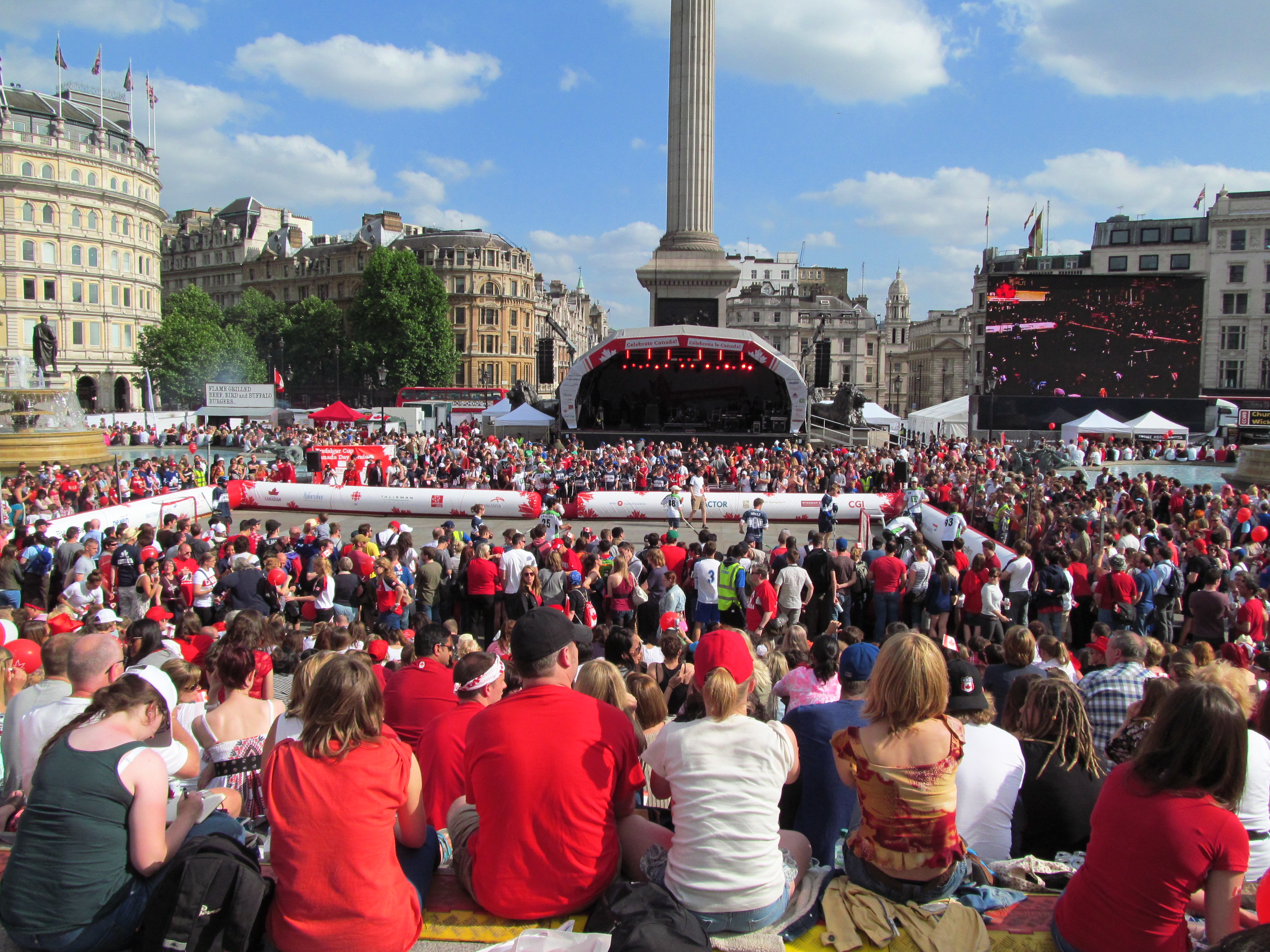
Canadian expatriates will often organize Canada Day activities in their local area on or near the date of the holiday. Examples include Canada D'eh, an annual celebration that takes place on June 30 at Lan Kwai Fong, in Hong Kong; Canadian Forces' events on bases in Afghanistan; at Trafalgar Square outside Canada House in London, England; in Mexico, at the Royal Canadian Legion in Chapala, and at the Canadian Club in Ajijic. In China, Canada Day celebrations are held at the Bund Beach by the Canadian Chamber of Commerce in Shanghai and at the Canadian International School of Beijing, sponsored by the Canada China Business Council.
Criticism and protest
Celebrating Canada Day can create tension in Quebec, where it competes with the province's Saint-Jean-Baptiste Day on June 24. The federal government sponsors Canada Day events in Montreal, while the Saint-Jean-Baptiste celebration relies on grassroots support and struggles with funding from the federal government and private sponsors.
Some Indigenous people in Canada view Canada Day negatively, linking it to the injustices they have faced from the Canadian government. This criticism intensified during Canada's 150th anniversary in 2017, as many felt that the celebrations ignored Indigenous contributions and current challenges. Similar concerns arose after the discovery of unmarked graves of Indigenous children at a residential school in British Columbia in June 2021. Canada Day events were cancelled or altered in many areas, and the Indigenous group Idle No More planned peaceful protests in major cities. Some politicians backed the cancellations, while others worried that these actions undermined the concept of Canada and hindered reconciliation efforts.
Notes
References
Sources
References
- "Canada in the Making > Constitutional History > 1867–1931: Becoming a Nation". Canadiana.
- (2017). "Celebrating Canada: Holidays, National Days, and the Crafting of Identities". University of Toronto Press, Scholarly Publishing Division.
- Adam Dodek. (2016). "The Canadian Constitution". University of Ottawa Faculty of Law.
- (July 2, 2007). "An unforgettable Canada Day, eh?". Toronto Star.
- (June 29, 2007). "Canada Day celebrations". Toronto Star.
- Canwest News Service. (July 1, 2007). "Harper salutes international role in Canada Day address". National Post.
- (July 1, 2013). "Happy anniversary, Canada". Toronto Star.
- (2009). "The Chronicles of Canada: Volume VIII – The Growth of Nationality". Fireship Press.
- "Heritage Saint John > Canadian Heraldry". Heritage Resources of Saint John and New Brunswick Community College.
- The Royal Household. "The Queen and the Commonwealth > Queen and Canada > History and present government". Queen's Printer.
- Department of Canadian Heritage. (2005). "The Crown in Canada". Queen's Printer for Canada.
- Department of Canadian Heritage. "Canada: Symbols of Canada". Queen's Printer for Canada.
- (2015). "Canadian Society in the Twenty-First Century, 3e: An Historical Sociological Approach". Canadian Scholars' Press.
- Canada Department of Justice. (1985). "Holiday Act". Canada Department of Justice.
- Government of Saskatchewan. (June 18, 2007). "Canada Day to be observed Monday, July 2". Queen's Printer for Saskatchewan.
- (June 26, 2018). "July 1st a Sunday? Holidays Act "Bumps" Canada Day to July 2nd".
- Levine, Allan. (June 28, 2013). "The evolution of July 1". National Post.
- Department of Canadian Heritage. "Ceremonial and Canadian Symbols Promotion > Canada Day". Queen's Printer for Canada.
- Department of Canadian Heritage. (July 30, 2013). "Dominion Day". Queen's Printer for Canada.
- (2008). "Canadian Studies in the New Millennium". University of Toronto Press.
- Canadian Heritage. "Canada Day Background/How we got our national holiday". Canoe.
- Carnegie, R.K.. (April 19, 1946). "Drew Right: Provinces Have Say-So On Holidays". The Globe and Mail.
- Editorial Board. (August 10, 1946). "A New Low in Compromise". The Globe and Mail.
- Canadian Heritage. (June 17, 2019). "Celebrate Canada". Queen's Printer for Canada.
- (November 19, 1977). "Across Canada/Pro-Canada sign painter has brush with law". The Globe and Mail.
- Cherry, Zena. (February 20, 1978). "Protocol chiefs gather to discuss their trade". The Globe and Mail.
- Stevens, Geoffrey. (March 2, 1978). "With many tongues". The Globe and Mail.
- Canadian Press. (March 30, 1978). "Federal support for new festival". The Globe and Mail.
- Bentley, D.M.R.. (1999). "Essay 11: Parading Past". Mnemographia Canadensis.
- "We should be celebrating Dominion Day". National Post.
- Cohen, Andrew. (2008). "The Unfinished Canadian: The People We Are". McClelland & Stewart Limited.
- "Society > Celebrations > Celebrating Canada Day". CBC.
- Congressional Quarterly, inc. (1985). "Editorial Research Reports, 1984". Cq Pr.
- "COVID-19: Canada Day in Ottawa goes virtual for 2nd year in a row with Jann Arden". Global News.
- "Ottawa's Canada Day celebrations cancelled due to coronavirus, virtual program planned". Global News.
- "2020 Canada Day 'unlike any other' as celebrations move online, cancelled amid COVID-19". Global News.
- "Three northern Saskatchewan communities 'pause' Canada Day". Global News.
- (June 24, 2021). "New Brunswick communities cancel Canada Day celebrations to 'step back and reflect'". CBC News.
- Kotyk, Alyse. (June 21, 2021). "More Canada Day festivities cancelled in B.C. following residential school discovery".
- (July 1, 2021). "'Shame on Canada': Thousands attend Cancel Canada Day rally on Parliament Hill". CTV News Ottawa.
- Hiscock, Philip. "Society and Culture > Folklore and Traditional Culture > Custom". Memorial University of Newfoundland.
- "A Living Memorial > Memorial Day". Memorial University of Newfoundland.
- (June 10, 2004). "CBC News > Indepth > China > Chinese Immigration". CBC.
- (26 June 2021). "排華法百年展徵集「身分證」 加國華人曾稱7月1日「僑恥日」". [[Ming Pao]].
- (3 November 2021). "華埠掌故將開幕 星島帶您先一探究竟". [[Sing Tao Daily (Canada)]].
- Lejtenyi, Patrick. "Moving day conspiracy". Montreal Mirror.
- Madigan, Tracey. (June 28, 2005). "Get a Move On". CBC.
- Department of Canadian Heritage. "British Columbia and Yukon invited to participate to "Celebrate Canada!" Days". Queen's Printer for Canada.
- Citizenship and Immigration Canada. (March 31, 2007). "Applying for citizenship > The citizenship ceremony". Queen's Printer for Canada.
- (March 31, 2007). "Prepare for the citizenship ceremony". Government of Canada.
- Allemang, John. (June 28, 2008). "We stand on guard for what?". Globe and Mail.
- (July 14, 2001). "Billboard". Nielsen Business Media, Inc.
- (2022-05-16). "Canada Day celebrations moving from Parliament Hill".
- CBC Archives. (July 28, 2019). "The many times the royals have jetted across the pond for Canada Day". Canadian Broadcasting Corporation.
- "Elizabeth II Queen of Canada: The Role of Queen Elizabeth II". Canadian Royal Heritage Trust.
- (January 22, 2010). "The Queen to address the United Nations". Queen's Printer.
- Campion-Smith, Bruce. (February 16, 2011). "Royal newlyweds are coming to Canada, but not Toronto". Toronto Star.
- (July 1, 2010). "Queen calls Canada 'example to the world'". CBC.
- (2019). "A list of Canada Day parties happening off Parliament Hill". CBC/Radio-Canada.
- "Canada Day in London". Canada Day London.
- Work, Andrew. (2015-06-29). "Reportage: O Canada!".
- (June 29, 2006). "Afghanistan Canada Day Celebrations Video Footage Available on Website". Queen's Printer for Canada.
- (2013). "About Canada Day International". Canada Day International.
- (July 1, 2006). "Troops refuse to let attack mar Canada Day break". CTV.
- (2017). "Canada Day in Trafalgar Square".
- O'Connor, Joe. (November 29, 2012). "As Legions shutter across Canada, veterans open a new branch in 'friendly' Mexico". National post.
- (2013). "Celebrate Canada Day with Your Friends". Canada Club.
- (May 17, 2013). "The Canadian Chamber of Commerce in Shanghai to Celebrate Canada's 146th Anniversary".
- "CCBC's Canada Day Fair in Beijing".
- Fedio, Chloe. (June 17, 2010). "Canada Day Parade organizers bemoan lack of political support". The Gazette.
- Hustake, Aalan. (May 25, 2008). "Proud Canadian, proud Quebecer who loved a parade". The Gazette.
- (June 29, 2022). "Rising costs, funding challenges mean no parade on Canada Day in Montreal".
- Geddes, John. (July 1, 2017). "'Home on native land' on Parliament Hill". Rogers.
- Dunham, Jackie. (2021-06-09). "Why some are calling for the cancellation of Canada Day this year".
- Chinta, Puxley. (June 13, 2017). "Many Indigenous people see little reason to celebrate Canada's 150th birthday". The Toronto Star.
- Kotyk, Alyse. (June 21, 2021). "More Canada Day festivities cancelled in B.C. following residential school discovery". CTV News British Columbia.
- (June 16, 2021). "One Canadian city has cancelled Canada Day: Should Toronto follow suit". CTV News Toronto.
- Aiello, Rachel. (June 23, 2021). "O'Toole tells Conservative caucus he's against cancelling Canada Day".
This article was imported from Wikipedia and is available under the Creative Commons Attribution-ShareAlike 4.0 License. Content has been adapted to SurfDoc format. Original contributors can be found on the article history page.
Ask Mako anything about Canada Day — get instant answers, deeper analysis, and related topics.
Research with MakoFree with your Surf account
Create a free account to save articles, ask Mako questions, and organize your research.
Sign up freeThis content may have been generated or modified by AI. CloudSurf Software LLC is not responsible for the accuracy, completeness, or reliability of AI-generated content. Always verify important information from primary sources.
Report