From Surf Wiki (app.surf) — the open knowledge base
Campos Basin
Coastal sedimentary basin of Brazil

Coastal sedimentary basin of Brazil
| Field | Value |
|---|---|
| name | Campos Basin |
| other_name | Bacia do Campos |
| pushpin_map | Brazil |
| pushpin_relief | 1 |
| coordinates | |
| region | Southeast |
| country | |
| state | Rio de Janeiro, Espírito Santo |
| cities | Campos dos Goytacazes and Macaé |
| onoffshore | Both, mostly offshore |
| boundaries | Vitória, Cabo Frio Highs, Serra do Mar |
| partof | Brazilian Atlantic margin |
| seas | South Atlantic |
| area | ~115000 km2 |
| basin_type | Passive margin on rift basin |
| plate | South American |
| orogeny | Break-up of Gondwana |
| age | Neocomian-recent |
| stratigraphy | Stratigraphy |
| fields | Marlim, Albacora-Leste, Barracuda, Roncador, Cachalote, Badejo |
The Campos Basin is one of 12 coastal sedimentary basins of Brazil. It spans both onshore and offshore parts of the South Atlantic with the onshore part located near Rio de Janeiro. The basin originated in Neocomian stage of the Cretaceous period 145–130 million years ago during the breakup of Gondwana. It has a total area of about 115000 km2, with the onshore portion small at only 500 km2.
Etymology
The basin is named after the Campos dos Goytacazes city.
Description
The Campos Basin is bound on the south by the Cabo Frio High, separating the basin from the Santos Basin and on the north by the Vitória High, forming the boundary with the Espírito Santo Basin. Campos Basin contains the Paraiba do Sul River delta.
Tectonic history
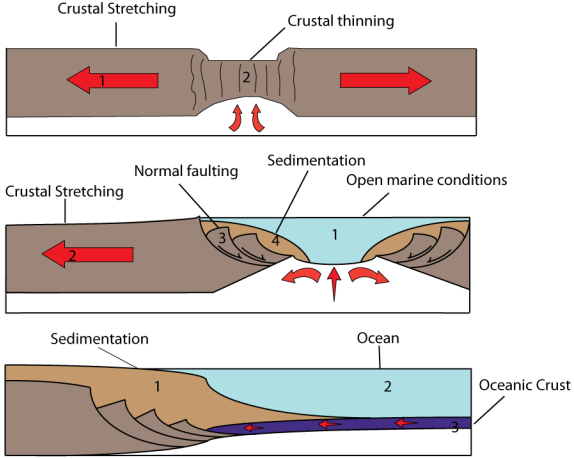
The South Atlantic margin developed on Archean stable cratons consisting of hard and resistant rocks and partly on the Neoproterozoic mobile belts composed of less resistant metamorphic rocks. The Precambrian basement of the Santos Basin is exposed as the Araçuaí Belt along the Brazilian coast, most notably in the inselbergs of Rio de Janeiro, of which Sugarloaf Mountain is the most iconic. The ancient rocks consist of a Neoproterozoic to Cambrian high-grade metamorphic core of granites and gneisses, formed during the collision of Gondwana in the Pan-African-Brasiliano orogeny. Basalts similar to the Paraná and Etendeka traps, exposed to the west in the Paraná Basin, have been found underlying the Santos Basin. The Tristan da Cunha hotspot, known as the Tristan hotspot, is considered the driver behind the formation of these flood basalts.
During the Early Cretaceous, the former continent Gondwana, as southern part of Pangea, starting to break-up, resulting in a sequence of rift basins bordering the present-day South Atlantic. The Pelotas-Namibia spreading commenced in the Hauterivian, around 133 million years ago and reached the Santos Basin to the north in the Barremian. Seafloor spreading continued northwards to the Campos Basin in the Early Albian, at approximately 112 Ma.
Five tectonic stages have been identified in the Brazilian basins:
- Pre-rift stage – Jurassic to Valanginian
- Syn-rift stage – Hauterivian to Late Barremian
- Sag stage – Late Barremian to Late Aptian
- Post-rift stage – Early to Middle Albian
- Drift stage – Late Albian to Holocene
Stratigraphy
Oil reservoirs include formations deposited during the Aptian and pre-Aptian continental rift phase, of post-salt Albian-Cenomanian shallow-water marine carbonates and deepwater sandstones, and in turbidites of the open marine drift phase of Late Cretaceous and early Tertiary ages.
The Namorado Field "location was selected based on seismic interpretation of a structural high at the top of the Macaé Formation (Albian limestones)" at a depth of about 3 km, and the reservoirs are marine turbidite deposits transgressing over the Albian limestone shelf.
The stratigraphy starts with basalt flows dated at 120 Ma, overlain by the Lagoa Feia Group, consisting of the organic-rich lacustrine "green shales" followed by lacustrine limestones and continental sandstones and conglomerates, transitioning into marine sediments with evaporites, limestones, and limestone altered dolomites. The shallow marine limestones of the Macaé Formation follow, then the Namorado turbidite sandstones, and finally the Campos Formation, consisting of the turbidite sandstone Carapebus Member and the prograding slope and shelf Ubatuba Formation.
Exploration

The off-shore oil exploration in the Campos Basin began in 1968. The first oil production started in 1977 from Enchova Field, at a water depth of 124 m. Albacora (1984), Marlim (1985), Albacora-Leste (1986), Marlim Sul (1987), Marlim Leste (1987), Barracuda (1989), Caratinga (1989), Espadarte (1994), Roncador (1996), Jubarte (2002), Cachalote (2002), and Badejo (2008). The largest Marlim field is located in the northeast of the basin, 110 km offshore in water depths ranging from 650 to.
By 2003, 41 oil and gas fields were discovered, which ranging at distances from 50 to from the coast and at water depths varying from 80 to. Of these fields, 37 are being developed by Petrobras. By 2003, the oil production from the basin had reached 1.21 million barrels per day. The production comes from a variety of reservoirs including siliciclastic turbidites, fractured basalts, coquinas, calcarenites (limestones). The total cumulative production from the Campos Basin by 2003 was 3.9 billion barrels of oil with remaining reserves of 8.5 billion barrels.
In February 2010, a new 65 million barrel discovery was made by Petrobras near the Barracuda oil field.
In 2020, the Enchova, Enchova Oeste, Marimbá, Piraúna, Bicudo, Bonito, Pampo, Trilha, Linguado, and Badejo concessions were sold by Petrobras to Trident Energy. These concessions are located in the shallow part of the Campos Basin, offshore Rio de Janeiro state.
References
References
- Love, 2015, 16:16
- Clemente, 2013, p.3
- Owen, 2014, p.36
- Peate, 1997, p.220
- Beasley et al., 2010, p.31
- Contreras, 2011, p.7
- The first exploratory well was drilled in 1971. The first field to be discovered was [[Garoupa Field. Garoupa]] in 1974, at a shallow water depth of {{convert. 120. m. ft, followed by Namorado in 1975 in {{convert. 166. m
- The largest fields, listed by their year of discovery year, include [[Linguado Field. Linguado]] (1978), [[Carapeba Field. Carapeba]] (1982), [[Vermelho Field. Vermelho]] (1982), [[Marimba Field
- Fraga et al., 2003
- Bruhn et al., 2003
- Flower 2010
- Slattery, Gram. (March 20, 2019). "Trident Energy takes lead in Petrobras oilfield sale".
This article was imported from Wikipedia and is available under the Creative Commons Attribution-ShareAlike 4.0 License. Content has been adapted to SurfDoc format. Original contributors can be found on the article history page.
Ask Mako anything about Campos Basin — get instant answers, deeper analysis, and related topics.
Research with MakoFree with your Surf account
Create a free account to save articles, ask Mako questions, and organize your research.
Sign up freeThis content may have been generated or modified by AI. CloudSurf Software LLC is not responsible for the accuracy, completeness, or reliability of AI-generated content. Always verify important information from primary sources.
Report