From Surf Wiki (app.surf) — the open knowledge base
Campaspe
Mistress of Alexander the Great

Mistress of Alexander the Great
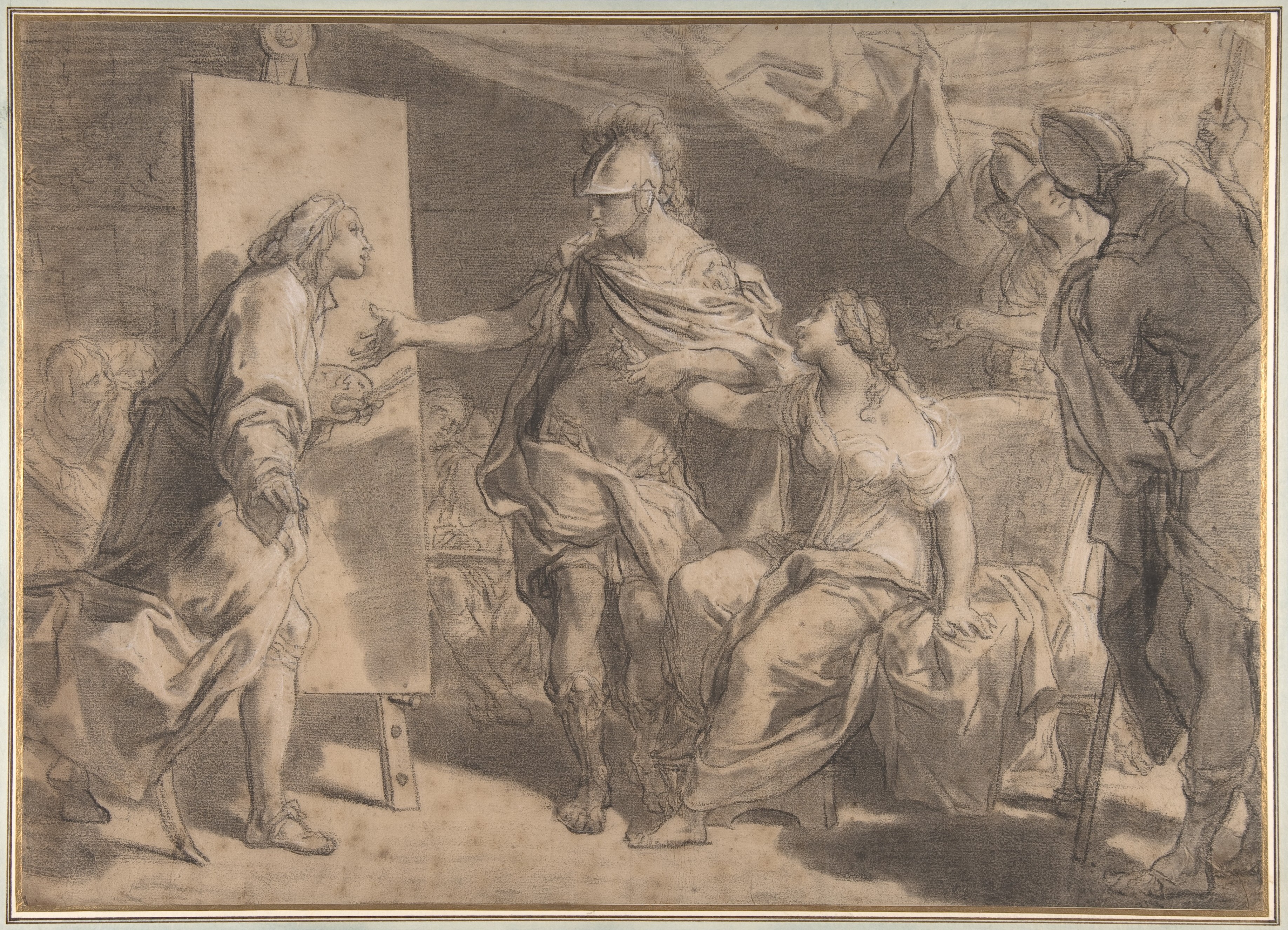
Campaspe (; Greek: Καμπάσπη, Kampaspē), or Pancaste (; Greek: Παγκάστη, Pankastē; also Pakate), was a supposed mistress of Alexander the Great and a prominent citizen of Larissa in Thessaly. No Campaspe appears in the five major sources for the life of Alexander and the story may be apocryphal. The biographer Robin Lane Fox traces her legend back to the Roman authors Pliny (Natural History), Lucian of Samosata and Aelian's Varia Historia. Aelian surmised that she initiated the young Alexander in love.
According to tradition, she was painted by Apelles, who had the reputation in antiquity for being the greatest of painters. The episode occasioned an apocryphal exchange that was reported in Pliny's Natural History: "Seeing the beauty of the nude portrait, Alexander saw that the artist appreciated Campaspe (and loved her) more than he. And so Alexander kept the portrait, but presented Campaspe to Apelles." Fox describes this bequest as "the most generous gift of any patron and one which would remain a model for patronage and painters on through the Renaissance." Apelles also used Campaspe as a model for his most celebrated painting of Aphrodite "rising out of the sea", the iconic Venus Anadyomene, "wringing her hair, and the falling drops of water formed a transparent silver veil around her form".
Legacy
Campaspe became a generic poetical synonym for a man's mistress.
The poet John Lyly (1553–1606) placed the following song within his 1584 comedy Campaspe:
At cards for kisses—Cupid paid: He stakes his quiver, bow and arrows, His mother's doves, and team of sparrows; Loses them too; then down he throws The coral of his lip, the rose Growing on's cheek (but none knows how); With these, the crystal of his brow, And then the dimple of his chin: All these did my Campaspe win. At last he set her both his eyes, She won, and Cupid blind did rise. O Love! has she done this to thee? What shall (alas!) become of me?}}
The Spanish playwright Pedro Calderón de la Barca wrote his own play on the Campaspe story, Darlo todo y no dar nada (1651).
In 1819, the painting Générosité d'Alexandre, by Jérôme-Martin Langlois depicted the scene where Alexander the Great gifted Campaspe to Apelles.
The Campaspe River in Victoria, Australia, the Campaspe River in Queensland, Australia and the Shire of Campaspe are named after her.
In E. R. Eddison's books of Zimiamvia, Campaspe is a water nymph who changes from human shape to a water-rat and back again. She is one of the attendants of Antiope, who represents Aphrodite.
Gallery
File:Giovanni Battista Tiepolo (Italian - Alexander the Great and Campaspe in the Studio of Apelles - Google Art Project.jpg|Alexander the Great and Campaspe in the Studio of Apelles by Giovanni Battista Tiepolo, 1740 File:Lagrenee, Louis Jean - Apelles verliebt sich in die Geliebte Alexander des Große - 1772.jpg|Apelles in Love with Alexander's Mistress by Louis-Jean-François Lagrenée, 1772 File:Jacques-Louis David - Apelles Painting Campaspe in the Presence of Alexander the Great.jpg|Apelles Painting Campaspe in the Presence of Alexander the Great by Jacques-Louis David, 1814 File:Augustins - Générosité d'Alexandre - Jérome-Martin Langlois 2004 1 80.jpg|Generosity of Alexander by Jérôme-Martin Langlois, 1819 File:Alexandre le Grand cédant Campaspe à Apelle.JPG|Alexander the Great Giving Campaspe to Apelles by Charles Meynier, 1822
References
Sources
References
- Her [[Aeolic Greek. Thessalian]] name is sometimes reported in [[Attic Greek. Atticized]] form as ''Pancaste''.
- [http://www.1stmuse.com/alex3/apelles.html John J. Popovic, "Apelles, the greatest painter of Antiquity"] Source quotes from Natural History 35.79–97.
- Fox, ''Alexander the Great'', 1973:50.
- Peck (1898).
- "Alexander Ceding Campaspe to Apelles". Getty.
- (27 May 1964). "The romance of Australian place names.". [[The Australian Women's Weekly]].
This article was imported from Wikipedia and is available under the Creative Commons Attribution-ShareAlike 4.0 License. Content has been adapted to SurfDoc format. Original contributors can be found on the article history page.
Ask Mako anything about Campaspe — get instant answers, deeper analysis, and related topics.
Research with MakoFree with your Surf account
Create a free account to save articles, ask Mako questions, and organize your research.
Sign up freeThis content may have been generated or modified by AI. CloudSurf Software LLC is not responsible for the accuracy, completeness, or reliability of AI-generated content. Always verify important information from primary sources.
Report