From Surf Wiki (app.surf) — the open knowledge base
Camberwell
Area of South East London

Area of South East London
| Field | Value |
|---|---|
| official_name | Camberwell |
| static_image_name | St Giles Church Camberwell 2000.jpg |
| static_image_caption | St Giles' Church, Camberwell |
| coordinates | |
| pushpin_map | United Kingdom London Southwark |
| os_grid_reference | TQ325767 |
| charingX_distance_mi | 2.7 |
| charingX_direction | NW |
| london_borough | Southwark |
| region | London |
| country | England |
| post_town | LONDON |
| postcode_area | SE |
| postcode_district | SE5 |
| dial_code | 020 |
| constituency_westminster | Peckham |
| constituency_westminster1 | Dulwich and West Norwood |
Camberwell ( ) is an area of South London, England, in the London Borough of Southwark, 2+3/4 mi southeast of Charing Cross.
Camberwell was first a village associated with the church of St Giles and a common of which Goose Green is a remnant. This early parish included the neighbouring hamlets of Peckham, Dulwich, Nunhead, and part of Herne Hill (the rest of Herne Hill was in the parish of Lambeth). Until 1889, it was part of the county of Surrey. In 1900 the original parish became the Metropolitan Borough of Camberwell.
In 1965, most of the Borough of Camberwell was merged into the London Borough of Southwark. To the west, part of both West Dulwich and Herne Hill come under the London Borough of Lambeth.
The place now known as Camberwell covers a much smaller area than the ancient parish, and it is bound on the north by Walworth; on the south by East Dulwich and Herne Hill; to the west by Kennington; and on the east by Peckham.
History
Camberwell was a settlement with a parish church when mentioned in the Domesday Book. It was held by Haimo the Sheriff (of Kent). Its Domesday assets were: six hides and one virgate. Up to the mid-19th century, Camberwell was visited by Londoners for its rural tranquillity and the reputed healing properties of its mineral springs. Camberwell was changed by the arrival of the railways in the 1860s. Camberwell Green is now a small area of common land but was once a traditional village green on which was held an annual fair.
There is evidence of a black community residing in Camberwell, made up mostly of African and North American slaves, during the 18th and 19th centuries.
Local government
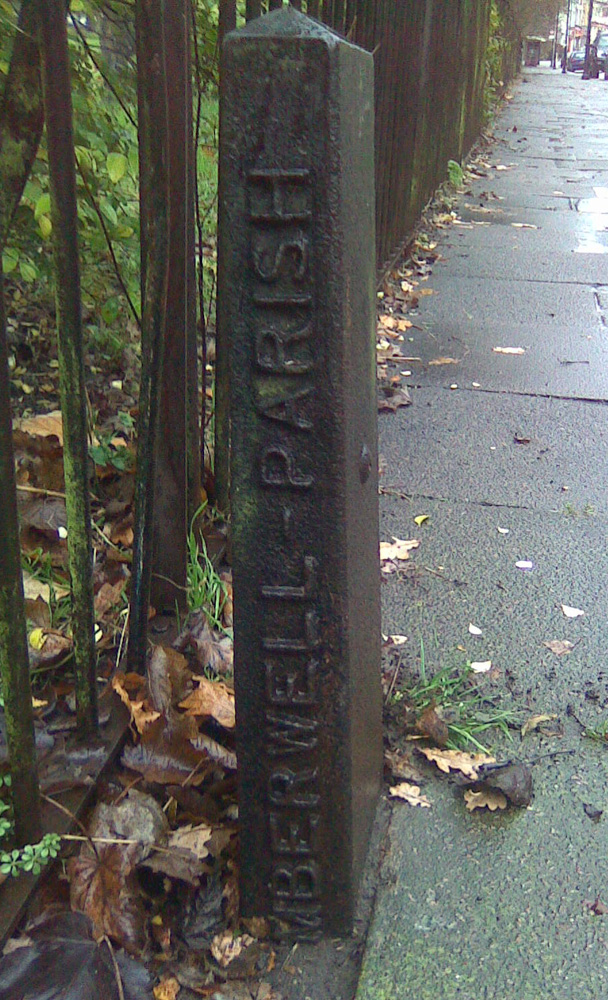
The parish of Camberwell
Camberwell St Giles is the name given to an ancient, and later civil, parish in the Brixton hundred of Surrey. The parish covered 4570 acre in 1831 and was divided into the liberty of Peckham to the east and the hamlet of Dulwich to the southwest, as well as Camberwell proper. The parish tapered in the south to form a point in what is now known as the Crystal Palace area. In 1829, it was included in the Metropolitan Police District and in 1855 it was included in the area of responsibility of the Metropolitan Board of Works, with Camberwell Vestry nominating one member to the board. In 1889 the board was replaced by the London County Council and Camberwell was removed administratively from Surrey to form part of the County of London.
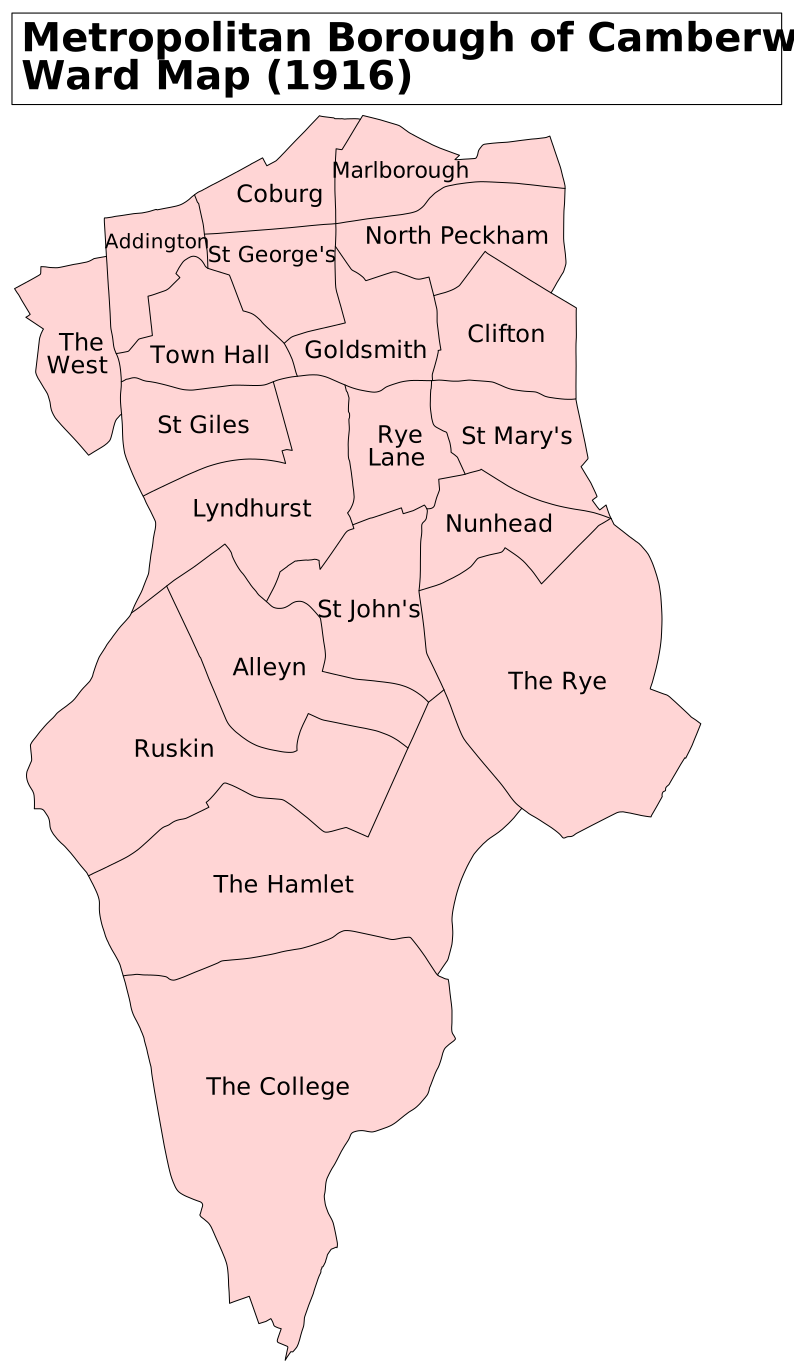
The Metropolitan Borough of Camberwell
In 1900, the area of the Camberwell parish became the Metropolitan Borough of Camberwell. In 1965, the metropolitan borough was abolished and its former area became the southern part of the London Borough of Southwark in Greater London. The western part of the area is situated in the adjacent London Borough of Lambeth.
Industrial history
The area has historically been home to many factories, including R. White's Lemonade, which originated in Camberwell, as well as Dualit toasters. Neither of these companies is now based in the area.
Former schools
Wilson's School was founded in 1615 in Camberwell by royal charter by Edward Wilson, vicar of the Parish of Camberwell. The charter was granted by James I. The school moved to its current site in Croydon in 1975. A school for girls, Mary Datchelor Girls' School, was established in Camberwell in 1877. It was built on two houses at 15 and 17 Grove Lane, the location of a former manor house. All except one of its 30 pupils came from the parish of St Andrew Undershaft in the City of London. The funding for the school came from a bequest from Mary Datchelor, who died childless. Proceeds of a property in Threadneedle Street used as a coffee-house were used to pay for apprenticeships for the poor boys of the parish, but as demographics in the City changed, it was decided to set up a school. By the 1970s, the school was receiving funding from the Clothworkers' Company and the Inner London Education Authority funded teaching posts. The school came under pressure from ILEA to become co-educational and comprehensive. Faced with this choice or becoming fully private, the school's governors instead decided to close in 1981. The school buildings were later used as offices for the charity Save the Children but have now been converted to flats.
Camberwell Collegiate School was an independent school located on the eastern side of Camberwell Grove, directly opposite the Grove Chapel. The Collegiate College had some success for a while, and led to the closure for some decades of the Denmark Hill Grammar School. However it had difficulty competing with other nearby schools including Dulwich College, and was closed in 1867.The land was sold for building.{{cite book |chapter-url=https://books.google.com/books?id=nfrdpmKuKPUC&q=%22camberwell+collegiate+school%22&pg=PT41
Important buildings


Camberwell today is a mixture of relatively well preserved Georgian and 20th-century housing, including a number of tower blocks. Camberwell Grove, Grove Lane and Addington Square have some of London's most elegant and well-preserved Georgian houses.
The Salvation Army's William Booth Memorial Training College, designed by Giles Gilbert Scott, was completed in 1932: it towers over South London from Denmark Hill. It has a similar monumental impressiveness to Gilbert Scott's other local buildings, Battersea Power Station and the Tate Modern, although its simplicity is partly the result of repeated budget cuts during its construction: much more detail, including carved Gothic stonework surrounding the windows, was originally planned. Camberwell is home to one of London's largest teaching hospitals, King's College Hospital with associated medical school the Guy's King's and St Thomas' (GKT) School of Medicine. The Maudsley Hospital, an internationally significant psychiatric hospital, is located in Camberwell along with the Institute of Psychiatry.
Early music halls in Camberwell were in the back hall of public houses. One, the "Father Redcap" (1853) still stands by Camberwell Green, but internally, much altered. In 1896, the Dan Leno company opened the "Oriental Palace of Varieties", on Denmark Hill. This successful venture was soon replaced with a new theatre, designed by Ernest A.E. Woodrow and with a capacity of 1,553, in 1899, named the "Camberwell Palace". This was further expanded by architect Lewen Sharp in 1908. By 1912, the theatre was showing films as a part of the variety programme and became an ABC cinema in September 1932 – known simply as "The Palace Cinema". It reopened as a variety theatre in 1943, but closed on 28 April 1956 and was demolished.
Nearby, marked by Orpheus Street, was the "Metropole Theatre and Opera House", presenting transfers of West End shows. This was demolished to build an Odeon cinema in 1939. The cinema seated 2,470, and has since been demolished. A second ABC cinema, known originally as the Regal Cinema and later as the ABC Camberwell, opened in 1940. With only one screen but 2,470 seats, the cinema was one of the largest suburban cinemas in London and continued to operate until 1973, after which it was used as a bingo hall until February 2010. The building retains its Art Deco style and is Grade II listed.
The Church of the Sacred Heart, Camberwell has been listed Grade II on the National Heritage List for England since 2015. Camberwell Town Hall, designed by Culpin and Bowers, was completed in 1934.
On 3 July 2009 a major fire swept through Lakanal House, a twelve-storey tower block. Six people were killed and at least 20 people were injured.
Camberwell beauty

The Camberwell beauty (also Camberwell Beauty) is a butterfly (Nymphalis antiopa) which is rarely found in the UK – it is so named because two examples were first identified on Coldharbour Lane, Camberwell in 1748. A large mosaic of the Camberwell beauty used to adorn the Samuel Jones paper factory on Southampton Way. The paper factory has since been demolished but the mosaic was removed and re-installed on the side of Lynn Boxing Club on Wells Way.
Culture
Art
.jpg)
Camberwell has several art galleries including Camberwell College of Arts, the South London Gallery and numerous smaller commercial art spaces. There is an annual Camberwell Arts Festival in the summer. The Blue Elephant Theatre on Bethwin Road is the only theatre venue in Camberwell.
A group now known as the YBAs (the Young British Artists) began in Camberwell – in the Millard building of Goldsmiths' College on Cormont Road. A former training college for women teachers, the Millard was the home of Goldsmiths Fine Art and Textiles department until 1988. It was converted to flats in 1996 and is now known as St Gabriel's Manor.
The core of the later-to-be YBAs, graduated from the Goldsmiths BA Fine Art degree course in the classes of 1987–90. Liam Gillick, Fiona Rae, Steve Park and Sarah Lucas, were graduates in the class of 1987. Ian Davenport, Michael Landy, Gary Hume, Anya Gallaccio, Henry Bond and Angela Bulloch, were graduates in the class of 1988; Damien Hirst, Angus Fairhurst, Mat Collishaw, Simon Patterson, and Abigail Lane, were graduates from the class of 1989; whilst Gillian Wearing, and Sam Taylor-Wood, were graduates from the class of 1990. During the years 1987–90, the teaching staff on the Goldsmiths BA Fine Art included Jon Thompson, Richard Wentworth, Michael Craig-Martin, Ian Jeffrey, Helen Chadwick, Mark Wallinger, Judith Cowan and Glen Baxter. Collishaw has a studio in a pub in Camberwell. as does the sculptor Anish Kapoor.
In his memoir Lucky Kunst, artist Gregor Muir, writes:
The building was also the hospital where Vera Brittain served as a nurse and described in her memoir Testament of Youth.
Literature
Thomas Hood, humorist and author of "The Song of the Shirt", lived in Camberwell from 1840 for two years; initially at 8, South Place, (now 181, Camberwell New Road). He later moved to 2, Union Row (now 266, High Street). He wrote to friends praising the clean air. In late 1841, he moved to St John's Wood. The Victorian art critic and watercolourist John Ruskin lived at 163 Denmark Hill from 1847, but moved out in 1872 as the railways spoiled his view. Ruskin designed part of a stained-glass window in St Giles' Church, Camberwell. Ruskin Park is named after him, and there is also a John Ruskin Street.
Another famous writer who lived in the area was the poet Robert Browning, who was born in nearby Walworth, and lived there until he was 28. Novelist George Gissing, in the summer of 1893, took lodgings at 76 Burton Road, Brixton. From Burton Road he went for long walks through nearby Camberwell, soaking up impressions of the way of life he saw emerging there." This led him to writing In the Year of Jubilee, the story of "the romantic and sexual initiation of a suburban heroine, Nancy Lord." Gissing originally called his novel Miss Lord of Camberwell.
Muriel Spark, the author of The Prime of Miss Jean Brodie and The Ballad of Peckham Rye lived, between 1955 and 1965, in a bedsit at 13 Baldwin Crescent, Camberwell. The novelist Mary Jane Staples, who grew up in Walworth, wrote a book called The King of Camberwell, the third instalment of her Adams family saga about Cockney life. Comedian Jenny Eclair is a long-term resident of Camberwell, and the area features in her 2001 novel Camberwell Beauty, named after a species of butterfly. Playwright Martin McDonagh and his brother, writer/director John Michael McDonagh, live in Camberwell. The 2014 novel The Paying Guests by Sarah Waters is set in 1920s Camberwell. In Daniel Defoe's novel Roxana (1724) the eponymous protagonist imagines her daughter, Susan, "drown'd in the Great Pond at Camberwell".
Nearby Peckham Rye was an important in the imaginative and creative development of poet William Blake, who, when he was eight, claimed to have seen the Prophet Ezekiel there under a bush, and he was probably ten years old when he had a vision of angels in a tree.
Music
The avant-garde band Camberwell Now named themselves after the area.
Basement Jaxx recorded three songs about Camberwell: "Camberwell Skies", "Camberskank" and "I live in Camberwell" which are on The Singles: Special Edition album (2005).
Florence Welch from British indie-rock band Florence and the Machine wrote and recorded a song entitled "South London Forever" on her 2018 album High as Hope based on her experience growing up in Camberwell, naming places such as the Joiners Arms and the Horniman Museum.
Festivals
Camberwell has played host to many festivals over the years, with the long-running Camberwell Arts Festival celebrating 20 years in 2014, and Camberwell Fair taking place on Camberwell Green in 2015, 2017 and 2018, resurrecting an ancient Fair that took place on the same green from 1279 to 1855. Since 2013, there is also an annual 10-day film festival – Camberwell Free Film Festival (CFFF) which is usually held in March/April in addition to special one-off screenings at other times of the year.
Transport
History
Until the First World War, Camberwell was served by three railway stations – Denmark Hill, Camberwell Gate (near Walworth), and Camberwell New Road in the west. Camberwell Gate and Camberwell New Road were closed in 1916 'temporarily' because of war shortages, but were never reopened.
London Underground has planned a Bakerloo line extension to Camberwell on at least three occasions since the 1930s.
Rail
Denmark Hill and Loughborough Junction railway stations serve Camberwell, whilst Peckham Rye and East Dulwich are both approximately 1 mi from Camberwell Green. These stations are all in London fare zone 2. London Overground, Southeastern, and Thameslink trains serve Denmark Hill. There are regular rail services to various destinations across Central London. There are also direct rail links to destinations elsewhere in London and the South East from Denmark Hill.
London Overground connects the area directly to Clapham and Battersea in the west, and Canada Water and Dalston east London. Thameslink trains carry passengers to Kentish Town in the north, whilst some peak-time services continue to destinations in Hertfordshire and Bedfordshire, such as Luton Airport. Eastbound Thameslink services travel towards Orpington or Sevenoaks, via Peckham, Catford, and Bromley, amongst other destinations. Southeastern trains eastbound serve destinations in South East London and Kent, including Peckham, Lewisham, Gravesend, and Dover.
Loughborough Junction is on the Thameslink route between St Albans City and Sutton. This provides Camberwell with a direct link southbound to Herne Hill, Streatham, Tooting, Wimbledon, Mitcham, and Sutton, amongst other destinations in South London. Northbound services run through the City of London and St Pancras. Destinations north of St Pancras include Kentish Town and West Hampstead. A limited Southeastern service between Blackfriars and Kent runs through Loughborough Junction.
Bus
Camberwell is served by numerous London Bus routes. Routes through Camberwell typically run east–west between Vauxhall and Peckham, or north–south between Elephant & Castle and Brixton or Dulwich.
Notable residents

Residents of the area have included children's author Enid Mary Blyton, who was born at 354 Lordship Lane, East Dulwich, on 11 August 1897 (though shortly afterwards the family moved to Beckenham), and the former leader of the TGWU, Jack Jones, who lived on the Ruskin House Park estate. Karl Marx initially settled with his family in Camberwell when they moved to London in 1849.
Others include the former editor of The Guardian Peter Preston. The Guardian columnist Zoe Williams is another resident, whilst Florence Welch of the rock band Florence + the Machine also lives in the area, as do actresses Lorraine Chase and Jenny Agutter. Syd Barrett, one of the founders of Pink Floyd, studied at Camberwell College of Arts from 1964.
Elizabeth Patterson Bonaparte gave birth to her son, Jérôme Napoléon Bonaparte, the nephew of the Emperor Napoleon I, in Camberwell in 1805.
- Tammy Abraham, professional footballer
- Henry Bessemer, inventor, had an estate in Denmark Hill
- John Bostock, professional footballer
- Stephen Bourne, British writer, film and social historian
- Jeremy Bowen, BBC war correspondent
- Thomas Brodie-Sangster, actor and musician
- Joseph Chamberlain, politician, born in Camberwell
- Florence Collingbourne (1880–1946), British actress and singer
- Catherine Dean, artist
- Alfred Domett (1811–1887) New Zealand politician and premier from 1862–63.
- Thomas Green (1659–1730)
- Albert Houthuesen, artist
- Marianne Jean-Baptiste, British actress, director and singer-songwriter
- Ida Lupino, Hollywood film actress and director, born in Herne Hill
- David McSavage, Irish stand-up
- William Henry Margetson, painter
- Erin O'Connor, fashion model
- Carolyn Quinn, BBC Radio 4 journalist
- James Ring (1856–1939) photographer, born in Camberwell.
- William Rust, British communist activist, war correspondent, and first editor of the Morning Star, born in Camberwell
- Jadon Sancho, professional footballer, lived in Peckham
- Edward Burnett Tylor, anthropologist
- Ben Watson, professional footballer
- Jack Whicher, detective
- Florence Welch (b. 1986), musician and front woman of Florence and the Machine.
References
References
- "Camberwell – British History Online".
- Southwark London Borough Council – [http://www.southwark.gov.uk/YourCommunity/Camberwell/ Community guide for Camberwell] {{Webarchive. link. (7 December 2007)
- "Camberwell".
- (27 May 2009). "Ancient well that gave name to Camberwell unearthed". The Daily Telegraph.
- Weinreb, Ben. (1986). "The London Encyclopedia". Adler & Adler.
- "Black Lives in England - Black British History in the 18th and 19th Centuries {{!}} Historic England".
- "Camberwell St Giles Surrey Family History Guide".
- link. (10 October 2010 ([http://www.visionofbritain.org.uk/bound_map_page.jsp?first=true&u_id=10128742&c_id=10001043 historic map]{{Dead link). (November 2018)
- In 1801, the population was 7,059 and by 1851 this had risen to 54,667.Vision of Britain – [http://www.visionofbritain.org.uk/data_theme_page.jsp?u_id=10128742&c_id=10001043&data_theme=T_POP Camberwell population]
- (2018). "History of Brunswick Park – Declared "one of the prettiest open spaces in south London"". Camberwell Quarterly.
- link. (17 March 2008 ([http://www.visionofbritain.org.uk/bound_map_page.jsp?first=true&u_id=10108032&c_id=10001043 historic map]{{Dead link). (November 2018)
- "Our History - Dualit Website".
- "Mary Datchelor School, Camberwell Grove – Works – Southwark Heritage".
- Archives, The National. "The Discovery Service".
- "Mary Datchelor School – Exploring Southwark".
- Walford, Edward. (1878). "Camberwell". Institute of Historical Research.
- "King's College London – Institute of Psychiatry, Psychology & Neuroscience Denmark Hill Campus". King's College London.
- [http://www.british-history.ac.uk/report.aspx?compid=41455 ''Shaftesbury Avenue'', Survey of London: volumes 31 and 32: St James Westminster, Part 2 (1963), pp. 68–84] accessed: 12 June 2008
- [http://cinematreasures.org/theater/18126 ''Camberwell Palace Theatre''] (Cinema Treasures) accessed 12 June 2008
- [http://www.arthurlloyd.co.uk/Camberwell.htm ''Camberwell Halls and Entertainment''] (Arthur Lloyd Theatre History) accessed: 12 June 2008
- [http://cinematreasures.org/theater/18111 ''ABC Camberwell''] (Cinema Treasures) accessed 22 February 2010
- {{NHLE
- Beasley, John D.. (2010). "Camberwell Through Time". Amberley Publishing.
- Vanessa, Fonesca. "Nymphalis antiopa". University of Michigan Museum of Zoology.
- "Camberwell Arts Festival".
- "Home page – Blue Elephant Theatre".
- (28 May 2012). "Art in the East End: Mat Collishaw". hungertv.com.
- Architects Journal June 2012 http://www.architectsjournal.co.uk/news/daily-news/caseyfierro-unwraps-anish-kapoor-studio/8625145.article
- Lucky Kunst, ''The Rise and Fall of Young British Art''. Aurum Press, London 2012, p. 11 {{ISBN. 1845133900
- 'Camberwell', Old and New London: Volume 6 (1878), pp. 269–286 Date accessed: 13 February 2011.> http://www.british-history.ac.uk/report.aspx?compid=45281
- "Welcome to Camberwell Guide". Southlondonguide.co.uk.
- "The Ruskin Window". Stgilescamberwell.org.uk.
- (26 January 2010). "Camberwell history – Southwark's historic villages". Southwark.gov.uk.
- Paul Delany, to ''[[In the Year of Jubilee]]''. London: J.M. Dent, 1994.
- Paul Delany, "Introduction".
- Mount, Ferdinand. "The Go-Away Bird". The Spectator.
- (15 August 2014). "The Paying Guests by Sarah Waters review – satire meets costume drama".
- Wight, Colin. "Virtual books: images only – The Notebook of William Blake: Introduction".
- Göran – 4 December 2011. "The 100 best London songs – Songs about London". Time Out London.
- Braidwood - 29 June 2018. (29 June 2018). "Florence Welch's guide to South London – the real-life places referenced in her new album". NME.
- [http://www.camberwellfair.co.uk/camberwell-fair-history] {{Webarchive. link. (22 May 2020 Camberwell Fair])
- "CFFF Vimeo Films".
- [http://www.loveplums.co.uk/Tube/Blackfriars_Loughborough.html Blackfriars Bridge – Loughborough Junction] {{Webarchive. link. (30 May 2012, UK.)
- [[Pevsner Architectural Guides. The Buildings of England]] London 2: South, Second Edition 1983, page 625
- Transport for London: [https://consultations.tfl.gov.uk/tube/bakerloo-extension Bakerloo line extension] {{Webarchive. link. (23 September 2021 , 5 January 2016)
- (2020). "London's Rail & Tube Services".
- "The Enid Blyton Society".
- (22 August 2014). "Living in Camberwell: area guide to homes, schools and transport links".
- Rühle, Otto. (2013). "Karl Marx: His Life and Work". Routledge.
- (7 January 2018). "Peter Preston obituary". The Guardian.
- "Zoe Williams: My neighbour, the Leopard Man of Peckham". The Guardian.
- Amy Grier. (31 July 2009). "Florence Welch – My London". Evening Standard.
- (18 January 2015). "Jenny Agutter on Call the Midwife, the Railway Children and the pitfalls of Hollywood". Radio Times.
- (16 August 2019). "Actress Jenny Agutter joins forces with Camberwell community leaders to help boost local businesses featuring Denmark Hill Railway Station – South London News". Londonnewsonline.co.uk.
- Kirby, Terry. (30 November 2006). "Syd Barrett's last remnants sold in frenzy of bidding". The Independent.
- (20 February 2015). "Jerome Napoleon Bonaparte, Napoleon's American Nephew – Shannon Selin".
- Association, The Football. "Back to his roots!". The Football Association.
- Beasley, John D.. (15 November 2010). "Camberwell Through Time". Amberley Publishing Limited.
- "AFC Camberwell".
- Jeremy Bowen. (22 June 2019). "Jeremy Bowen on Twitter: "As a Camberwell resident since the 1980s, I'd like to say that mostly it's calm and peaceful. Though there can be some police activity at night."".
- (2 September 2015). "Thomas Brodie-Sangster: I'd like an evil role, actually".
- [[Julian Amery]] and [[J. L. Garvin]], ''The life of Joseph Chamberlain'', Six volumes, Macmillan, 1932–1969.
- [https://www.ancestry.co.uk/interactive/8912/ONS_B18802AZ-0061?pid=38666009&backurl=https://search.ancestry.co.uk/cgi-bin/sse.dll?indiv%3D1%26dbid%3D8912%26h%3D38666009%26tid%3D%26pid%3D%26usePUB%3Dtrue%26_phsrc%3Ddjv3312%26_phstart%3DsuccessSource&treeid=&personid=&hintid=&usePUB=true&_phsrc=djv3312&_phstart=successSource&usePUBJs=true&_ga=2.125041354.1335830168.1588585387-1197399642.1515349816 England & Wales, Civil Registration Birth Index, 1837–1915 for Florence Eliza Collingbourne: 1880, Q1-Jan–Feb–Mar – Ancestry.com {{subscription required}}]
- "Albert Houthuesen Chronology".
- [https://teara.govt.nz/en/biographies/1d15/domett-alfred ''Dictionary of New Zealand Biography'']
- ''Dictionary of British Sculptors'' 1660–1851 by Rupert Gunnis p.179
- "Marianne Jean-Baptiste blue plaque".
- ''Southwark News'' "DOUBLE PLAQUE IN HERNE HILL FOR HOLLYWOOD STARS STANLEY AND IDA LUPINO"[https://www.southwarknews.co.uk/news/double-plaque-in-herne-hill-for-hollywood-stars-stanley-and-ida-lupino/]
- Nolan, Larissa. (9 May 2021). "David McSavage: I like having the status of an outsider".
- (12 March 2006). "Back to the future".
- (22 July 2014). "Birthdays". [[The Guardian]].
- Sullivan, John. "James Ring".
- (2004). "Rust, William Charles (1903–1949), political activist and journalist".
- Cawley, Richard. (9 October 2018). "South Londoner Jadon Sancho could make full England debut – at the age of just 18". South London Press.
- Lowie, Robert H. "Edward B. Tylor." ''American Anthropologist'', vol. 19, no. 2, 1917, p. 262. JSTOR, [http://www.jstor.org/stable/660758].
- Hugman, Barry J., ed. (2010). The PFA Footballers' Who's Who 2010–11. Mainstream Publishing. p. 430. {{ISBN. 978-1-84596-601-0.
- [http://search.ancestry.co.uk/iexec?htx=View&r=5538&dbid=1558&iid=31280_199025-00155&fn=Jonathan&ln=Whitcher&st=r&ssrc=&pid=5384950 London, England, Births and Baptisms, 1813–1906 Record for Jonathan Whitcher] – [[Ancestry.co.uk]]
- Ryan, Francesca. (4 June 2009). "Florence and the Machine interview: sound and vision". The Telegraph.
This article was imported from Wikipedia and is available under the Creative Commons Attribution-ShareAlike 4.0 License. Content has been adapted to SurfDoc format. Original contributors can be found on the article history page.
Ask Mako anything about Camberwell — get instant answers, deeper analysis, and related topics.
Research with MakoFree with your Surf account
Create a free account to save articles, ask Mako questions, and organize your research.
Sign up freeThis content may have been generated or modified by AI. CloudSurf Software LLC is not responsible for the accuracy, completeness, or reliability of AI-generated content. Always verify important information from primary sources.
Report