From Surf Wiki (app.surf) — the open knowledge base
Calorimeter (particle physics)
Experimental apparatus that measures the energy of particles
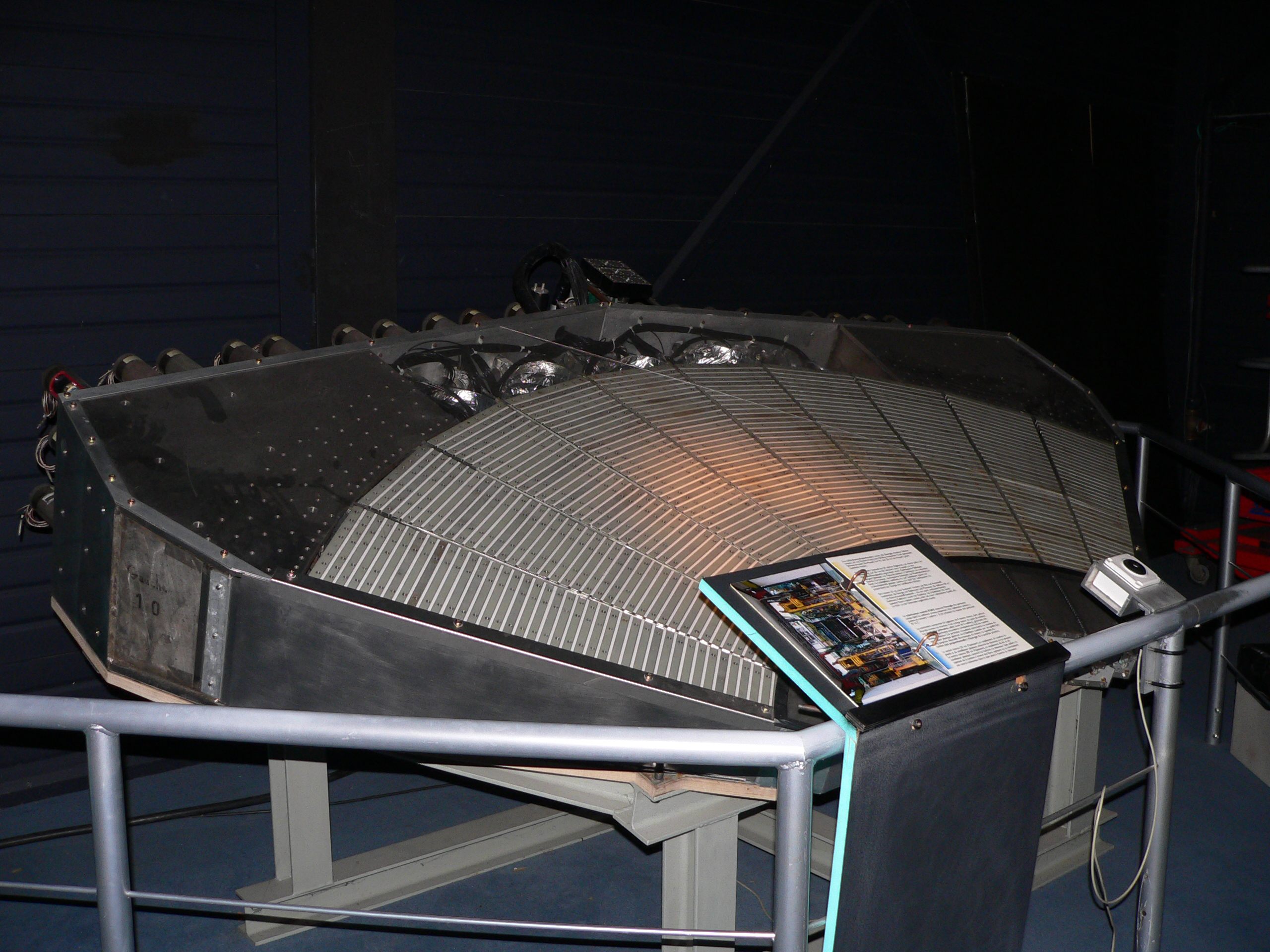
Experimental apparatus that measures the energy of particles
In experimental particle physics, a calorimeter is a type of detector that measures the energy of particles. Particles enter the calorimeter and initiate a particle shower in which their energy is deposited in the calorimeter, collected, and measured. The energy may be measured in its entirety, requiring total containment of the particle shower, or it may be sampled. Typically, calorimeters are segmented transversely to provide information about the direction of the particle or particles, as well as the energy deposited, and longitudinal segmentation can provide information about the identity of the particle based on the shape of the shower as it develops. Calorimetry design is an active area of research in particle physics.
Types of calorimeters
Electromagnetic versus hadronic
such as electrons, positrons and photons. A . (See types of particle showers for the differences between the two.) Calorimeters are characterized by the radiation length (for ECALs) and nuclear interaction length (for HCALs) of their active material. ECALs tend to be 15–30 radiation lengths deep while HCALs are 5–8 nuclear interaction lengths deep.
Homogeneous versus sampling
An ECAL or an HCAL can be either a sampling calorimeter or a homogeneous calorimeter.
Calorimeters in high-energy physics experiments
Most particle physics experiments use some form of calorimetry. Often it is the most practical way to detect and measure neutral particles from an interaction. In addition, calorimeters are necessary for calculating "missing energy" which can be attributed to particles that rarely interact with matter and escape the detector, such as neutrinos. In most experiments the calorimeter works in conjunction with other components like a central tracker and a muon detector. All the detector components work together to achieve the objective of reconstructing a physics event.
References
References
- Particle Physics Booklet 2006 pg 272
This article was imported from Wikipedia and is available under the Creative Commons Attribution-ShareAlike 4.0 License. Content has been adapted to SurfDoc format. Original contributors can be found on the article history page.
Ask Mako anything about Calorimeter (particle physics) — get instant answers, deeper analysis, and related topics.
Research with MakoFree with your Surf account
Create a free account to save articles, ask Mako questions, and organize your research.
Sign up freeThis content may have been generated or modified by AI. CloudSurf Software LLC is not responsible for the accuracy, completeness, or reliability of AI-generated content. Always verify important information from primary sources.
Report