From Surf Wiki (app.surf) — the open knowledge base
Calming the storm
Miracle carried out by Jesus according to the Bible
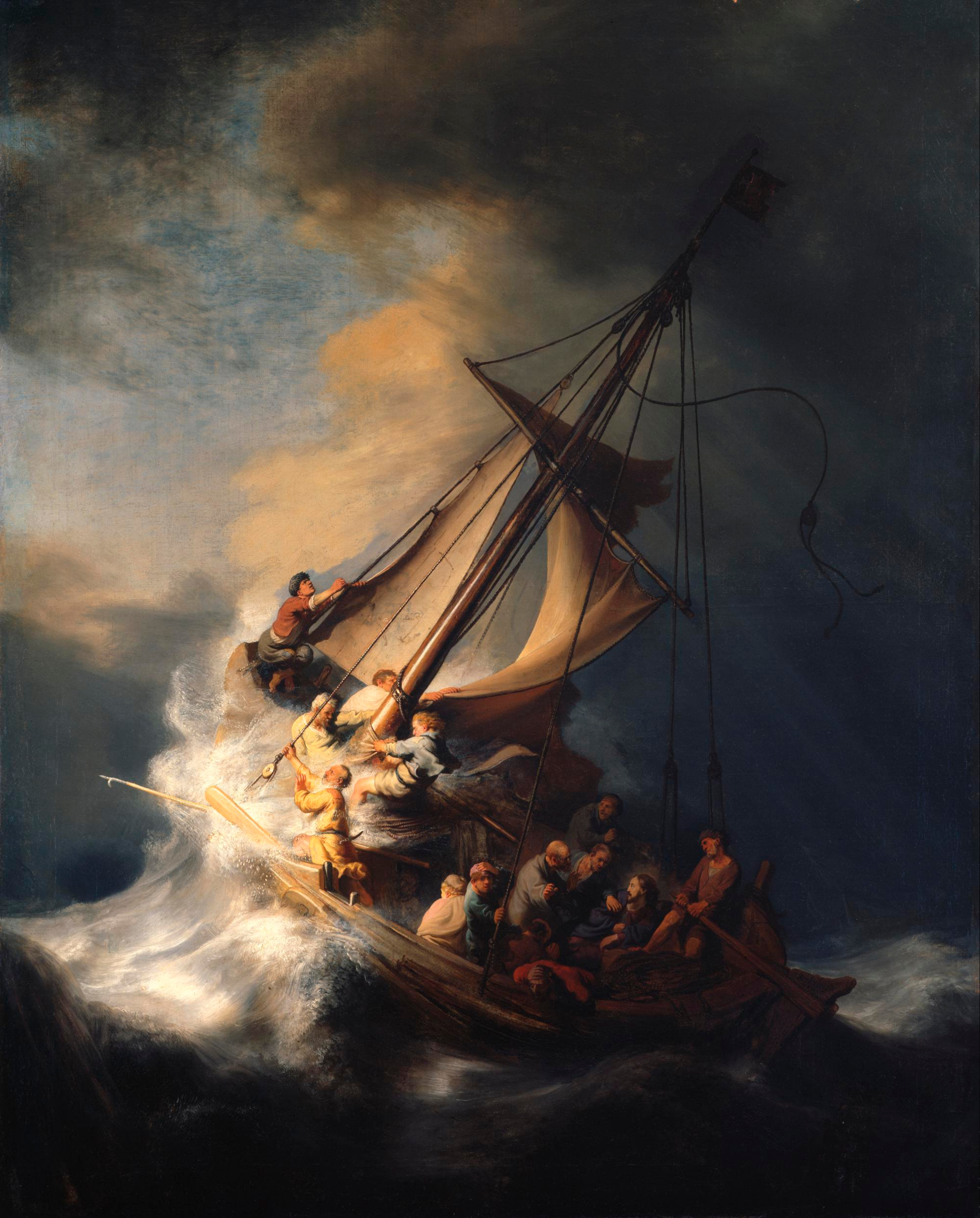
Miracle carried out by Jesus according to the Bible
Calming the storm is one of the miracles of Jesus in the Gospels, reported in Matthew 8:23–27, Mark 4:35–41, and Luke 8:22–25 (the Synoptic Gospels). This episode is distinct from Jesus' walk on water, which also involves a boat on the lake and appears later in the narrative.
Biblical accounts
According to the Gospels, one evening Jesus and his disciples were crossing the Sea of Galilee in a boat. Suddenly a furious storm came up, with the waves breaking over the boat so that it was nearly swamped. Jesus was asleep on a cushion in the stern, and the disciples woke him and asked, "Teacher, don't you care if we drown?" The Gospel of Mark then states that:
He then rebuked the wind, and said to the sea, "Peace! Be still!" Then the wind ceased, and there was a dead calm. He said to them, "Why are you afraid? Have you still no faith?" And they were filled with great awe and said to one another, "Who then is this, that even the wind and the sea obey him?”
Analysis
Author Michael Keene commented that the Sea of Galilee was known for its sudden and fierce storms and that the Jews were people of the land who were generally uncomfortable at sea, especially since they believed the sea to be full of frightening creatures. The Pulpit Commentary attributes these sudden storms to winds arising on the summits of Mount Hermon, in the Anti-Lebanon mountains to the north.
The Anglican clergyman John Clowes commented that by asking the question "Why are you so afraid?", Jesus was asking his disciples to explore in their own minds the cause and origin of fear, so they would realize that all fear has its roots in natural affection and thought, separate from spiritual affection and thought. And by asking "Do you still have no faith?" Jesus was manifestly pointing to a defect in their spiritual principles. Clowes further commented that by that last question Jesus was manifestly instructing his disciples, and through them all future generations of mankind, that fear is the constant result of the want of Heavenly principles in the human mind.
Justus Knecht notes that: "the object of this miracle was 1. to increase and strengthen the faith of the apostles; 2. to teach the apostles and their successors that they, as fishers of men, would be exposed to many persecutions and afflictions; but that Jesus would always be with them to hush the storm."
Artworks
File:Cristo apacigua la tempestad en el lago Tiberiades.jpg|Juan de Flandes 1490–1500 File:Brueghel, Jan I - Christ in the Storm on the Sea of Galilee - 1596.jpg|Jan Brueghel the Elder 1596 File:Pieter Stalpaert - Christ sleeping during the storm.jpg|Pieter Stalpaert 1617 File:Simon de Vlieger - Calming the storm.jpg|Simon de Vlieger 1637 File:Cornelis de Wael - Calming the storm.jpg|Cornelis de Wael 1630s File:Backhuysen, Ludolf, I - Christ in the Storm on the Sea of Galilee - Google Art Project.jpg|Ludolf Bakhuizen 1695 File:Eugène Delacroix - Christ on the Sea of Galilee - Google Art Project.jpg|Eugène Delacroix 1854 File:James Ensor (1891) Christus bedaart de storm 001.jpg|James Ensor 1891
References
References
- (Oct 1, 2004). "The People's New Testament Commentary". Westminster John Knox Press.
- Keene, Michael. (2002). "St Mark's Gospel and the Christian Faith". Nelson Thornes.
- Clowes, John. (1817). "The Miracles of Jesus Christ". J. Gleave.
This article was imported from Wikipedia and is available under the Creative Commons Attribution-ShareAlike 4.0 License. Content has been adapted to SurfDoc format. Original contributors can be found on the article history page.
Ask Mako anything about Calming the storm — get instant answers, deeper analysis, and related topics.
Research with MakoFree with your Surf account
Create a free account to save articles, ask Mako questions, and organize your research.
Sign up freeThis content may have been generated or modified by AI. CloudSurf Software LLC is not responsible for the accuracy, completeness, or reliability of AI-generated content. Always verify important information from primary sources.
Report