From Surf Wiki (app.surf) — the open knowledge base
California State Polytechnic University, Pomona
Public university in Pomona, California, US

Public university in Pomona, California, US
| Field | Value |
|---|---|
| name | California State Polytechnic University, Pomona |
| former_name | California Polytechnic School Vorhees Unit (1938–1956) |
| California Polytechnic School Kellogg-Vorhees Unit (1956–1966) | |
| California State Polytechnic College, Kellogg-Vorhees (1966–1972) | |
| image | California Polytechnic (Pomona) university seal.svg |
| image_upright | .8 |
| motto | Discere Faciendo (Latin) |
| mottoeng | "Learn by Doing" |
| free_label | Newspaper |
| free | The Poly Post |
| established | |
| type | Public polytechnic university |
| endowment | $186.7 million (2024) |
| faculty | 1,512 (fall 2021) |
| president | Iris S. Levine (interim) |
| provost | Terri Gomez |
| students | 27,196 (fall 2024) |
| undergrad | 25,255 (fall 2024) |
| postgrad | 1,941 (fall 2024) |
| city | Pomona, California |
| country | United States |
| coordinates | |
| campus | Large suburb |
| campus_size | 1438 acre |
| colors | Green and gold |
| mascot | Billy Bronco |
| sports_nickname | Broncos |
| sporting_affiliations | NCAA Division II – CCAA |
| parent | California State University |
| accreditation | WSCUC |
| academic_affiliations | Space-grant |
| website | |
| logo | Calpoly pomona univ logo.png |
| logo_size | 250 |
California Polytechnic School Kellogg-Vorhees Unit (1956–1966) California State Polytechnic College, Kellogg-Vorhees (1966–1972)
California State Polytechnic University, Pomona (Cal Poly Pomona) is a public polytechnic research university in Pomona, California, United States. It is the largest of the three polytechnic universities in the California State University system by enrollment.
Cal Poly Pomona began as a southern campus of the California Polytechnic School (now known as Cal Poly San Luis Obispo) in 1938, following the donation of the Voorhis School for Boys and its adjacent farm in San Dimas by Charles and Jerry Voorhis. This Pomona campus expanded in 1949 when it was gifted the W.K. Kellogg Institute of Animal Husbandry from the University of California, which was originally Will Keith Kellogg's horse ranch. Cal Poly Kellogg-Voorhis and Cal Poly San Luis Obispo continued operations under unified administrative control until 1966, when Cal Poly Pomona was formed as an independent university.
Cal Poly Pomona currently offers bachelor's degrees in 94 majors, 39 master's degree programs, 13 teaching credentials, and a doctorate across nine distinct academic colleges. The university is one among a small group of polytechnic universities in the United States which tend to be primarily devoted to the instruction of technical arts and applied sciences. Cal Poly, Pomona is a Hispanic-serving institution (HSI) and is eligible to be designated as an Asian American Native American Pacific Islander serving institution (AANAPISI).
Its sports teams are known as the Cal Poly Pomona Broncos and play in the NCAA Division II as part of the California Collegiate Athletic Association (CCAA). The Broncos sponsor 10 varsity sports and have won 14 NCAA national championships. Current and former Cal Poly Pomona athletes have won 7 Olympic medals (3 gold, 1 silver, and 3 bronze).
History
See also: [[California Polytechnic State University#History
.PNG)
Events leading to the foundation of present-day Cal Poly Pomona began with the ending of the Voorhis School for Boys near Walnut Creek in San Dimas, California, and its acquisition by the San Luis Obispo–based California Polytechnic School in 1938.
The California Polytechnic School (Cal Poly San Luis Obispo) was founded as a vocational high school when California Governor Henry Gage signed the Polytechnic School Bill on March 8, 1901, after its drafting by school founder Myron Angel. Voorhis School, on the other hand, had been established in 1928 as a private vocational school which provided elementary schooling for underprivileged boys and operated under the Christian religious principle, "education coupled with the Kingdom of God". Its founder Charles B. Voorhis and headmaster Jerry Voorhis maintained the school opened throughout the worst years of the Great Depression but persistent economic pressures forced them to transfer control to Cal Poly in San Luis Obispo in 1938.
Voorhis School became the Cal Poly-Voorhis Unit and its educational offerings were raised to the same level as Cal Poly in San Luis Obispo's, then a two-year college. The horticulture program was moved to the new satellite campus and the two units operated as one institution spanning two locations under the leadership of president Julian McPhee.
During World War II most of the student body was called to active military duty; enrollment declined and the campus closed in 1943. Reopening after the war, Cal Poly-Voorhis Unit operated in San Dimas until 1956 when it moved to Will Keith Kellogg’s former horse ranch in the neighboring city of Pomona, California. Acknowledging its Kellogg legacy, Cal Poly-Voorhis Unit changed its name to Cal Poly Kellogg-Voorhis Unit and offered six programs in agriculture. The inaugural class of 1957 at the new campus consisted of 57 students graduating with bachelor's degrees in a ceremony held at the Rose Garden in Pomona and religious services at Voorhis Chapel in San Dimas. Also in 1957, Cal Poly Kellogg-Voorhis introduced the College of Engineering, the second academic unit after the College of Agriculture. The California Master Plan for Higher Education added the two Cal Poly campuses to the new California State College system in 1961 and Cal Poly Kellogg-Voorhis Unit opened its doors for the first time to 329 female students. President McPhee retired in 1966, and Cal Poly split into two different and independent universities. The partnership between the two campuses remains with their involvement in the annual Cal Poly Universities Rose Float.
To better reflect its new ties to the California State College system, Cal Poly Kellogg-Voorhis changed its name to "California State Polytechnic College, Kellogg-Voorhis" in 1966 and became the 16th campus to officially join the CSC system. Robert C. Kramer assumed presidency of the independent campus in 1966 (second overall as the university recognizes McPhee as its first) and California State Polytechnic College, Kellogg-Voorhis finally adopted its present-day name California State Polytechnic University, Pomona on June 1, 1972.
In 1998, Cal Poly Pomona received criticism when it planned to grant an honorary degree to Robert Mugabe. Mugabe's negative humanitarian record as president of Zimbabwe led to protests from staff, faculty and students, ultimately forcing the university to rescind the plan.{{cite news | title= Cal Poly Pomona Chief Is Focus of Campus Contention
Cal Poly Pomona underwent further growth in the late 20th and early 21st centuries, with the construction of the CLA Building (demolished in 2022), academic facilities, expansion to the Cal Poly Pomona University Library and the addition of programs such as the Lyle Center for Regenerative Studies, the I-Poly High School and the U.R. Bronco undergraduate research program. Under then-president J. Michael Ortiz, Cal Poly Pomona launched its first comprehensive capital campaign in fall of 2008 to increase its permanent endowment. Nevertheless, the negative economic effects caused by the late-2000s recession resulted in increased student fees, reduced enrollment availability, eliminated two athletic programs and introduced a mandatory furlough calendar for most of its employees.
In April 2024, CPP students joined other campuses across the United States in protests against the humanitarian crisis and genocide in Gaza.
Name
See also: [California State University#Campus naming conventions
The university is officially known as "California State Polytechnic University, Pomona" and "Cal Poly Pomona", and is also referred to as "CPP". The name "Cal Poly" is protected by trademark and state statute exclusively for [California Polytechnic State University in San Luis Obispo. Referring to Cal Poly Pomona simply as "Cal Poly" can cause confusion. To honor each institution's unique identity and ensure clear communication, Cal Poly Pomona's Office of Public Affairs recommends using "Cal Poly Pomona" or "CPP" when mentioning the university. This practice recognizes Cal Poly Pomona as an independent and respected institution with distinct strengths within the California State University (CSU) system.
File:The University of California W.K. Kellogg Institute-Pomona.svg||alt=Former seal used by the university during the University of California years (1932–1943). File:University Seal of Cal Poly in Pomona, CA (mid-1980s-2017).svg| File:Cal_Poly_Seal.svg|
Campus
| Los Angeles Cal Poly Pomona is located partially within the limits of Pomona, a largely suburban city that is part of the Los Angeles metropolitan area. The city of Pomona is located in the eastern portion of Los Angeles County and borders the neighboring county of San Bernardino to the east. The university's 1725 acre campus make it the second largest in the California State University system, a figure which includes various facilities scattered throughout Southern California such as a 53 acre ranch in Santa Paula, California, 25 acre campus at the former Spadra Landfill (now known as "Spadra Ranch"), and the Neutra VDL Studio and Residences in Silver Lake, Los Angeles. The university is currently negotiating the transfer of the 302 acre Lanterman Developmental Center from the State of California. The land is to be used for academic purposes and expansion of the Innovation Village and also shared by the California Highway Patrol, the California Air Resources Board and the California Conservation Corps.
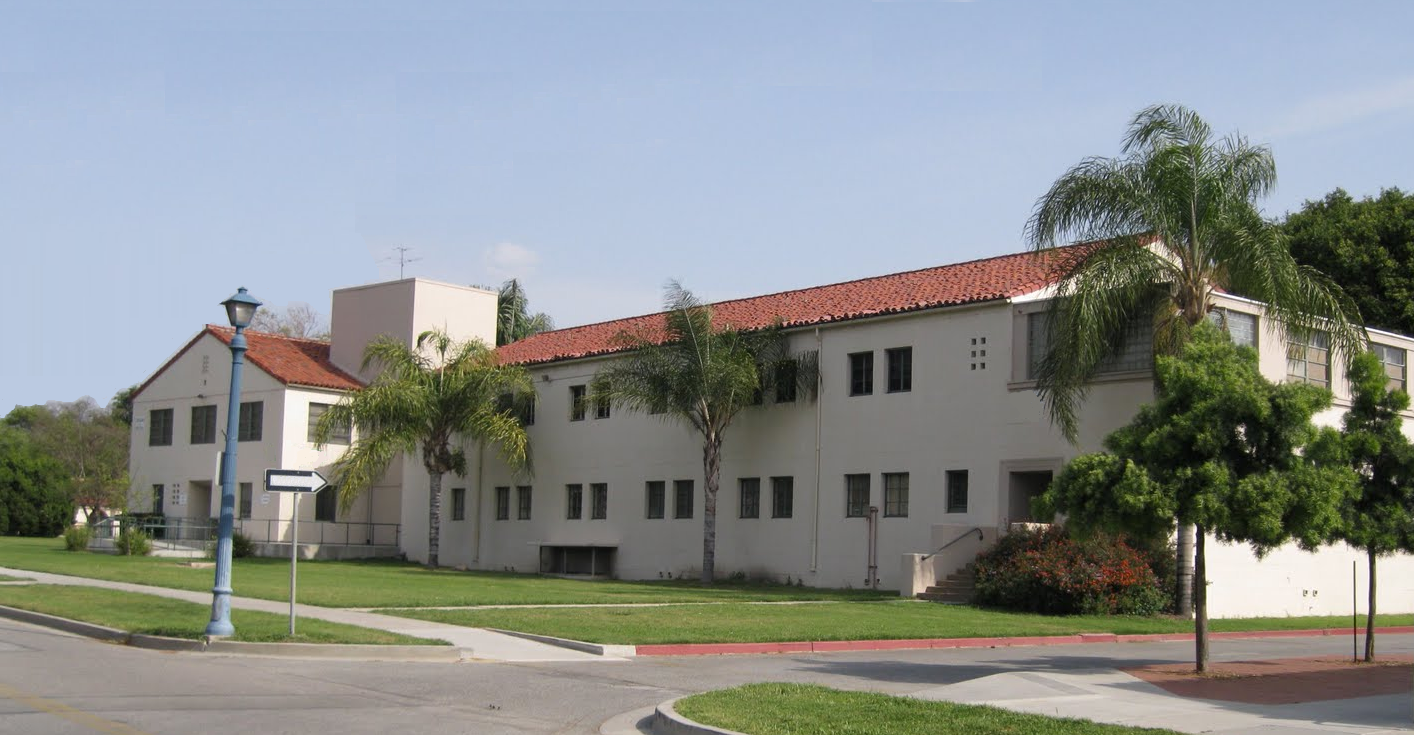
Although part of the Los Angeles metropolitan area, the university is in close proximity to two other large metropolitan and culturally defined regions, the Inland Empire and Orange County. The university has a tier 1 area, defined as a geographical admissions region surrounding the campus, roughly bounded by the San Gabriel Mountains to the north, the city of Chino Hills to the south, Interstate 605 to the west, and Interstate 15 to the east. Cal Poly Pomona's campus buildings vary in age and style from the Mission Revival Kellogg Horse Stables and the Kellogg House (suggesting the Spanish colonial architectural heritage of Southern California) built in the 1920s; the modernist box-like portion of the library completed in 1969; to contemporary dormitories, engineering, science and library-expansion facilities completed in the early 21st century. Manor House serves as the official residence of the university president.
Leisure and recreational locations include a rose garden which dates back to the Kellogg horse ranch years; the Kellogg House designed by Los Angeles-based architects Charles Gibbs Adams, Myron Hunt and Harold Coulson Chambers in the 1920s; and a 1.3 acre Japanese garden built in 2003 and designed by Takeo Uesugi. Kellogg's House features grounds which were initially landscaped by Charles Gibbs Adams but were later completed by Florence Yoch & Lucile Council. Cal Poly Pomona's George and Sakaye Aratani Japanese Garden is one among three under management by institutions of higher education in the County of Los Angeles, the others being the Earl Burns Miller Japanese Garden at Cal State Long Beach, and the Shinwa-En Garden at Cal State Dominguez Hills. At the center of the campus and atop Horsehill are the buildings of the Collins College of Hospitality Management and Kellogg West, a hotel and conference center and home of the student/faculty-run Restaurant at Kellogg Ranch.
At the northwest part of the campus is the Voorhis Ecological Reserve, which serves as a 31 ha wildlife corridor containing Coastal Sage Scrub and Coast Live Oak trees among others. Contrasting some of these architecturally prominent facilities, there are various portable buildings on campus which are used to accommodate the growing enrollment of recent decades. Cal Poly Pomona operates the International Polytechnic High School, a college preparatory high school located on campus.
The letters "CPP" made of concrete are located on Colt Hill overlooking the campus. The letters "CP" were initially added in 1959, with the second "P" added in 2004 to distinguish it from the Cal Poly campus in San Luis Obispo.
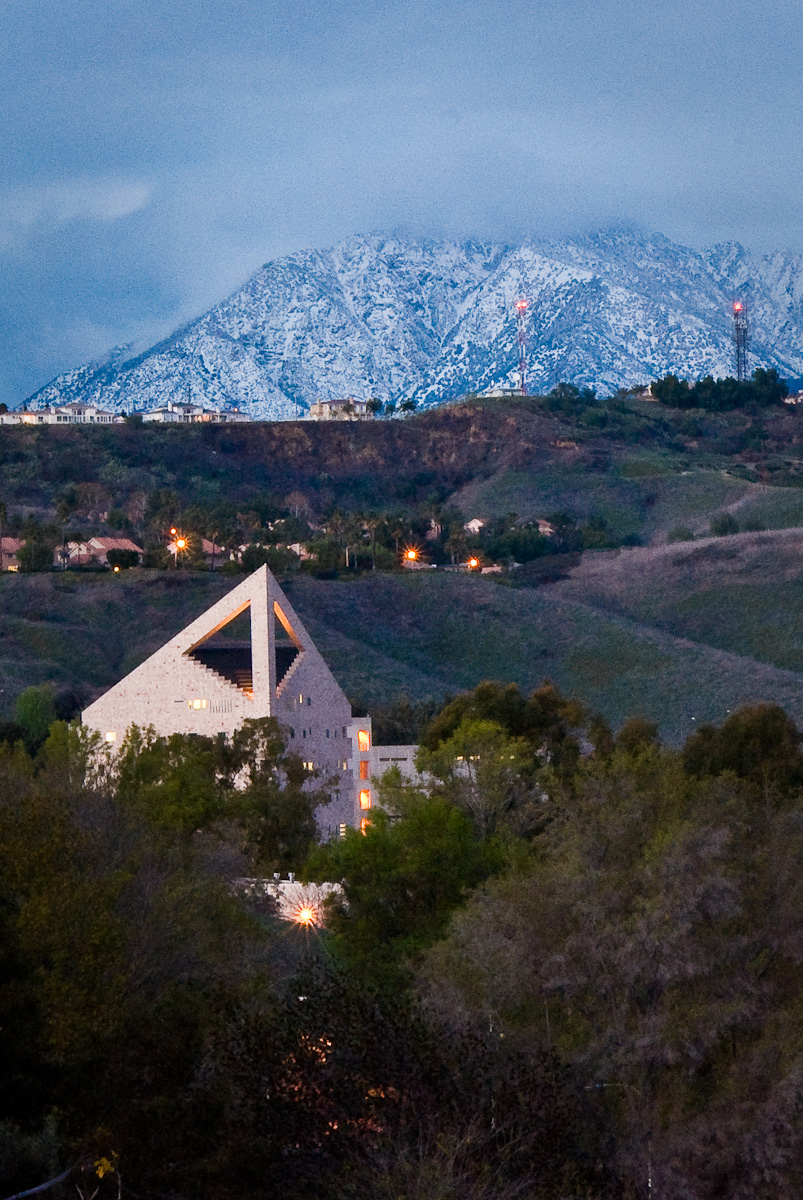
Between 1993 and 2022, Cal Poly Pomona's dominant landmark was a futurist-styled administrative facility known as the CLA Building which was designed by Antoine Predock and opened in 1993. The building's peculiar shape (standing out by a triangular-shaped "skyroom" atop its eight-story tower) became a symbol of the university; in addition, its close location to film studios based in the Hollywood borough of Los Angeles have prompted its inclusion in motion pictures such as Gattaca and Impostor. In 2013, the California State University Board of Trustees voted to demolish the building and replace it with a new academic/faculty complex because of severe seismic risks, as determined when now reviewed in the context of more recent seismic research than was required by building codes at the time of its original design and building permit. Despite the fact that numerous other buildings on the CPP campus are much older, which brings into question their adequacy as they too sit on the same presumed fault line, only the CLA building was to be completely demolished by the end of summer 2022.
Noted modernist architect James Pulliam once served as campus architect and instructor and designed the Bookstore, W. Keith and Janet Kellogg Art Gallery, Interim Design Center (IDC) and Student Union building which architectural historian David Gebhard regarded as the best building on campus.
Academic and research facilities
The W. K. Kellogg Arabian Horse Center is an academic and research facility serving one of the 22 terms and conditions to the donation of the Kellogg ranch by maintaining Kellogg's purebred Arabian horses and their breeding program. Another academic facility highlighting the Kellogg legacy is the Horse Stables (also known as University Plaza) which contains a small research library specializing in equine studies along with offices for student services and various campus organizations.

Conceived in 1995 by then university president, Bob H. Suzuki, and initially financed by NASA and the Economic Development Administration, the Innovation Village is a 65 acre public/private partnership research and business facility at the southern edge of the campus. Major tenants include the American Red Cross, Southern California Edison, and the NASA Commercialization Center. The project is currently at the halfway mark of building and leasing 1000000 sqft of the projected total building space. Once complete, it is estimated that the project would employ 2000 to 3000 people and provide half a billion dollars of economic benefits to the local, regional and state economies.
Campus sustainability and transportation
.PNG)
The university has actively sought to reduce carbon emissions and energy usage on campus. In November 2007, Cal Poly Pomona became a signatory member of the American College & University Presidents Climate Commitment. Among other things, this committed the university to ensure that within one year, it would purchase or produce at least 15% of the institution's electric consumption from renewable sources. The university, along with other members in the CSU, is also a member of the California Climate Action Registry. and lists on The Princeton Review's Guide to 375 Green Colleges. As a part of the campus' Climate Action Plan to reduce its carbon footprint, the campus offers incentive parking for students and faculty participating in its Rideshare program. The carpooling initiative gives users the opportunity to park in reserved spaces located closer to campus buildings.
Cal Poly Pomona's institute for sustainability education is the Lyle Center for Regenerative Studies. The center was built adjacent to an old landfill and conducts research in the areas of sustainable technology and agriculture. As an example of Cradle to Cradle Design, it uses solar-powered dormitories, aquaculture ponds, and organic gardens while providing environmentally sustainable housing accommodation for 22 graduate students. In 2010, with the installation of a 210,000 kW hours CPV system by Amonix, the center became the first carbon neutral facility in the California State University system. The center is part of Agriscapes, a 40 acre research project that showcases environmental and agricultural sustainable practices including methods to grow food, conserve water and energy and recycle urban waste. Agriscapes is home of the Farm Store at Kellogg Ranch which sells locally and campus-grown foods and products. Cal Poly Pomona campus also contains a rainforest greenhouse, a California ethnobotany garden, and an aquatic biology center collectively known as BioTrek, which provides environmental education to all academic levels.
The entire campus community is served by a free campus shuttle system known as "Bronco Express" run by the office of Transportation Services. In addition, PTS also offers a shuttle service known as "Metrolink" which provides both students and faculty a direct connection from the Pomona North and Downtown Pomona Metrolink stations to the CLA Building. Foothill Transit operates local bus service, a weekday shuttle to the San Dimas A Line station, and diverts weekday buses on the Silver Streak bus rapid transit to campus. A mobility hub is currently being designed to be constructed on the southeastern corner of the campus.
Seismic risks and other challenges of campus development
Although it is believed that the San Jose Fault (indicated by USGS as having a presumed period of 130,000 years) runs through campus, and geotechnical investigations have been conducted, there is uncertainty regarding its precise type and location. The CLA Building has been said to suffer from "structural flaws" that do not seem to have been clearly publicized, except that they had been "most notably, water intrusion", which continues to be portrayed inaccurately as a "structural flaw". In 2005, the university filed a lawsuit against a contractor, for which it was compensated $13.3 million in an out-of-court settlement. Amid these concerns, in September 2010, CSU's board of trustees approved a proposal to have the building razed.
Hideo Sasaki's architectural firm, Sasaki Associates, Inc., found in the February 2010 master plan that the campus's seismic risk, uneven terrain, lack of parking spaces, small classrooms, and pedestrian-unfriendly roads are major constraints for future campus development. It also indicated the lack of identity, an undefined sense of arrival, and a desire to build a stronger on-campus community, among others, as recurrent themes among campus's users. Nonetheless, the firm highlights campus ethnic diversity, its location-climate, and the natural beauty of campus, among others, as positive aspects of the physical campus as well as the campus life experience. It may be appropriate for the CSU
Organization and administration
| College founding |
|---|
| College |
| Agriculture |
| Business Administration |
| Education and Integrative Studies |
| Engineering |
| Environmental Design |
| Hospitality Management (Collins) |
| Letters, Arts, and Social Sciences |
| Science |
Cal Poly at Pomona is one of three polytechnics in the 23-member California State University system. The CSU system is governed by a 25-member board of trustees, including one faculty trustee, one alumni trustee, and two student trustees, and has authority over curricular development, campus planning, and fiscal management. The university system is currently governed by Chancellor Mildred García, who assumed the office in 2023.
The chief executive of the Cal Poly Pomona campus is Interim President Iris S. Levine.
Cal Poly Pomona is a member of the American Association of State Colleges and Universities (AASCU)
University Educational Trust (UET)
The University Educational Trust (UET) was a 501(c)(3) tax-exempt organization serving as a source of external fund-raising, funds-management and revenue-distribution at Cal Poly Pomona. According to meeting minutes from 2011, the "Cal Poly Pomona University Educational Trust (UET) Board of Directors, the Chancellor's Office and University Administration made the decision to dissolve the UET and transfer all of its net assets to the Cal Poly Pomona Foundation, Inc."
Endowment
Cal Poly Pomona financial endowment was valued at $186.7 million as of the 2023–24 fiscal year. Early major donors helped raise more than half of the campaign's goal of $150 million before its formal launch. They included an anonymous benefactor who pledged $12 million, and $2 million from 1980 alumni Mickey and Lee Segal. Just before the campaign launch, on July 26, 2010, the W. K. Kellogg Foundation awarded a $42 million challenge grant to the university to increase educational access to underrepresented communities, making it the largest cash gift in the history of the CSU system. On February 28, 2011, Panda Express founders Andrew and Peggy Cherng announced a $2.5 million pledge to Cal Poly Pomona's Collins College of Hospitality Management. The university expects that its permanent endowment at the conclusion of its first comprehensive campaign will top $100 million. On June 15, 2021, philanthropist MacKenzie Scott made a $40 million cash gift to Cal Poly Pomona, making it the largest donation or grant to Cal Poly Pomona given by an individual.
Academics
Main article: Cal Poly Pomona academics

Cal Poly Pomona's academic offerings have evolved throughout the years. Prior to the ownership shift to Cal Poly SLO in 1938, the Voorhis School for Boys in San Dimas had been providing educational offerings in "music, bookkeeping, agriculture, library work, carpentry, nature study, machine shop, and printing" coupled with Christian religious fundamentals to an all-male student body with poor, underage boys. In 1938, the campus became the agricultural branch of Cal Poly SLO when a small staff was transfer from San Luis Obispo along with group of agricultural inspection students. Thus, Cal Poly at Pomona (then just Cal Poly) began offering Associate's degrees in 1938 and Bachelor's degrees in 1940 when, despite legislative opposition from pro-University of California members in Sacramento, president Julian McPhee asked allied members Armistead B. Carter and Daniel C. Murphy to introduce the bill when two opposing members were not present to vote. Following the governance breakup with the San Luis Obispo in 1966, and as outlined by the 1960 California Master Plan for Higher Education, Cal Poly Pomona continued "offer[ing] undergraduate and graduate instruction through the master's degree in the liberal arts and sciences and professional education, including teacher education." Currently, Cal Poly Pomona promotes a "learn by doing" philosophy, where an essential part of the curriculum is hands-on application of knowledge.
Merriam-Webster mentions that "polytechnic", a word first known to have been used in 1798, is derived from the French polytechnique which contains the Greek-roots "poly" (English: many) and "technē" (art). Thus, Merriam-Webster defines "polytechnic" as, "relating to or devoted to instruction in many technical arts or applied sciences". Cal Poly Pomona's polytechnic approach, and learn-by-doing philosophy, encourages students in all programs to get real-world experience and skills necessary to join the workforce upon graduation.
In addition, the university is among six other institutions of higher education in California that have been designated a "Center of Academic Excellence" by the Department of Homeland Security and the National Security Agency (NSA). While all majors are encouraged to participate in co-op opportunities and internships, all students must do a senior research project.
The 300,000 sqft Cal Poly Pomona University Library serves "as the central intellectual and cultural resource of the campus community" and contains 2.4 million items and serves as an important center for academic research. Built in 1969 for $4.2 million, the library underwent a major renovation and expansion completed in the summer of 2008 at a cost of over $46 million. The library participates in the Online Computer Library Center (OCLC) Enhance program which allows it to correct or add information to bibliographic records in WorldCat.
Distinctions
With approximately 5,000 students, its college of Engineering is the second largest in the California State University system. The university has the largest Mechanical Engineering, Electrical Engineering, Civil Engineering, and Construction Engineering programs in the CSU, and is the only campus to offer an Engineering Technology focus.
Just behind Cal State Fullerton, the university has the second largest Business Administration major in the CSU with nearly 5,000 students. Its Hospitality program is the largest in the CSU and one of the largest in all of the US, with approximately 1,000 students enrolled. Overall, the university holds the fourth largest business college in the CSU.
Rankings
According to ''U.S. News & World Report'''s 2025 "Best Regional Universities West Rankings," Cal Poly Pomona is ranked 3rd in the western United States for regional public schools whose highest degree is a Master's, 2nd in Top Public Schools, 2nd in Best Colleges for Veterans, 9 in Top Performers on Social Mobility (tie) and 27 in Best Value School. The same report ranked the College of Engineering for 10th (tie) out of undergraduate engineering schools in the U.S. where doctorates are not offered, with national program rankings of:
- Computer Engineering: 3nd
- Aerospace Engineering: 4th
- Civil Engineering: 4th
- Electrical Engineering: 4th
- Mechanical Engineering: 8th
| a | #FFCE00 | 2px}}" | 2025 USNWR Graduate School Rankings | Program | Ranking |
|---|---|---|---|---|---|
| Public Affairs Programs | 179 |
Money Magazine ranked Cal Poly Pomona 15th in the country out of more than 700 schools it evaluated for its 2020 Best Colleges ranking. The Daily Beast ranked Cal Poly Pomona 159th in the country out of the nearly 2000 schools it evaluated for its 2014 Best Colleges ranking.
In Forbes magazine's 2019 list of "America's Best Colleges", Cal Poly Pomona was ranked number 273 among the 650 best public and private colleges and universities in the nation. In the 2012 "PayScale College Salary Report" conducted by PayScale of bachelor's graduates without higher degrees, Cal Poly Pomona ranked 19th among public universities in the country with a starting median salary of $46,800 and a mid-career median salary of $93,000. This places Cal Poly Pomona the fourth highest in California and the second highest in the CSU, while besting every UC with the exception of Berkeley and San Diego.
In December 2014 Kiplinger ranked Cal Poly Pomona 94th out of the top 100 best-value public schools in the nation, and 11th in California. Furthermore, Cal Poly Pomona is considered one of the top investments for educational value, with a 2013 net 30-year return on investment (ROI) of $917,100 according to PayScale. This ROI is the third highest in the CSU and 113th highest of the 1,511 US colleges and universities that were ranked, besting most UC campuses.
Admissions
Fall Enrolled Freshman Statistics
| 2024 | 2023 | 2022 | 2021 | title=Fast Facts Fall 2020 | url=https://www.cpp.edu/data/documents/cpp-facts/fall_2020_fast_facts_v2.pdf | publisher=Cal Poly Pomona Office of Institutional Research, Planning, and Analytics (IRPA) | access-date=20 July 2021}} | title=Fast Facts Fall 2019 | url=https://www.cpp.edu/~data/documents/cpp-facts/fall_2019_fast_facts_v2_12_06.pdf | publisher=Cal Poly Pomona Office of Academic Research and Resources | access-date=27 September 2019}} | title=Common Data Set 2018-2019 | url=https://www.cpp.edu/~arar/CommonDataSet/CommonDataSetDocs/cds2018.pdf | publisher=Cal Poly Pomona Office of Academic Research and Resources | access-date=27 September 2019 }} | title=Common Data Set 2017-2018 | url=https://www.cpp.edu/~arar/CommonDataSet/CommonDataSetDocs/cds2017.pdf | publisher=Cal Poly Pomona Office of Academic Research and Resources | access-date=30 September 2019 | archive-date=April 19, 2019 | archive-url=https://web.archive.org/web/20190419181124/https://www.cpp.edu/~arar/CommonDataSet/CommonDataSetDocs/cds2017.pdf | url-status=dead }} | title=Common Data Set 2016-2017 | url=https://www.cpp.edu/~arar/CommonDataSet/CommonDataSetDocs/cds2016.pdf | publisher=Cal Poly Pomona Office of Academic Research and Resources | access-date=30 September 2019 | archive-date=March 14, 2017 | archive-url=https://web.archive.org/web/20170314153413/http://www.cpp.edu/~arar/CommonDataSet/CommonDataSetDocs/cds2016.pdf | url-status=dead }} | title=Common Data Set 2015-2016 | url=https://www.cpp.edu/~arar/CommonDataSet/CommonDataSetDocs/cds2015.pdf | publisher=Cal Poly Pomona Office of Academic Research and Resources | access-date=1 October 2019 }} | 2014 | Applicants | Admitted | % Admitted | Enrollment | Average GPA |
|---|---|---|---|---|---|---|---|---|---|---|---|---|---|---|---|---|---|---|---|---|---|---|---|---|---|---|---|---|---|---|---|---|---|---|---|---|---|---|---|
| (out of 4.0) | |||||||||||||||||||||||||||||||||||||||
| 51,024 | 46,241 | 49,721 | 41,226 | 32,801 | |||||||||||||||||||||||||||||||||||
| 37,607 | 33,808 | 27,439 | 25,105 | 17,014 | |||||||||||||||||||||||||||||||||||
| 55.2 | 60.9 | 51.9 | |||||||||||||||||||||||||||||||||||||
| 4,679 | 3,655 | 3,463 | 3,658 | ||||||||||||||||||||||||||||||||||||
| 3.69 | 3.69 | 3.78 | 3.69 | 3.57 | 3.55 | 3.51 | 3.49 | 3.52 | 3.50 | 3.42 |
The Carnegie Foundation for the Advancement of Teaching and U.S. News & World Report describe Cal Poly Pomona's admissions process as "selective". The CSU system lists Cal Poly Pomona among 16 of its institutions with higher admission standards for first-time freshmen. For the Fall of 2016 there were 32,917 first-time, first year applicants: 19,474 were admitted (51.9%) and 4,204 enrolled (an admissions yield of 21.6%). The middle 50% range of SAT scores was 440–560 for reading and 460–600 for math, while the middle 50% ACT Composite range was 20–27. Of the enrolled freshmen, 25.6% had a high school GPA of 3.75 or higher, while the average GPA was 3.45.
Freshmen applicants who graduate high school outside Cal Poly Pomona's Tier 1 area (known as Tier 2 applicants) are rank ordered by eligibility index and granted admission based on a year-specific cutoff score. Since academic year 2010–2011, Tier 1 applicants may no longer be guaranteed admissions based on the CSU Eligibility Index and may be subject to similar criteria as Tier 2 applicants.
Demographics
| Race and ethnicity | Total | Economic diversity | |||
|---|---|---|---|---|---|
| Hispanic | {{bartable | 54 | % | 2 | background:green}} |
| Asian | {{bartable | 21 | % | 2 | background:orange}} |
| White | {{bartable | 13 | % | 2 | background:cyan}} |
| Two or more races | {{bartable | 4 | % | 2 | background:violet}} |
| Unknown | {{bartable | 3 | % | 2 | background:brown}} |
| Black | {{bartable | 2 | % | 2 | background:purple}} |
| Foreign national | {{bartable | 2 | % | 2 | background:#008080}} |
| Low-income | {{bartable | 46 | % | 2 | background:blue}} |
| Affluent | {{bartable | 54 | % | 2 | background:red}} |
Cal Poly Pomona is an ethnically and culturally diverse university, self-described as "Champions of Diversity", College Prowler states that "Cal Poly is the melting pot of the Cal States". As of 2018 Cal Poly Pomona has the third largest enrollment percentage of Asian Americans in the Cal State System.
Cal Poly Pomona has over 1,000 visa-bearing international students.
Impaction
During the fall admissions filing period, the CSU designates academic programs where more applications are received than can be accommodated by the campus, and designates them as "impacted". At Cal Poly Pomona, impacted academic programs include: Animal Health Science, Animal Science, Aerospace Engineering, Chemical and Materials Engineering, Civil Engineering, Computer Engineering, Electrical Engineering, Mechanical Engineering, Architecture, Psychology, Sociology, Communication, Biology, Biotechnology, and undeclared programs. As such, applicants are rank ordered by eligibility index regardless of local admissions area and are accepted as space permits. Cal Poly Pomona students who wish to change majors to an impacted program must meet supplemental requirements required for that major. Requesting a change to an impacted major must be received by the end of the initial filing period for the term for which new majors are being accepted (i.e. By February 28, 2010, for summer 2011; November 30, 2010, for fall 2011; June 30, 2011, for winter 2012; or August 31, 2011, for spring 2012).
Student life

Housing
.png)
With an on-campus housing capacity of 3,519 students, Cal Poly Pomona has the fifth largest housing system in the California State University. In 2016, 39% of first-year students and 10% of all students live in college housing.
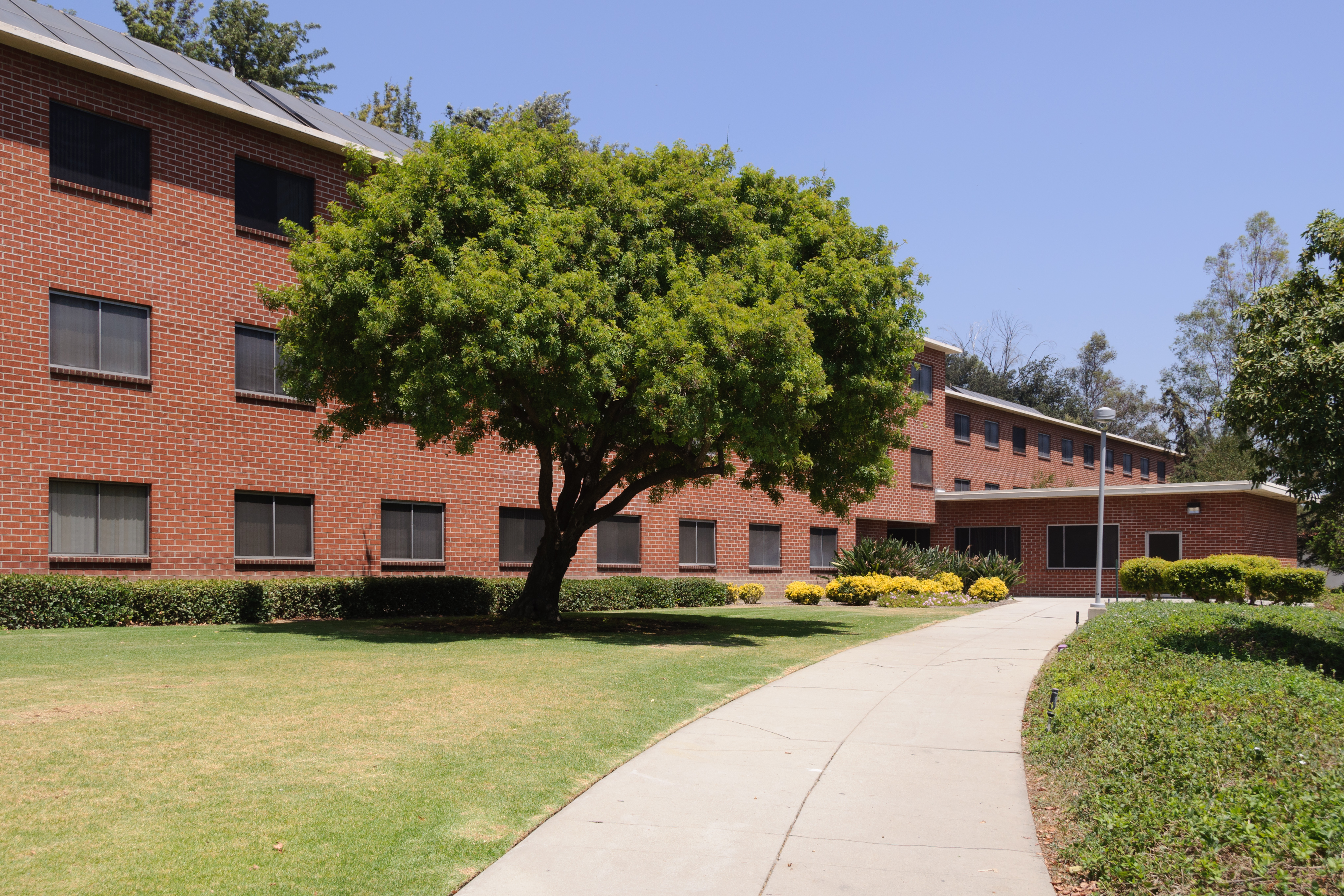
There are three residential styles on the Pomona campus. The oldest housing facilities consist of six residential halls, known as the Traditional Halls, located on University Drive. The four older red-brick halls are named Alamitos, Aliso, Encinitas, and Montecito, each providing accommodation for up to 212 residents. The other two housing halls (Cedritos and Palmitas), were the result of a 1968 development and each has room to accommodate up to 185 residents. These two halls were described as eligible for the California Historic Register as "a significant example of the work of highly noted Southern California architectural firm, Smith and Williams".
Newer residential complexes include the University Village and the Suites which offer apartment-style living to non-freshman students. The Residence Halls, Traditional Halls, and the Suites are managed by the Division of Student Affairs, whereas the University Village is managed by the Cal Poly Pomona Foundation. Phase I of the construction of the Suites, housing 420 students, was completed in 2004 and Phase II, housing 622 students, opened in 2010.
In an effort to reduce commuting and raise academic performance and retention, starting with the 2010–2011 academic year, freshmen who did not graduate from a high school in the Tier 1 Local Admissions area (the area roughly bounded by the San Gabriel Mountains and Chino Hills to the north and south and the 15 and 605 freeways to the east and west), are required to live on campus.
Currently, there have been ongoing efforts to grow the residential community on campus. In 2017, construction began on two new residential halls (Sicomoro and Secoya) along with a new dining hall (Centerpointe Dining Commons), which are intended to replace the aging and seismically unfit residential community along University Drive. The new Residence Halls opened to select first-year residents in January 2020. The Residence Halls can house 980 residents and are only open to first-year students.

Bronco Student Center
Main article: Bronco Student Center
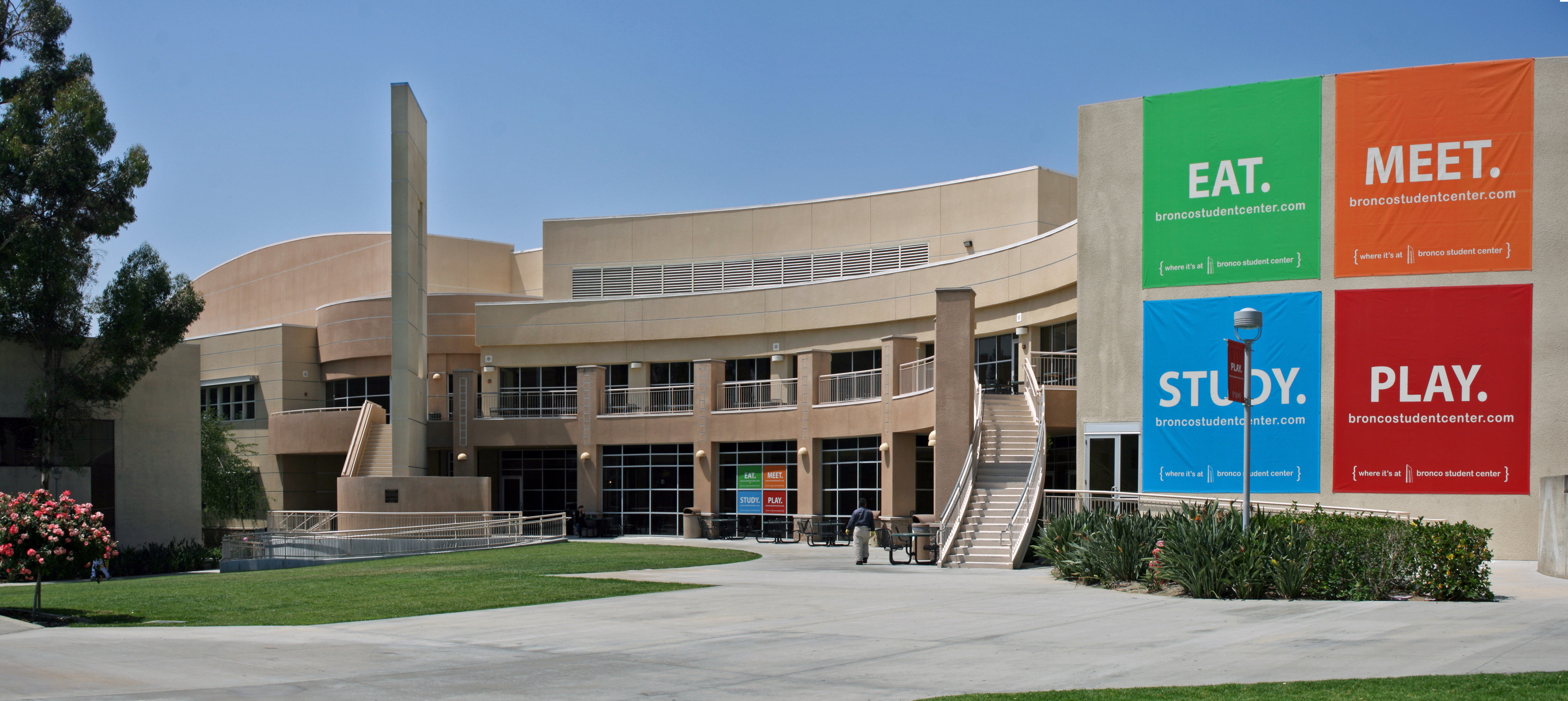
The Bronco Student Center is a student activity center for meetings, conferences, meals, recreation, and shopping for students and alumni on the campus of Cal Poly Pomona in Pomona, California. This is where ASI student government offices are located, as well as other various student run departments like facilities and operations, Recreation, Programming and Marketing (RPM), Business Services, Games Room Etc. (GRE).
LGBT-friendly campus
According to The Advocate College Guide for LGBT Students, Cal Poly Pomona is one of the nation's best campuses for lesbian, gay, bisexual, and transgender students. The university offers gender-neutral housing, a pride center for LGBT students, the club oSTEM (out in STEM) and Pride Alliance for faculty and staff members.
Campus media
Campus events are covered by the student newspaper, the Poly Post. It was founded in 1940 as the Bronc's Cheer when the university was still in San Dimas. The name was changed to The Poly Views in 1942 and finally to The Poly Post in 1962.
The Bronco Sports Show is a quarterly television broadcast capturing the highlights and statistics from Bronco Athletics along with other featured events around the campus.
CPP News is the university's official online magazine. CPP News features news, announcements of campus events, spotlights on various departments, and resources for faculty and staff. A web site also provides a comprehensive archival search for past articles and photos.
Bronco Pep Band
Main article: Bronco Pep Band
The Bronco Pep Band is a student-run band at Cal Poly Pomona. The band is a group within the athletic department. It follows the tradition of other student-run bands in the sense that it focuses on its members' individuality. The band attends athletic events during the year to encourage the school's athletic teams and audience support/involvement. The pep band is entirely voluntary and all students at Cal Poly Pomona or anyone else in the area are free to join.
Greek life
Greek Life at Cal Poly Pomona consists of 16 fraternities and 11 sororities governed by the Greek Council. From the total male undergraduate population, 2% are enrolled in fraternities and 1% of women in sororities respectively. In 2005, Lambda Phi Epsilon pledge Kenny Luong died from injuries suffered during a brutal football game between members of the fraternity and those pledging to join it.
Rose Parade float
Main article: Cal Poly Universities Rose Float
Cal Poly Pomona together with Cal Poly San Luis Obispo has participated in the Tournament of Roses parade since 1949; winning the Award of Merit in their first year. From 1949 to 2005, the floats have won 44 awards. This joint program is one of the longest consecutive running self-built entries in the parade, as well as the only "self built" floats designed and constructed entirely by students year-round on both campuses. The Rose Float tradition continues today and marks the partnership between the two Cal Poly campuses.
Athletics
Main article: Cal Poly Pomona Broncos
Voorhis Vikings
Before the university moved from San Dimas to Pomona, the college had a handful of athletic teams named the "Voorhis Vikings". They were composed mostly of homeless and orphaned boys of all races who were cared for at the Voorhis School during the ten-year period it operated. Despite this historical background, the university's current athletic programs are named the Broncos.
Cal Poly Pomona Broncos
Cal Poly Pomona varsity teams compete in the California Collegiate Athletic Association of NCAA Division II. Teams are known as the Cal Poly Pomona Broncos and field 11 sports for men and women across the fall, winter, and spring seasons. Cal Poly Pomona's most recent national championship came in 2024 Division II Women's Soccer when the Broncos defeated Minnesota State Mankato 2–1 in Matthews, North Carolina, earning the program's first title. The Broncos are currently the most successful department in the CCAA, having achieved 74 CCAA Titles and 15 National Titles. University athletes have also claimed 25 individual National Titles, coming in men's and women's track and field, men's and women's tennis, and women's gymnastics. Besides being located in close proximity to each other, Cal State LA and Cal Poly Pomona have competed heavily as conference rivals.
Team national championships for the Broncos include the following:
- Baseball (3): 1976, 1980, 1983
- Men's Cross Country (1): 1983
- Men's Basketball (1): 2010
- Women's Basketball (5): 1982, 1985, 1986, 2001, 2002
- Women's Soccer (1): 2024
- Women's Tennis (4): 1980, 1981, 1991, 1992
Notable people
Main article: List of Cal Poly Pomona people
File:The Fed - Albert Fattal (Artificial Intelligence and Blockchain) IMG 20231207 125015 513-2.jpg|Albert Fattal File:WikiBornsteinJUL2010.jpg|Jonathan Bornstein File:Dr DisRespect Cropped.jpg|Dr Disrespect (Hershel Beahm IV) File:Kim rhode 2007.jpg|Kim Rhode File:HLS Headshot.jpg|Hilda Solis File:Forest Whitaker by Gage Skidmore.jpg|Forest Whitaker File:Iggy & the Stooges @ Brussels Summer Festival 2012 (8371448222).jpg|James Williamson File:Larry Wilmore by Gage Skidmore.jpg|Larry Wilmore File:Coach Jim Zorn.jpg|Jim Zorn File:Jack Dangermond in 2012.jpg|Jack Dangermond
Notes
References
Sources
References
- "Tracing Cal Poly's roots". Cal Poly Pomona University Library.
- "Undergraduate Program". [[Cal Poly Pomona]].
- "Public NCSE Tables".
- "Fall 2021 Fast Facts".
- (2025). "About the Interim President". California State Polytechnic University, Pomona.
- "Office of the Provost". California State Polytechnic University, Pomona.
- "Fall Student Characteristics".
- "IPEDS-California State Polytechnic University, Pomona".
- "Cal Poly Pomona".
- "University Brand". California State Polytechnic University, Pomona.
- "Get the Bronco Spirit!". California State Polytechnic University, Pomona.
- "CSU Degrees".
- "Archived copy".
- "Welcome to Doctoral Studies". California State Polytechnic University, Pomona.
- "Top 12 Athletics Achievements".
- {{Harvnb. Pflueger. 1999
- {{Harvnb. Angel. 1907
- "Walnut Creek Habitat and Open Space Project Site Assessment Report".
- {{Harvnb. Pflueger. 1999
- (February 2019). "The Finding Aid of the Voorhis Family Collection 0090". [[California Digital Library]].
- {{Harvnb. Pflueger. 1999
- {{Harvnb. Pflueger. 1999
- {{Harvnb. Pflueger. 1999
- "University History". [[California Polytechnic State University]].
- Ferreira, Allen. (1985). "Cal Poly San Dimas?". California State Polytechnic University, Pomona.
- {{Harvnb. Pflueger. 1999
- "Historic Milestones". CSU.
- "Index of /~ar-75th/pages".
- "Heritage and History at Cal Poly Pomona". California State Polytechnic University, Pomona.
- "California State Polytechnic University, Pomona – Historical Development". California State Polytechnic University, Pomona.
- {{Harvnb. Pflueger. 1999
- (2003). "University Ranks Fifth in West, Engineering Program Ninth in Nation by U.S. News & World Report". PolyTrends.
- {{Harvnb. Pflueger. 1999
- (March 18, 2009). "Voices From Our Past – Cal Poly Pomona Oral History". California State Polytechnic University, Pomona.
- (March 18, 2009). "CSU | Public Affairs | Historic Milestones". [[California State University]].
- (October 27, 2010). "Predock Defends Doomed Pomona Tower". [[The Architect's Newspaper]].
- (2019-04-30). "CLA in limbo".
- "CSU Trustees Vote to Raise 2010–11 Fees by 5 Percent". PolyCentric.
- "California State University Officials Outline Enrollment Cuts and Preview 2010–2011 Budget". [[California State University]].
- "Cal Poly Pomona Forced to Drop Men's and Women's Tennis". [[United States Tennis Association]].
- (July 21, 2009). "Cal State approves student fee increases and furloughs". [[KPCC (radio station).
- Miramontes, Danna. (2024-05-07). "CPP students join Pro-Palestinian protests across the nation - The Poly Post".
- "Identity". Office of Public Affairs at Cal Poly at Pomona.
- {{Harvnb. Pflueger. 1999
- "About Cal Poly Pomona – A brief mélange of history, quick facts, and philosophy". California State Polytechnic University, Pomona.
- (2023-04-14). "City Council District Map". City of Pomona, CA.
- Koga, James S.. "The Physical Cal Poly Pomona". California State Polytechnic University, Pomona.
- "Cal Poly English Language Institute". American Association of Intensive English Programs.
- "Department Facilities". California State Polytechnic University, Pomona.
- "Spadra Landfill (Post Closure Activities)". Sanitation Districts of Los Angeles County.
- (2008). "Inland Empire Insights". Wilkin Guge Marketing.
- "Department Facilities". [[Los Angeles Newspaper Group]].
- "Kellogg, W.K., Ranch House, Pomona, CA". [[University of Washington]].
- Cheetham, Robert. "George and Sakaye Aratani Japanese Garden at Cal Poly Pomona". Japanese Garden Research Network, Inc..
- "Japanese Gardens in Southern California and Arizona". Consulate General of Japan in Los Angeles.
- "Voorhis Ecological Reserve". California State Polytechnic University, Pomona.
- (Spring 2019). "The CPP Letters". Cal Poly Pomona Magazine.
- Perez, Erica. (March 23, 2010). "Iconic Cal Poly building poses earthquake hazard". [[California Watch]].
- (January 29, 2019). "Lights, camera, Broncos: Productions filmed on campus". [[The Poly Post]].
- Nelson, Valerie J.. (January 1, 2006). "James Pulliam, 80; Architect, Teacher Noted for Modernism". Los Angeles Times.
- "General Information". Innovation Village.
- "Innovation Park Puts Cal Poly Pomona on Biotech Map". [[Los Angeles Business Journal]].
- "Presidential Order on Climate Commitment". Cal Poly Pomona.
- (December 15, 2009). "Members". [[California Climate Action Registry]].
- "286 Green Colleges (Full List)". [[The Princeton Review]] in partnership with the U.S. [[Green Building Council]].
- (February 2022). "Climate Action Plan".
- "Obtain a Rideshare Parking Permit".
- (September 30, 2010). "Lyle Center Goes Carbon Neutral with Amonix Solar Energy Systems". [[California State University]].
- "About BioTrek". California State Polytechnic University, Pomona.
- "Bronco Express Shuttle". Cal Poly Pomona.
- "Preliminary Engineering For Cal Poly Pomona Mobility Hub - Bid Information - Foothill Transit {{!}} BidNet Direct".
- Hill, David. (September 27, 2010). "Antoine Predock's CLA Building in California May Be Demolished". [[Architectural Record]].
- (September 15, 2010). "Cal Poly Pomona may demolish iconic building". [[Inland Valley Daily Bulletin]].
- (February 11, 2010). "Cal Poly Pomona Campus Masterplan Forum". Sasaki Associates, Inc..
- (2009–2010). "Poly @lumni E-Newsletter". Poly Alumni.
- (May 11, 2020). "MBA Guide: Cal Poly Pomona - College of Business Administration". Los Angeles Business Journal.
- (December 2017). "Department Philosophy". Office of Diversity and Compliance at California State Polytechnic University, Pomona.
- "History". College of Environmental Design at California State Polytechnic University, Pomona.
- "About The Collins College of Hospitality Management". The Collins College of Hospitality Management.
- {{Harvnb. Gerth. 2010
- "Campus Homepages". California State University.
- "Board of Trustees". The California State University.
- "Overview – Board of Trustees". The California State University.
- "Chancellor". The California State University.
- "Office of the President". The California State University.
- "Members by State & Territories". [[American Association of State Colleges and Universities]].
- (November 2018). "New Territory: Cal Poly Pomona Launches Bold Fundraising Campaign". California State Polytechnic University, Pomona.
- (September 21, 2011). "Cal Poly Pomona Foundation, Inc Audit Committee Meeting Minutes September 21, 2011".
- (December 2017). "Cal Poly Pomona Sets $150 Million Fundraising Goal". Office of Public Affairs at California State Polytechnic University, Pomona.
- "Anonymous $12 million gift to Cal Poly Pomona".
- "Mickey and Lee Segal Pledge $2 Million to Cal Poly". Inland Valley Daily Bulletin.
- Rivera, Carla. (July 27, 2010). "Cal Poly Pomona receives $42-million cash grant, largest in Cal State history". Los Angeles Times.
- (July 26, 2010). "Cal Poly Pomona Benefits from Unprecedented Gift from W.K. Kellogg Foundation". [[W. K. Kellogg Foundation]].
- (February 28, 2011). "Panda founders pledge $2.5 million to Cal Poly Pomona". Pasadena Star-News.
- (December 2017). "Comprehensive Campaign Tops $100 Million". polycentric.
- (June 16, 2021). "It wasn't a crank call: Surprising many, MacKenzie Scott gives millions to California groups".
- {{Harvnb. Pflueger. 1999
- {{Harvnb. Kennedy. 2001
- {{Harvnb. Kennedy. 2001
- "California State University mission". University of California – Office of the President.
- (December 2017). "University Vision and Identity Initiative". University Advancement Division at Cal Poly at Pomona.
- "Polytechnic – Definition and More from the Free Merriam-Webster Dictionary". [[Merriam-Webster]].
- (December 2017). "Polytechnic Approach". Cal Poly at Pomona.
- Schaffhauser, Dian. (March 27, 2009). "Student Competition Tests Cyber Security Skills". Campus Technology.
- "Centers of Academic Excellence – Institutions". [[National Security Agency]].
- "Hands-on Activities". California State Polytechnic University, Pomona.
- "Support the University Library". California State Polytechnic University, Pomona.
- {{Harvnb. Pflueger. 1999
- "The Evolution of a Library: 1938-2000". Cal Poly Pomona.
- "OCLC Enhance participants". [[Online Computer Library Center]].
- Limbeek, Monica Malhotra, Lisa. "CSU - AS - Student Enrollment in Degree Programs Report - Fall 2012".
- "California State Polytechnic University, Pomona - U.S. News Best Grad School Rankings".
- . (2020). ["Money's Best Colleges"](https://money.com/best-colleges/).
- . (November 6, 2014). ["The Daily Beast's Guide to the Best Colleges 2014"](http://www.thedailybeast.com/articles/2014/11/06/the-daily-beast-s-down-and-dirty-guide-to-the-best-colleges-2014.4.html).
- "Top State Universities By Salary Potential". PayScale, Inc..
- (December 2014). "Kiplinger's Best College Values 2015".
- "2013 College Education ROI Rankings". PayScale, Inc..
- "CDS2024".
- "CDS2023".
- "CDS2022".
- "CDS2021".
- "Fast Facts Fall 2020". Cal Poly Pomona Office of Institutional Research, Planning, and Analytics (IRPA).
- "Common Data Set 2020-2021". Cal Poly Pomona Office of Institutional Research, Planning, and Analytics (IRPA).
- "Fast Facts Fall 2019". Cal Poly Pomona Office of Academic Research and Resources.
- "Common Data Set 2019-2020". Cal Poly Pomona Office of Institutional Research, Planning, and Analytics (IRPA).
- (August 2025). "Common Data Set 2018-2019". Cal Poly Pomona Office of Academic Research and Resources.
- (August 2025). "Just the Facts - Fall 2018". Cal Poly Pomona Office of Academic Research and Resources.
- "Common Data Set 2017-2018". Cal Poly Pomona Office of Academic Research and Resources.
- "Just the Facts - Fall 2017". Cal Poly Pomona Office of Academic Research and Resources.
- "Common Data Set 2016-2017". Cal Poly Pomona Office of Academic Research and Resources.
- "Just the Facts - Fall 2016". Cal Poly Pomona Office of Academic Research and Resources.
- (August 2025). "Common Data Set 2015-2016". Cal Poly Pomona Office of Academic Research and Resources.
- "Just the Facts - Fall 2015". Cal Poly Pomona Office of Academic Research and Resources.
- "Overview of California State Polytechnic University--Pomona".
- "Carnegie Foundation - Institution Profile". [[Carnegie Foundation for the Advancement of Teaching]].
- "Campuses That Have Higher Standards". [[California State University]].
- "Common Data Set 2016–17". Institutional Research & Academic Resources at California State Polytechnic University, Pomona.
- "Cal Poly Pomona Admissions and Outreach – FTE Impaction". California State Polytechnic University, Pomona.
- "Monday Video – February 22, 2010". polycentric.
- "Fall Student Characteristics".
- "California State Polytechnic University-Pomona". [[United States Department of Education]].
- (November 24, 2009). "Diversity". Office of Diversity and Compliance at Cal Poly Pomona.
- "Cal Poly Pomona – Diversity". [[College Prowler]].
- "Ethnicity Enrollment Profile".
- "International Students". Cal Poly Pomona College of the Extended University, International Center.
- "Impacted Programs". California State Polytechnic University, Pomona.
- "Undeclared Students". California State Polytechnic University, Pomona.
- "Division of Student Affairs".
- "Change of Major". California State Polytechnic University, Pomona-Registar's Office.
- (2016). "Facilities planning".
- (August 2025). "Future Students". Cal Poly Pomona}}{{Dead link.
- (August 2016). "CEQA Final Environmental Impact Report: State Clearinghouse Number 2015111042". cpp.edu.
- "PCAD - California Polytechnic State University, Pomona, Residence Halls, Pomona, CA". pcad.lib.washington.edu.
- "Attachment D: Smith and Williams". ww2.cityofpasadena.net.
- Hendel, archINFORM – Sascha. "Residence Halls [California State Polytechnic University]". archINFORM.
- "Public and Civic Buildings · Outside In: The Architecture of Smith and Williams · UCSB ADC Omeka". adc-exhibits.museum.ucsb.edu.
- "Residence hall/suite information". University Housing Services at Cal Poly Pomona.
- "University Village". Cal Poly Pomona Foundation.
- (2010-02-28). "Cal Poly requiring certain freshmen to live at university".
- "University Prepares to Embark on New Freshman Housing Project {{!}} PolyCentric".
- "New Residence Halls Ready for Students {{!}} PolyCentric".
- "Division of Student Affairs".
- "Division of Student Affairs".
- Roeder, Walter H.. "Highlights of Cal Poly Pomona History".
- "PolyCentric | Cal Poly Pomona". Polycentric.cpp.edu.
- "Polycentric Cal Poly Pomona Archives". Polycentric.cpp.edu.
- "Cal Poly Pomona – Greek Life". [[College Prowler]].
- "Fraternity & Sorority Life at Cal Poly Pomona". California State Polytechnic University, Pomona.
- "Chapter History". Sigma Nu Fraternity.
- (December 1, 2015). "Ten Years Later, a Fraternity Hazing Death Still Takes Its Toll". NBC News.
- "Special Collections & University Archives-Voorhis Vikings". University Library at California State Polytechnic University, Pomona.
- "All-Time CCAA Champions". [[California Collegiate Athletic Association]].
- "History". [[Cal Poly Pomona Broncos]].
- "History of Cal Poly Pomona Athletics".
This article was imported from Wikipedia and is available under the Creative Commons Attribution-ShareAlike 4.0 License. Content has been adapted to SurfDoc format. Original contributors can be found on the article history page.
Ask Mako anything about California State Polytechnic University, Pomona — get instant answers, deeper analysis, and related topics.
Research with MakoFree with your Surf account
Create a free account to save articles, ask Mako questions, and organize your research.
Sign up freeThis content may have been generated or modified by AI. CloudSurf Software LLC is not responsible for the accuracy, completeness, or reliability of AI-generated content. Always verify important information from primary sources.
Report