From Surf Wiki (app.surf) — the open knowledge base
California quail
Species of ground-dwelling bird
Species of ground-dwelling bird
The California quail (Callipepla californica), also known as the California valley quail or Valley quail, is a small ground-dwelling bird in the New World quail family. These birds have a curving crest, plume or topknot made of six feathers, that droops forward: black in males and brown in females; the flanks are brown with white streaks. Males have a dark brown cap and a black face with a brown back, a grey-blue chest and a light brown belly. Females and immature birds are mainly grey-brown with a light-colored belly. Their closest relative is Gambel's quail, which has a more southerly distribution and a longer crest at 2.5 in, a brighter head and lacks the scaly appearance of the California quail. The two species separated about 1–2 million years ago, during the Late Pliocene or Early Pleistocene.
Taxonomy
Subspecies
There are seven recognized subspecies:
- C. c. californica (Shaw, 1798) – northern Oregon and western Nevada to southern California and Coronado Islands
- C. c. achrustera (Peters, 1923) – San Lucas California quail – southern Baja California

- C. c. brunnescens (Ridgway, 1884) – extreme northern coastal California to southern Santa Cruz County
- C. c. canfieldae (Van Rossem, 1939) – Owen Valley quail – Owens Valley of east central California
- C. c. catalinensis (Grinnell, 1906) – Santa Catalina quail – Santa Catalina Island (off southern California)
- C. c. orecta (Oberholser, 1932) – Warner Valley quail – Warner Valley in Oregon to extreme northern California
- C. c. plumbea (Grinnell, 1926) – San Quintin California quail – San Diego County to southern Baja California
Behavior
The California quail is a highly sociable bird that often gathers in small flocks known as "coveys". One of their daily communal activities is a dust bath. A group of quail will select an area where the ground has been newly turned or is soft, and using their underbellies, will burrow downward into the soil some one to two inches. They then wriggle about in the indentations they have created, flapping their wings and ruffling their feathers, causing dust to rise in the air. They seem to prefer sunny places in which to create these dust baths. An ornithologist is able to detect the presence of quail in an area by spotting the circular indentations left behind in the soft dirt, some 7 – in diameter.
They are year-round residents. Although this bird coexists well at the edges of urban areas, it is declining in some areas as human populations increase. They were originally found mainly in the southwestern United States but they have been introduced into other areas including British Columbia, Hawaii, Chile, Uruguay, Brazil, Argentina, Peru, South Africa, New Zealand, and to Norfolk Island and King Island in Australia. These birds forage on the ground, often scratching at the soil. They can sometimes be seen feeding at the sides of roads. Their diet consists mainly of seeds and leaves, but they also eat some berries and insects; for example, Toyon berries are a common food source. If startled, these birds explode into short rapid flight, called "flushing". Given a choice, they will normally escape on foot.
Breeding
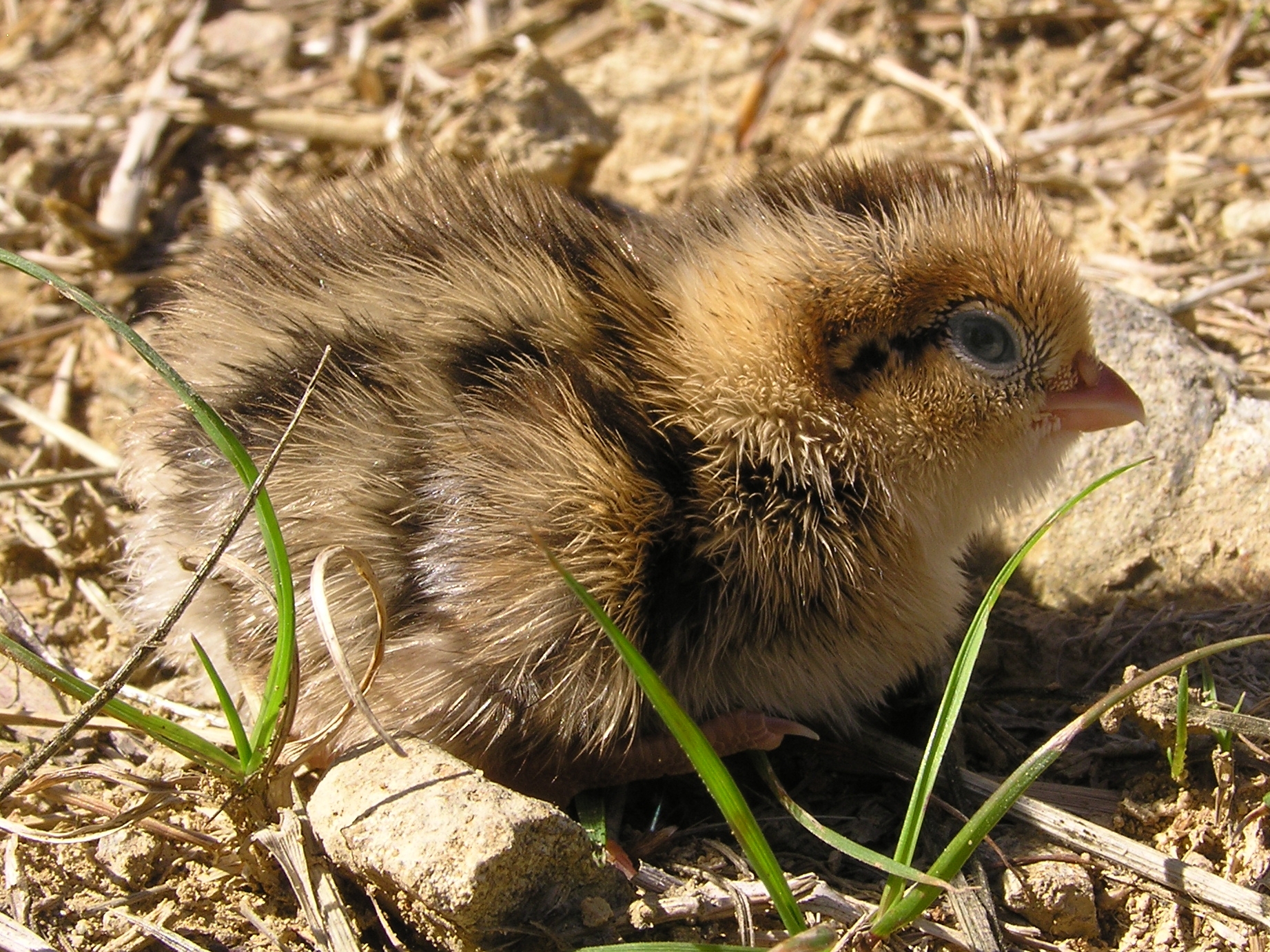
Their breeding habitat is shrubby areas and open woodlands in western North America. The nest is a shallow scrape lined with vegetation on the ground beneath a shrub or other cover. The female usually lays approximately 12 eggs. Once hatched, the young associate with both adults. Often, families group together, into multifamily "communal broods" which include at least two females, multiple males and many offspring. Males associated with families are not always the genetic fathers. In good years, females will lay more than one clutch, leaving the hatched young with the associated male and laying a new clutch, often with a different associated male.
They have a variety of vocalizations including the social "chicago" call, contact "pips" and warning "pips". During the breeding season, males utter the agonistic "squill" and will often interrupt their social mate's "chicago" call with a "squill," a possible form of antiphonal calling.
State bird
The California quail is the state bird of California. It was established as the state bird in 1931.
The quail population has fluctuated significantly throughout California. Once plentiful in San Francisco, by 2017 only one California quail remained in the city. Local birders named the male bird Ishi after the last known member of California's Native American Yahi tribe. Quail were likely introduced to Santa Catalina Island about 12,000 years ago by Native Americans, and there is a minimal genetic difference between the island and the mainland quail populations.
Gallery
Callipepla californica LC0242.jpg | A pair introduced in New Zealand 7Z1E8972c.jpg|Male File:Callipepla californica -California, USA -female and chick- 8.jpg|Female and young chick Colin de Californie MHNT.jpg|Egg – Muséum de Toulouse
References
References
- BirdLife International. (2021). "''Callipepla californica''".
- "Iconic California: State Symbols that Represent California".
- (2022). "50 California Facts". Meet The USA.
- Long, John L. (1981). Introduced Birds of the World. Agricultural Protection Board of Western Australia, 21–493
- (February 11, 2014). "California State Bird: California Valley Quail". Nstate.
- (November 5, 2017). "There's only 1 quail left in San Francisco, and cats are likely to blame". SF Gate.
- Hogan, C. Michael. (2008). "Toyon (''Heteromeles arbutifolia'')".
- (1998). "Molecular Systematics of the Scaled Quail complex (genus ''Callipepla'')". [[Auk (journal).
- (2006). "Role of California (Callipepla californica) and Gambel's (Callipepla gambelii) Quail in the Ecology of Mosquito-Borne Encephalitis Viruses in California, USA". Vector-Role and Zoonotic Diseases.
- (1987). "Genetic Variation, Population Structure, and Evolution of California Quail". The Condor.
- (2018). "Persistence of antipredator behavior in an island population of California quail". Ethology.
This article was imported from Wikipedia and is available under the Creative Commons Attribution-ShareAlike 4.0 License. Content has been adapted to SurfDoc format. Original contributors can be found on the article history page.
Ask Mako anything about California quail — get instant answers, deeper analysis, and related topics.
Research with MakoFree with your Surf account
Create a free account to save articles, ask Mako questions, and organize your research.
Sign up freeThis content may have been generated or modified by AI. CloudSurf Software LLC is not responsible for the accuracy, completeness, or reliability of AI-generated content. Always verify important information from primary sources.
Report