From Surf Wiki (app.surf) — the open knowledge base
Calcutta Cup
Rugby competition between Scotland and England
Rugby competition between Scotland and England
| Field | Value |
|---|---|
| name | Calcutta Cup |
| image | Calcutta Cup, England vs Scotland.jpg |
| sport | Rugby union |
| awardedfor | Winner of England–Scotland fixture |
| country | |
| first | 10 March 1879; ago |
| number | 130 |
| mostwins | (83) |
| mostrecent | (2025) |
The Calcutta Cup is the trophy awarded to the winner of the rugby match between teams of England and Scotland played annually in the Six Nations Championship. Like the match itself (England–Scotland), the Calcutta Cup is the oldest trophy contested between any two international rugby union teams, pre-dating the Bledisloe Cup (Australia–New Zealand) by more than half a century. It is also the oldest of several trophies awarded under the umbrella of the Six Nations Championship, which include the Millennium Trophy (England–Ireland), Centenary Quaich (Ireland–Scotland), Giuseppe Garibaldi Trophy (France–Italy), Auld Alliance Trophy (France–Scotland), the Doddie Weir Cup (Scotland–Wales) and the Cuttitta Cup (Italy–Scotland).
History
Calcutta Club
On Christmas Day in 1872 a game of rugby union football was played in Calcutta, British India by a group of forty people (twenty-a-side), with one team representing England and the other Scotland.{{efn|Although the match has often been said to represent England and Scotland, it has also been reported to have been representative of England and the other Home Nations. and soldiers of the Royal East Kent Regiment. In 1874, the club joined the Rugby Football Union (RFU). By 1878, the club's diminishing members withdrew club funds, a total of ₹270, and had them melted down to make a trophy. The trophy was presented by the club to the RFU and was used as “the best means of doing some lasting good for the cause of Rugby Football.”
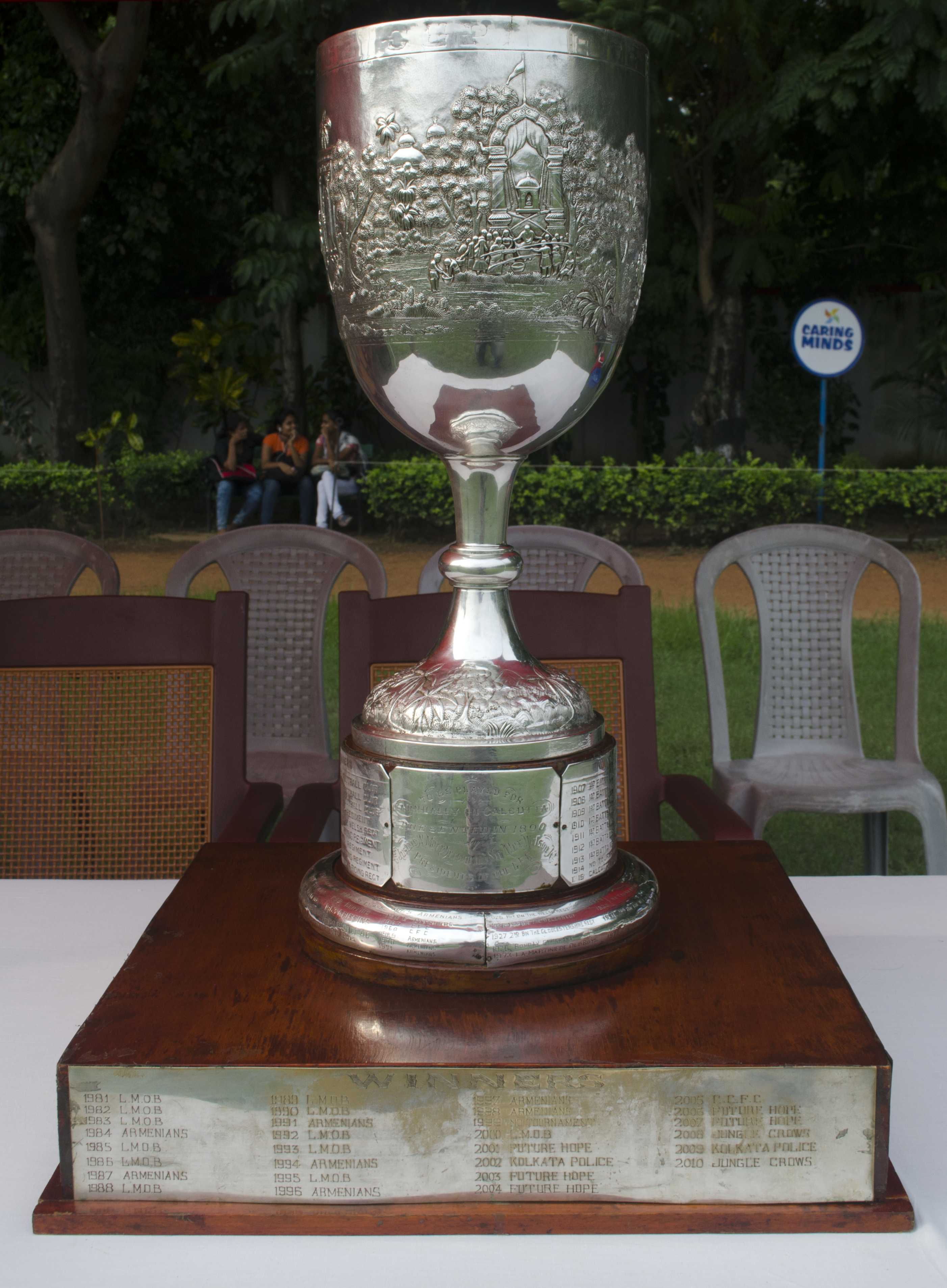
The cup
The domed lid is surmounted by an elephant which is, it is said, copied from the Viceroy's own stock. The inscription on the Cup's wooden base reads: The Calcutta Cup.
There is an anomaly in the recording of the winning country on the base of the Cup. It was first played for in 1879, but the plinth shows records extending back to the first international in 1871.
While the original was handmade by Indian craftsmen, the replicas were made using modern technology.
In 1988 the cup was damaged by the antics of some drunken players, including England number eight Dean Richards and Scotland flanker John Jeffrey who played football with the Calcutta Cup along Princes Street in Edinburgh. Jeffrey received a six-month ban from the Scottish Rugby Union (SRU), whilst Richards was given a one-match sentence from England.
Competition
Despite the initial request of the Calcutta Club that the trophy be used as rugby's answer to football's FA Cup, the RFU refused to turn the Calcutta Cup into a knock-out competition for English club sides. They believed that "competitiveness" ran against the amateur ethos and instead decided that a game should be played each year between England and Scotland and whoever wins should keep it for that year. The first Calcutta Cup match was played at Raeburn Place, Edinburgh, on 10 March 1879 and ended in a draw; Scotland scored a drop goal and England a goal. The following year on 28 February 1880 England became the first winners of the Calcutta Cup when they defeated Scotland by two goals & three tries to one goal in Manchester. Matches have continued on an annual basis except for two interruptions due to the World Wars between 1915–1919 and 1940–1946.
As of 2025, 132 Calcutta Cup matches have taken place. Currently, this game is the annual match between the two nations in the Six Nations Championship. The ground alternates between Murrayfield Stadium in Edinburgh (on even years) and Twickenham Stadium in London (on odd years).
In 2004, the two countries' rugby governing bodies, the Rugby Football Union (England) and the Scottish Rugby Union, were considering a plan to add a second Calcutta Cup fixture each year, outside the Six Nations Championship. The second fixture would be hosted by the away nation in the Six Nations fixture of the same year. Under that plan, one nation would have to win both matches to take the Cup off its current holder. Due to a largely unfavourable reaction, the proposal was dropped.
Results
Results summary
| Team | Gms. |
|---|---|
| 83 | |
| 48 |
| Team | Wins |
|---|---|
| 72 | |
| 44 | |
| Draws | 16 |
| Year | Date | Winner | Score | Stadium and location | Holder (aggregate times held) |
|---|---|---|---|---|---|
| 1879 | 10 March | draw | (0) 1G–1G (1T) | Raeburn Place, Edinburgh | |
| 1880 | 28 February | (1) | (5T) 2G–1G (1T) | Whalley Range, Manchester | (2) |
| 1881 | 19 March | draw | (2T) 1G–1G (1T) | Raeburn Place, Edinburgh | |
| 1882 | 4 March | (1) | (0) 0G–0G (2T) | Whalley Range, Manchester | (1) |
| 1883 | 3 March | (2) | (1T) 0G–0G (2T) | Raeburn Place, Edinburgh | (7) |
| 1884 | 1 March | (3) | (1T) 1G–0G (1T) | Rectory Field, Blackheath | |
| 1885 | Not played}} | ||||
| 1886 | 13 March | draw | (0) 0G–0G (0) | Raeburn Place, Edinburgh | |
| 1887 | 5 March | draw | (1T) 0G–0G (1T) | Whalley Range, Manchester | |
| 1888 | Not played}} | ||||
| 1889 | |||||
| 1890 | 1 March | (4) | 0–6 | Raeburn Place, Edinburgh | |
| 1891 | 7 March | (2) | 3–9 | Athletic Ground, Richmond | (2) |
| 1892 | 5 March | (5) | 0–5 | Raeburn Place, Edinburgh | (8) |
| 1893 | 4 March | (3) | 0–8 | Headingley Stadium, Leeds | (6) |
| 1894 | 17 March | (4) | 6–0 | Raeburn Place, Edinburgh | |
| 1895 | 9 March | (5) | 3–6 | Athletic Ground, Richmond | |
| 1896 | 14 March | (6) | 11–0 | Cathkin Park, Glasgow | |
| 1897 | 13 March | (6) | 12–3 | Fallowfield Stadium, Manchester | (10) |
| 1898 | 12 March | draw | 3–3 | Powderhall Stadium, Edinburgh | |
| 1899 | 11 March | (7) | 0–5 | Rectory Field, Blackheath | (9) |
| 1900 | 10 March | draw | 0–0 | Inverleith, Edinburgh | |
| 1901 | 9 March | (8) | 3–18 | Rectory Field, Blackheath | |
| 1902 | 15 March | (7) | 3–6 | Inverleith, Edinburgh | (11) |
| 1903 | 21 March | (9) | 6–10 | Athletic Ground, Richmond | (12) |
| 1904 | 19 March | (10) | 6–3 | Inverleith, Edinburgh | |
| 1905 | 18 March | (11) | 0–8 | Athletic Ground, Richmond | |
| 1906 | 17 March | (8) | 3–9 | Inverleith, Edinburgh | (12) |
| 1907 | 16 March | (12) | 3–8 | Rectory Field, Blackheath | (15) |
| 1908 | 21 March | (13) | 16–10 | Inverleith, Edinburgh | |
| 1909 | 20 March | (14) | 8–18 | Athletic Ground, Richmond | |
| 1910 | 19 March | (9) | 5–14 | Inverleith, Edinburgh | (14) |
| 1911 | 18 March | (10) | 13–8 | Twickenham Stadium, London | |
| 1912 | 16 March | (15) | 8–3 | Inverleith, Edinburgh | (16) |
| 1913 | 15 March | (11) | 3–0 | Twickenham Stadium, London | (21) |
| 1914 | 21 March | (12) | 15–16 | Inverleith, Edinburgh | |
| 1915 | Not played due to World War I}} | ||||
| 1916 | |||||
| 1917 | |||||
| 1918 | |||||
| 1919 | |||||
| 1920 | 20 March | (13) | 13–4 | Twickenham Stadium, London | |
| 1921 | 19 March | (14) | 0–18 | Inverleith, Edinburgh | |
| 1922 | 18 March | (15) | 11–5 | Twickenham Stadium, London | |
| 1923 | 17 March | (16) | 6–8 | Inverleith, Edinburgh | |
| 1924 | 15 March | (17) | 19–0 | Twickenham Stadium, London | |
| 1925 | 21 March | (16) | 14–11 | Murrayfield Stadium, Edinburgh | (19) |
| 1926 | 20 March | (17) | 9–17 | Twickenham Stadium, London | |
| 1927 | 19 March | (18) | 21–13 | Murrayfield Stadium, Edinburgh | |
| 1928 | 17 March | (18) | 6–0 | Twickenham Stadium, London | (22) |
| 1929 | 16 March | (19) | 12–6 | Murrayfield Stadium, Edinburgh | (22) |
| 1930 | 16 March | draw | 0–0 | Twickenham Stadium, London | |
| 1931 | 21 March | (20) | 28–19 | Murrayfield Stadium, Edinburgh | |
| 1932 | 19 March | (19) | 16–3 | Twickenham Stadium, London | (23) |
| 1933 | 18 March | (21) | 3–0 | Murrayfield Stadium, Edinburgh | (23) |
| 1934 | 17 March | (20) | 6–3 | Twickenham Stadium, London | (24) |
| 1935 | 16 March | (22) | 10–7 | Murrayfield Stadium, Edinburgh | (24) |
| 1936 | 21 March | (21) | 9–8 | Twickenham Stadium, London | (26) |
| 1937 | 20 March | (22) | 3–6 | Murrayfield Stadium, Edinburgh | |
| 1938 | 19 March | (23) | 16–21 | Twickenham Stadium, London | (25) |
| 1939 | 18 March | (23) | 6–9 | Murrayfield Stadium, Edinburgh | (28) |
| 1940 | Not played due to World War II}} | ||||
| 1941 | |||||
| 1942 | |||||
| 1943 | |||||
| 1944 | |||||
| 1945 | |||||
| 1946 | |||||
| 1947 | 15 March | (24) | 24–5 | Twickenham Stadium, London | |
| 1948 | 20 March | (24) | 6–3 | Murrayfield Stadium, Edinburgh | (26) |
| 1949 | 19 March | (25) | 6–3 | Twickenham Stadium, London | (29) |
| 1950 | 18 March | (25) | 13–11 | Murrayfield Stadium, Edinburgh | (27) |
| 1951 | 17 March | (26) | 5–3 | Twickenham Stadium, London | (42) |
| 1952 | 15 March | (27) | 3–19 | Murrayfield Stadium, Edinburgh | |
| 1953 | 21 March | (28) | 26–8 | Twickenham Stadium, London | |
| 1954 | 20 March | (29) | 3–13 | Murrayfield Stadium, Edinburgh | |
| 1955 | 19 March | (30) | 9–6 | Twickenham Stadium, London | |
| 1956 | 17 March | (31) | 6–11 | Murrayfield Stadium, Edinburgh | |
| 1957 | 16 March | (32) | 16–3 | Twickenham Stadium, London | |
| 1958 | 15 March | draw | 3–3 | Murrayfield Stadium, Edinburgh | |
| 1959 | 21 March | draw | 3–3 | Twickenham Stadium, London | |
| 1960 | 19 March | (33) | 12–21 | Murrayfield Stadium, Edinburgh | |
| 1961 | 18 March | (34) | 6–0 | Twickenham Stadium, London | |
| 1962 | 17 March | draw | 3–3 | Murrayfield Stadium, Edinburgh | |
| 1963 | 16 March | (35) | 10–8 | Twickenham Stadium, London | |
| 1964 | 21 March | (26) | 15–6 | Murrayfield Stadium, Edinburgh | (30) |
| 1965 | 20 March | draw | 3–3 | Twickenham Stadium, London | |
| 1966 | 19 March | (27) | 6–3 | Murrayfield Stadium, Edinburgh | |
| 1967 | 18 March | (36) | 27–14 | Twickenham Stadium, London | (45) |
| 1968 | 16 March | (37) | 6–8 | Murrayfield Stadium, Edinburgh | |
| 1969 | 15 March | (38) | 8–3 | Twickenham Stadium, London | |
| 1970 | 21 February | (28) | 14–5 | Murrayfield Stadium, Edinburgh | (33) |
| 1971 | 20 March | (29) | 15–16 | Twickenham Stadium, London | |
| 1972 | 18 March | (30) | 23–9 | Murrayfield Stadium, Edinburgh | |
| 1973 | 17 March | (39) | 15–16 | Twickenham Stadium, London | (46) |
| 1974 | 2 February | (31) | 16–14 | Murrayfield Stadium, Edinburgh | (34) |
| 1975 | 15 March | (40) | 7–6 | Twickenham Stadium, London | (47) |
| 1976 | 21 February | (32) | 22–12 | Murrayfield Stadium, Edinburgh | (35) |
| 1977 | 15 January | (41) | 26–6 | Twickenham Stadium, London | (53) |
| 1978 | 4 March | (42) | 0–15 | Murrayfield Stadium, Edinburgh | |
| 1979 | 3 February | draw | 7–7 | Twickenham Stadium, London | |
| 1980 | 15 March | (43) | 18–30 | Murrayfield Stadium, Edinburgh | |
| 1981 | 21 February | (44) | 23–17 | Twickenham Stadium, London | |
| 1982 | 16 January | draw | 9–9 | Murrayfield Stadium, Edinburgh | |
| 1983 | 5 March | (33) | 12–22 | Twickenham Stadium, London | (37) |
| 1984 | 4 February | (34) | 18–6 | Murrayfield Stadium, Edinburgh | |
| 1985 | 16 March | (45) | 10–7 | Twickenham Stadium, London | (54) |
| 1986 | 15 February | (35) | 33–6 | Murrayfield Stadium, Edinburgh | (38) |
| 1987 | 4 April | (46) | 21–12 | Twickenham Stadium, London | (57) |
| 1988 | 5 March | (47) | 6–9 | Murrayfield Stadium, Edinburgh | |
| 1989 | 4 February | draw | 12–12 | Twickenham Stadium, London | |
| 1990 | 17 March | (36) | 13–7 | Murrayfield Stadium, Edinburgh | (39) |
| 1991 | 16 February | (48) | 21–12 | Twickenham Stadium, London | (66) |
| 1992 | 18 January | (49) | 7–25 | Murrayfield Stadium, Edinburgh | |
| 1993 | 6 March | (50) | 26–12 | Twickenham Stadium, London | |
| 1994 | 5 February | (51) | 14–15 | Murrayfield Stadium, Edinburgh | |
| 1995 | 18 March | (52) | 24–12 | Twickenham Stadium, London | |
| 1996 | 2 March | (53) | 9–18 | Murrayfield Stadium, Edinburgh | |
| 1997 | 1 February | (54) | 41–13 | Twickenham Stadium, London | |
| 1998 | 22 March | (55) | 20–34 | Murrayfield Stadium, Edinburgh | |
| 1999 | 20 February | (56) | 24–21 | Twickenham Stadium, London | |
| 2000 | 2 April | (37) | 19–13 | Murrayfield Stadium, Edinburgh | (40) |
| 2001 | 3 March | (57) | 43–3 | Twickenham Stadium, London | (71) |
| 2002 | 2 February | (58) | 3–29 | Murrayfield Stadium, Edinburgh | |
| 2003 | 22 March | (59) | 40–9 | Twickenham Stadium, London | |
| 2004 | 21 February | (60) | 13–35 | Murrayfield Stadium, Edinburgh | |
| 2005 | 19 March | (61) | 43–22 | Twickenham Stadium, London | |
| 2006 | 25 February | (38) | 18–12 | Murrayfield Stadium, Edinburgh | (41) |
| 2007 | 3 February | (62) | 42–20 | Twickenham Stadium, London | (72) |
| 2008 | 8 March | (39) | 15–9 | Murrayfield Stadium, Edinburgh | (42) |
| 2009 | 21 March | (63) | 26–12 | Twickenham Stadium, London | (81) |
| 2010 | 13 March | draw | 15–15 | Murrayfield Stadium, Edinburgh | |
| 2011 | 13 March | (64) | 22–16 | Twickenham Stadium, London | |
| 2012 | 4 February | (65) | 6–13 | Murrayfield Stadium, Edinburgh | |
| 2013 | 2 February | (66) | 38–18 | Twickenham Stadium, London | |
| 2014 | 8 February | (67) | 0–20 | Murrayfield Stadium, Edinburgh | |
| 2015 | 14 March | (68) | 25–13 | Twickenham Stadium, London | |
| 2016 | 6 February | (69) | 9–15 | Murrayfield Stadium, Edinburgh | |
| 2017 | 11 March | (70) | 61–21 | Twickenham Stadium, London | |
| 2018 | 24 February | (40) | 25–13 | Murrayfield Stadium, Edinburgh | (44) |
| 2019 | 16 March | draw | 38–38 | Twickenham Stadium, London | |
| 2020 | 8 February | (71) | 6–13 | Murrayfield Stadium, Edinburgh | (82) |
| 2021 | 6 February | (41) | 6–11 | Twickenham Stadium, London | (48) |
| 2022 | 5 February | (42) | 20–17 | Murrayfield Stadium, Edinburgh | |
| 2023 | 4 February | (43) | 23–29 | Twickenham Stadium, London | |
| 2024 | 24 February | (44) | 30–21 | Murrayfield Stadium, Edinburgh | |
| 2025 | 22 February | (72) | 16–15 | Twickenham Stadium, London | (83) |
Records
The current record number of points scored by a player in a Calcutta Cup game was set by Jonny Wilkinson in 2007 when he scored 27 points (1 try, 2 conversions, 5 penalties, 1 drop goal). The previous record of 24 points was held by Rob Andrew.
Other Calcutta Cups
In 1884, Calcutta Cricket and Football Club again set up a rugby section and in 1890 set up an inter club trophy, the Calcutta Rugby Union Challenge Cup, promptly christened the Calcutta Cup.
The 2007 edition of the Cup was held by Jungle Crows, in which Future Hope Harlequins defeated CC&FC in final. The second division trophy was won by Calcutta Cricket and Football Club Panthers.
The original and oldest Calcutta Cup is a silver trophy played for annually by the members of Royal Blackheath Golf Club. It was a gift from the Royal Calcutta Golf Club in response to the presentation of a medal given by Blackheath. It is made from melted down silver rupees, reputedly from the same batch of melted down silver rupees as the Rugby Union Cup played for between England and Scotland. The cup arrived in London in 1875. It was first played for in December 1875 three years before the first Calcutta Cup match between England and Scotland. The Cup held by Royal Blackheath Golf Club has only two handles unlike the well known Calcutta Cup. It is only in recent years that the history of the original Calcutta Cup has been appreciated by sporting historians.
Royal Blackheath Golf Club members had close links with Blackheath Football Club (Rugby) which was one of the most prominent clubs in the early years of the Rugby Football Union. Members of both clubs served in India in the 1870s. This link is the most likely explanation for the creation of a similar cup being created by the Calcutta Rugby Club a few years later and becoming the world-famous Calcutta Cup.
Notes
References
References
- (11 March 2019). "The Story of the Calcutta Cup". [[Keith Prowse]].
- (8 February 2020). "Why is England vs Scotland called the Calcutta Cup? Six Nations 2020 clash explained". [[Daily Mirror]].
- "The History of the Calcutta Cup". [[Scottish Rugby Union]] (SRU).
- Johnson, Ben. "The Calcutta Cup".
- "The Calcutta Cup goes kickabout". ESPNscrum.
- "Calcutta Cricket and Football Club history".
- (11 September 2019). "How rugby is still thriving in Kolkata, birthplace of the historic Calcutta Cup". SCROLL.
- Hyde, Nick. (2007-08-06). "FUTURE HOPE HARLEQUINS RETAIN CALCUTTA CUP".
This article was imported from Wikipedia and is available under the Creative Commons Attribution-ShareAlike 4.0 License. Content has been adapted to SurfDoc format. Original contributors can be found on the article history page.
Ask Mako anything about Calcutta Cup — get instant answers, deeper analysis, and related topics.
Research with MakoFree with your Surf account
Create a free account to save articles, ask Mako questions, and organize your research.
Sign up freeThis content may have been generated or modified by AI. CloudSurf Software LLC is not responsible for the accuracy, completeness, or reliability of AI-generated content. Always verify important information from primary sources.
Report