From Surf Wiki (app.surf) — the open knowledge base
Calaveras Big Trees State Park
State park in California, US
State park in California, US
| Field | Value |
|---|---|
| name | Calaveras Big Trees State Park |
| photo | File:Calaveras Big Trees State Park - South Grove, CA - panoramio (8).jpg |
| photo_caption | Giant sequoias in Calaveras South Grove |
| map | California#USA |
| relief | 1 |
| location | Calaveras and Tuolumne counties, California, United States |
| nearest_city | Arnold, California |
| coordinates | |
| area_acre | 6498 |
| elevation | 4560–4920 ft |
| established | 1931 |
| visitation_num | more than 250,000 |
| visitation_year | 2022 |
| governing_body | California Department of Parks and Recreation |
Calaveras Big Trees State Park is a state park of California, United States, preserving two groves of giant sequoia trees. Located 4 miles (6.4 km) northeast of Arnold, California in the middle elevations of the Sierra Nevada, it has been a major tourist attraction since 1852, when the existence of the trees was first widely reported. Two famous exhibition trees, the Discovery Tree and the Mother of the Forest, were felled for display. It is also considered the longest continuously operated tourist attraction in California.
History
Early history
The giant sequoia was well known to Native American tribes living in its area. Native American names for the species include Wawona, toos-pung-ish and hea-mi-within, the latter two in the language of the Tule River Tribe.
The first reference to the giant sequoias of Calaveras Big Trees by Europeans was in 1833, in the diary of the explorer J. K. Leonard; the reference does not mention any specific locality, but his route would have taken him through the Calaveras Grove. This discovery was not publicized. The next European to see the trees was John M. Wooster, who carved his initials in the bark of the 'Hercules' tree in the Calaveras Grove in 1850; again, this received no publicity. Much more publicity was given to Augustus T. Dowd at the North Grove in 1852, commonly cited as the discoverer of both the grove and the species as a whole.
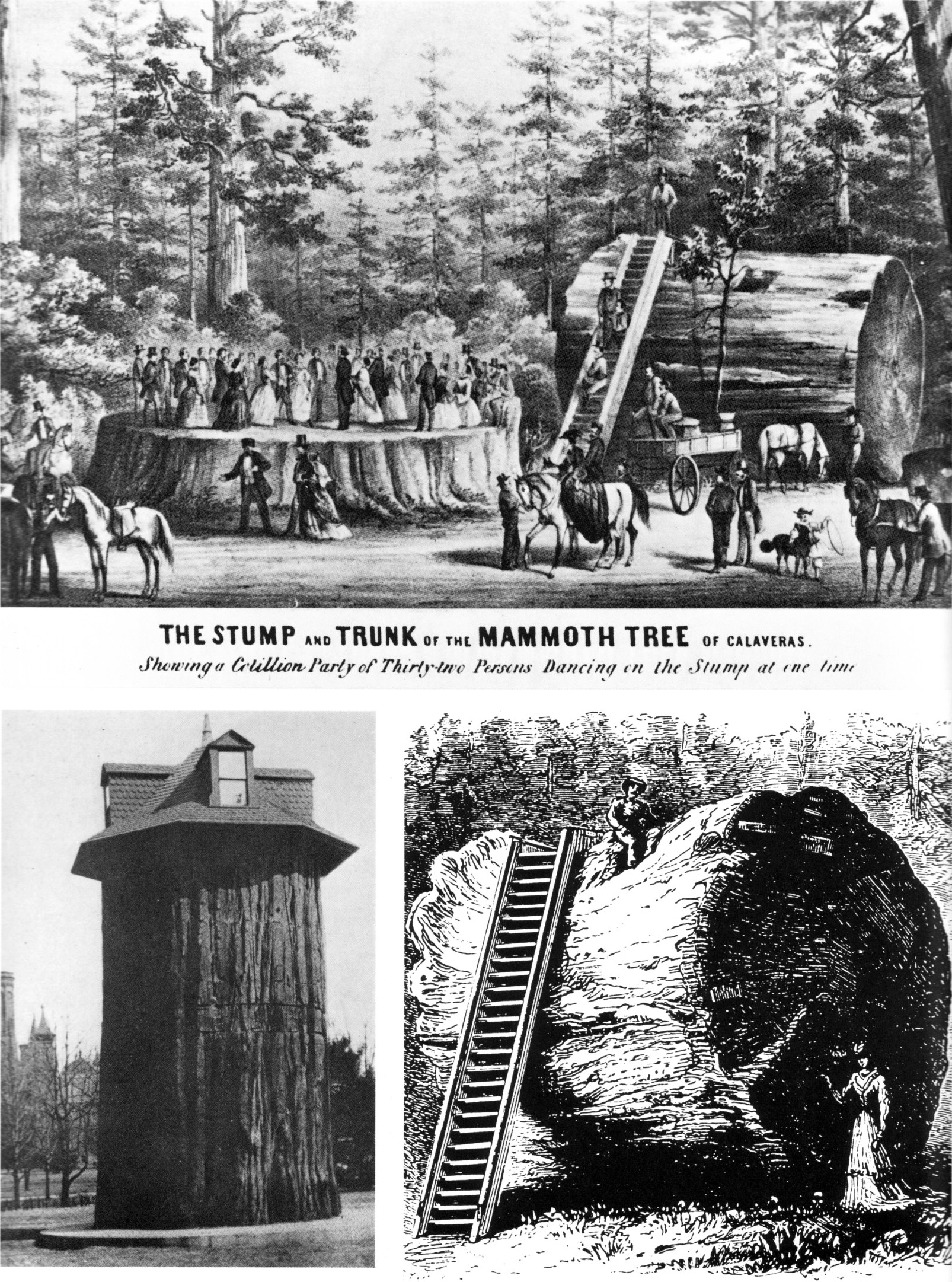
The "Discovery Tree" was recorded by Dowd in 1852 and felled in 1853, leaving a giant stump and a section of trunk showing the holes made by the augers used to fell it. It measured 25 ft in diameter at its base and was determined by ring count to be 1,244 years old when felled. A section of the trunk was toured with little fanfare while the stump was later turned into a dance floor. John Muir wrote an essay titled "The Vandals Then Danced Upon the Stump!" to criticize the felling of the tree.

In 1854, a second tree named the "Mother of the Forest" was stripped of its bark in 1854, to be reassembled at exhibitions. This mortally wounded the tree, since outer layer of protective bark was removed. The tree didn't survive long after, having shed its entire canopy by 1861. In 1908, with the tree unprotected by its fire resistant bark, a fire swept through the area and burned away much of what was left of the tree, leaving a fire-blackened snag.

The forest is also home to what remains of the "Father of the Forest", an ancient and exceedingly enormous giant sequoia which fell centuries ago. Reportedly, the tree was 435 ft high with a 110 ft circumference- a "giant of giants".
In early 1880s, a tunnel was cut through the compartments by a private land owner at the request of James Sperry, founder of the Murphys Hotel, so that tourists could pass through it. The tree was chosen in part because of the large forest fire scar. The Pioneer Cabin Tree, as it was soon called, emulated the tunnel carved into Yosemite's Wawona Tree, and was intended to compete with it for tourists.
Preservation
Along with the 1850s exhibitions, the destruction of the big trees was met with public outcry. In 1864, on introducing the bill that would become the Yosemite Grant, senator John Conness opined that even after people had seen the physical evidence of the Discovery Tree and the Mother of the Forest, they still did not believe the trees were genuine, and that the areas they were from should be protected. This did not guarantee any legal protection for the trees of Calaveras Grove.
By the turn of the century the land was owned by several lumber companies, with plans to cut the remaining trees down, as sequoia and giant sequoia with their thick trunks were seen as great sources of lumber at the time. This again caused a chorus of public outcry by locals and conservationists, and the area continued to be treated as a tourist attraction. Parcels of land that would later become the state park and nearby national park were optioned by lumberman Robert P. Whiteside in January 1900, with the intention of logging. A protracted battle to preserve the trees was launched by Laura Lyon White and the California Club. Legislation in 1900 and 1909 authorized the federal government to purchase the property, but Whiteside refused to sell the land at the offered price, preferring its higher valuation as parkland. It was not until 1931 that Whiteside's family began to divest the property, beginning with the North Grove.
The Yosemite protection was gradually extended to most sequoias, and Calaveras Grove was joined to California State Parks in 1931. According to John Muir the forest protected by the park is: "A flowering glade in the very heart of the woods, forming a fine center for the student, and a delicious resting place for the weary."{{cite news |url=http://www.latimes.com/local/california/la-me-live-winter-weather-california-iconic-sequoia-tree-in-california-state-1483942759-htmlstory.html |date=January 8, 2017 |location=Truckee, California |newspaper=Los Angeles Times |title=An iconic tunnel tree in a California state park is no more after huge storm

Over the years other parcels of mixed conifer forests, including the much larger South Calaveras Grove of Giant Sequoias (purchased in 1954 for US$2.8 million, equivalent to US $ in dollars), have been added to the park to bring the total area to over 6400 acre. The North Grove contains about 100 mature giant sequoias; the South Grove, about 1,000. The state park now encompasses 6498 acre in Calaveras and Tuolumne counties.
Fire management
The importance of fire to giant sequoias cannot be overstated. Other than the change of seasons, fire is the most recurrent and critical process in determining the life history of this species. Tree ring records from giant sequoias show that frequent surface fires were the typical pattern of fire occurrence over the past 2,000 years. But this pattern changed after about 1860, when fire frequency declined sharply. This decline in regional fire was probably a result of decrease in fires set by Native Americans, followed by fire suppression by government agencies.
The state provided $7 million in 2022 from the Wildfire and Forest Resiliency Program to spend over five years, "to make our forest resilient when a big fire comes through". A prescribed burn was conducted by park crews on about 180 acres of the North Grove in late October through early November.
Attractions
The North Grove includes several noteworthy giant sequoias:
- Discovery Tree: the stump of what was once the largest tree of the park.
- Mother of the Forest: a fire-blackened snag is all that remains of the second largest tree of the park.
- Pioneer Cabin Tree: a giant sequoia tree that collapsed during a storm on January 8, 2017; it was one of only two living giant sequoia tunnel trees still standing (the other being the California Tunnel Tree of Mariposa Grove).
- Empire State: the largest tree of the North Grove, which measures 30 ft at ground level and 23 ft at 6 ft above ground.
The South Grove also included several noteworthy giant sequoias:
- Louis Agassiz: the largest living tree of the Calaveras groves measuring 250 ft tall and more than 25 ft in diameter 6 ft above ground. It is the 37th largest giant sequoia in the world, and could be considered either the 36th or 35th largest depending on how badly Ishi Giant and Black Mountain Beauty have atrophied following devastating wildfires in 2015 and 2017, respectively.
- Palace Hotel Tree: the second largest living tree of the Calaveras groves; features a large deep burn scar at its base that one can walk into. This tree has nails burned into its inner trunk by past travelers.
Other attractions of Calaveras Big Trees include the Stanislaus River, Beaver Creek, the Lava Bluff Trail, and Bradley Trail.
File:US CA SP Calaveras Big Trees 2020sep06 Mother of the Forest.jpg|Mother of the Forest File:CalaverasTreeTunnel1.jpgPioneer Cabin Tree in 2006. File:US CA SP Calaveras Big Trees Louis Agassiz Tree.jpg|Louis Agassiz Tree - One of the last few Giant Sequoia File:US CA SP Calaveras Big Trees Giant Sequoia burned in 1908.jpg|Giant Sequoia burned in fire of 1908 holding its ground File:US CA SP Calaveras Big Trees Palace Tree.jpg|Palace Tree with large hollowed out trunk. Travellers have stuck nails on its internal trunk
Activities
The park houses two main campgrounds with a total of 129 campsites, six picnic areas and hundreds of miles of established trails.
Other activities include cross-country skiing, evening ranger talks, numerous interpretive programs, environmental educational programs, junior ranger programs, hiking, mountain biking, bird watching and summer school activities for school children. Dogs are allowed on leash in developed areas like picnic sites, campgrounds, roads and fire roads (dirt). Dogs are not allowed on the designated trails, nor in the woods in general.

Access
The park is open year-round. The main road through the park is closed during the winter season. The North Grove Area is easily accessible during the winter season. There are no public transportation options to the park. The closest bus stop is the Arnold Public Library in Arnold, California. The park is accessible via Upper Moran road at gate 15. There is no public parking so the access is used by foot, bicycle, snowshoe or cross-country ski.
Climate
| Jan record high F = 73 | Feb record high F = 82 | Mar record high F = 82 | Apr record high F = 88 | May record high F = 93 | Jun record high F = 100 | Jul record high F = 107 | Aug record high F = 106 | Sep record high F = 106 | Oct record high F = 94 | Nov record high F = 89 | Dec record high F = 78 | year record high F = 107 | Jan record low F = 1 | Feb record low F = 3 | Mar record low F = 8 | Apr record low F = 15 | May record low F = 21 | Jun record low F = 21 | Jul record low F = 31 | Aug record low F = 32 | Sep record low F = 28 | Oct record low F = 20 | Nov record low F = 9 | Dec record low F = 0 | year record low F = 0 |access-date = March 22, 2024}}{{cite web |access-date = March 22, 2024}}
References
Notes
Citations
References
- Farquhar, Francis P.. (1925). "Discovery of the sierra Nevada". California Historical Society Quarterly.
- McKinney, John. (2002-10-13). "An autumn walk through Calaveras County's majestic groves". Los Angeles Times.
- (March 1859). "The Mammoth Trees of California". Hutchings’ California Magazine.
- (10 May 2007). "Blessed Unrest: How the Largest Social Movement in History Is Restoring Grace, Justice, and Beau ty to the World". Penguin.
- Tweed, William C.. (October 1, 2016). "King Sequoia: The Tree That Inspired a Nation, Created Our National Park System, and Changed the Way We Think about Nature". Heyday.
- ""Father of the Forest", a Giant of Giants--fallen centuries ago--originally 435 ft. High, 110 ft. Cir., Calaveras Grove, Cal".
- (8 September 1883). "Trip to the Big Trees". Sacramento Daily Union.
- California State Parks. (August 2025). ["Hanging On By A Branch: The Pioneer Cabin Tree"](http://www.hmdb.org/marker.asp?marker=95184 }}{{Dead link).
- (January 9, 2017). "The Latest: Famed giant sequoia topples in California storms".
- (September 6, 2010). "Calaveras Big Trees". [[Arcadia Publishing]].
- (September 28, 2016). "The Calaveras Big Trees North Grove Trail". Inspiredimperfection.com.
- (1866). "The Pioneer's Cabin and Pluto's Chimney – Big Tree Grove, Calaveras County". Library of Congress.
- . (January 9, 2017). ["Iconic Pioneer Cabin tree falls during strong Northern California storm"](http://www.cbsnews.com/news/iconic-pioneer-cabin-tree-falls-during-strong-northern-california-storm/). *[[CBS News]]*.
- Hongo, Hudson. (January 9, 2017). "After More Than 100 Years, California's Iconic Tunnel Tree Is No More". [[Gizmodo]].
- Mazza, Ed. (January 9, 2017). "GREEN: Pioneer Cabin Tree, Iconic Giant Sequoia With 'Tunnel', Falls In Storm". [[The Huffington Post]].
- Summers, Jordan. (May 15, 2012). "60 Hikes Within 60 Miles: Sacramento: Including Auburn, Folsom, and Davis". Menasha Ridge Press.
- Hickman, Leo. (27 June 2013). "How a giant tree's death sparked the conservation movement 160 years ago". The Guardian.
- (May 18, 1864). "The Congressional Globe". A Century of Lawmaking for a New Nation: U.S. Congressional Documents and Debates, 1774-1875.
- Dollar, George. (July 1897). "Timber Titans". The Strand Magazine.
- (2005). "A Cult of Beauty: The Public Life and Civic Work of Laura Lyon White". California History.
- (1975). "The Giant Sequoia of the Sierra Nevada". [[U.S. Department of the Interior]], [[National Park Service]].
- Kramer, Carol. (2010). "Calaveras Big Trees". Arcadia Publishing.
- Isne, John. (2013). "Our National Park Policy: A Critical History". Routledge.
- "California State Park System Statistical Report: Fiscal Year 2009/10". California State Parks.
- "Calaveras Big Trees State Park".
- "Giant Sequoias and Fire". U.S. National Park Service.
- McCarthy, Guy. (2022-02-04). "'This is an emergency': Calaveras Big Trees staff, advocates raise alarm about fire threat to iconic giant sequoias". The Union Democrat.
- Wigglesworth, Alex. (2023-07-12). "Anger builds after controlled burn badly damages California sequoias". Los Angeles Times.
- North Grove Guidebook, Calaveras Big Trees State Park
- "How Big are Big Trees?". California State Parks.
This article was imported from Wikipedia and is available under the Creative Commons Attribution-ShareAlike 4.0 License. Content has been adapted to SurfDoc format. Original contributors can be found on the article history page.
Ask Mako anything about Calaveras Big Trees State Park — get instant answers, deeper analysis, and related topics.
Research with MakoFree with your Surf account
Create a free account to save articles, ask Mako questions, and organize your research.
Sign up freeThis content may have been generated or modified by AI. CloudSurf Software LLC is not responsible for the accuracy, completeness, or reliability of AI-generated content. Always verify important information from primary sources.
Report