From Surf Wiki (app.surf) — the open knowledge base
Cage aerial
Type of radio antenna
Type of radio antenna
A cage antenna (British cage aerial) is a radio antenna where a conventional design has been augmented by replacing a single long conductor with several parallel wires, connected at their ends, and held in position by ring spacers or support struts mounted on a central mast (if any). The "cage" is either mounted around a central mast (either conducting or non-conducting) or suspended from overhead wires.
Examples
A few examples of aerials made of cage sections are:
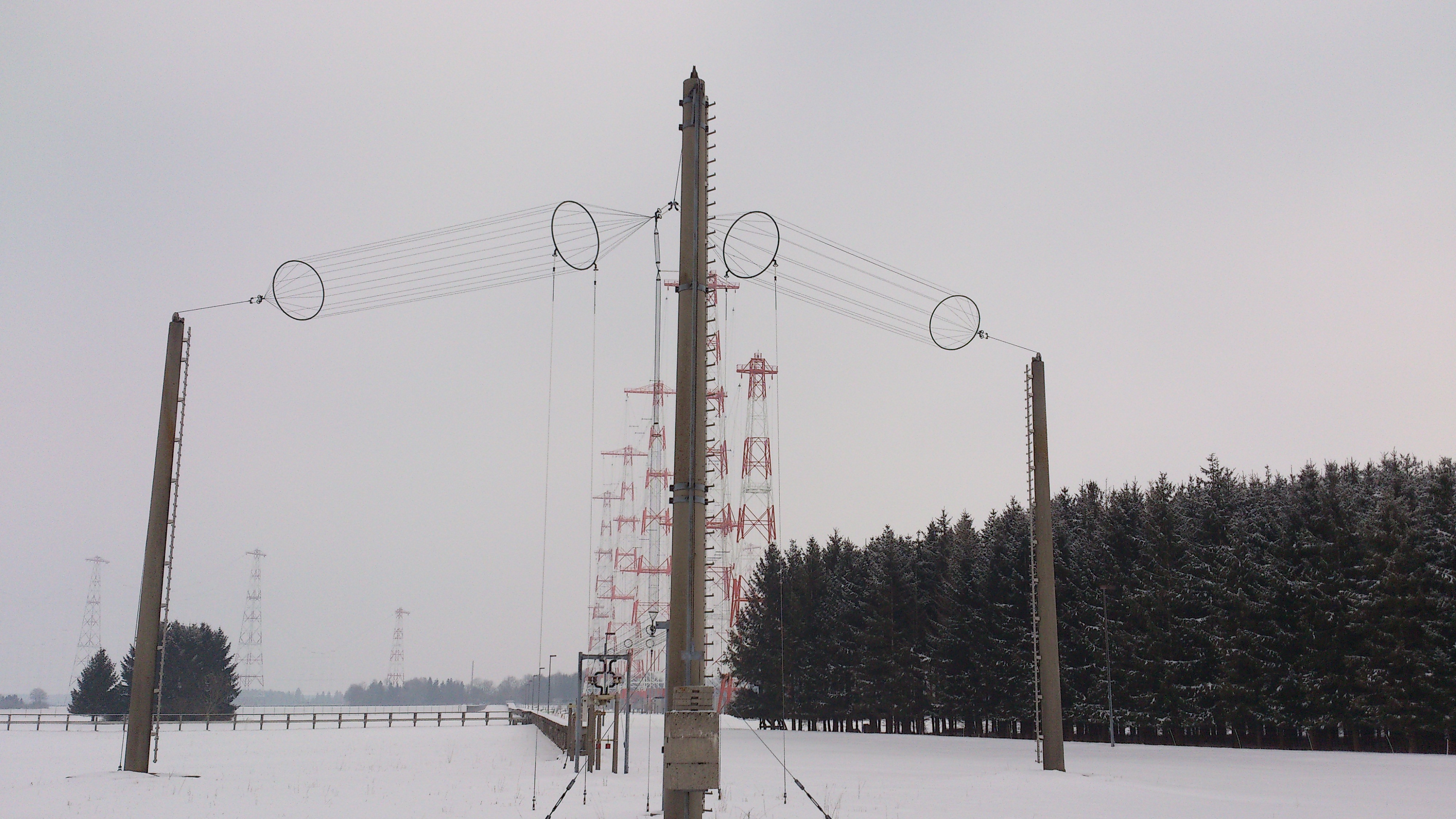
; Quadrant antenna : A quadrant antenna is an omnidirectional shortwave transmitting antenna shaped like a rhombus or lozenge, made from two identical, opposing L-shaped cage dipoles lying in the same horizontal plane, aligned with their 'elbows' pointing in opposite directions ; Curtain antenna : A curtain array antenna is a directional shortwave transmitting antenna made of several parallel-aligned dipoles, each made of cage sections.
History
In 1921, an amateur radio operator tried to win a $500 prize with his cage aerial.
References
References
- "Rundfunksender in Bayern".
- "Kurzwellensender Moosbrunn bei Wien".
- Gernsback, Hugo. (2016). "Results of the $500.00 Prize Contest: Who Will Save the Radio Amateur? (1923)". University of Minnesota Press.
This article was imported from Wikipedia and is available under the Creative Commons Attribution-ShareAlike 4.0 License. Content has been adapted to SurfDoc format. Original contributors can be found on the article history page.
Ask Mako anything about Cage aerial — get instant answers, deeper analysis, and related topics.
Research with MakoFree with your Surf account
Create a free account to save articles, ask Mako questions, and organize your research.
Sign up freeThis content may have been generated or modified by AI. CloudSurf Software LLC is not responsible for the accuracy, completeness, or reliability of AI-generated content. Always verify important information from primary sources.
Report