From Surf Wiki (app.surf) — the open knowledge base
Caesium chloride
hygroscopic 1.640 (0.59 μm) 1.631 (0.75 μm) 1.626 (1 μm) 1.616 (5 μm) 1.563 (20 μm) Cubic (Cl−) Caesium bromide Caesium iodide Caesium astatide Sodium chloride Potassium chloride Rubidium chloride Francium chloride
Caesium chloride or cesium chloride is the inorganic compound with the formula CsCl. This colorless salt is an important source of caesium ions in a variety of niche applications. Its crystal structure forms a major structural type where each caesium ion is coordinated by 8 chloride ions. Caesium chloride dissolves in water. CsCl changes to NaCl structure on heating. Caesium chloride occurs naturally as impurities in carnallite (up to 0.002%), sylvite and kainite. Less than 20 tonnes of CsCl is produced annually worldwide, mostly from a caesium-bearing mineral pollucite.
Caesium chloride is widely used in isopycnic centrifugation for separating various types of DNA. It is a reagent in analytical chemistry, where it is used to identify ions by the color and morphology of the precipitate. When enriched in radioisotopes, such as 137CsCl or 131CsCl, caesium chloride is used in nuclear medicine applications such as treatment of cancer and diagnosis of myocardial infarction. Another form of cancer treatment was studied using conventional non-radioactive CsCl. Whereas conventional caesium chloride has a rather low toxicity to humans and animals, the radioactive form easily contaminates the environment due to the high solubility of CsCl in water. Spread of 137CsCl powder from a 93-gram container in 1987 in Goiânia, Brazil, resulted in one of the worst-ever radiation spill accidents killing four, including one child, and directly affecting 249 people.
Crystal structure
Main article: Cubic crystal system
The caesium chloride structure adopts a primitive cubic lattice with a two-atom basis, where both atoms have eightfold coordination. The chloride atoms lie upon the lattice points at the corners of the cube, while the caesium atoms lie in the holes in the center of the cubes; an alternative and exactly equivalent 'setting' has the caesium ions at the corners and the chloride ion in the center. This structure is shared with CsBr and CsI and many binary metallic alloys. In contrast, the other alkaline halides have the sodium chloride (rocksalt) structure. When both ions are similar in size (Cs+ ionic radius 174 pm for this coordination number, Cl− 181 pm) the CsCl structure can be adopted, when they are different (Na+ ionic radius 102 pm, Cl− 181 pm) the sodium chloride structure is adopted. Upon heating to above 445 °C, the normal caesium chloride structure (α-CsCl) converts to the β-CsCl form with the rocksalt structure (space group Fmm).
Physical properties
Caesium chloride is colorless in the form of large crystals and white when powdered. It readily dissolves in water with the maximum solubility increasing from 1865 g/L at 20 °C to 2705 g/L at 100 °C. The crystals are highly hygroscopic and deliquescent. Caesium chloride crystals gradually disintegrate at ambient conditions. Caesium chloride does not form hydrates.
| Т (°C) | 0 | 10 | 20 | 25 | 30 | 40 | 50 | 60 | 70 | 80 | 90 | 100 |
|---|---|---|---|---|---|---|---|---|---|---|---|---|
| S (wt%) | 61.83 | 63.48 | 64.96 | 65.64 | 66.29 | 67.50 | 68.60 | 69.61 | 70.54 | 71.40 | 72.21 | 72.96 |
In contrast to sodium chloride and potassium chloride, caesium chloride readily dissolves in concentrated hydrochloric acid. sulfur dioxide (2.95 g/L at 25 °C), ammonia (3.8 g/L at 0 °C), acetone (0.004% at 18 °C), acetonitrile (0.083 g/L at 18 °C), ethylacetate and other complex ethers, butanone, acetophenone, pyridine and chlorobenzene.
Despite its wide band gap of about 8.35 eV at 80 K, caesium chloride weakly conducts electricity, and the conductivity is not electronic but ionic. The conductivity has a value of the order 10−7 S/cm at 300 °C. It occurs through nearest-neighbor jumps of lattice vacancies, and the mobility is much higher for the Cl− than Cs+ vacancies. The conductivity increases with temperature up to about 450 °C, with an activation energy changing from 0.6 to 1.3 eV at about 260 °C. It then sharply drops by two orders of magnitude because of the phase transition from the α-CsCl to β-CsCl phase. The conductivity is also suppressed by application of pressure (about 10 times decrease at 0.4 GPa) which reduces the mobility of lattice vacancies.
| Concentration, | |||||
|---|---|---|---|---|---|
| wt% | Density, | ||||
| kg/L | Concentration, | ||||
| mol/L | refractive index | ||||
| (at 589 nm) | Freezing point depression, °C relative to water | Viscosity, | |||
| 10−3 Pa·s | |||||
| 0.5 | – | 0.030 | 1.3334 | 0.10 | 1.000 |
| 1.0 | 1.0059 | 0.060 | 1.3337 | 0.20 | 0.997 |
| 2.0 | 1.0137 | 0.120 | 1.3345 | 0.40 | 0.992 |
| 3.0 | 0.182 | 1.3353 | 0.61 | 0.988 | |
| 4.0 | 1.0296 | 0.245 | 1.3361 | 0.81 | 0.984 |
| 5.0 | 0.308 | 1.3369 | 1.02 | 0.980 | |
| 6.0 | 1.0461 | 0.373 | 1.3377 | 1.22 | 0.977 |
| 7.0 | 0.438 | 1.3386 | 1.43 | 0.974 | |
| 8.0 | 1.0629 | 0.505 | 1.3394 | 1.64 | 0.971 |
| 9.0 | 0.573 | 1.3403 | 1.85 | 0.969 | |
| 10.0 | 1.0804 | 0.641 | 1.3412 | 2.06 | 0.966 |
| 12.0 | 1.0983 | 0.782 | 1.3430 | 2.51 | 0.961 |
| 14.0 | 1.1168 | 0.928 | 1.3448 | 2.97 | 0.955 |
| 16.0 | 1.1358 | 1.079 | 1.3468 | 3.46 | 0.950 |
| 18.0 | 1.1555 | 1.235 | 1.3487 | 3.96 | 0.945 |
| 20.0 | 1.1758 | 1.397 | 1.3507 | 4.49 | 0.939 |
| 22.0 | 1.1968 | 1.564 | 1.3528 | – | 0.934 |
| 24.0 | 1.2185 | 1.737 | 1.3550 | – | 0.930 |
| 26.0 | 1.917 | 1.3572 | – | 0.926 | |
| 28.0 | 2.103 | 1.3594 | – | 0.924 | |
| 30.0 | 1.2882 | 2.296 | 1.3617 | – | 0.922 |
| 32.0 | 2.497 | 1.3641 | – | 0.922 | |
| 34.0 | 2.705 | 1.3666 | – | 0.924 | |
| 36.0 | 2.921 | 1.3691 | – | 0.926 | |
| 38.0 | 3.146 | 1.3717 | – | 0.930 | |
| 40.0 | 1.4225 | 3.380 | 1.3744 | – | 0.934 |
| 42.0 | 3.624 | 1.3771 | – | 0.940 | |
| 44.0 | 3.877 | 1.3800 | – | 0.947 | |
| 46.0 | 4.142 | 1.3829 | – | 0.956 | |
| 48.0 | 4.418 | 1.3860 | – | 0.967 | |
| 50.0 | 1.5858 | 4.706 | 1.3892 | – | 0.981 |
| 60.0 | 1.7886 | 6.368 | 1.4076 | – | 1.120 |
| 64.0 | 7.163 | 1.4167 | – | 1.238 |
Reactions
Caesium chloride completely dissociates upon dissolution in water, and the Cs+ cations are solvated in dilute solution. CsCl converts to caesium sulfate upon being heated in concentrated sulfuric acid or heated with caesium hydrogen sulfate at 550–700 °C:
:2 CsCl + H2SO4 → Cs2SO4 + 2 HCl :CsCl + CsHSO4 → Cs2SO4 + HCl
Caesium chloride forms a variety of double salts with other chlorides. Examples include 2CsCl·BaCl2, 2CsCl·CuCl2, CsCl·2CuCl and CsCl·LiCl, and with interhalogen compounds: :
Occurrence and production
Caesium chloride occurs naturally as an impurity in the halide minerals carnallite (KMgCl3·6H2O with up to 0.002% CsCl), and in mineral waters. For example, the water of Bad Dürkheim spa, which was used in isolation of caesium, contained about 0.17 mg/L of CsCl. None of these minerals are commercially important.
On industrial scale, CsCl is produced from the mineral pollucite, which is powdered and treated with hydrochloric acid at elevated temperature. The extract is treated with antimony chloride, iodine monochloride, or cerium(IV) chloride to give the poorly soluble double salt, e.g.: :CsCl + SbCl3 → CsSbCl4
Treatment of the double salt with hydrogen sulfide gives CsCl: :2 CsSbCl4 + 3 H2S → 2 CsCl + Sb2S3 + 8 HCl
High-purity CsCl is also produced from recrystallized (and ) by thermal decomposition: :
Only about 20 tonnes of caesium compounds, with a major contribution from CsCl, were being produced annually around the 1970s and is sold internationally through a UK dealer. The salt is synthesized at 200 °C because of its hygroscopic nature and sealed in a thimble-shaped steel container which is then enclosed into another steel casing. The sealing is required to protect the salt from moisture.
Laboratory methods
In the laboratory, CsCl can be obtained by treating caesium hydroxide, carbonate, caesium bicarbonate, or caesium sulfide with hydrochloric acid: :CsOH + HCl → CsCl + H2O :Cs2CO3 + 2 HCl → 2 CsCl + 2 H2O + CO2
Uses
Precursor to Cs metal
Caesium chloride is the main precursor to caesium metal by high-temperature reduction: :2 CsCl (l) + Mg (l) → MgCl2 (s) + 2 Cs (g) : CsCl (l) + Li (l) → LiCl (l) + Cs (g)
A similar reaction – heating CsCl with calcium in vacuum in presence of phosphorus – was first reported in 1905 by the French chemist M. L. Hackspill and is still used industrially.
Caesium hydroxide is obtained by electrolysis of aqueous caesium chloride solution:
: 2 CsCl + 2 H2O → 2 CsOH + Cl2 + H2
Solute for ultracentrifugation
Caesium chloride is widely used in centrifugation in a technique known as isopycnic centrifugation. Centripetal and diffusive forces establish a density gradient that allow separation of mixtures on the basis of their molecular density. This technique allows separation of DNA of different densities (e.g. DNA fragments with differing A-T or G-C content). This application requires a solution with high density and yet relatively low viscosity, and CsCl suits it because of its high solubility in water, high density owing to the large mass of Cs, as well as low viscosity and high stability of CsCl solutions.
Organic chemistry
Caesium chloride is rarely used in organic chemistry. It can act as a phase transfer catalyst reagent in selected reactions. One of these reactions is the synthesis of glutamic acid derivatives
:\overbrace{\ce{CH2=CHCOOCH3}}^\text{Methyl acrylate} + \ce{ArCH=N-CH(CH3)-COOC(CH3)3 -[\ce{TBAB,\ CsCl,\ K2CO3}][\ce{CPME,\ 0^\circ C}] {ArCH=N-C(C2H4COOCH3)(CH3)-COOC(CH3)3}}
where TBAB is tetrabutylammonium bromide (interphase catalyst) and CPME is a cyclopentyl methyl ether (solvent).
Another reaction is substitution of tetranitromethane
:\overbrace{\ce{C(NO2)4}}^\text{tetranitromethane} + \ce{CsCl -[\ce{DMF}] {C(NO2)3Cl} + CsNO2}
where DMF is dimethylformamide (solvent).
Analytical chemistry
Caesium chloride is a reagent in traditional analytical chemistry used for detecting inorganic ions via the color and morphology of the precipitates. Quantitative concentration measurement of some of these ions, e.g. Mg2+, with inductively coupled plasma mass spectrometry, is used to evaluate the hardness of water.
| Ion | Accompanying reagents | Residue | Morphology | Detection limit (μg) |
|---|---|---|---|---|
| AsO33− | KI | Cs2[AsI5] or Cs3[AsI6] | Red hexagons | 0.01 |
| Au3+ | AgCl, HCl | Cs2Ag[AuCl6] | Gray-black crosses, four and six-beamed stars | 0.01 |
| Au3+ | NH4SCN | Cs[Au(SCN)4] | Orange-yellow needles | 0.4 |
| Bi3+ | KI, HCl | Cs2[BiI5] or 2.5H2O | Red hexagons | 0.13 |
| Cu2+ | (CH3COO)2Pb, CH3COOH, KNO2 | Cs2Pb[Cu(NO2)6] | Small black cubes | 0.01 |
| In3+ | — | Cs3[InCl6] | Small octahedra | 0.02 |
| [IrCl6]3− | — | Cs2[IrCl6] | Small dark-red octahedra | – |
| Mg2+ | Na2HPO4 | CsMgPO4 or 6H2O | Small tetrahedra | – |
| Pb2+ | KI | Cs[PbI3] | Yellow-green needles | 0.01 |
| Pd2+ | NaBr | Cs2[PdBr4] | Dark-red needles and prisms | – |
| [ReCl4]− | — | Cs[ReCl4] | Dark-red rhombs, bipyramids | 0.2 |
| [ReCl6]2− | — | Cs2[ReCl6] | Small yellow-green octahedra | 0.5 |
| ReO4− | — | CsReO4 | Tetragonal bipyramids | 0.13 |
| Rh3+ | KNO2 | Cs3[Rh(NO2)6] | Yellow cubes | 0.1 |
| Ru3+ | — | Cs3[RuCl6] | Pink needles | – |
| [RuCl6]2− | — | Cs2[RuCl6] | Small dark-red crystals | 0.8 |
| Sb3+ | — | Cs2[SbCl5]·nH2O | Hexagons | 0.16 |
| Sb3+ | NaI | Cs[SbI4] or Cs2[SbI5] | Red hexagons | 0.1 |
| Sn4+ | — | Cs2[SnCl6] | Small octahedra | 0.2 |
| TeO33− | HCl | Cs2[TeCl6] | Light yellow octahedra | 0.3 |
| Tl3+ | NaI | Cs[TlI4] | Orange-red hexagons or rectangles | 0.06 |
It is also used for detection of the following ions:
| Ion | Accompanying reagents | Detection | Detection limit (μg/mL) |
|---|---|---|---|
| Al3+ | K2SO4 | Colorless crystals form in neutral media after evaporation | 0.01 |
| Ga3+ | KHSO4 | Colorless crystals form upon heating | 0.5 |
| Cr3+ | KHSO4 | Pale-violet crystals precipitate in slightly acidic media | 0.06 |
Medicine
The American Cancer Society states that "available scientific evidence does not support claims that non-radioactive cesium chloride supplements have any effect on tumors."
Nuclear medicine and radiography
Caesium chloride composed of radioisotopes such as 137CsCl and 131CsCl, is used in nuclear medicine, including treatment of cancer (brachytherapy) and diagnosis of myocardial infarction. In the production of radioactive sources, it is normal to choose a chemical form of the radioisotope which would not be readily dispersed in the environment in the event of an accident. For instance, radiothermal generators (RTGs) often use strontium titanate, which is insoluble in water. For teletherapy sources, however, the radioactive density (Ci in a given volume) needs to be very high, which is not possible with known insoluble caesium compounds. A thimble-shaped container of radioactive caesium chloride provides the active source.
Miscellaneous applications
Caesium chloride is used in the preparation of electrically conducting glasses and screens of cathode ray tubes. In conjunction with rare gases CsCl is used in excimer lamps{{cite journal
CsCl is a potent inhibitor of HCN channels, which carry the h-current in excitable cells such as neurons. Therefore, it can be useful in electrophysiology experiments in neuroscience.
Toxicity
Caesium chloride has a low toxicity to humans and animals. However, caesium chloride powder can irritate the mucous membranes and cause asthma.
Because of its high solubility in water, caesium chloride is highly mobile and can even diffuse through concrete. This is a drawback for its radioactive form which urges a search for less chemically mobile radioisotope materials. Commercial sources of radioactive caesium chloride are well sealed in a double steel enclosure.
References
Bibliography
References
- Haynes, p. 4.57
- Haynes, p. 10.240
- (1994). "Relaxation of excitons in wide-gap CsCl crystals". Journal of Physics: Condensed Matter.
- Haynes, p. 4.132
- (1977). "The transition mechanism between the CsCl-type and NaCl-type structures in CsCl". Acta Crystallographica Section A.
- [https://pubchem.ncbi.nlm.nih.gov/#tab/sidsrcname=ChemIDplus&query=7647-17-8&input_type=text Cesium chloride]. nlm.nih.gov
- {{Greenwood&Earnshaw2nd
- Wells A.F. (1984) ''Structural Inorganic Chemistry'' 5th edition Oxford Science Publications {{ISBN. 0-19-855370-6
- (1951). "Polymorphism of cesium and thallium halides". Acta Crystallographica.
- Lidin, p. 620
- Haynes, p. 5.191
- Caesium chloride has also a relatively high solubility in [[formic acid]] (1077 g/L at 18 °C) and [[hydrazine]]; medium solubility in [[methanol]] (31.7 g/L at 25 °C) and low solubility in [[ethanol]] (7.6 g/L at 25 °C),Plyushev, p. 97
- Haynes, p. 5.126
- Lidin, p. 645
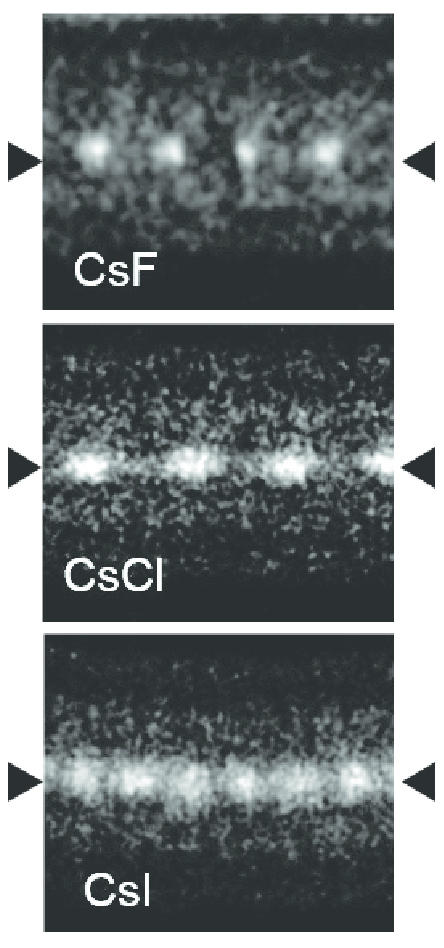
- (2014). "Atomic structure and dynamic behaviour of truly one-dimensional ionic chains inside carbon nanotubes". Nature Materials.
- [[sylvite]] (KCl) and [[kainite]] (MgSO4·KCl·3H2O),Plyushev, pp. 210–211
- Plyushev, p. 206
- Plsyushev, pp. 357–358
- 10.1002/0470862106.ia712
- Plyushev, p. 90
- (May 2025). "FDA alerts health care professionals of significant safety risks associated with cesium chloride". Food and Drug Administration.
- (August 2, 2018). "FDA blacklists cesium chloride, ineffective and dangerous naturopathic cancer treatment".
- Tver'yanovich, Y. S.. (1998). "Optical absorption and composition of the nearest environment of neodymium in glasses based on the gallium-germanium-chalcogen system". Glass Phys. Chem..
- Biel, Martin. (2009). "Hyperpolarization-Activated Cation Channels: From Genes to Function". Physiological Reviews.
- (June 2010). "Clinical effects of cesium intake". Biological Trace Element Research.
- Time]]''. 2009.
- (1975). "Аналитическая химия рубидия и цезия". Nauka.
- Ehrenreich, Henry. (1984). "Solid state physics: advances in research and applications". Academic Press.
- (January 2008). "Radiation source use and replacement: abbreviated version". National Academies Press.
- (1984). "The High pH Therapy for Cancer, Tests on Mice and Humans". Pharmacology Biochemistry and Behavior.
- (1964). "The direct diagnosis of myocardial infarction by photoscanning after administration of cesium-131". American Heart Journal.
- (1998). "Химическая энциклопедия (Chemical encyclopedia)". Soviet Encyclopedia.
- (1988). "The Radiological Accident in Goiânia". [[International Atomic Energy Agency.
- (1968). "Cesium 131 Photoscan: Aid in the Diagnosis of Myocardial Infarction". JAMA: The Journal of the American Medical Association.
- (2007). "Assessing the therapeutic and toxicological effects of cesium chloride following administration to nude mice bearing PC-3 or LNCaP prostate cancer xenografts". Cancer Chemotherapy and Pharmacology.
- [https://minerals.usgs.gov/minerals/pubs/commodity/cesium/mcs-2010-cesiu.pdf Cesium] {{Webarchive. link. (2011-10-30 . Mineral Commodity Summaries January 2010. U.S. Geological Survey)
- Bick, Manfred and Prinz, Horst (2002) "Cesium and Cesium Compounds" in ''Ullmann's Encyclopedia of Industrial Chemistry'', Wiley-VCH, Weinheim. Vol. A6, pp. 153–156. {{doi. 10.1002/14356007.a06_153
This article was imported from Wikipedia and is available under the Creative Commons Attribution-ShareAlike 4.0 License. Content has been adapted to SurfDoc format. Original contributors can be found on the article history page.
Ask Mako anything about Caesium chloride — get instant answers, deeper analysis, and related topics.
Research with MakoFree with your Surf account
Create a free account to save articles, ask Mako questions, and organize your research.
Sign up freeThis content may have been generated or modified by AI. CloudSurf Software LLC is not responsible for the accuracy, completeness, or reliability of AI-generated content. Always verify important information from primary sources.
Report