From Surf Wiki (app.surf) — the open knowledge base
Cadillac Fleetwood Brougham

| Field | Value | |||||
|---|---|---|---|---|---|---|
| name | Cadillac Fleetwood Brougham | |||||
| image | 1984 Cadillac Fleetwood Brougham d'Elegance coupe, front right, 07-21-2024.jpg | |||||
| caption | 1984 Cadillac Fleetwood Brougham d'Elegance coupe | |||||
| model_years | 1977–1986 | |||||
| manufacturer | Cadillac (General Motors) | |||||
| assembly | Detroit Assembly, Detroit, Michigan, U.S. | |||||
| predecessor | Cadillac Sixty Special | |||||
| successor | Cadillac Brougham | |||||
| class | Full-size luxury car | |||||
| layout | FR layout | |||||
| platform | C-body | |||||
| D-body | ||||||
| wheelbase | 1977–79: 121.5 in | |||||
| 1980–82: 121.4 in | ||||||
| 1983–86: 121.5 in | ||||||
| body_style | 4-door sedan | |||||
| 2-door coupe | ||||||
| engine | 250 cuin HT-4100 V8 | |||||
| 252 cuin Buick V6 | ||||||
| 307 cuin Oldsmobile V8 | ||||||
| 350 cuin LF9 Diesel V8 | ||||||
| <br /> {{convert | 368 | cuin | L | 1 | abbr | on}} L62 V8 |
| 425 cuin L33/L35 V8 | ||||||
| transmission | 3-speed TH-400 automatic | |||||
| 3-speed TH-350C automatic | ||||||
| 4-speed TH-200-4R automatic | ||||||
| length | 1977–79: 221.2 in | |||||
| 1980–86: 221.0 in | ||||||
| width | 4-door: 75.3 in | |||||
| 2-door: 75.4 in | ||||||
| height | 1977: 57.2 in | |||||
| 1978–86 4-door: 56.7 in | ||||||
| 2-door: 54.6 in | ||||||
| weight | 4000 - | |||||
| designer | Bill Mitchell | |||||
| related | Cadillac De Ville | |||||
| Buick Electra | ||||||
| Oldsmobile 98 |
the Cadillac Fleetwood 60 Special and Brougham
D-body 1980–82: 121.4 in 1983–86: 121.5 in 2-door coupe 252 cuin Buick V6 307 cuin Oldsmobile V8 350 cuin LF9 Diesel V8
368 cuin L62 V8 425 cuin L33/L35 V8 3-speed TH-350C automatic 4-speed TH-200-4R automatic 1980–86: 221.0 in 2-door: 75.4 in 1978–86 4-door: 56.7 in 2-door: 54.6 in Buick Electra Oldsmobile 98 The Cadillac Fleetwood Brougham is a luxury car manufactured by Cadillac from 1977 through 1986. In 1987, the Fleetwood Brougham name was shortened to simply Brougham, with production continuing through 1992 with only minor updates.
Cadillac used the "Fleetwood" name as a prefix between 1934 and 1976 on several of its most expensive models, always designating an elevated level of luxury. From 1957 until 1961, Cadillac used the "Brougham" sub-designation for its exclusive four-door Eldorado models.
In 1965, the "Brougham" name was first affixed to "Fleetwood" on the Fleetwood Sixty Special as an upgraded option package, which included a vinyl roof and special "Brougham" script lettering on the sides, but it was not a separate model. In 1966, the Fleetwood Brougham was added as a separate model, accompanying the Fleetwood 60 Special, which continued through 1970. In 1971, with the Fleetwood Brougham outselling the Fleetwood 60 Special by a large margin, the two models were consolidated into a single model, the Fleetwood 60 Special Brougham, and would continue with this name through 1976. The car's name was shortened to Fleetwood Brougham with the 1977 downsizing across the GM car line. The "d'Elegance" and "Talisman" sub-models were also sometimes used to designate upgraded option packages.
Evolution of the ''Fleetwood'' designation

.jpg)
Lawrence P. Fisher was the Fisher brother most closely involved with Cadillac in its early years. In 1916, he joined the Fisher Body Company, which had been formed by two of his brothers in 1908. Larry (as people knew him) was one of four of the seven Fisher brothers who brought Fisher Body Corporation under the General Motors umbrella in 1919. In May 1925, Alfred P. Sloan, then the head of General Motors, appointed Fisher as Cadillac General Manager, an office he retained through 1934. Fisher immediately went to work adding exclusive, custom bodies to the Cadillac range. Thus he oversaw the purchase of the Fleetwood Metal Body Company by the Fisher Body Corporation in September 1925.
The Fleetwood Body Company of Fleetwood, Pennsylvania, was founded by Harry Urich in the nineteenth century. It began as a small community of craftsmen founded by Henry Fleetwood, Esq. of Penwortham, near Lancaster, England (the Fleetwood family flourished in England in the 17th and 18th centuries). The rich traditions of 300 years of coach-building that the Fleetwood Body Company applied to its work on cars secured for it a high reputation in automobile circles worldwide by the 1920s. Coachwork was built by Fleetwood for a variety of luxury makes through 1924. However, after the Fisher Body Corporation purchased the Fleetwood Body Company in 1925, Fleetwood bodies were reserved exclusively for Cadillac. By 1929 GM had purchased the remaining stock holdings of the Fisher Body Corporation and thus became sole owner of both the Fisher and Fleetwood companies.
Originally an enclosed carriage, drawn by a single horse, for 2–4 persons, “Brougham” owes its name to British statesman, Henry Brougham. Cadillac first used the name in 1916 to designate an enclosed 5-7 passenger sedan body style. In the thirties, the name was given to a formal body style with open chauffeur compartment and enclosed rear quarters, metal roof and often "razor-edged" styling. When Cadillac started offering Fleetwood bodies on some of its cars in 1925, the Brougham body style was Fleetwood bodied every year with the exception of 1926. After 1937 the Brougham name was not applied to any Cadillac for the remainder of the pre-WW II period.
The Brougham name would eventually reappear on the 1955 Cadillac Eldorado Brougham show car which preceded the 4-door Eldorado Brougham hardtops of the 1957 to 1960 model years. In 1957 the Cadillac Series 70 Eldorado Brougham joined the Sixty Special and the Series 75 as the only Cadillac models with Fleetwood bodies although Fleetwood script or crests did not appear anywhere on the exterior of the car, and so this would also mark the first time in 20 years that a Fleetwood bodied car was paired with the Brougham name. When production of the Eldorado Brougham was shifted in 1959 from the Cadillac Fleetwood plant in Detroit to Pininfarina in Turin, Italy, only then did it acquire Fleetwood wheel discs and doorsill moldings, presumably because the design work and final touches were still being done by Fleetwood. The 1960 Eldorado Brougham would be the final iteration.
After a five year absence the Brougham name once again reappeared as an option package on the 1965 Cadillac Sixty Special. The following year the Brougham moved up to becoming a subseries of the Fleetwood Sixty Special. This continued through 1970. Starting in 1971 the Sixty Special was only available as the well equipped Fleetwood Sixty Special Brougham.
When the Sixty Special Series was retired in 1977, the Fleetwood Brougham took its place as Cadillac's largest owner-driven sedan model through 1986.
{{anchor|Cadillac Fleetwood Brougham (1977–1986)}}Fleetwood Brougham
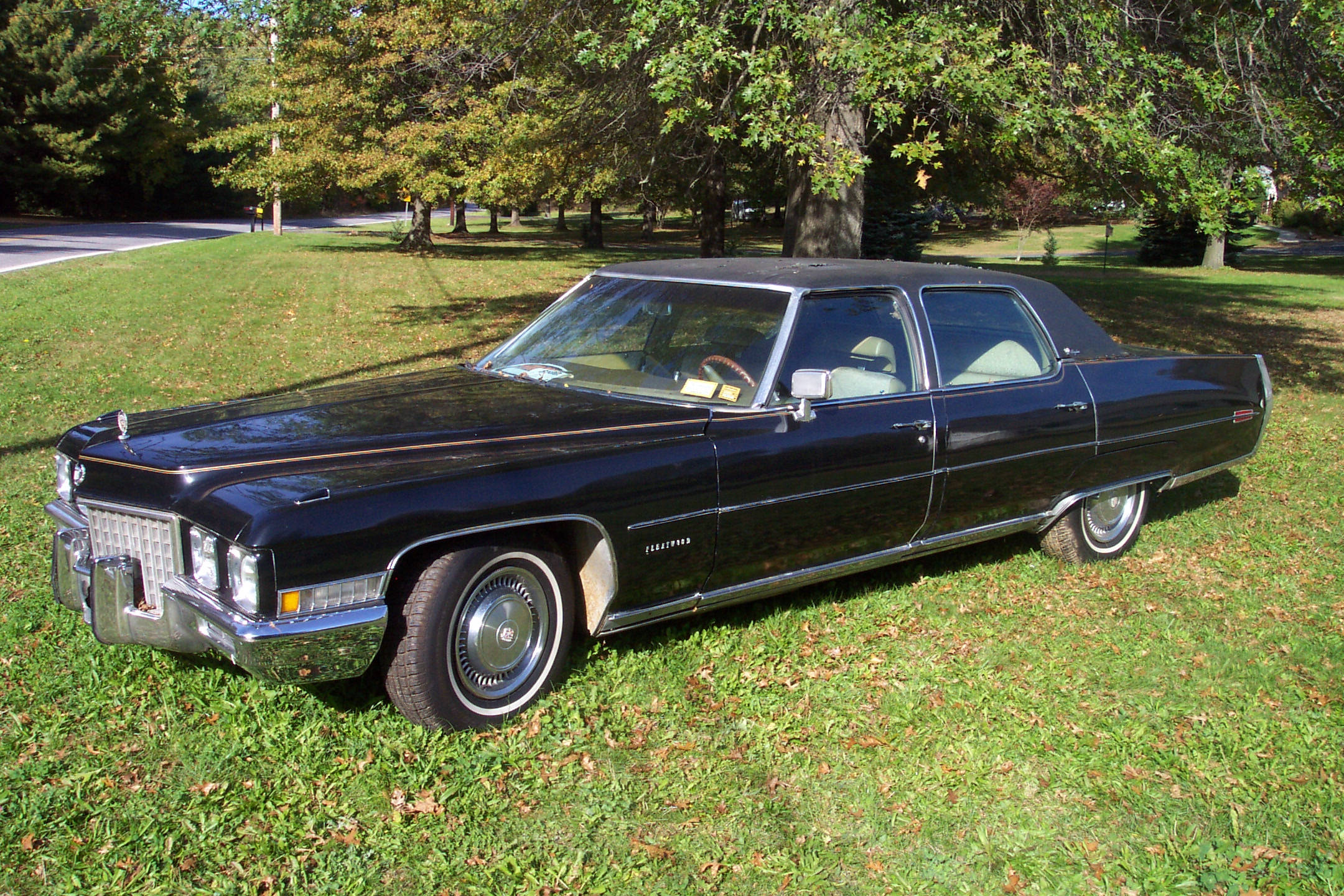
For 1977, GM significantly downsized their full sized cars. The DeVille and Fleetwood Brougham rode on the same 121.5" wheelbase and were powered by the 425 cubic inch (7.0 L) V8. This engine was basically a de-bored version of the 472/500 (7.7 L/8.2 L) V8 of previous years. Compared with the 1976 Fleetwood Sixty Special Brougham, the Fleetwood Brougham had a wheelbase 11.5" shorter and weighed nearly 900 lb (400 kg) less. The new Fleetwood Brougham, which had lost its exclusive longer wheelbase, was now virtually identical to the lesser Sedan de Ville. Other than the name, there were only subtle exterior differences between a Fleetwood Brougham and Sedan de Ville, including a slightly reshaped B-pillar and rear side windows. The 1980 refresh eliminated this distinction. The interior of the Fleetwood was more plush and offered more features as standard.
** Size comparison between 1974 Cadillac Fleetwood Sixty Special Brougham and 1977 Cadillac Fleetwood Brougham **
| 1974 Cadillac Fleetwood 60 Special Brougham | 1977 Cadillac Fleetwood Brougham |
|---|---|
| Wheelbase | 133.0 in |
| Overall Length | 233.7 in |
| Width | 79.8 in |
| Height | 55.3 in |
| Front Headroom | 39.3 in |
| Front Legroom | 41.9 in |
| Front Hip Room | 57.8 in |
| Front Shoulder Room | 62.1 in |
| Rear Headroom | 38.3 in |
| Rear Legroom–ins. | 44.6 in |
| Rear Hip Room | 58.0 in |
| Rear Shoulder Room | 64.0 in |
| Luggage Capacity | 15.9 cuft |
In 1980, GM gave all of the full-sized B and C-body line new sheet metal to tidy up the styling and improve aerodynamics. The basic dashboard design was retained. Also new for 1980 was a two-door Fleetwood Brougham Coupe, which was based upon the Coupe de Ville but featured an exclusive formal landau vinyl roof. The 425 cu in (7.0 L) engine, a reduced bore 472, was further debored for 1980-81 to 368 cubic inches or 6.0 liters in order to comply with newly-enacted CAFE standards. For 1981, the 368 was provided with a modulated displacement system designed by Eaton Corporation, controlled by a digital computer, which locked off intake and exhaust valves to two or four of the eight cylinders, thus running effectively as a V6 or V4 under light load conditions when in third gear, and over 35 mph. This engine, called the "V8-6-4", was reliable, but the computer technology of the era was not refined enough for smooth operation and it was dropped from all models but limousines after 1981.
Both the 425 and 368 are small-bore versions of the durable 472 (which was introduced in late 1967 for the '68 model year). The larger 500 had the 472's bore but a longer stroke. This engine family was the last Cadillac cast-iron engine, and the last 'big-block'. During this period, an assortment of engines were offered in the interest of fuel economy. These included the Buick 252 V6, diesel Oldsmobile 350 V8, and of Cadillac's own "HT-4100" small block V8, an alloy unit with cast iron cylinder liners which was troublesome and prone to early failure. The first two were dropped in 1982 once gas prices began falling while the latter persisted through 1986.
For 1985, Cadillac introduced a brand-new front-wheel drive platform for DeVille and Fleetwood. This car featured two "firsts"; it had the first transverse mounted V8 ever (the HT4100) and it was the first car to have a high mounted rear stop-lamp that was federally mandated starting in the 1986 model year. The rear wheel drive 1985 Cadillac Fleetwood Brougham continued on nearly unchanged from the 1984 model. 1985 was the final model year for the Fleetwood Brougham coupe. In 1986, the HT-4100 V8 was replaced with an Oldsmobile-sourced 307 cubic inch (5.0 L) V8 in the Fleetwood Brougham.
Production Figures:
| Coupe | Sedan | Yearly Total | Total | 8,336 | 102,075 | 110,411 |
|---|---|---|---|---|---|---|
| 1985 | 8,336 | 52,960 | 61,296 | |||
| 1986 | - | 49,115 | 49,115 |
Brougham
Main article: Cadillac Brougham

For 1987, Cadillac revised its model nomenclature for its premium sedan lines. To reduce market confusion over the smaller front-wheel drive Fleetwood (introduced in 1985), the D-body Fleetwood Brougham was renamed the Cadillac Brougham.
Produced since 1977 with only incremental changes since its 1980 update, the Brougham was offered through 1992. For 1993, the D-body Cadillac was restyled and rebranded as the Cadillac Fleetwood; the Brougham name also returned, becoming a trim package.
Engines
| Years | Displacement | Power | Torque | |||
|---|---|---|---|---|---|---|
| 1981–1982 | 252 cuin Buick V6 | 125 hp | {{convert | 205 | lbft | Nm |
| 1982–1985 | 250 cuin HT-4100 V8 | 135 hp | {{convert | 190 | lbft | Nm |
| 1986 | 307 cuin Oldsmobile 307 V8 | 140 hp | {{convert | 245 | lbft | Nm |
| 1979–1985 | 350 cuin LF9 Diesel V8 | 105 hp | {{convert | 205 | lbft | Nm |
| 1980–1981 | 368 cuin L62 V8-6-4 V8 | 145 hp | {{convert | 270 | lbft | Nm |
| 1977–1979 | 425 cuin L33 V8 | 180 hp | {{convert | 320 | lbft | Nm |
| 1977–1979 | 425 cuin L35 V8 | 195 hp | {{convert | 320 | lbft | Nm |
References
References
- "Cadillac Terms and Definitions D - G". Cadillacdatabase.net.
- Kimes, Beverly. (1996). "Standard Catalog of American Cars 1805-1942". Krause publications.
- Gunnell, John. (2005). "Standard Catalog of Cadillac 1903-2005". Krause publications.
- "Cadillac Terms and Definitions A - C". Cadillacdatabase.net.
- Kowalke, Ron. (1997). "Standard Catalog of American Cars 1946-1975". Krause publications.
- Bonsall, Thomas. (2003). "The Cadillac Story". Stanford University Press.
- "Mark II Meets Eldorado Brougham". Special Interest Autos.
- "1957-1960 Cadillac Eldorado Brougham - page 5". auto.howstuffworks.com.
- "1957-1960 Cadillac Eldorado Brougham - page 6". auto.howstuffworks.com.
- Flammang, James. (1999). "Standard Catalog of American Cars 1976-1999". Krause publications.
- Flammang, James M.. (1999). "Standard catalog of American cars, 1976-1999". Krause Publications.
This article was imported from Wikipedia and is available under the Creative Commons Attribution-ShareAlike 4.0 License. Content has been adapted to SurfDoc format. Original contributors can be found on the article history page.
Ask Mako anything about Cadillac Fleetwood Brougham — get instant answers, deeper analysis, and related topics.
Research with MakoFree with your Surf account
Create a free account to save articles, ask Mako questions, and organize your research.
Sign up freeThis content may have been generated or modified by AI. CloudSurf Software LLC is not responsible for the accuracy, completeness, or reliability of AI-generated content. Always verify important information from primary sources.
Report