From Surf Wiki (app.surf) — the open knowledge base
CACNA1C
Protein-coding gene in humans
Protein-coding gene in humans
Voltage-dependent L-type calcium channel subunit alpha-1C (also known as Cav1.2) is a protein that in humans is encoded by the CACNA1C gene. Cav1.2 is a subunit of L-type voltage-dependent calcium channel.
Structure and function
This gene encodes an alpha-1 subunit of a voltage-dependent calcium channel. Calcium channels mediate the influx of calcium ions (Ca2+) into the cell upon membrane polarization (see membrane potential and calcium in biology).
The alpha-1 subunit consists of 24 transmembrane segments and forms the pore through which ions pass into the cell. The calcium channel consists of a complex of alpha-1, alpha-2/delta and beta subunits in a 1:1:1 ratio. The S3-S4 linkers of Cav1.2 determine the gating phenotype and modulated gating kinetics of the channel. Cav1.2 is widely expressed in the smooth muscle, pancreatic cells, fibroblasts, and neurons. However, it is particularly important and well known for its expression in the heart where it mediates L-type currents, which causes calcium-induced calcium release from the ER Stores via ryanodine receptors. It depolarizes at -30mV and helps define the shape of the action potential in cardiac and smooth muscle. The protein encoded by this gene binds to and is inhibited by dihydropyridine. In the arteries of the brain, high levels of calcium in mitochondria elevates activity of nuclear factor kappa B NF-κB and transcription of CACNA1c and functional Cav1.2 expression increases. Cav1.2 also regulates levels of osteoprotegerin.
CaV1.2 is inhibited by the action of STIM1.
Regulation
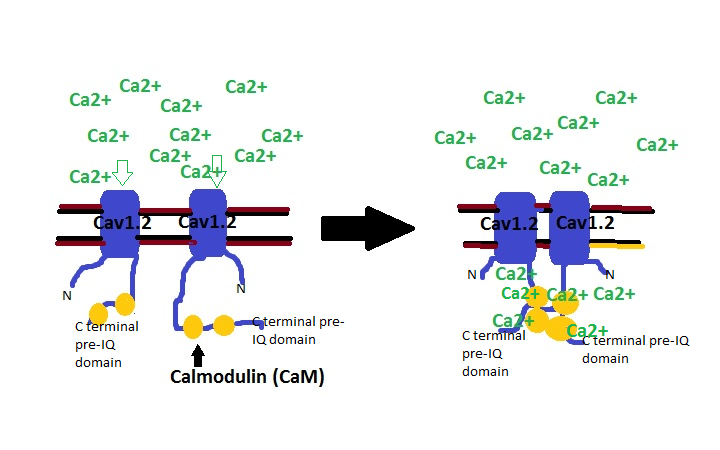
The activity of CaV1.2 channels is tightly regulated by the Ca2+ signals they produce. An increase in intracellular Ca2+ concentration implicated in Cav1.2 facilitation, a form of positive feedback called Ca2+-dependent facilitation, that amplifies Ca2+ influx. In addition, increasing influx intracellular Ca2+ concentration has implicated to exert the opposite effect Ca2+ dependent inactivation. These activation and inactivation mechanisms both involve Ca2+ binding to calmodulin (CaM) in the IQ domain in the C-terminal tail of these channels. Cav1.2 channels are arranged in cluster of eight, on average, in the cell membrane. When calcium ions bind to calmodulin, which in turn binds to a Cav1.2 channel, it allows the Cav1.2 channels within a cluster to interact with each other. This results in channels working cooperatively when they open at the same time to allow more calcium ions to enter and then close together to allow the cell to relax.
Clinical significance
Relevance of ''CACNA1C'' in clinical disorders
Timothy Syndrome
Timothy Syndrome is a rare autosomal dominant disorder caused by rare heterozygous missense (non-synonymous) variants (mutations) in CACNA1C. These variants are typically called 'gain of function' variants as their functional impact alters the excitation of the Cav1.2 channel. The most frequent causative pathogenic variants for Timothy syndrome are p.G406R and p.G402S. There are two subtypes of Timothy syndrome: Type 1 and Type 2. Timothy Syndrome Type 1 is caused by p.G406R in exon 8, with individuals presenting with prolonged QT, cardiac arrhythmia, neurodevelopmental delays, syndactyly, hypoglycaemia and hypotonia. Individuals with Type 2 predominantly harbour p.G406R too, but, due to alternative splicing, this variant occurs in exon 8A. Timothy syndrome Type 2 has a similar phenotype to type 1 but also exhibits hip dysplasia. Further variants have been linked to both syndromes.
LongQT Type 8
Alongside Timothy Syndrome, high-penetrance missense CACNA1C variants have also been noted in patients with LongQT Type 8, predominantly with no further extra-cardiac symptoms presenting. LongQT Type 8 is a condition which is categorised by a prolonged QT interval, syncope and ventricular arrhythmias. Although extra-cardiac features are not common, this could be due to underreporting.
Insufficient evidence: Brugada Syndrome
Although CACNA1C variants have been identified in Brugada Syndrome patients, the evidence for variants (such as p.A39V and p.G490R) causing genetic aetiology is disputed. The link between Brugada Syndrome and CACNA1C variants is limited and predominantly consists of single-family cases with limited disease segregation. There is currently insufficient evidence for the impact of CACNA1C variants on Brugada Syndrome, as currently corroborated by the Genomics England Panel App.
Moderate/low impact variants
Large-scale genetic analyses have shown the possibility that CACNA1C is associated with bipolar disorder
- and subsequently also with schizophrenia. Also, a CACNA1C risk allele has been associated to a disruption in brain connectivity in patients with bipolar disorder, while not or only to a minor degree, in their unaffected relatives or healthy controls. In a first study in Indian population, the Schizophrenia associated Genome-wide association study (GWAS) single nucelotide polymorphism (SNP) was found not to be associated with the disease. Furthermore, the main effect of rs1006737 was found to be associated with spatial abilityefficiency scores. Subjects with genotypes carrying the risk allele of rs1006737 (G/A and A/A) were found to have higher spatial ability efficiency scores as compared to those with the G/G genotype. While in healthy controls those with G/A and A/A genotypes were found to have higher spatial memory processing speed scores than those with G/G genotypes, the former had lower scores than the latter in schizophrenia subjects. In the same study the genotypes with the risk allele of rs1006737 namely A/A was associated with a significantly lower Align rank transformed Abnormal and involuntary movement scale (AIMS) scores of Tardive dyskinesia(TD).
Interactive pathway map
References
References
- (Aug 1991). "Normalization of current kinetics by interaction between the alpha 1 and beta subunits of the skeletal muscle dihydropyridine-sensitive Ca2+ channel". Nature.
- (Dec 2005). "International Union of Pharmacology. XLVIII. Nomenclature and structure-function relationships of voltage-gated calcium channels". Pharmacological Reviews.
- (May 2013). "L-type calcium channel targeting and local signalling in cardiac myocytes". Cardiovascular Research.
- (Nov 2004). "L-type calcium channels: the low down". Journal of Neurophysiology.
- (Aug 2012). "Ca2+-dependent modulation of voltage-gated Ca2+ channels". Biochimica et Biophysica Acta (BBA) - General Subjects.
- (Aug 2014). "The role of L-type voltage-gated calcium channels Cav1.2 and Cav1.3 in normal and pathological brain function". Cell and Tissue Research.
- "Entrez Gene: voltage-dependent, L type, alpha 1C subunit".
- (Sep 2010). "Mitochondria control functional CaV1.2 expression in smooth muscle cells of cerebral arteries". Circulation Research.
- (Jan 2004). "Osteoprotegerin expression and secretion are regulated by calcium influx through the L-type voltage-sensitive calcium channel". Endocrinology.
- (Oct 2010). "Cell biology. How to STIMulate calcium channels". Science.
- (May 2004). "Modulation of the voltage sensor of L-type Ca2+ channels by intracellular Ca2+". The Journal of General Physiology.
- (Dec 2010). "Multiple C-terminal tail Ca(2+)/CaMs regulate Ca(V)1.2 function but do not mediate channel dimerization". The EMBO Journal.
- (2015). "Graded Ca2+/calmodulin-dependent coupling of voltage-gated CaV1.2 channels". eLife.
- (October 2004). "Ca(V)1.2 calcium channel dysfunction causes a multisystem disorder including arrhythmia and autism". Cell.
- (October 2004). "Ca(V)1.2 calcium channel dysfunction causes a multisystem disorder including arrhythmia and autism". Cell.
- (March 2015). "Expanding the phenotype of Timothy syndrome type 2: an adolescent with ventricular fibrillation but normal development". American Journal of Medical Genetics. Part A.
- (March 2017). "Timothy syndrome 1 genotype without syndactyly and major extracardiac manifestations". American Journal of Medical Genetics. Part A.
- (November 2024). "A Natural History Study of Timothy Syndrome". Orphanet Journal of Rare Diseases.
- (June 2013). "Exome sequencing and systems biology converge to identify novel mutations in the L-type calcium channel, CACNA1C, linked to autosomal dominant long QT syndrome". Circulation. Cardiovascular Genetics.
- (December 2014). "Long QT syndrome type 8: novel CACNA1C mutations causing QT prolongation and variant phenotypes". Europace.
- (January 2007). "Loss-of-function mutations in the cardiac calcium channel underlie a new clinical entity characterized by ST-segment elevation, short QT intervals, and sudden cardiac death". Circulation.
- (April 2022). "Evaluation of gene validity for CPVT and short QT syndrome in sudden arrhythmic death". European Heart Journal.
- (September 2018). "Reappraisal of Reported Genes for Sudden Arrhythmic Death: Evidence-Based Evaluation of Gene Validity for Brugada Syndrome". Circulation.
- (November 2014). "Complex Brugada syndrome inheritance in a family harbouring compound SCN5A and CACNA1C mutations". Basic Research in Cardiology.
- (December 2010). "Mutations in the cardiac L-type calcium channel associated with inherited J-wave syndromes and sudden cardiac death". Heart Rhythm.
- (May 2022). "Role of CACNA1C in Brugada syndrome: Prevalence and phenotype of probands referred for genetic testing". Heart Rhythm.
- (2020-11-01). "Role of CACNA1C variants in Brugada syndrome: clinical aspects and genetic testing strategies". European Heart Journal.
- (Oct 2010). "The bipolar disorder risk allele at CACNA1C also confers risk of recurrent major depression and of schizophrenia". Molecular Psychiatry.
- (Feb 2011). "Case-case genome-wide association analysis shows markers differentially associated with schizophrenia and bipolar disorder and implicates calcium channel genes". Psychiatric Genetics.
- Schizophrenia Working Group of the Psychiatric Genomics Consortium. (2014-07-24). "Biological insights from 108 schizophrenia-associated genetic loci". Nature.
- (May 2013). "The impact of CACNA1C allelic variation on effective connectivity during emotional processing in bipolar disorder". Molecular Psychiatry.
- (2023). "Effect of rs1108580 of DBH and rs1006737 of CACNA1C on Cognition and Tardive Dyskinesia in a North Indian Schizophrenia Cohort". Molecular Neurobiology.
This article was imported from Wikipedia and is available under the Creative Commons Attribution-ShareAlike 4.0 License. Content has been adapted to SurfDoc format. Original contributors can be found on the article history page.
Ask Mako anything about CACNA1C — get instant answers, deeper analysis, and related topics.
Research with MakoFree with your Surf account
Create a free account to save articles, ask Mako questions, and organize your research.
Sign up freeThis content may have been generated or modified by AI. CloudSurf Software LLC is not responsible for the accuracy, completeness, or reliability of AI-generated content. Always verify important information from primary sources.
Report