From Surf Wiki (app.surf) — the open knowledge base
Cabaret (1972 film)
1972 American musical film by Bob Fosse

1972 American musical film by Bob Fosse
| Field | Value | ||
|---|---|---|---|
| image | Original movie poster for Cabaret.jpg | ||
| caption | Theatrical release poster | ||
| director | Bob Fosse | ||
| screenplay | Jay Presson Allen | ||
| based_on | {{plainlist | ||
| * {{Based on | Cabaret<br>(1966 musical) | Joe Masteroff<ref name | "afi"}} |
| * {{Based on | I Am a Camera<br>(1951 play) | John Van Druten<ref name | "afi"/}} |
| * {{Based on | Goodbye to Berlin<br>(1939 novel) | Christopher Isherwood<ref name | "afi"/}} |
| producer | Cy Feuer | ||
| starring | {{Plainlist | ||
| cinematography | Geoffrey Unsworth | ||
| editing | David Bretherton | ||
| music | {{plain list | ||
| * Kander and Ebb<ref name | "afi"/ | ||
| * Ralph Burns<ref name | "afi"/ | ||
| studio | ABC Pictures Corp. | ||
| distributor | Allied Artists | ||
| released | |||
| runtime | 124 minutes | ||
| country | United States | ||
| language | English | ||
| budget | $4.6 million | ||
| gross | $42.8 million |
- Liza Minnelli
- Michael York
- Helmut Griem
- Marisa Berenson
- Joel Grey
- Score and lyrics:
- Kander and Ebb
- Adaptation:
- Ralph Burns
Cabaret is a 1972 American musical drama film directed and choreographed by Bob Fosse from a screenplay by Jay Presson Allen. It is based on the 1966 stage musical by Joe Masteroff (book) and the duo Kander and Ebb (music), which in turn was based on the 1951 play I Am a Camera by John Van Druten and the 1939 novel Goodbye to Berlin by Christopher Isherwood. It stars Liza Minnelli, Michael York, Helmut Griem, Marisa Berenson, and Joel Grey. Multiple numbers from the stage score were used for the film, which also featured three other songs by Kander and Ebb, including two written for the adaptation.
In the traditional manner of musical theater, most major characters in the stage version sing to express their emotions and advance the plot; in the film, however, the musical numbers are almost entirely diegetic and take place inside the club, with the exception of "Tomorrow Belongs to Me", which is not performed in the club or by the club characters, but is still diegetic, a nationalistic song sung by a Nazi youth and the German crowd.
Cabaret was released in the United States on February 13, 1972, by Allied Artists. The film received critical acclaim and eventually earned more than $42 million in the box office against a production budget of $4.6 million. At the 45th Academy Awards, the film won in eight categories - including Best Director (Fosse), Best Actress (Minnelli), Best Supporting Actor (Grey), and Best Score - holding the record for most Oscars earned by a film not honored for Best Picture. In 1995, Cabaret was selected by the Library of Congress for preservation in the United States National Film Registry as being deemed "culturally, historically, or aesthetically significant".
Plot
In 1931 Berlin, a young, openly promiscuous American, Sally Bowles, performs at the Kit Kat Klub. A new British arrival in the city, Brian Roberts, moves into the boarding house where Sally lives. A reserved academic and writer, Brian must give English lessons to earn a living while completing his doctorate. Sally tries to seduce Brian, but he tells her that on three previous occasions he has tried to have sexual relationships with women, all of which failed. They become friends, and Brian witnesses Sally's bohemian life in the last days of the Weimar Republic. When Brian consoles Sally after her father cancels his meeting with her, they become lovers, concluding that his previous failures with women were because they were "the wrong three girls".
Maximilian von Heune, a rich, married playboy and baron, befriends Sally and takes her and Brian to his country estate where they are both spoiled and courted. After a somewhat enigmatic experience with Brian, Max drops his pursuit of the pair in haste. During an argument, Sally tells Brian that she has been having sex with Max, and Brian reveals that he has as well. Brian and Sally later reconcile, and Sally reveals that Max left them 300 marks and mockingly compares the sum with what a professional prostitute earns.
Sally learns that she is pregnant but is unsure of the father. Brian offers to marry her and take her back to his university life in Cambridge. At first, they celebrate their resolution to start this new life together, but after a picnic between Sally and Brian, in which Brian acts distant and uninterested, Sally becomes disheartened by the vision of herself as a bored faculty wife washing dirty diapers. Ultimately, she has an abortion, without informing Brian in advance. When he confronts her, she shares her fears, and the two reach an understanding. Brian departs for England, and Sally continues her life in Berlin, embedding herself in the Kit Kat Klub.
Meanwhile, Fritz Wendel, a German Jew passing as a Protestant Christian, is in love with Natalia Landauer, a wealthy German Jewish heiress who holds him in contempt and suspects his motives. Through Brian, Sally advises him to be more aggressive, which eventually enables Fritz to win her love. However, to gain her parents' consent for their marriage, Fritz must reveal his Jewish background, which he does and the two are married by a rabbi.
The rise of Fascism in Europe is an ever-present undercurrent and is the overarching plot of the film. The progress of the primary characters can be tracked through their changing actions and attitudes towards the ever rising tide of German Nazism in the Weimar Republic. At the beginning of the film, a member of the Nazi Party is expelled from the Kit Kat Klub by the club manager, who suffers a subsequent beating.
The rise of the Nazis in the 1930s is also demonstrated towards the end of the film in a rural beer garden scene. There, a blond boy sings to an audience of all ages ("Tomorrow Belongs to Me") about the beauties of nature and youth. It is eventually revealed that the boy is wearing a Hitlerjugend uniform. The ballad then transforms into a militant Nazi anthem, and by the song's end, one by one nearly all of the adults and young people rise and join in the singing. "Do you still think you can control them?" Brian then asks Max. After the beer garden scene, Brian gets into a confrontation with a Nazi on a Berlin street, which leads to his receiving a beating.
In the final scene of the film in the Kit Kat Klub, it slowly becomes apparent in the hazy club that audience members wearing NSDAP uniforms are now sitting in the preferred front seats of the club.
Cast
- Liza Minnelli as Sally Bowles
- Michael York as Brian Roberts
- Helmut Griem as Baron Maximilian von Heune
- Joel Grey as the master of ceremonies
- Fritz Wepper as Fritz Wendel
- Marisa Berenson as Natalia Landauer
- Elisabeth Neumann-Viertel as Fräulein Schneider
- Helen Vita as Fräulein Kost
- as Fräulein Mayr
- Gerd Vespermann as Bobby
- Ralf Wolter as Herr Ludwig
- Ricky Renée as Elke
- as the cantor
- Kathryn Doby, Inge Jaeger, Angelika Koch, Helen Velkovorska, Gitta Schmidt and Louise Quick as the Kit Kat Klub dancers
- Oliver Collignon as the Hitler Youth singer (uncredited)
- Mark Lambert as the singing voice of the Hitler Youth singer (uncredited)
- Pierre Franckh as a Nazi (uncredited)
Historical basis
The events depicted in the 1972 film are derived from Anglo-American writer Christopher Isherwood's autobiographical tales of his colorful escapades in the Weimar Republic. In 1929, Isherwood visited poet W.H. Auden in Weimar-era Berlin during the final year of the Golden Twenties. He soon relocated to Berlin to avail himself of the boy prostitutes found in the city's orgiastic Jazz Age cabarets. His expatriate social circle included Auden, Stephen Spender, and 19-year-old British flapper Jean Ross.
By early 1931, Isherwood shared modest lodgings with Ross, a cabaret singer and aspiring film actress. While rooming together in a boarding house in Berlin's Schöneberg quarter, a 27-year-old Isherwood settled into a sexual relationship with a 16-year-old German boy, while Ross engaged in a series of sexual liaisons. After five or six months, the boarding house evicted Ross due to her sexual escapades, and she moved in with a heroin addict. During this period, Isherwood and Ross purportedly met John Blomshield, a wealthy playboy who inspired the film character of Baron Maximilian von Heune. Blomshield sexually pursued both Isherwood and Ross. After inviting them on a trip abroad, he disappeared without saying goodbye.
In the summer of 1931, Ross became pregnant by jazz pianist and later actor Peter van Eyck. She underwent a near-fatal abortion facilitated by Isherwood, who pretended to be her impregnator. While Ross recovered from the botched abortion procedure, Germany's political situation deteriorated. As Berlin's daily scenes featured "poverty, unemployment, political demonstrations and street fighting between the forces of the extreme left and the extreme right," Isherwood, Spender, and others realized that they must flee the country. "There was a sensation of doom to be felt in the Berlin streets," Spender recalled.
After the Enabling Act cemented Adolf Hitler's dictatorship, Isherwood fled Nazi Germany in May 1933, traveling initially to Greece. The Nazis shuttered most of Berlin's seedy cabarets, and many of Isherwood's acquaintances fled abroad or perished in concentration camps. These factual events served as the genesis for Isherwood's 1937 novella Sally Bowles, republished in the 1939 novel Goodbye to Berlin, which John Van Druten adapted into the 1951 play I Am a Camera and Harold Prince produced as the 1966 musical Cabaret.
Production
Pre-production
In July 1968, Cinerama made a verbal agreement to make a film version of the 1966 Broadway musical but pulled out in February 1969. In May 1969, Allied Artists paid a company record $1.5 million for the film rights and planned a company record budget. The cost of $4,570,000 was split evenly with ABC Pictures.
In 1971, Bob Fosse learned through Harold Prince, director of the original Broadway production, that Cy Feuer was producing a film adaptation of Cabaret through ABC Pictures and Allied Artists. This was the first film produced in the revival of Allied Artists. Determined to direct the film, Fosse begged Feuer to hire him. However, Fosse had previously directed the unsuccessful film adaptation of Sweet Charity, a box office failure which made chief executives Manny Wolf and Marty Baum reluctant to hire him. Wolf and Baum preferred a more renowned or established director such as Billy Wilder, Joseph L. Mankiewicz or Gene Kelly.
Eager to hire Fosse, Feuer appealed to the studio heads, citing Fosse's talent for staging and shooting musical numbers, adding that if inordinate attention was given to filming the book scenes at the expense of the musical numbers, the whole film could fail. Fosse ultimately was hired. Over the next months, Fosse met with previously hired screenwriter Jay Presson Allen to discuss the screenplay.
Screenplay revisions
As production neared, Fosse became increasingly dissatisfied with Allen's script which was based on Joe Masteroff's original book of the stage version. Fosse hired Hugh Wheeler to rewrite and revise Allen's work. Wheeler was referred to as a "research consultant," and Allen retained screenwriting credit. Wheeler, a friend of Christopher Isherwood, knew that Isherwood had been critical of the stage musical due to its bowdlerizations of his material. Wheeler went back to Isherwood's original stories in order to ensure a more faithful adaptation of the source material. In particular, Wheeler restored the subplot about the gigolo and the Jewish heiress. Wheeler also drew on gay author Christopher Isherwood's openness about his homosexuality to make the leading male character a bisexual man "rather than the heterosexual as he had been in the stage musical."
Fosse decided to increase the focus on the Kit Kat Klub, where Sally performs, as a metaphor for the decadence of Germany in the 1930s by eliminating all but one of the musical numbers performed outside the club. The only remaining outside number is "Tomorrow Belongs to Me", a folk song rendered spontaneously by patrons at an open-air café. In addition, the show's original songwriters Kander and Ebb wrote two new songs, "Mein Herr" and "Money", and incorporated "Maybe This Time", a song they composed in 1964 and first released by Kaye Ballard.
Casting
Feuer had cast Liza Minnelli as Sally Bowles and Joel Grey (reprising his stage role) long before Fosse was attached to the project. Fosse was given the choice of using Grey as Master of Ceremonies, at studio insistence, or walking away from the production. He ultimately backed down on his "It's either me or Joel" threat, but relations between them were cool.
Fosse hired Michael York as Sally Bowles's bisexual love interest, a casting choice which Minnelli initially believed was incorrect until she performed with him. Several smaller roles, as well as the remaining four dancers in the film, eventually were cast in West Germany.
Minnelli had auditioned to play Sally in the original Broadway production but was deemed too inexperienced at the time, even though she had won Broadway's Tony Award for Best Actress in a Musical. By the time Cabaret reached the screen, however, Minnelli was a film star having earned an Oscar nomination as the emotionally damaged college student in The Sterile Cuckoo (1969).
For her performance as Sally in the film, Minnelli reinterpreted the character and—at the explicit suggestion of her father, film and stage director Vincente Minnelli—she deliberately imitated film actress Louise Brooks, a flapper icon and sex symbol of the Jazz Age. Brooks, much like the character of Sally Bowles in the film, was an aspiring actress and American expat who temporarily moved to Weimar Berlin in search of international stardom. Minnelli later recalled:
In particular, Minnelli drew upon Brooks' "Lulu makeup and helmet-like coiffure." For the meeting between Sally Bowles and Brian Roberts, Minnelli modeled her movements and demeanor upon Brooks; in particular, the scene in Pandora's Box (1929) where Brooks' carefree character of Lulu is first introduced. Ultimately, Minnelli would win the Academy Award for Best Actress for her portrayal of Sally Bowles.
Filming
Fosse and Feuer traveled to West Germany in order to finish assembling the film crew. During this time, Fosse highly recommended Robert L. Surtees for cinematographer, but Feuer and the top executives saw Surtees's work on Sweet Charity as one of the film's many artistic problems. Producers eventually chose British cinematographer Geoffrey Unsworth. Designers Rolf Zehetbauer, Hans Jürgen Kiebach and Herbert Strabel served as production designers. Charlotte Flemming designed costumes. Dancers Kathryn Doby, Louise Quick and John Sharpe were brought on as Fosse's dance aides.
Rehearsals and filming took place entirely in West Germany. For reasons of economy, indoor scenes were shot at the Bavaria Film Studios in Grünwald, outside Munich. Prior to filming, Fosse would complain every afternoon on the set of Willy Wonka & the Chocolate Factory because that film was overrunning and keeping him from starting work on the same stage.
Narrative and news reading
Although the songs throughout the film allude to and advance the narrative, every song except "Tomorrow Belongs to Me" is executed in the context of a Kit Kat Klub performance. The voice heard on the radio reading the news throughout the film in German was that of associate producer Harold Nebenzal, whose father Seymour Nebenzahl produced such notable Weimar films as M (1931), Testament of Dr. Mabuse (1933), and Threepenny Opera (1931).
Comparison to source materials
The film significantly differs from the Broadway musical. In the stage version, Sally is English (as she was in Isherwood's Goodbye to Berlin). In the film adaptation, she is American. Cliff Bradshaw was renamed Brian Roberts and made British (as was Isherwood, upon whom the character was based), rather than American as in the stage version. The characters and plotlines involving Fritz, Natalia and Max were pulled from I Am a Camera and did not appear in the stage production of Cabaret (or in Goodbye to Berlin).
The most significant change involves the excision of the two main characters: Fraulein Schneider, who runs a boarding house, and her love interest, Herr Schultz, a German grocer. Their doomed romance plot, and the consequences of a Gentile falling in love with a Jew during the rise of antisemitism, was cut. With the removals were "So What?" and "What Would You Do", sung by Schneider, the song "Meeskite", sung by Schultz, and their two duets "It Couldn't Please Me More (The Pineapple Song)" (cut) and "Married" (reset as a piano instrumental, and a phonograph record), as well as a short reprise of "Married", sung alone by Schultz.
Kander and Ebb wrote several new songs and removed others. "Don't Tell Mama" was replaced by "Mein Herr", and "The Money Song" (retained in an instrumental version as "Sitting Pretty") was replaced by "Money, Money." "Mein Herr" and "Money, Money", which were composed for the film, were integrated into the stage musical alongside the original numbers. The song "Maybe This Time", which Sally performs at the cabaret, predates the stage musical, recorded by Minnelli in 1964. Although "Don't Tell Mama" and "Married" were removed as featured musical numbers, both still appear in the film instrumentally: the bridge section of "Mama" is heard playing on Sally's gramophone; "Married" initially plays on the piano in Fraulein Schneider's parlor, and later heard on Sally's gramophone in a German translation ("Heiraten") sung by cabaret singer Greta Keller. Additionally, "If You Could See Her", performed by the MC, originally concluded with the line "She isn't a meeskite at all" onstage. The film changes this to "She wouldn't look Jewish at all," a return to Ebb's original lyrics.
Soundtrack
Main article: Cabaret (soundtrack)
Reception
Box office
The film opened at the Ziegfeld Theatre in New York City on February 13, 1972, with a single performance benefit grossing $2,538. It grossed another $165,038 from 6 other theatres in 6 key cities reported by Variety, placing it tenth at the US box office. After seven months of release, it had grossed $5.3 million in the New York metropolitan area. Variety estimated that this represented 30% of the film's total compared to the normal 15% for the market, one of the few big-budget films to perform much better in New York. Based on this estimate, the film had grossed around $17 million. By year end, Variety reported that it had earned theatrical rentals of $10,885,000, making it the eighth most successful film of the year. Following the film's success at the Academy Awards in March 1973, it reached number one at the US box office with a gross of $1,880,000 for the week, a record for Allied Artists. It remained number one for a second week. By May 1973, the film had earned rentals of $16 million in the United States and Canada and $7 million in other countries and reported a profit of $4,904,000. By the end of 1973, Variety had updated the film's rentals in the United States and Canada to $18,175,000.
Critical reception
Contemporary reviews
Variety claimed the film received the most "sugary" reviews of the year. Roger Ebert gave a positive review in January 1972, saying: "This is no ordinary musical. Part of its success comes because it doesn't fall for the old cliché that musicals have to make you happy. Instead of cheapening the movie version by lightening its load of despair, director Bob Fosse has gone right to the bleak heart of the material and stayed there well enough to win an Academy Award for Best Director."
A.D. Murphy of Variety wrote "The film version of the 1966 John Kander-Fred Ebb Broadway musical Cabaret is most unusual: it is literate, bawdy, sophisticated, sensual, cynical, heart-warming, and disturbingly thought-provoking. Liza Minnelli heads a strong cast. Bob Fosse's generally excellent direction recreates the milieu of Germany some 40 years ago."
Roger Greenspun of The New York Times wrote in February 1972 that "Cabaret is one of those immensely gratifying imperfect works in which from beginning to end you can literally feel a movie coming to life." Likewise, Pauline Kael of The New Yorker wrote a review that same month in which she applauded the film:
Reaction of Isherwood and others
_(cropped1).jpg)
Although Cabaret (1972) was well received by film critics upon its release, author Christopher Isherwood and other persons upon whom the film's characters were based were less receptive towards the cinematic adaptation. Isherwood himself was critical of the 1972 film due to what he perceived as its negative portrayal of homosexuality:
Similarly, Isherwood's friend Jean Ross—upon whom the character of Sally Bowles was based—was ambivalent about the film. She felt the depiction of 1930s Berlin "was quite, quite different" from reality. Nevertheless, she conceded that the depiction of their social circle of British expatriates as pleasure-seeking libertines was accurate: "We were all utterly against the bourgeois standards of our parents' generation. That's what took us to [Weimar-era] Berlin. The climate was freer there." Such ambivalence towards Cabaret (1972) was not unique among Isherwood's circle.
The poet Stephen Spender lamented how Cabaret (1972) glossed over Weimar Berlin's crushing poverty: Both Spender and Ross contended that the 1972 film and 1966 Broadway musical deleteriously glamorized the harsh realities of the 1930s Weimar era.
Retrospective reviews
In 2002, Jamie Russell of the BBC wrote that the film was "the first musical ever to be given an X certificate, Bob Fosse's Cabaret launched Liza Minnelli into Hollywood superstardom and re-invented the musical for the Age of Aquarius." In 2013, film critic Peter Bradshaw listed Cabaret at number one on his list of "Top 10 Musicals", describing it as "satanically catchy, terrifyingly seductive...directed and choreographed with electric style by Bob Fosse...Cabaret is drenched in the sexiest kind of cynicism and decadent despair." In 2024, Forbes ranked Cabaret as the best movie musical of all time.
Controversies
Although less explicit compared with other films made in the 1970s, Cabaret dealt explicitly with topics like corruption, sexual ambiguity, false dreams, and Nazism. Tim Dirks at Filmsite.org notes: "The sexually-charged, semi-controversial, kinky musical was the first one ever to be given an X rating (although later re-rated) with its numerous sexual flings and hedonistic club life. There was considerable sexual innuendo, profanity, casual sex talk (homosexual and heterosexual), some evidence of anti-Semitism, and even an abortion in the film." It was also rated X in the UK and later re-rated as 15.
On the topic of Nazism, there was little consensus among critics about the possibly fascist implications of the film and play. However, critic Steven Belletto wrote a critique of Cabaret in the journal Criticism, published by Wayne State University Press, in which he highlighted the film's anti-fascist themes, evident both within and outside the musical acts. According to Belletto, "despite the ways that the film has been understood by a variety of critics, [Cabaret] rejects the logic of fascist certainty by staging various numbers committed to irony and ambiguity."
The "Tomorrow Belongs to Me" scene was controversial, with Kander and Ebb, both of whom were Jewish, sometimes being wrongly accused of using a historical Nazi song. According to an article in Variety in November 1976, the film was censored in West Berlin when it was first released there theatrically, with the sequence featuring the Hitler Youth singing "Tomorrow Belongs to Me" having been deleted. This elimination was made "because of the feeling that it might stir up resentments in the audience by showing the sympathizers for the Nazi movement during the '30s." The sequence was restored, however, when the film was shown on West German television on November 7, 1976.
Another topic of discussion was the song "If You Could See Her", which closed with the line: "If you could see her through my eyes, she wouldn't look Jewish at all." The point of the song was showing anti-Semitism as it begins to run rampant in Berlin, but there were a number of Jewish groups who interpreted the lyrics differently.
Accolades
Cabaret earned a total of ten Academy Award nominations (winning eight of them) and holds the record for most Academy Awards for a film that did not also win Best Picture.
Shortly before the Academy Awards, Bob Fosse won two Tony Awards for directing and choreographing Pippin, his biggest stage hit. Months later, he won the Primetime Emmy Award for choreographing and directing Liza Minnelli's television special Liza with a Z, thereby becoming the first director to win all three awards in one year.
| Award | Category | Nominee(s) | Result | Ref. |
|---|---|---|---|---|
| Academy Awards | Best Picture | Cy Feuer | ||
| Best Director | Bob Fosse | |||
| Best Actress | Liza Minnelli | |||
| Best Supporting Actor | Joel Grey | |||
| Best Adapted Screenplay | Jay Presson Allen | |||
| Best Art Direction | Hans Jürgen Kiebach, Rolf Zehetbauer and Herbert Strabel | |||
| Best Cinematography | Geoffrey Unsworth | |||
| Best Film Editing | David Bretherton | |||
| Best Scoring: Adaptation and Original Song Score | Ralph Burns | |||
| Best Sound | Robert Knudson and David Hildyard | |||
| American Cinema Editors Awards | Best Edited Feature Film | David Bretherton | ||
| Belgian Film Critics Association | Grand Prix | |||
| Bodil Awards | Best Non-European Film | Bob Fosse | ||
| British Academy Film Awards | Best Film | |||
| Best Direction | Bob Fosse | |||
| Best Actress in a Leading Role | Liza Minnelli | |||
| Best Actress in a Supporting Role | Marisa Berenson | |||
| Best Screenplay | Jay Presson Allen | |||
| Best Art Direction | Rolf Zehetbauer | |||
| Best Cinematography | Geoffrey Unsworth | |||
| Best Costume Design | Charlotte Flemming | |||
| Best Film Editing | David Bretherton | |||
| Best Soundtrack | David Hildyard, Robert Knudson, and Arthur Piantadosi | |||
| Most Promising Newcomer to Leading Film Roles | Joel Grey | |||
| British Society of Cinematographers Awards | Best Cinematography in a Theatrical Feature Film | Geoffrey Unsworth | ||
| David di Donatello Awards | Best Foreign Director | Bob Fosse | ||
| Best Foreign Actress | Liza Minnelli | |||
| Directors Guild of America Awards | Outstanding Directorial Achievement in Motion Pictures | Bob Fosse | ||
| Golden Globe Awards | Best Motion Picture – Musical or Comedy | |||
| Best Actress in a Motion Picture – Musical or Comedy | Liza Minnelli | |||
| Best Supporting Actor – Motion Picture | Joel Grey | |||
| Best Supporting Actress – Motion Picture | Marisa Berenson | |||
| Most Promising Newcomer – Female | ||||
| Best Director – Motion Picture | Bob Fosse | |||
| Best Screenplay – Motion Picture | Jay Presson Allen | |||
| Best Original Song – Motion Picture | "Mein Herr" | |||
| Music by John Kander; | ||||
| Lyrics by Fred Ebb | ||||
| "Money, Money" | ||||
| Music by John Kander; | ||||
| Lyrics by Fred Ebb | ||||
| Kansas City Film Critics Circle Awards | Best Supporting Actor | Joel Grey | ||
| National Board of Review Awards | Top Ten Films | |||
| Best Film | ||||
| Best Director | Bob Fosse | |||
| Best Supporting Actor | Joel Grey | |||
| Best Supporting Actress | Marisa Berenson | |||
| National Film Preservation Board | National Film Registry | |||
| National Society of Film Critics Awards | Best Actress | Liza Minnelli | ||
| Best Supporting Actor | Joel Grey | |||
| Best Cinematography | Geoffrey Unsworth | |||
| Online Film & Television Association Awards | Hall of Fame – Motion Picture | |||
| Sant Jordi Awards | Best Performance in a Foreign Film | Liza Minnelli | ||
| Writers Guild of America Awards | Best Comedy – Adapted from Another Medium | Jay Presson Allen |
American Film Institute recognition
- AFI's 100 Years...100 Songs
- Cabaret – No. 18
- AFI's Greatest Movie Musicals – No. 5
- AFI's 100 Years...100 Movies (10th Anniversary Edition) – No. 63
National Film Registry
Inducted into the National Film Registry in 1995 among a list of 25 Films that year.
Legacy
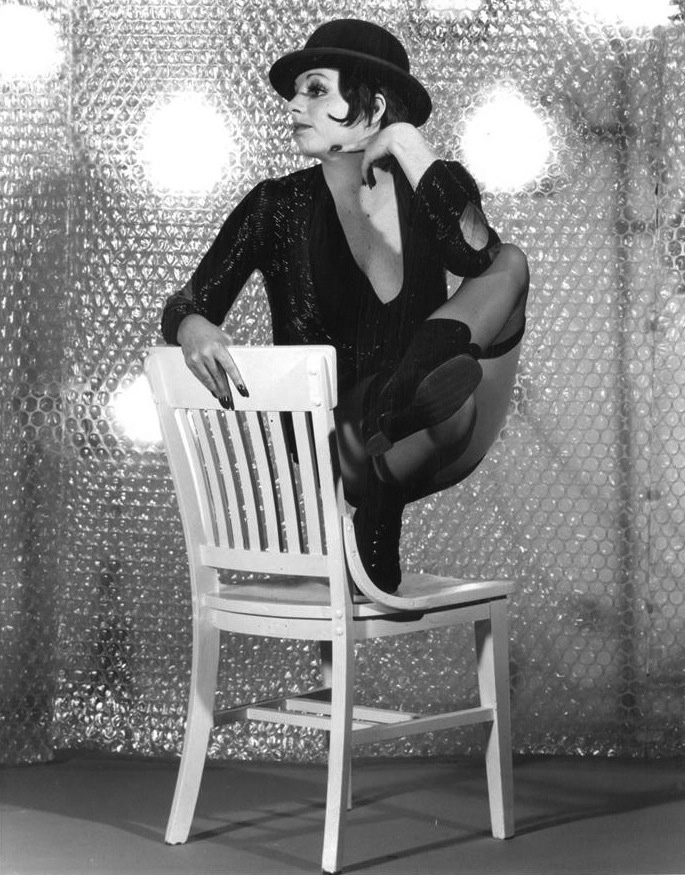
Cabaret has been cited by TV Guide as among the greatest films made and in Movieline magazine as one of the "100 Best Movies Ever". It was included in Film4's "100 Greatest Films of All Time" at #78 and in The San Francisco Chronicles "Hot 100 Films of the Past", being hailed as "the last great musical. Liza Minnelli plays Sally Bowles, an American adrift in pre-Nazi Berlin, in Bob Fosse's stylish, near-perfect film."
David Benedict has written in The Guardian about Cabaret influence in musical films: "Back then, musicals were already low on film-goers' lists, so how come it was such a success? Simple: Cabaret is the musical for people who hate them. Given the vibrancy of its now iconic numbers – Liza Minnelli in bowler and black suspenders astride a bentwood chair belting out 'Mein Herr' or shimmying and shivering with pleasure over 'Money' with Joel Grey – it sounds strange to say it, but one of the chief reasons why Cabaret is so popular is that it's not shot like a musical."
The film has been listed as one of the most important for queer cinema for its depictions of bisexuality, arguably transgressive at the time of its 1972 post-Code release and has been credited with turning Liza Minnelli into a gay icon. Film blogs have selected it as "the gayest winner in the history of the Academy." Filmmaker Bill Condon cited the film as a source of inspiration for his 2025 adaptation of Kander and Ebb's stage musical version of Kiss of the Spider Woman.
In a February 2020 article, Vulture named Cabaret as one of "The Best Movies That Lost Best Picture at the Oscars."
Home media
The film was first released to DVD in 1998. There have been releases in 2003, 2008, and 2012. The film's international ancillary distribution rights are owned by ABC (now part of The Walt Disney Company), Fremantle (UK), Warner Bros. (which acquired the film as part of its purchase of Lorimar Productions, which had acquired the film library of Allied Artists) has US domestic distribution rights.
In April 2012, Warner unveiled a new restoration of the film at the TCM Classic Film Festival. A DigiBook edition was later released on Blu-ray on February 5, 2013. Before this restoration, Cabaret had been sold on a standard-definition DVD from Warner Bros., but the film was unavailable in high-definition or for digital projections in cinemas. The original camera negative is lost, and a surviving interpositive had a vertical scratch that ran through 1,000 feet, or 10 minutes, of one of its reels, as confirmed by Ned Price, vice president of mastering and restoration for Warner Bros. The damage ostensibly was inflicted by a grain of dirt that had rolled through the length of the reel, beginning with a scene in which Michael York's character confronts a pro-Nazi boarding house resident, and had cut into the emulsion. The marred frames were digitally restored, but "the difficult part was matching the grain structure so the fix was invisible." After automated digital repair attempts failed, the 1,000 feet of damaged film was hand painted using a computer stylus.
Warner Archive Collection reissued the Blu-ray on November 20, 2018, without the DigiBook.
Notes
References
Bibliography
Francesco Mismirigo, Cabaret, un film allemand, Université de Genève, 1984
References
- "Cabaret (1972)".
- {{harvnb. Moss. 1979: Isherwood frequented "the boy-bars in Berlin in the late years of the Weimar Republic.... [He] discovered a world utterly different from the repressive English one he disliked, and with it, the excitements of sex and new subject matter."
- {{harvnb. Isherwood. 1976
- {{harvnb. Parker. 2005
- {{harvnb. Isherwood. 1976
- {{harvnb. Parker. 2005
- (February 16, 1972). "Temp and Biz in N.Y. Rise; Holders Improve; 'Abductors' $18,000, In 3d; 'Cabaret,' Opening Day, Sock $8,684".
- (February 23, 1972). "Washington Throws $ Over Hudson; Ziegfeld's Hit, At Last, 'Cabaret,' 80G; Newcomers Benefit From Holiday Span".
- (March 1, 1972). "50 Top-Grossing Films".
- (September 13, 1972). "'Cabaret' New York Area $5,282,263; Figure Is Boff; Less So In Sticks".
- (January 3, 1973). "Big Rental Films of 1972".
- (April 4, 1973). "'Cabaret' in Oscar Wow".
- (April 11, 1973). "50 Top-Grossing Films".
- (April 18, 1973). "50 Top-Grossing Films".
- (January 9, 1974). "Udated All-Time Film Champs".
- Frederick, Robert B.. (January 3, 1973). "'Godfather': & Rest Of Pack".
- "The 45th Academy Awards (1973) Nominees and Winners".
- (1973). "BAFTA Awards: Film in 1973".
- "Best Cinematography in Feature Film".
- "25th DGA Awards".
- "Cabaret – Golden Globes".
- (December 14, 2013). "KCFCC Award Winners – 1970-79".
- "1972 Award Winners".
- "Complete National Film Registry Listing".
- (19 December 2009). "Past Awards".
- "Film Hall of Fame Inductees: Productions".
- "Awards Winners". Writers Guild of America.
- Higgins, Molly. (January 25, 2025). "What Changes Have Been Made for the Jennifer Lopez-Led ''Kiss of the Spider Woman'' Movie Musical?".
- Fleming, Mike Jr.. (January 25, 2025). "Sundance: Bill Condon On Revisiting ''Kiss Of The Spider Woman'' After 40 Years & Turning Jennifer Lopez Loose In An MGM-Style Musical".
- "Cabaret Blu-ray".
- (March 2011). "Films Winning 4 or More Awards Without Winning Best Picture". Academy of Motion Picture Arts and Sciences.
- {{AFI film. 54427. Cabaret
- Aguiar, Annabel. (June 29, 2021). "'Willy Wonka and the Chocolate Factory' at 50: The tender yet terrifying movie that never lost its flavor". [[Washington Post]].
- Baines, Christian. (July 24, 2012). "10 Classic Movies Every Gay Man Must See".
- . ["Cabaret"](https://www.bbfc.co.uk/releases/cabaret-1970-2).
- . (May 31, 1973). "ABC's 5 Years of Film Production Profits & Losses". *[[Penske Media Corporation]]*.
- Belletto, Steven. (2008). "'Cabaret' and Antifascist Aesthetics". Criticism.
- Benedict, David. (June 15, 2002). "Win When You're Singing". [[Guardian Media Group]].
- Bletchly, Rachel. (April 2, 2013). "Their True Characters". [[Reach plc]].
- . ["Cabaret, Worldwide Box Office"](http://www.worldwideboxoffice.com/movie.cgi?title=Cabaret&year=1972). *Worldwide Box Office*.
- . (December 3, 2013). ["Top 10 Musicals"](https://www.theguardian.com/film/filmblog/2013/dec/03/top-10-movie-musicals). *[[Guardian Media Group]]*.
- Buck, Jerry. (March 28, 1973). "Liza Minnelli Is Named Best Actress — Brando Won't Accept Oscar". [[Ogden Newspapers]].
- Bucknell, Katherine. (August 26, 2024). "How Weimar Berlin Inspired Christopher Isherwood's Sally Bowles". [[Grove Atlantic]].
- "Cabaret (1972) soundtrack details".
- (April 25, 1974). "Christopher Isherwood on Day at Night, with James Day".
- (June 27, 1997). "Actress-comedian sings her song – 36 years after losing it to Streisand". [[Deseret News]].
- Dirks, Tim. (2013). "Cabaret (1972)".
- Doyle, Rachel B.. (April 12, 2013). "Looking for Isherwood's Berlin". [[The New York Times Company]].
- Ebert, Roger. (January 1, 1972). "Cabaret Movie Review & Film Summary (1972)". Ebert Digital LLC.
- Elber, Lynn. (April 12, 2012). "'Cabaret': Bob Fosse Classic Gets Restoration For 40th Anniversary". [[BuzzFeed]].
- Escandon, Rosa. (March 5, 2024). "The 35 Best Movie Musicals Of All Time".
- Farina, William. (2013). "The German Cabaret Legacy in American Popular Music". [[McFarland & Company]].
- Dirks, Tim. "100 Greatest Films of All Time".
- Frost, Peter. (December 31, 2013). ["Jean Ross: The Real Sally Bowles"](https://www.morningstaronline.co.uk/a-52c7-Jean-Ross-the-real-Sally-Bowles}}Frost's article is more or less a summary of the Oxford National Biography article by [[Peter Parker (author)). [[People's Press Printing Society]].
- Fryer, Jonathan. (1993). "Eye of the Camera". [[Allison & Busby]].
- Garebian, Keith. (2011). "The Making of Cabaret". [[Oxford University Press]].
- Greenspun, Roger. (February 14, 1972). "Liza Minnelli Stirs a Lively 'Cabaret'". [[The New York Times Company]].
- Guthmann, Edward. (October 5, 1997). "A Hot 100 From Out of the Past". [[The San Francisco Chronicle]].
- (September 9, 2004). "Colored Lights: Forty Years of Words and Music, Show Biz, Collaboration, and All That Jazz". [[Farrar, Straus and Giroux]].
- . ["Cabaret – Broadway Musical – Original"](https://www.ibdb.com/broadway-production/cabaret-3348/#songs). *[[The Broadway League]]*.
- Isherwood, Christopher. (1976). "Christopher and His Kind: A Memoir, 1929-1939". [[Farrar, Straus and Giroux]].
- Isherwood, Christopher. (2012). "Liberation: Diaries, Vol. 3: 1970–1983". [[HarperCollins]].
- Izzo, David Garrett. (2005). "Christopher Isherwood Encyclopedia". [[McFarland & Company]].
- Johnstone, Iain. (1975). "The Real Sally Bowles". Hanson Publications, Inc..
- Kael, Pauline. (February 12, 1972). "Grinning (Review of Cabaret)". [[Condé Nast]].
- Liebenson, Donald. (January 4, 1996). "Cinematic Legends Take Their Place in National Film Registry". [[Chicago Tribune]].
- Lehmann, John. (1987). "Christopher Isherwood: A Personal Memoir". [[Henry Holt and Company]].
- MacLean, Roy. (2014). "Berlin: Portrait of a City Through the Centuries". [[St. Martin's Press]].
- McNary, Dave. (January 31, 2012). "Restored 'Cabaret' to Open TCM Festival". [[Penske Media Corporation]].
- (February 5, 2006). "Liza Minnelli".
- Moss, Howard. (June 3, 1979). "Christopher Isherwood: Man and Work". [[The New York Times Company]].
- Dirks, Tim. "The 100 Best Movies Ever Made by Movieline Magazine".
- "Complete National Film Registry Listing". [[United States Government Publishing Office]].
- . (March 8, 1996). ["Cabaret: Original Soundtrack Recording (1972 Film)"](https://www.amazon.com/exec/obidos/ASIN/B000005KOH/soundtrackcollec).
- . (December 9, 2012). ["50 Essential Gay Films"](http://www.out.com/entertainment/movies/2011/02/09/50-essential-gay-films). *Pride Media*.
- Parker, Peter. (September 2004). "Ross, Jean Iris (1911–1973)".
- Parker, Peter. (2005). "Isherwood: A Life Revealed". [[Picador (imprint).
- Phipps, Keith. (February 2020). "The Best Movies That Lost Best Picture at the Oscars". [[Vox Media]].
- Reuben, Michael. (January 25, 2013). "Cabaret Blu-ray".
- Riedel, Michael. (March 26, 2024). "The Untold History of Cabaret: Revived and Kicking".
- Russell, Jamie. (June 6, 2002). "BBC – Films – Review – Cabaret". [[BBC]].
- Schudel, Matt. (January 23, 2019). "Kaye Ballard, comic actress and singer from vaudeville to TV, dies at 93". Nash Holdings.
- Spender, Stephen. (1966). "World Within World: The Autobiography of Stephen Spender". [[University of California Press]].
- Spender, Stephen. (October 30, 1977). "Life Wasn't a Cabaret". [[The New York Times Company]].
- St. James, James. (June 8, 2017). "The Gay Essentials: The 50 Movies Every Gay Man Needs to See".
- Steyn, Mark. (November 29, 1997). "Hammerstein, Bernstein, Blitzstein, Jule Styne – The great names of American musical theatre are Jewish.". Independent Digital News & Media Ltd.
- . (2012). ["Cabaret (1972)"](http://www.tcm.com/festival/programs/458081/index.html).
- . (2016). ["Cabaret (1972) – Notes – TCM.com"](https://www.tcm.com/tcmdb/title/21780/cabaret#notes). *[[Warner Bros.*.
- Thomson, David. (March 21, 2005). "The Observer as Hero".
- Dirks, Tim. "50 Greatest Movies from TV Guide".
- . (May 28, 1969). ["'Cabaret' Film Rights Bought for $1.5-Million"](https://www.nytimes.com/1969/05/28/archives/cabaret-film-rights-bought-for-15million.html). *[[The New York Times Company]]*.
- Murphy, A.D.. (February 16, 1972). "Cabaret". [[Penske Media Corporation]].
This article was imported from Wikipedia and is available under the Creative Commons Attribution-ShareAlike 4.0 License. Content has been adapted to SurfDoc format. Original contributors can be found on the article history page.
Ask Mako anything about Cabaret (1972 film) — get instant answers, deeper analysis, and related topics.
Research with MakoFree with your Surf account
Create a free account to save articles, ask Mako questions, and organize your research.
Sign up freeThis content may have been generated or modified by AI. CloudSurf Software LLC is not responsible for the accuracy, completeness, or reliability of AI-generated content. Always verify important information from primary sources.
Report