From Surf Wiki (app.surf) — the open knowledge base
C/2002 V1 (NEAT)
Sungrazing comet
Sungrazing comet
| Field | Value |
|---|---|
| name | C/2002 V1 (NEAT) |
| image | C 2002 V1 2003-02-01 J87 v1.jpg |
| caption | Comet NEAT on February 1, 2003 |
| discovery_ref | |
| discoverer | S. H. Pravdo |
| discovery_site | NEAT–Haleakalā (608) |
| discovery_date | 6 November 2002 |
| designations | CK02V010 |
| orbit_ref | |
| epoch | 26 December 2002 (JD 2452634.5) |
| observation_arc | 350 days |
| obs | 1,510 |
| semimajor | 1,010 AU |
| perihelion | 0.0992 AU |
| aphelion | 2,020 AU |
| eccentricity | 0.999902 |
| period | 32,123 years |
| inclination | 81.706° |
| asc_node | 64.088° |
| arg_peri | 152.170° |
| tjup | 0.061 |
| Earth_moid | 0.1511 AU |
| Jupiter_moid | 0.9175 AU |
| physical_ref | |
| mean_radius | km |
| density | kg/m3 |
| mass | 6.6 kg |
| M1 | 6.0 |
| M2 | 13.8 |
| magnitude | –0.5 |
| (2003 apparition) | |
| last_p | 18 February 2003 |
(2003 apparition)
Comet NEAT, formally designated as C/2002 V1, is a non-periodic comet that appeared in November 2002. The comet peaked with an apparent magnitude of approximately –0.5, making it the eighth-brightest comet seen since 1935. It was seen by SOHO in February 2003. At perihelion the comet was only 0.0992 AU from the Sun, where it was initially expected to be disintegrated, however reanalysis of its orbit has indicated that it has survived many of its previous perihelia, thus making breakup unlikely.
Observations
Comet NEAT was discovered from the 1.2 m Schmidt telescope of the Haleakalā Observatory as a magnitude-17 object on 6 November 2002 on the course of the Near-Earth Asteroid Tracking (NEAT) survey. The comet became visible in the naked eye by January 2003.
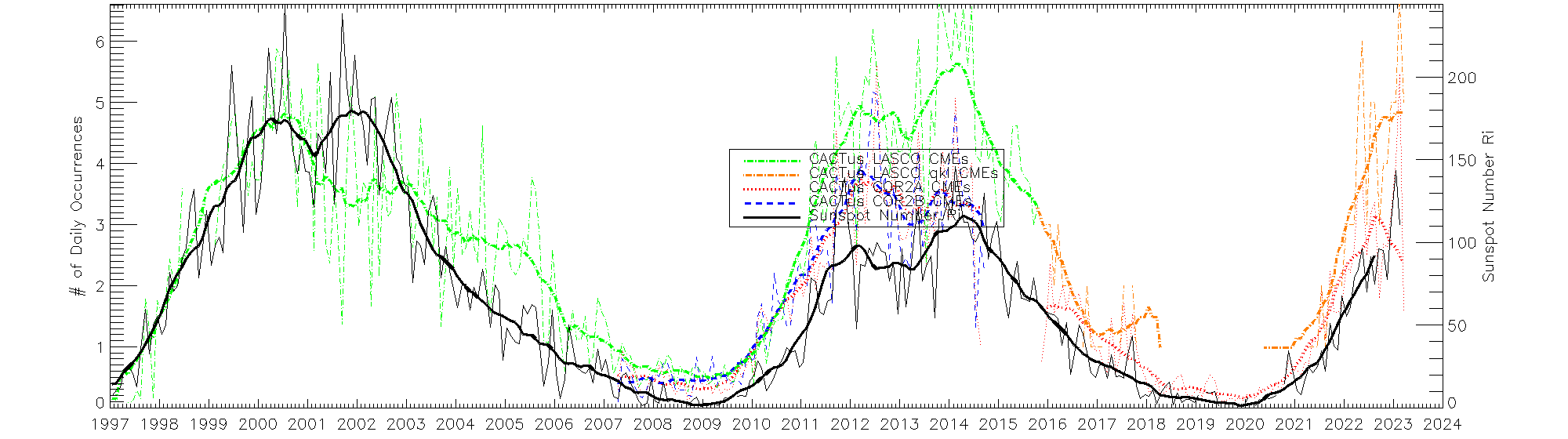
The comet was hit by a coronal mass ejection during its perihelion on 18 February 2003, where it was only 5.7 degrees from the Sun from Earth's perspective. Speculation that the CME was caused by the comet's close approach was dismissed by scientists; comets and CMEs occur close together in time only by coincidence, and there were 56 CMEs recorded in February 2003. C/2002 V1 (NEAT) appeared impressive as viewed by the Solar and Heliospheric Observatory (SOHO) as a result of the forward scattering of light off of the dust in the coma and tail. The comet remained observable with telescopes until October 2003.
The orbit of a long-period comet is properly obtained when the osculating orbit is computed at an epoch after leaving the planetary region and is calculated with respect to the center of mass of the Solar System. Using JPL Horizons, the barycentric orbital elements for epoch 2020-Jan-01 generate a semi-major axis of 1,100 AU, an apoapsis distance of 2,230 AU, and a period of approximately 37,000 years.
References
| access-date= 7 September 2011 }}
| access-date= 30 October 2024 }}
| access-date= 6 April 2011 }} (Solution using the Solar System Barycenter and barycentric coordinates. Select Ephemeris Type:Elements and Center:@0)
| access-date= 5 December 2024 | archive-date= 2 March 2003 | archive-url= https://web.archive.org/web/20030302140655/http://www.esa.int/export/esaCP/SEMD3X1A6BD_index_0.html | url-status= dead
| access-date= 12 February 2009 }}
| access-date= 5 December 2024 }}
| access-date= 5 August 2008 }}
| access-date= 7 April 2011 }}
| doi-access= free }}
| access-date= 7 October 2011 }} (CME rate)
| access-date= 5 December 2024 }}
| doi-access= free }}
| access-date= 30 October 2024 }}
| access-date= 5 December 2024 | archive-date= 4 April 2004 | archive-url= https://web.archive.org/web/20040404112347/http://www.space.com/spacewatch/comet_neat_030131.html | url-status= dead
| access-date= 5 August 2008 | archive-date= 5 June 2003 | archive-url= https://web.archive.org/web/20030605075757/http://www.space.com/scienceastronomy/neat_soho_030218.html | url-status= dead
| access-date= 5 August 2008 | archive-date= 5 March 2005 | archive-url= https://web.archive.org/web/20050305114222/http://www.space.com/scienceastronomy/comet_conspiracy_030228.html | url-status= dead
| archive-date= 5 October 2011 | archive-url= https://web.archive.org/web/20111005215531/http://sungrazer.nrl.navy.mil/index.php?p=news/comets_cmes | url-status= live | access-date= 17 April 2025
This article was imported from Wikipedia and is available under the Creative Commons Attribution-ShareAlike 4.0 License. Content has been adapted to SurfDoc format. Original contributors can be found on the article history page.
Ask Mako anything about C/2002 V1 (NEAT) — get instant answers, deeper analysis, and related topics.
Research with MakoFree with your Surf account
Create a free account to save articles, ask Mako questions, and organize your research.
Sign up freeThis content may have been generated or modified by AI. CloudSurf Software LLC is not responsible for the accuracy, completeness, or reliability of AI-generated content. Always verify important information from primary sources.
Report