From Surf Wiki (app.surf) — the open knowledge base
Burke County, North Carolina
County in North Carolina, United States

County in North Carolina, United States
| Field | Value |
|---|---|
| county | Burke County |
| state | North Carolina |
| ex image | Burke County Courthouse, Morganton, NC.jpg |
| ex image cap | Burke County Courthouse in Morganton |
| seal | Burke County Seal.png |
| logo | Burke County Logo.webp |
| motto | "All About Advancing" |
| founded | 1777 |
| named for | Thomas Burke |
| seat wl | Morganton |
| largest city wl | Morganton |
| city type | community |
| area_total_sq_mi | 514.24 |
| area_land_sq_mi | 506.24 |
| area_water_sq_mi | 8.00 |
| area percentage | 1.56 |
| population_as_of | 2020 |
| population_total | 87570 |
| pop_est_as_of | 2024 |
| population_est | 88545 |
| population_density_sq_mi | 172.98 |
| coordinates | |
| district | 14th |
| time zone | Eastern |
| web | www.burkenc.org |
| mapframe | yes |
| mapframe-marker | none |
| mapframe-marker = none
Burke County is a county in the U.S. state of North Carolina. It is part of the state's western mountain region, containing sections of the Blue Ridge Mountains including the Linville Gorge and South Mountains. As of the 2020 census, its population was 87,570. Its county seat is Morganton. Burke County is part of the Hickory-Lenoir-Morganton, NC Metropolitan Statistical Area.
History
Early history
Indigenous peoples inhabited the interior and the coastal areas for thousands of years. Native Americans of the complex and far-flung Mississippian culture inhabited the county long before Europeans arrived in the New World. They were part of a trade network extending from the Gulf Coast to the Great Lakes. They built earthwork mounds, including at Joara, a 12 acre site and regional chiefdom in North Carolina, near present-day Morganton. It was the center of the largest Native American settlement in North Carolina, dating from about 1000 AD and expanding into the next centuries.
In 1567, Spanish Juan Pardo's expedition arrived and built Fort San Juan at Joara, claiming the area for the colony of Spanish Florida. Pardo named the settlement Cuenca, after his home city. They had been sent by the governor at Santa Elena (Parris Island) in South Carolina to find an overland route to the silver mines in central Mexico, believing that the Appalachians were connected to a range there.
Captain Juan Pardo, leader of the expedition, left about 30 soldiers at the fort while continuing his exploration. His expedition built another five forts to the west, in the foothills of the mountains. In the spring of 1568, the Indians attacked Fort San Juan, killing the soldiers and burning the fort. The natives killed all soldiers except one at the garrisons, at five other Spanish forts in the interior.
A record of Pardo's expedition was not discovered and translated into English until the late 20th century. In the 1990s, excavation was started at a site believed to be Joara, continuing into the 21st century. In 2013, archeologists announced that they had found remains of Fort San Juan at Joara, confirming early accounts. This has changed knowledge and interpretation of early European encounters and colonization efforts in what would become the United States, as Spanish efforts preceded the successful efforts of England in Jamestown, Virginia, by 40 years.
18th century
In 1777, during the American Revolutionary War, Burke County was formed from Rowan County. It was named for Thomas Burke, then serving as a delegate to the Continental Congress (1777 to 1781). He was later elected as governor of North Carolina, serving one term from 1781 to 1782. The western Piedmont was settled by many Scots-Irish and German immigrants in the mid- to late 18th century. They were generally yeoman farmers and fiercely independent.
The Burke County Regiment participated in the Battle of Kings Mountain, which pitted Appalachian frontiersmen against the Loyalist forces of British commander Ferguson at Kings Mountain, SC, in the American Revolution. Rather than waiting for Ferguson to invade their territory, militiamen throughout the Blue Ridge who crossed over the mountains to meet the enemy were known as the Over Mountain Men.
As population increased, the county was divided to form other jurisdictions. In 1791, parts of Burke County and Rutherford County were combined to form Buncombe County.
19th century
In 1833, parts of Burke and Buncombe Counties were combined to form Yancey County. In 1841, parts of Burke and Wilkes Counties were combined to form Caldwell County. In 1842, additional parts of Burke and Rutherford Counties were combined to form McDowell County. Finally, in 1861, parts of Burke, Caldwell, McDowell, Watauga, and Yancey Counties were combined to form Mitchell County.
Geography
According to the U.S. Census Bureau, the county has a total area of 514.24 sqmi, of which 506.24 sqmi is land and 8.00 sqmi (1.56%) is water. The county contains portions of two lakes: Lake James along its western border with McDowell County and Lake Rhodhiss along its northeastern border with Caldwell County.
Table Rock, a prominent peak in the county in the east rim of Linville Gorge, part of Pisgah National Forest, has been described as "the most visible symbol in the region".
In the southern part of the county, the South Mountains State Park covers almost 21000 acre and features waterfalls and hiking trails.
National protected areas
- Blue Ridge Parkway (part)
- Linville Falls
- Linville Gorge Wilderness (part)
- Pisgah National Forest (part)
State and local protected areas
- Johns River Game Land
- Lake James State Park (part)
- Pisgah National Forest Game Land (part)
- Pisgah (WRC) Game Land (part)
- South Mountains Game Lands (part)
- South Mountains State Park
Major water bodies
- Canoe Creek
- Catawba River
- Dales Creek
- Drowning Creek
- Hall Creek
- Henry Fork
- Irish Creek
- Jacob Fork
- Lake James
- Lake Rhodhiss
- Linville River
- Little River
- Old Catawba River
- Pearcey Creek
- Rock Creek
- Roses Creek
- Silver Creek
- Upper Creek
Adjacent counties
- Avery County – northwest
- Caldwell County – north
- Catawba County – east
- Cleveland County – south
- Rutherford County – south
- McDowell County – west
Major highways
Major infrastructure
- Foothills Regional Airport (partially in Caldwell County)
- Hickory Regional Airport (partially in Catawba County)
Demographics
|align-fn=center 1790–1960 1900–1990 1990–2000 2010 2020
2020 census
| Race / Ethnicity (NH = Non-Hispanic) | title=P004: Hispanic or Latino, and Not Hispanic or Latino by Race – 2000: DEC Summary File 1 – Burke County, North Carolina | url=https://data.census.gov/table/DECENNIALSF12000.P004?q=P004:+HISPANIC+OR+LATINO,+AND+NOT+HISPANIC+OR+LATINO+BY+RACE+[73]&g=050XX00US37023 | publisher=United States Census Bureau | access-date= }} | title=P2 Hispanic or Latino, and Not Hispanic or Latino by Race – 2010: DEC Redistricting Data (PL 94-171) - Burke County, North Carolina | url=https://data.census.gov/table/DECENNIALPL2010.P2?q=p2&g=050XX00US37023 | website=United States Census Bureau}} | % 2000 | % 2010 |
|---|---|---|---|---|---|---|---|---|---|
| White alone (NH) | 75,727 | 75,472 | 68,664 | 84.95% | |||||
| Black or African American alone (NH) | 5,953 | 5,953 | 4,762 | 6.68% | |||||
| Native American or Alaska Native alone (NH) | 213 | 207 | 238 | 0.24% | |||||
| Asian alone (NH) | 3,093 | 3,163 | 3,150 | 3.47% | |||||
| Pacific Islander alone (NH) | 80 | 162 | 64 | 0.09% | |||||
| Other race alone (NH) | 89 | 87 | 240 | 0.10% | |||||
| Mixed race or Multiracial (NH) | 813 | 1,234 | 3,268 | 0.91% | |||||
| Hispanic or Latino (any race) | 3,180 | 4,634 | 7,184 | 3.57% | |||||
| Total | 89,148 | 90,912 | 87,570 | 100.00% |
As of the 2020 census, 87,570 people and 25,391 families resided in the county. The median age was 44.2 years, 20.0% of residents were under the age of 18, 20.9% of residents were 65 years of age or older, for every 100 females there were 98.7 males, and for every 100 females age 18 and over there were 97.3 males age 18 and over.
There were 35,140 households in the county, of which 27.2% had children under the age of 18 living in them. Of all households, 47.4% were married-couple households, 18.4% were households with a male householder and no spouse or partner present, and 27.5% were households with a female householder and no spouse or partner present. About 28.5% of all households were made up of individuals and 13.9% had someone living alone who was 65 years of age or older.
There were 39,525 housing units, of which 11.1% were vacant. Among occupied housing units, 71.7% were owner-occupied and 28.3% were renter-occupied. The homeowner vacancy rate was 1.3% and the rental vacancy rate was 8.0%.
The racial makeup of the county was 79.6% White, 5.5% Black or African American, 1.5% American Indian and Alaska Native, 3.6% Asian, 0.1% Native Hawaiian and Pacific Islander, 4.4% from some other race, and 5.3% from two or more races. Hispanic or Latino residents of any race comprised 8.2% of the population.
54.1% of residents lived in urban areas, while 45.9% lived in rural areas.
2000 census
At the 2000 census, 89,148 people, 34,528 households, and 24,342 families were residing in the county. The population density was 176 /mi2. The 37,427 housing units had an average density of 74 /mi2. The racial makeup of the county was 86.01% White, 6.71% African American, 0.30% Native American, 3.48% Asian, 0.21% Pacific Islander, 2.17% from other races, and 1.11% from two or more races. About 3.57% of the population were Hispanics or Latinos of any race.
Of the 34,528 households, 31.0% had children under 18 living with them, 54.9% were married couples living together, 11.0% had a female householder with no husband present, and 29.5% were not families. About 25.5% of all households were made up of individuals, and 9.9% had someone living alone who was 65 or older. The average household size was 2.48, and the average family size was 2.94.
In the county, the age distribution was 24.0% under 18, 8.90% from 18 to 24, 29.6% from 25 to 44, 24.0% from 45 to 64, and 13.4% who were 65 or older. The median age was 37 years. For every 100 females, there were 100.00 males. For every 100 females 18 and over, there were 97.70 males.
The median income for a household in the county was $35,629, and for a family was $42,114. Males had a median income of $27,591 versus $21,993 for females. The per capita income for the county was $17,397. About 8.00% of families and 10.70% of the population were below the poverty line, including 13.6% of those under 18 and 12.5% of those 65 or over.
Government and politics
Burke County leans heavily Republican in presidential elections. The last Democrat to carry the county was Jimmy Carter in 1976. Lyndon Johnson, who won the county as a Democrat in 1964, was the only other one to do so since World War II. However, as late as the 1990s, Democratic presidential candidates have managed to garner 40% of the county's vote. As was typical for all of the South outside the Appalachian highlands and a few stronghold Republican counties, Burke County was mostly solidly Democratic before World War II.
In the North Carolina Senate, Burke County lies within the 46th Senate district, which also covers Cleveland County and is represented by Republican Warren Daniel. In the North Carolina House of Representatives, the northern two-thirds of Burke County comprises the 86th District represented by Republican Hugh Blackwell. The southern third lies within the 112nd district, which also covers Rutherford County and is represented by Republican David Rogers.
Burke County is a member of the regional Western Piedmont Council of Governments. The county is governed by a five-member Board of Commissioners, elected to serve four-year terms.
Communities
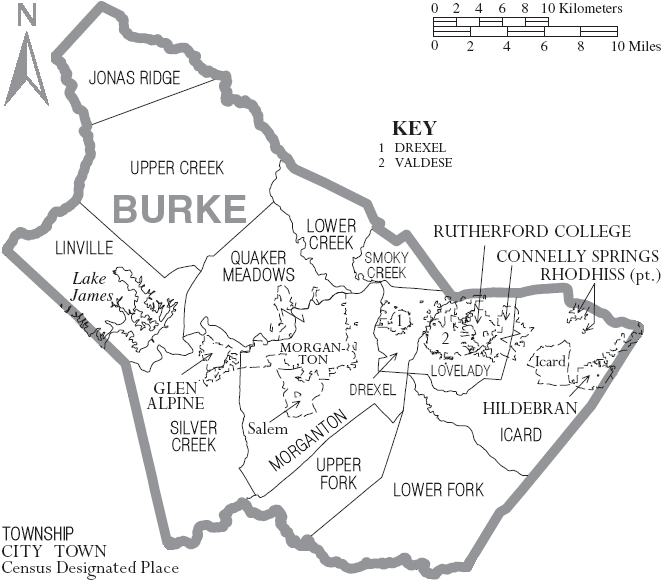
City
- Morganton (county seat and largest community)
Towns
- Connelly Springs
- Drexel
- Glen Alpine
- Hildebran
- Long View
- Rhodhiss
- Rutherford College
- Valdese
Townships
- Drexel
- Icard
- Jonas Ridge
- Linville
- Lovelady
- Lower Creek
- Lower Fork
- Quaker Meadows
- Silver Creek
- Smoky Creek
- Upper Creek
- Upper Fork
- Hildebran
- Connelly Springs
- Rutherford College
- Valdese
Census-designated places
- Icard
- Salem
Unincorporated communities
- Amherst
- Enola
- Jonas Ridge
- Linville Falls
- Petersburg
- Pleasant Grove
- Sunnyside
- Chesterfield
Education
All of Burke County is in the Burke County Schools school district.
In popular culture
Although never explicitly mentioned by name in the novel, the hideout of Robur-the villain in Jules Verne's Master of the World-is thought to be Table Rock Mountain in Burke County.
The outdoor drama From This Day Forward has been performed annually in Burke County since 1968. It tells the story of the founding of the town of Valdese.
Many scenes from the 1992 film Last of the Mohicans were filmed in Burke County. A full-scale fort was built next to the Linville boat access on Lake James for the filming. The fort was later destroyed and the land replanted with trees. Many of the extras who played settlers, British soldiers, and Native Americans were locals from Burke and surrounding counties.
The final scene from The Hunt for Red October had the backdrop filmed on Lake James, while the actors stayed in Hollywood.
In 2011, scenes for the Lionsgate adaptation of The Hunger Games were filmed near Hildebran, North Carolina, at the Henry River Mill Village.
References
References
- "Find a County". National Association of Counties.
- [http://www.warren-wilson.edu/~arch/fs2004/background.html David Moore, Robin Beck, and Christopher Rodning, "In Search of Fort San Juan: Sixteenth Century Spanish and Native Interaction in the North Carolina Piedmont"] {{Webarchive. link. (June 17, 2009 , Warren Wilson College Archaeology Home Page, 2004, accessed June 26, 2008)
- [https://www.nytimes.com/2013/07/23/science/fort-tells-of-spains-early-ambitions.html John Noble Wilford, "Fort Tells of Spain’s Early Ambitions"], ''New York Times'', July 22, 2013, accessed July 22, 2013
- (Clark, "Burke County," pp. 37–39)
- (August 23, 2022). "2020 County Gazetteer Files – North Carolina". United States Census Bureau.
- Clark, Larry. (2007). "Burke County, North Carolina: Historic Tales from the Gateway to the Blue Ridge". The History Press.
- "NCWRC Game Lands".
- "County Population Totals and Components of Change: 2020-2024". United States Census Bureau.
- "U.S. Decennial Census". United States Census Bureau.
- "Historical Census Browser". University of Virginia Library.
- (March 27, 1995). "Population of Counties by Decennial Census: 1900 to 1990". United States Census Bureau.
- (April 2, 2001). "Census 2000 PHC-T-4. Ranking Tables for Counties: 1990 and 2000". United States Census Bureau.
- "State & County QuickFacts". United States Census Bureau.
- "QuickFacts: Burke County, North Carolina". United States Census Bureau.
- "P004: Hispanic or Latino, and Not Hispanic or Latino by Race – 2000: DEC Summary File 1 – Burke County, North Carolina". [[United States Census Bureau]].
- "P2 Hispanic or Latino, and Not Hispanic or Latino by Race – 2010: DEC Redistricting Data (PL 94-171) - Burke County, North Carolina".
- "P2 Hispanic or Latino, and Not Hispanic or Latino by Race – 2020: DEC Redistricting Data (PL 94-171) - Burke County, North Carolina".
- (2021). "2020 Decennial Census Demographic Profile (DP1)".
- (2021). "2020 Decennial Census Redistricting Data (Public Law 94-171)".
- (2023). "2020 Decennial Census Demographic and Housing Characteristics (DHC)".
- "U.S. Census website". [[United States Census Bureau]].
- "Burke County Board of Commissioners".
- Leip, David. "Dave Leip's Atlas of U.S. Presidential Elections".
- Geography Division. (January 8, 2021). "2020 CENSUS - SCHOOL DISTRICT REFERENCE MAP: Burke County, NC". [[U.S. Census Bureau]].
- (June 3, 1973). "Outdoor Drama At Valdese Has Long Run". [[Charlotte Observer]].
This article was imported from Wikipedia and is available under the Creative Commons Attribution-ShareAlike 4.0 License. Content has been adapted to SurfDoc format. Original contributors can be found on the article history page.
Ask Mako anything about Burke County, North Carolina — get instant answers, deeper analysis, and related topics.
Research with MakoFree with your Surf account
Create a free account to save articles, ask Mako questions, and organize your research.
Sign up freeThis content may have been generated or modified by AI. CloudSurf Software LLC is not responsible for the accuracy, completeness, or reliability of AI-generated content. Always verify important information from primary sources.
Report