From Surf Wiki (app.surf) — the open knowledge base
Bunker buster
Munition for penetrating hardened or deeply buried targets

Munition for penetrating hardened or deeply buried targets
A bunker buster is a type of munition that is designed to penetrate hardened targets or targets buried deep underground, such as military bunkers.
Armor piercing shells
Röchling shells were bunker-busting artillery shells, developed by the German engineer August Coenders, based on the theory of increasing sectional density to improve penetration. They were tested in 1942 and 1943 against the Belgian Fort d'Aubin-Neufchâteau.
Aircraft delivered bombs
World War II
Germany
In World War II the Luftwaffe developed a series of unguided rocket-propelled armor-piercing bombs for use against shipping and fortifications.
United Kingdom
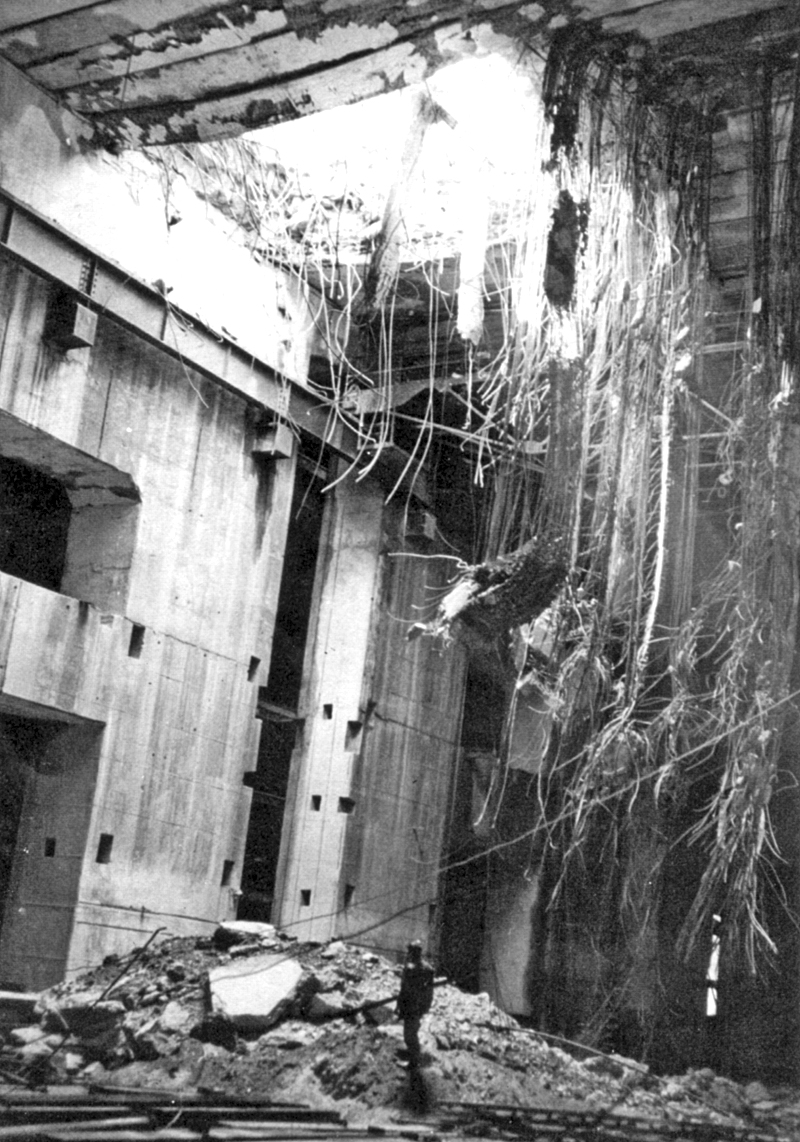

In World War II, the British designer Barnes Wallis, already famous for inventing the bouncing bomb, designed two bombs that would become the conceptual predecessors of modern bunker busters: the five tonne Tallboy and the ten tonne Grand Slam. These were "Earthquake" bombs—a concept he had first proposed in 1939. The designs were very aerodynamic, allowing them to exceed the speed of sound as they fell from 22,000 ft (6,700 m). The tails were designed with offset fins causing the bombs to spin as they fell. Using the same principle as a spinning top, this enabled them to resist being deflected, thereby improving accuracy. They had casings of high grade steel, much stronger than the typical World War II bomb so that they would survive hitting a hardened surface, or penetrate deep into the ground.
Though these bombs might be thought of as "bunker busters" today, the original "earthquake" theory was more complex and subtle than simply penetrating a hardened surface. The earthquake bombs were designed not to strike a target directly, but to impact beside it, penetrate under it, and create a 'camouflet', or large buried cavern, at the same time as delivering a shock wave through the target's foundations. The target then collapses into the hole, no matter how hardened it may be. The bombs had strong casings because they needed to travel through rock rather than reinforced concrete, though they could perform equally well against hardened surfaces. In an attack on the Valentin U-Boat pens at Farge, two Grand Slams went through the 15 ft (4.5 m) reinforced concrete hardening—equalling or exceeding the best current penetration specifications.
The British Disney bomb (officially "4500 lb [2,000 kg] Concrete piercing/Rocket Assisted Bomb", also known as the "Crab") was a World War II device designed to be used against U-boat pens and other super-hardened targets. Devised by Captain Edward Terrell RNVR of the Admiralty's Directorate of Miscellaneous Weapons Development, it had a streamlined hardened case and weighed about 4500 lb including the rocket assembly. The actual explosive content was about 500 lb.
For accuracy, the bombs had to be dropped precisely from a pre-determined height (usually 20000 ft). They would free-fall for around 30 seconds until, at 5000 ft, the rockets were ignited, causing the tail section to be expelled. The rocket burn lasted for three seconds and added 300 ft/s to the bomb's speed, giving a final impact speed of 1450 ft/s, approximately Mach 1.29.Other sources mention a striking speed of 2400 ft/s. (, ) Post-war tests demonstrated that the bombs were able to penetrate a 14 ft thick concrete roof, with the predicted (but untested) ability to penetrate 16 ft of concrete.
United States
Post war, the US added a form of remote guidance to the Tallboy to create the Tarzon, a 12,000 lb bomb deployed in the Korean War against an underground command center near Kanggye.
Modern


The US BLU-109 bomb is intended to penetrate concrete shelters and other hardened structures before exploding. It entered service in 1985. Israeli F-15I fighter jets are believed to have used BLU-109s in the strikes that killed Hezbollah leader Hassan Nasrallah in Beirut on 27 September 2024.
During Operation Desert Storm (1991), there was a need for a deep penetration bomb similar to the British weapons of World War II, but none of the NATO air forces had such a weapon. As a stop-gap, some were developed over a period of 28 days, using old 8 inch (203 mm) artillery barrels as casings. These bombs weighed over two tons and carried 647 lb of high explosive. They were laser-guided and were designated "Guided Bomb Unit-28 (GBU-28)". It was proven effective for the intended role.
An example of a Russian bunker buster is the KAB-1500L-Pr. It is delivered with the Su-24M and the Su-34 aircraft. It is stated to be able to penetrate 10–20 m of earth or 2 m of reinforced concrete. The bomb weighs 1500 kg, with 1100 kg being the high explosive penetrating warhead. It is laser guided and has a reported strike accuracy of 7 m CEP.
The US has a series of custom made bombs such as the Paveway series of laser-guided bombs to penetrate hardened or deeply buried structures:
| Depth of Penetration | |
|---|---|
| reinforced concrete | Weapon Systems |
| 1.8 m | BLU-109 Penetrator |
| 3.4 m | BLU-116 Advanced Unitary Penetrator (AUP) |
| BLU-118/B Thermobaric weapon | GBU-15, GBU-24, AGM-130 |
| more than 6 m | BLU-113 Super Penetrator |
| 18 m | BLU-127 Massive Ordnance Penetrator |
Turkey is another country known to be developing bunker busters, such as the SARB-83 and NEB-84.
Fuzing
The traditional fuze is the same as a classic armor-piercing bomb: a combination of timer and a sturdy dynamic propeller on the rear of the bomb. The fuze is armed when the bomb is released, and detonates when the propeller stops turning and the timer has expired.
Modern bunker busters may use a conventional fuze, but some also include a microphone and microcontroller. The microphone listens, and the microcontroller counts the number of floors until the bomb breaks through the desired numbers of floors. Northrop Grumman is working on the Hard Target Void Sensing Fuze (HTVSF), an electronic and cockpit programmable fuze capable of destroying deeply buried targets. It provides multiple delay arming and detonation times, as well as a void-sensing capability, which allows for precision activation of the fuze for 2000 and weapons to explode when they reach an open space in a deeply buried bunker.
Missiles
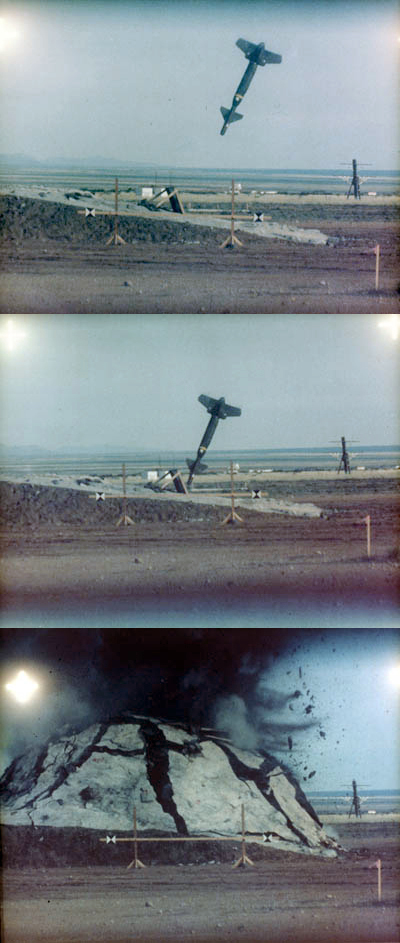
The extra speed provided by a rocket motor enables greater penetration of a missile-mounted bunker buster warhead. To reach maximum penetration (impact depth), the warhead may consist of a high-density projectile only. Such a warhead carries more energy than a warhead with chemical explosives (kinetic energy of a projectile at hypervelocity).
Nuclear
Main article: Nuclear bunker buster
The nuclear bunker buster is the nuclear weapon version of the bunker buster. The non-nuclear component of the weapon is designed to greatly enhance the penetration into soil, rock, or concrete to deliver a nuclear warhead to a target. These weapons would be used to destroy deeply buried hardened, underground military bunkers. In theory, the amount of radioactive nuclear fallout would be reduced from that of a standard, air-burst nuclear detonation because they would have relatively low explosive yield. However, because such weapons necessarily come into contact with large amounts of earth-based debris, they may, under certain circumstances, still generate significant fallout. Warhead yield and weapon design have changed periodically throughout the history of the design of such weapons. An underground explosion releases a larger fraction of its energy into the ground, compared to an explosion at or above the surface which releases most of its energy into the atmosphere.
Notes
References
- "Running parallel with the development of large bombs was a project for obtaining high striking velocities by means of a rocket assisted 4,500-lb [2,000 kg] British bomb called the Disney. (...) As early as June 1945, the concrete V-weapon structure at Watten was used as a target".
- Figure 280, p. 558, provides a detailed diagram of the Disney bomb (with its internals).
References
- "Les étranges obus du fort de Neufchâteau ''(suite)''".
- (28 September 2024). "'Banned' Bunker-Buster Bombs used by Israel to kill Hezbollah chief Hassan Nasrallah: 7 things to know". Mint.
- {{harvnb. Project Ruby. 1946
- "Earthquake Bombs". Barnes Wallis Foundation.
- {{harvnb. Burakowski. Sala. 1960
- {{harvnb. Project Ruby. 1946
- {{harvnb. Project Ruby. 1946
- (29 September 2024). "Israel likely used U.S.-made 2,000-pound bombs in Nasrallah strike, visuals show". The Washington Post.
- (30 September 2024). "US-made 2,000-pound bombs likely used in strike that killed Hezbollah chief Nasrallah, CNN analysis shows". CNN.
- "Why the Pentagon is beefing up its 'bunker buster' bombs".
- (11 August 2009). "Soviet/Russian Guided Bombs".
- "SARB-83 - Penetrator Bomb - TÜBİTAK SAGE".
- "NEB-84 - Penetrator Bomb - TÜBİTAK SAGE".
- (5 April 2011). "ATK Awarded Contract for Hard Target Void Sensing Fuze (HTVSF) Engineering & Manufacturing Development (EMD) Phase". ATK.
- (February 28, 2020). "Northrop Grumman Awarded $110 Million for US Air Force Hard Target Void Sensing Fuze".
This article was imported from Wikipedia and is available under the Creative Commons Attribution-ShareAlike 4.0 License. Content has been adapted to SurfDoc format. Original contributors can be found on the article history page.
Ask Mako anything about Bunker buster — get instant answers, deeper analysis, and related topics.
Research with MakoFree with your Surf account
Create a free account to save articles, ask Mako questions, and organize your research.
Sign up freeThis content may have been generated or modified by AI. CloudSurf Software LLC is not responsible for the accuracy, completeness, or reliability of AI-generated content. Always verify important information from primary sources.
Report