From Surf Wiki (app.surf) — the open knowledge base
Bulldozer
Mobile machine which uses a frontal blade to push large volumes of material
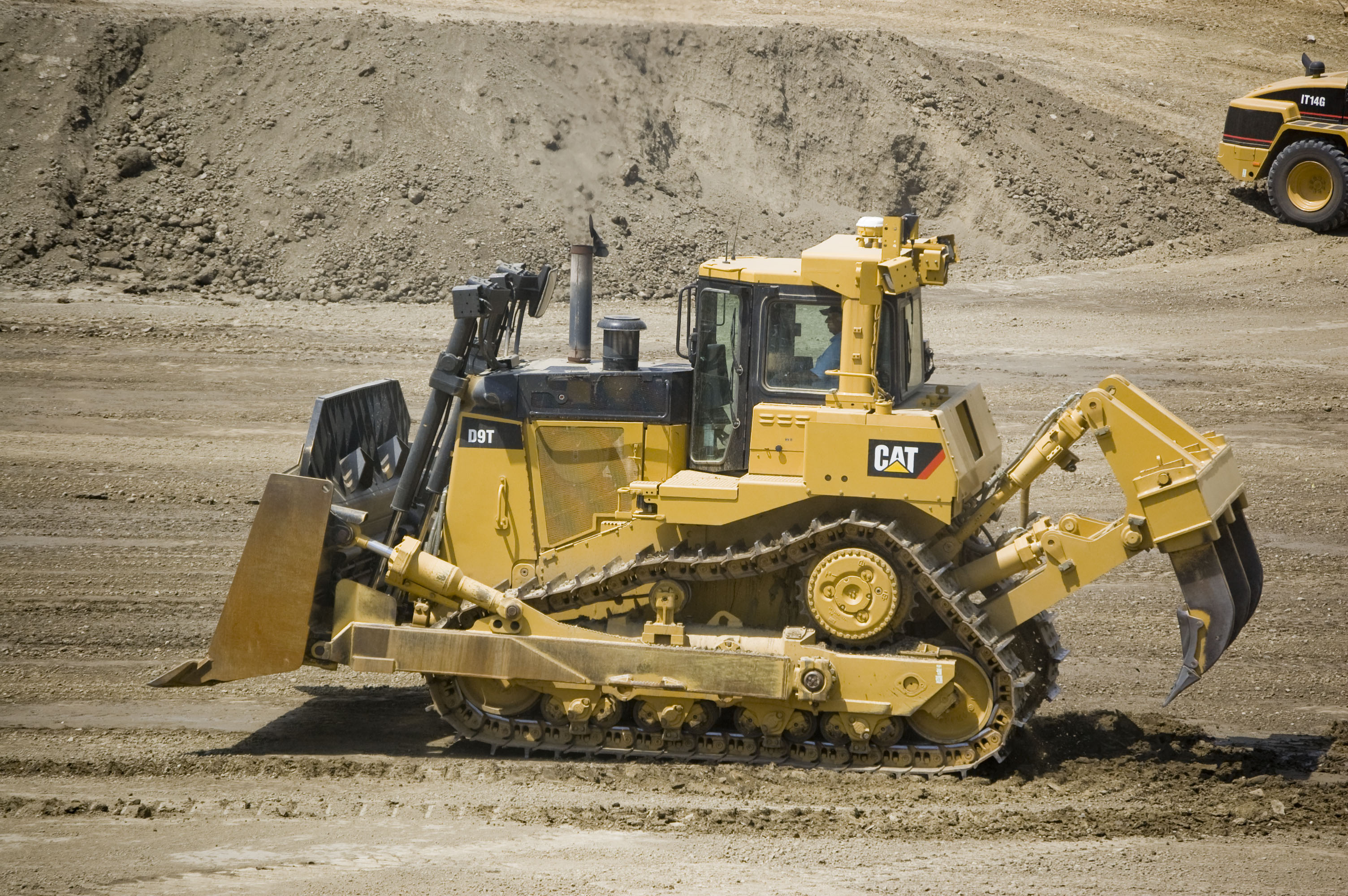
Mobile machine which uses a frontal blade to push large volumes of material
A bulldozer or dozer (also called a crawler) is a large tractor equipped with a metal blade at the front for pushing material (soil, sand, snow, rubble, or rock) during construction work. It travels most commonly on continuous tracks, though specialized models riding on large off-road tires are also produced. Its most popular accessory is a ripper, a large hook-like device mounted singly or in multiples in the rear to loosen dense materials.
Bulldozers are used heavily in large and small scale construction, road building, mining and quarrying, on farms, in heavy industry factories, and in military applications in both peace and wartime.
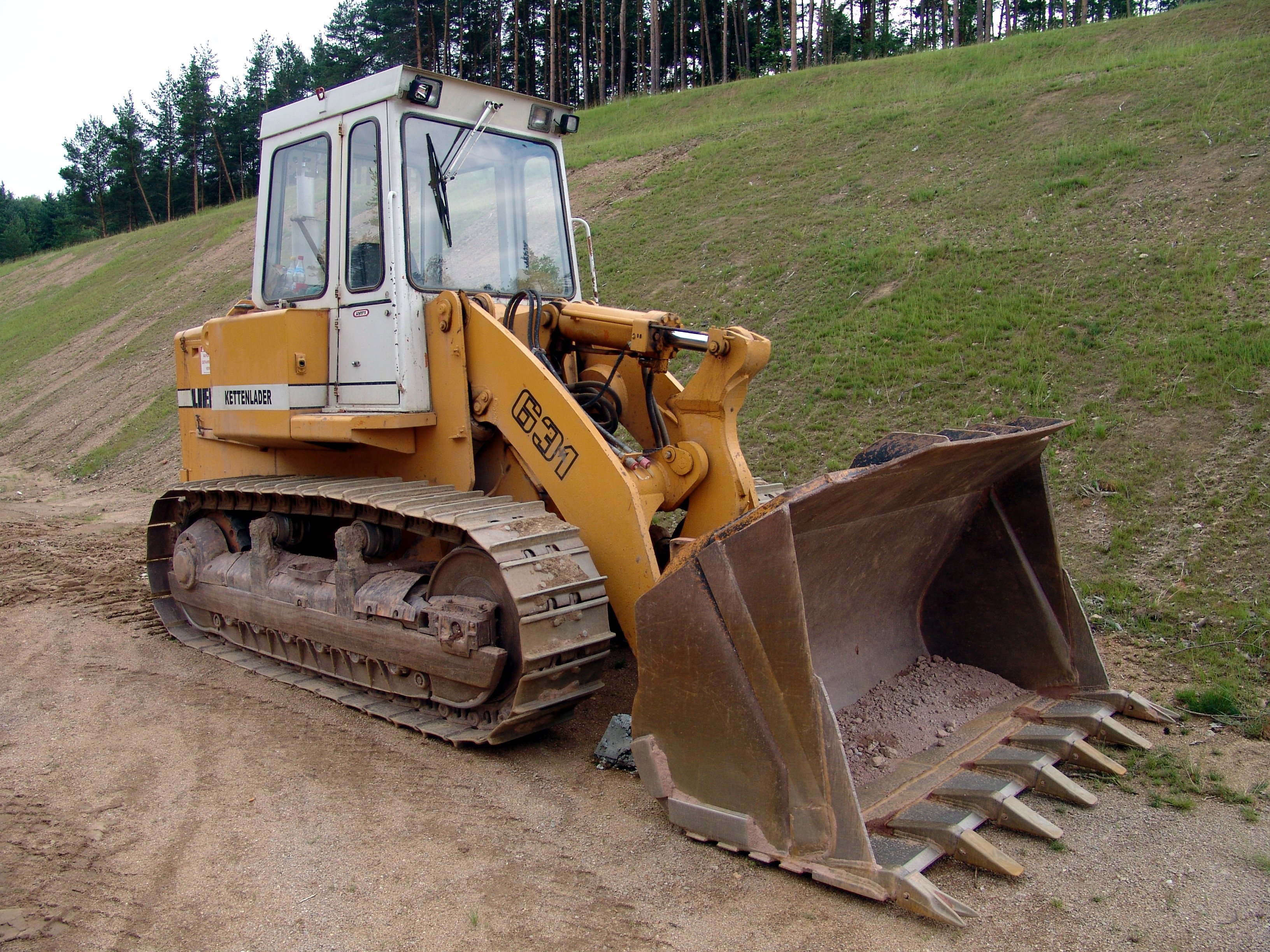
The word "bulldozer" refers only to a motorized unit fitted with a blade designed for pushing. The word is sometimes used inaccurately for other heavy equipment such as the generally similar front-end loader designed for carrying material rather than pushing it. The term originally referred only to the blade attachment but is now commonly applied to any crawler tractor with a front-mounted blade.
Description
|[[File:Liebherr 722 Planierraupe 2.JPG|thumb|The same bulldozer's multishank ripper]]}}
Typically, bulldozers are large and powerful tractors with continuous tracked treads. The tracks give them excellent traction and mobility through very rough terrain. Wide tracks also help distribute the vehicle's weight over a large area (decreasing ground pressure), thus preventing it from sinking in sandy or muddy ground. Extra-wide tracks are known as swamp tracks or low ground pressure (lgp) tracks. Bulldozers have transmission systems designed to take advantage of the track system and provide excellent tractive force.
These traits allow bulldozers to excel in road building, construction, mining, forestry, land clearing, infrastructure development, and any other projects requiring highly mobile, powerful, and stable earth-moving equipment.
A variant is the all-wheel-drive wheeled bulldozer, which generally has four large rubber-tired wheels, hydraulically operated articulated steering, and a hydraulically actuated blade mounted forward of the articulation joint.
The bulldozer's primary tools are the blade and the ripper:
Blade

.jpg)
Bulldozer blades come in three types:
- straight ("S blade"), short with no lateral curve or side wings. Can be used for fine grading.
- universal ("U blade"), tall and very curved, with large side wings to maximize load.
- combination ("S-U", or semi-U), shorter, with less curvature and smaller side wings. It is typically used for pushing large rocks, as at a quarry.
Blades can be fitted straight across the frame, or at an angle. All can be lifted, some, with additional hydraulic cylinders, can be tilted to vary the angle up to one side.
Sometimes, a bulldozer is used to push or pull another piece of earth-moving equipment known as a "scraper" to increase productivity. The towed Fresno Scraper, invented in 1883 by James Porteous, was the first design to enable this to be done economically, removing the soil from an area being cut and depositing where needed as fill. Dozer blades with a reinforced center section for pushing are known as "bull blades".
Dozer blades are added to combat engineering vehicles and other military equipment, such as artillery tractors such as the Type 73 or M8 tractor, to clear battlefield obstacles and prepare firing positions. Dozer blades may be mounted on main battle tanks to clear antitank obstacles or mines, and dig improvised shelters.
Ripper
A ripper is a long, claw-like shank that may be mounted singly or in multiples on the rear of a bulldozer to loosen hard and impacted materials. It is raised and lowered as desired by hydraulic cylinders. Usually a single shank is preferred for heavy ripping. The ripper is equipped with a replaceable tungsten steel alloy tip, known as a boot.
Ripping can not only loosen soil (such as podzol hardpan) in agricultural and construction applications but break shaly rock or pavement into easily handled rubble.
A variant of the ripper is the stumpbuster, a single spike protruding horizontally used to split a tree stump. File:Caterpillar D9N.jpg|A Caterpillar D9N equipped with a single-shank ripper File:Liebherr 724 Planierraupe 4.jpg|Multishank ripper
Variants
Armored bulldozers
Main article: Armored bulldozer

Bulldozers employed for combat-engineering roles are often fitted with armor to protect the driver from firearms and debris, enabling bulldozers to operate in combat zones. The most widely documented use is the Israeli Military militarized Caterpillar D9, for earth moving, clearing terrain obstacles, opening routes, and detonating explosive charges. The IDF used armoured bulldozers extensively during Operation Rainbow where they were used to uproot Gaza Strip smuggling tunnels and destroy residential neighbourhoods, water wells and pipes, and agricultural land to expand the military buffer zone along the Philadelphi Route. This use drew criticism against both the use and the suppliers of armoured bulldozers from human-rights organizations such as the EWASH-coalition and Human Rights Watch, the latter of whom urged Caterpillar to cease their sale of bulldozers to the IDF. The use of bulldozers was seen as necessary by Israeli authorities to uproot smuggling tunnels, destroy houses used by Palestinian gunmen, and expand the buffer zone.
Some forces' engineer doctrines differentiate between a low-mobility armoured dozer (LMAD) and a high-mobility armoured dozer (HMAD). The LMAD is dependent on a flatbed to move it to its employment site, whereas the HMAD has a more robust engine and drive system designed to give it road mobility with a moderate range and speed. HMADs, however, normally lack the full cross-country mobility characteristics of a dozer blade-equipped tank or armoured personnel carrier.
Some bulldozers have been fitted with armor by civilian operators to prevent bystanders or police from interfering with the work performed by the bulldozer, as in the case of strikes or demolition of condemned buildings. This has also been done by civilians with a dispute with the authorities, such as Marvin Heemeyer, who outfitted his Komatsu D355A bulldozer with homemade composite armor to then demolish government buildings.
Remote-controlled dozers
In recent years, innovations in the construction technology have made remote-controlled bulldozers a reality. Now, heavy machinery can be controlled from up to 1,000 feet away. This contributes to the safety of workers on the jobsite, keeping them at a secure distance from potentially dangerous jobs.
The advancement and the ability to control the heavy machinery from afar provides workers with the sufficient control over the dozers to get the job done. Though these machines are still in their early stages, many construction companies are using them successfully.
History


The first bulldozers were adapted from Holt farm tractors that were used to plough fields. The versatility of tractors in soft ground for logging and road building contributed to the development of the armored tank in World War I.
In 1923, farmer James Cummings and draftsman J. Earl McLeod made the first designs for the bulldozer. A replica is on display at the city park in Morrowville, Kansas, where the two built the first bulldozer. On December 18, 1923, Cummings and McLeod filed U.S. patent #1,522,378 that was later issued on January 6, 1925, for an "Attachment for Tractors."
By the 1920s, tracked vehicles became common, particularly the Caterpillar 60. Rubber-tired vehicles came into use in the 1940s. To dig canals, raise earthen dams, and do other earth-moving jobs, these tractors were equipped with a large, thick, metal plate in front. (The blade got its curved shape later). In some early models, the driver sat on top in the open without a cabin. The three main types of bulldozer blades are a U-blade for pushing and carrying soil relatively long distances, a straight blade for "knocking down" and spreading piles of soil, and a brush rake for removing brush and roots. These attachments (home-built or built by small equipment manufacturers of attachments for wheeled and crawler tractors and trucks) appeared by 1929.
Widespread acceptance of the bull-grader does not seem to appear before the mid-1930s. The addition of power down-force provided by hydraulic cylinders instead of just the weight of the blade made them the preferred excavation machine for large and small contractors alike by the 1940s, by which time the term "bulldozer" referred to the entire machine and not just the attachment.
Over the years, bulldozers got bigger and more powerful in response to the demand for equipment suited for ever larger earthworks. Firms such as Caterpillar, Komatsu, Clark Equipment Co, Case, Euclid, Allis Chalmers, Liebherr, LiuGong, Terex, Fiat-Allis, John Deere, Massey Ferguson, BEML, XGMA, and International Harvester manufactured large, tracked-type earthmoving machines. R.G. LeTourneau and Caterpillar manufactured large, rubber-tired bulldozers.
Bulldozers grew more sophisticated as time passed. Improvements include drivetrains analogous to (in automobiles) an automatic transmission instead of a manual transmission, such as the early Euclid C-6 and TC-12 or Model C Tournadozer, blade movement controlled by hydraulic cylinders or electric motors instead of early models' cable winch/brake, and automatic grade control. Hydraulic cylinders enabled the application of down force, more precise manipulation of the blade, and automated controls.
A more recent innovation is the outfitting of bulldozers with GPS technology, such as manufactured by Topcon Positioning Systems, Inc., Trimble Inc, or Leica Geosystems, for precise grade control and (potentially) "stakeless" construction. As a response to the many, and often varying claims about these systems, the Kellogg Report published in 2010 a detailed comparison of all the manufacturers' systems, evaluating more than 200 features for dozers alone.
The best-known maker of bulldozers is Caterpillar. Komatsu, Liebherr, Case, Hitachi, Volvo, and John Deere are present-day competitors. Although these machines began as modified farm tractors, they became the mainstay for big civil construction projects, and found their way into use by military construction units worldwide. The best-known model, the Caterpillar D9, was also used to clear mines and demolish enemy structures.
Manufacturers
Industry statistics based on 2010 production published by Off-Highway Research showed Shantui was the largest producer of bulldozers, making over 10,000 units that year (two in five of the crawler-type dozers made worldwide). The next-largest producer by number of units is Caterpillar Inc., which produced 6,400 units.
Komatsu introduced the D575A in 1981, the D757A-2 in 1991, and the D575A-3 in 2002, which the company touts as the biggest bulldozer in the world.
Etymology
- A 19th-century term used in engineering for a horizontal forging press
- Around 1870s: In the USA, a "bulldose" was a large dose (namely, one large enough to be literally or figuratively effective against a bull) of any sort of medicine or punishment.
- By the late 1870s, "to bulldoze" and "bulldozing" were being used throughout the United States to describe intimidation "by violent and unlawful means", which sometimes meant a severe whipping or coercion, or other intimidation, such as at gunpoint. It had a particular meaning in the Southern United States as a whipping or other punishment for African Americans to suppress black voter turnout in the 1876 United States presidential election.
- 1886: "Bulldozer" meant a large-caliber pistol and the person who wielded it.
- Late 19th century: "Bulldozing" meant using brute force to push over or through any obstacle, with reference to two bulls pushing against each other's heads in a fight over dominance.
- 1930s: applied to the vehicle
These appeared as early as 1929, but were known as "bull grader" blades, and the term "bulldozer blade" did not appear to come into widespread use until the mid-1930s. "Bulldozer" now refers to the whole machine, not just the attachment. In contemporary usage, "bulldozer" is sometimes shortened to "dozer", and the verb "bulldozing" to "dozing", thus making a homophone with the pre-existing unrelated verb "dozing" (for being somnolent, napping).
Gallery
File:Cat D11 View 2.jpg|Caterpillar D11N with a double shank ripper File:Poti Seaport, Georgia — Receiving of New Bulldozers for Solid Waste Management (03).jpg|Bulldozer for solid waste management File:QRH Challenger 2s in Estonia MOD 45167094.jpg|British Challenger 2 tank fitted with pivoting dozer blade, 2020 File:Cabless Cat D8.jpg|Caterpillar D8 bulldozer without a cab File:First Tractor Company - old working model - 01.jpg|A First Tractor Company bulldozer still operational in 2012 on Xinbu Island, Hainan, China File:Zettelmeyer ZD 3001.jpg|Zettelmeyer ZD 3001 wheeled bulldozer File:Skid-steer bulldozer.webp|Skid-steer bulldozer File:Bulldozer 2.jpg|John Deere bulldozer
References
- Trewhitt, Philip. (1999). "Armoured Fighting Vehicles". Dempsey-Parr.
- "The Essential Guide to Stump-Related Attachments for Heavy Machinery".
- (2012-08-28). "Profile: Rachel Corrie". BBC News.
- (October 2004). "Razing Rafah: Mass Home Demolitions in the Gaza Strip".
- (2004-11-21). "Israel: Caterpillar Should Suspend Bulldozer Sales".
- "Israel's violations of human rights regarding water and sanitation in the OPT - Report by Al-Haq and EWASH to CESCR - Non-Un document".
- (15 June 2010). "Kansas Curiosities: Quirky Characters, Roadside Oddities & Other Offbeat Stuff". Rowman & Littlefield.
- [https://patents.google.com/patent/US1522378?oq=1522378 Patent 1522378, Attachment For Tractors, John E McLeod and James D Cummings, Filed December 18, 1923.]
- Haddock, Keith. "Euclid-General Motors' Crawler Tractor". PEI Tractor Club.
- The Kellogg Report LLC (2010). Article: The Kellogg Report. Retrieved December 15, 2010 from [https://web.archive.org/web/20110111000139/http://www.kelloggreport.com/index.html kelloggreport.com]
- (May 2011). "Shantui officially largest dozer producer in the world". The Earthmover & Civil Contractor.
- [http://www.komatsu.com.au/AboutKomatsu/NewsAndPublications/News/Pages/THE-WORLDS-BIGGEST-DOZER-ROLLS-OFF-THE-LINE.aspx "The Worlds biggest Dozer Rolls Off The Line"] {{Webarchive. link. (2015-12-30 - Retrieved 2016-02-26)
- Bartlett, John Russell. (1877). "Dictionary of Americanisms: A Glossary of Words and Phrases, Usually Regarded as Peculiar to the United States". Little, Brown, and Company.
- "What in the Word?! The racist roots of 'bulldozer'". [[Oxford University Press]].
- (19 February 2018). "Original Meaning of 'bulldozer': A Racist Bully".
- (8 October 2020). "In a Word: The Racist Origins of 'Bulldozer'".
- "History of the Bulldozer".
This article was imported from Wikipedia and is available under the Creative Commons Attribution-ShareAlike 4.0 License. Content has been adapted to SurfDoc format. Original contributors can be found on the article history page.
Ask Mako anything about Bulldozer — get instant answers, deeper analysis, and related topics.
Research with MakoFree with your Surf account
Create a free account to save articles, ask Mako questions, and organize your research.
Sign up freeThis content may have been generated or modified by AI. CloudSurf Software LLC is not responsible for the accuracy, completeness, or reliability of AI-generated content. Always verify important information from primary sources.
Report