From Surf Wiki (app.surf) — the open knowledge base
Bulgarian dialects
Overview of dialects of the Bulgarian language

Overview of dialects of the Bulgarian language
Pronunciation of man and tooth, derived from Proto-Slavic words *mǫžь and *zǫbъ on the map:
-
, (see зъб)
-
, (see заб)
-
,
-
,
-
,
-
,
-
,
-
,
-
, ]]


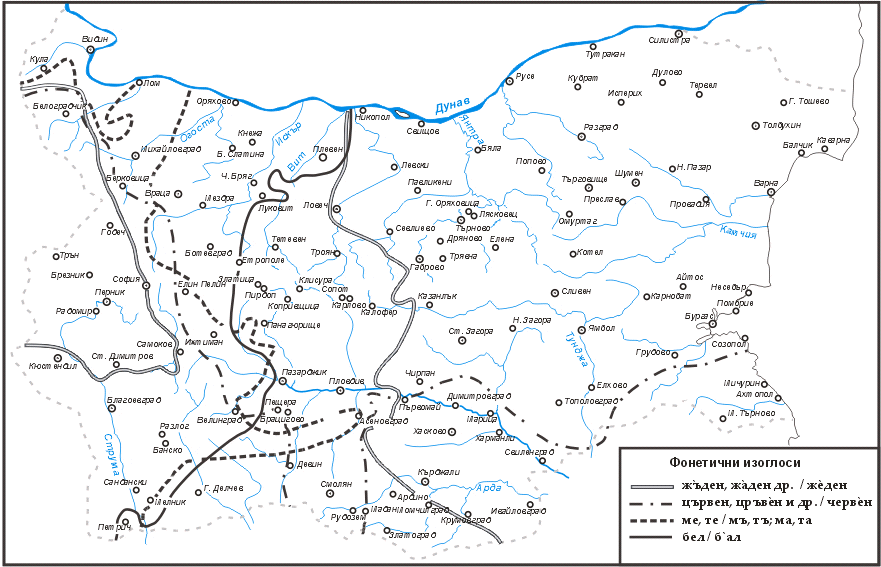


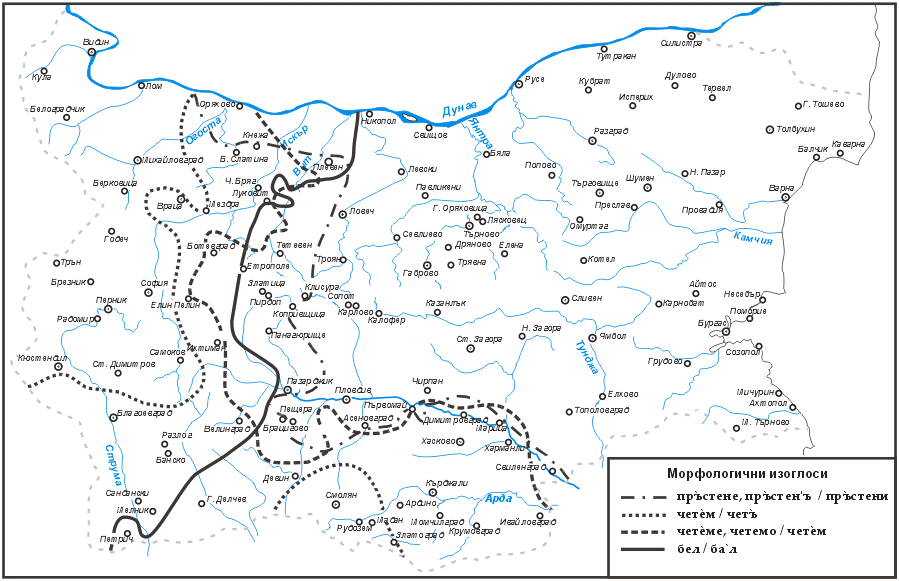
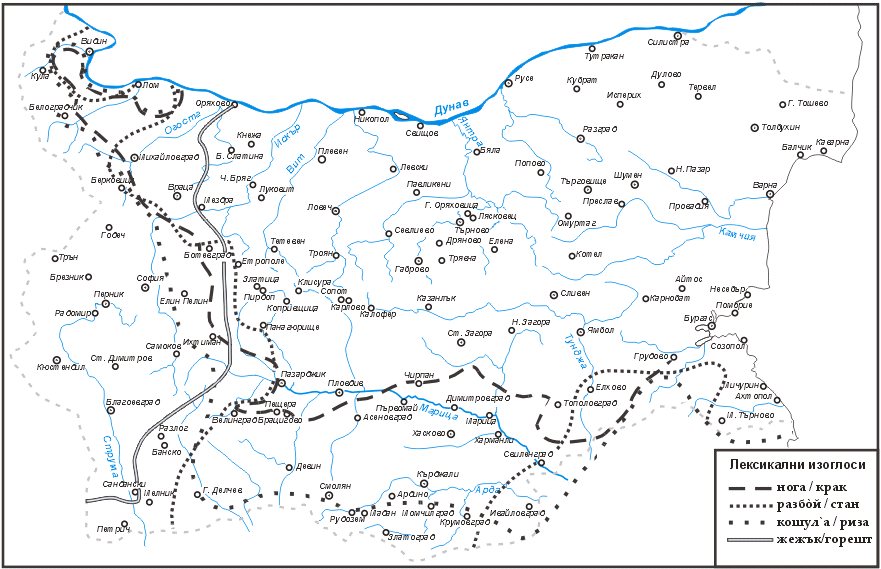
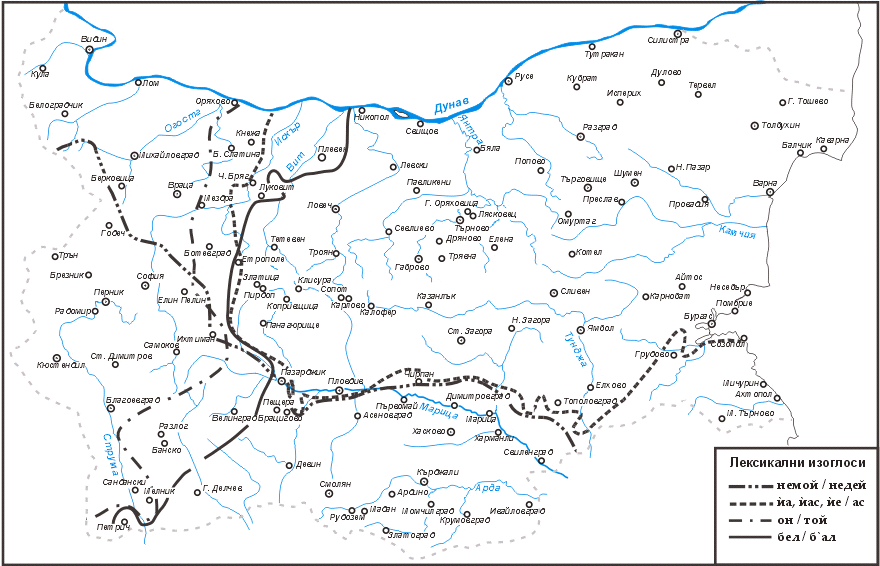


Bulgarian dialects are the regional varieties of the Bulgarian language, a South Slavic language. Bulgarian dialectology dates to the 1830s and the pioneering work of Neofit Rilski, Bolgarska gramatika (published 1835 in Kragujevac, Principality of Serbia). Other notable researchers in this field include Marin Drinov, Konstantin Josef Jireček, Lyubomir Miletich, Aleksandar Teodorov-Balan, Stoyko Stoykov.
The dialects of Macedonian are classified as part of Bulgarian in the older literature. Presently, Bulgarian linguistics continue to treat it as such. Since the second half of the 20th century, foreign authors have mostly adopted the convention of treating these in terms of a separate Macedonian language, following the codification of Macedonian as the literary standard language of Yugoslav Macedonia.{{Cite book |editor-last=Garry |editor-first=Jane |editor2-last=Rubino |editor2-first=Carl
The Bulgarian ethnos absorbed diverse Slavic tribes and not a particular language. The main isogloss separating the Bulgarian dialects into Eastern and Western is the yat border, marking the different mutations of the Old Bulgarian yat form (ѣ, *ě), pronounced as either /ʲa/ or /ɛ/ to the east (byal, but plural beli in Balkan dialects, "white") and strictly as /ɛ/ to the west of it (bel, plural beli) throughout former Yugoslavia. Isoglosses shape three groups. Besides the Eastern and Western dialects, the Rup group of dialects is distinct, which comprises the Rhodopes and everything southwards from Thessaloniki to Istanbul, although it is an Eastern dialect. The official language derives most often from the northeastern group of dialects nominally based on Veliko Tarnovo dialect. Many Western South Slavic lexical, morphological and phonological isoglosses are present in all Western Bulgarian dialects and rarer in Rup dialects, which peak in Torlakian. Bulgarian, Macedonian and Serbian dialects share characteristics far beyond the Torlakian area and beyond the contested territories of the medieval Bulgarian and Serbian states, which are west of Sofia. So, these political entities are not responsible for the transitional features, but they are basically rooted in other type of evolution, likely in a makeup in the contact area of the two sources of Eastern and Western South Slavic tribes. The makeup of the transitional area shows a mix of Eastern and Western South Slavic characteristics found in western Bulgaria, which contact happened in the Balkans assuming the exact location of this area. All isoglosses commonly share gradual borders deep inside the country, but the northeast always do not, which likely means that the contact zone mixed after the settling of the Slavs in the Balkans. In one instance both a and ъ for nasal yus are part of Elin Pelin dialect. Probably one of the words that remain the same on one of the largest areas in Bulgaria is that for night nosht, which is at best rare in other Slavic languages, in which along with the Torlaks in Bulgaria noch means night.
In eastern Bulgarian dialects in contrast with the other South Slavic languages, standard Ukrainian and Czech, the unstressed vowel e by palatalization turns into i or ie. The Bulgarian pronouns in third person toy, te are documented in some Ukrainian dialects.
Bulgarian dialects can be divided into the following dialectal groups and individual dialects:
Notes
References
References
- Кочев (Kochev), Иван (Ivan). (2001). "Български диалектен атлас (Bulgarian dialect atlas)". Bulgarian Academy of Sciences.
- Mazon, Andre. ''Contes Slaves de la Macédoine Sud-Occidentale: Etude linguistique; textes et traduction''; Notes de Folklore, Paris 1923, p. 4.
- Селищев, Афанасий. Избранные труды, Москва 1968.
- Max Vasmer ''Die Slaven in Griechenland''. Verlag der Akademie der Wissenschaften, Berlin 1941. Kap. VI: Allgemeines und sprachliche Stellung der Slaven Griechenlands.
- K. Sandfeld, ''Balkanfilologien'' (København, 1926, MCMXXVI).
- [[Konstantin Josef Jireček]], ''Die Balkanvölker und ihre kulturellen und politischen Bestrebungen'', Urania, II, Jg. 13, 27. März 1909, p. 195.
- Stefan Verković, Описание быта македонских болгар; Топографическо-этнографический очерк Македонии (Петербург, 1889).
- Стойков (Stoykov), Стойко. (2002). "Българска диалектология (Bulgarian dialectology)". Акад. изд. "Проф. Марин Дринов".
- Institute of Bulgarian Language. (1978). "Единството на българския език в миналото и днес". [[Bulgarian Academy of Sciences]].
- Шклифов, Благой. Речник на костурския говор, Българска диалектология, София 1977, с. кн. VIII, с. 201–205.
- 1-85065-534-0, p. 116.
- 0-8142-0913-0.
- link. (2009-03-11 , UCLA International Institute)
- isp. Большaя Советская Энциклопедия, tom. 37, Moskva 1938, р 743–744
- Mazon, A. Documents, contes et chansons slaves de l’Albanie du sud. Paris, 1936, 462 p.
- Per Stoykov.
- Bulgarian dialectology, p. 170
- Bulgarian dialectology, p. 171
- Bulgarian dialectology, p. 172
- Bulgarian dialectology, p. 173
- Bulgarian dialectology, p. 174
- Bulgarian dialectology, p. 175
- Bulgarian dialectology, p. 176
- Bulgarian dialectology, p. 179
- Bulgarian dialectology, p. 180
- Bulgarian dialectology, p. 181
- Bulgarian dialectology, p. 182
- Bulgarian dialectology, p. 183
- Bulgarian dialectology, p. 184
This article was imported from Wikipedia and is available under the Creative Commons Attribution-ShareAlike 4.0 License. Content has been adapted to SurfDoc format. Original contributors can be found on the article history page.
Ask Mako anything about Bulgarian dialects — get instant answers, deeper analysis, and related topics.
Research with MakoFree with your Surf account
Create a free account to save articles, ask Mako questions, and organize your research.
Sign up freeThis content may have been generated or modified by AI. CloudSurf Software LLC is not responsible for the accuracy, completeness, or reliability of AI-generated content. Always verify important information from primary sources.
Report