From Surf Wiki (app.surf) — the open knowledge base
Buick V8 engine
,_left_side_view.jpg)
| Field | Value |
|---|---|
| name | Buick V8 engines |
| image | 1964 Buick Wildcat 445 engine (401ci Nailhead).jpg |
| caption | 401 cu in "Nailhead" in a 1964 Buick Wildcat |
| manufacturer | Buick (General Motors) |
| aka | Fireball V8 |
| (nickname) | |
| Nailhead (1953–1966) | |
| production | – Buick City |
| (engine block and heads) | |
| Saginaw Metal Casting Operations | |
| predecessor | Buick straight-eight |
| successor | |
| configuration | 90º V8 |
| displacement | 215-455 cuin |
| bore | 3.5 - |
| stroke | 2.8 - |
| block | Cast iron, Aluminum |
| head | Cast iron, Aluminum |
| valvetrain | OHV 2 valves x cyl. |
| compression | 8.8:1–11.0:1 |
| fuelsystem | Carter AFB or Rochester carburetors |
| fueltype | Gasoline |
| coolingsystem | Water-cooled |
| power | 150-360 hp |
| torque | 220-510 lbft |
| weight | 318-467 lb |
(nickname) Nailhead (1953–1966) (engine block and heads) Saginaw Metal Casting Operations
The Buick V8 is a family of V8 engines produced by the Buick division of General Motors (GM) between 1953 and 1981. All were 90° water-cooled V8 OHV naturally aspirated engines.
Evolution
The Buick V8 family can be divided into three groupings: "Nailheads", produced between 1953 and 1966, which came in two generations using different blocks in displacements from 264-425 cuin, and are known for their unique valve design and head configuration; "small blocks" produced from 1961 to 1982 in displacements from 215-350 cuin; and "big blocks" produced from 1967 to 1976 in displacements from 400-455 cuin.
The use of "small-block" and "big-block" terminology refers to the respective engine block's bore spacing, external dimensions, and weight, not internal engine displacement.
The "Nailhead" nickname derives from the unusually long, small valves of the original Buick V8, a function in part of the unusual horizontal positioning of the engine's heads.
Even though they are not generally held to be, by some important empirical measures, including a deck height that allowed displacement to grow to 425 cuin, the Buick "Nailhead" engines can be regarded as "big block" - a term that did not exist in that usage until exceptionally large displacement V8s with correspondingly large blocks began to appear and be distinguished from their more moderate-sized predecessors. The term "small-block" is a retronym, developed to distinguish engines with small and medium blocks from the very large block engines being introduced in response to increasing automobile size and the "horsepower wars" of the 1960s.
Both the Nailheads and the mid 1960s-on "big-block" engines shared a 4.75 in bore spacing. The Buick "small-block", which predated the "big-block", had its own block and bore spacing. Both "big-" and "small-block" engines were clean sheet designs.
Some Buick V8s, such as the 350, 400, and 455, have the same displacements as V8s of other GM divisions, but they are entirely different designs. Buick Nailhead V8s can be distinguished by the top surfaces of their valve covers being horizontal (parallel to the ground). Later Buick small and big block V8s have a front-mounted distributor tilted to the drivers side (like Cadillacs), but siamesed center exhaust ports (unlike Cadillacs).
Nailhead
Buick produced two generations of "Nailhead" engine, serially between 1953 and 1966. The first spanned 1953-1956, in two displacements: the original 322 CID from 1953 to 1956, and a de-bored "junior" 264 CID version only in 1954 and 1955. The second spanned 1957-1966, with an original 364 CID displacement produced 1957-1961, a 401 CID from 1959-1966, and a final 425 CID from 1963 to 1966. All second generation engines used the same block, bore spacing, and different combinations of bore and stroke. All Nailheads had cast iron blocks and heads. Both generation's vertical valve arrangement resulted in unusually compact V8s of their displacement.
The two engines shared a similar valve architecture but were different designs with different blocks. Among the changes in the second generation were larger, less-restrictive valves and ports, a better flowing manifold, thinner castings for both block and heads, new 1.6:1 rocker arms, increasing valve lift, more radical camshafts with increased duration.
First-generation
Buick's first generation V8 was offered from 1953 through 1956; it replaced the Buick straight-eight. While officially called the "Fireball V8" by Buick, it became known by enthusiasts as the "Nailhead" for the unusual vertical alignment of its small-sized valves (Originally it was known to hot-rodders as the "nail valve", because the engine's small heads contained valves with long stems, which made them look like nails.)
During this era, Buick ranked smoothness above most other marketing objectives, and the Dynaflow transmission's non-shifting design was demonstrably smoother than the other rough shifting automatics then available. With the Dynaflow, a high torque engine was needed to provide adequate acceleration, so that's what the Nailhead was designed to deliver.
Both the intake and exhaust valves were on the intake manifold side of a "pent-roof combustion chamber". To offset restrictive port diameters and the smaller-sized valves [1.75 in intake, 1.25 in exhaust], the Nailhead V8s used a camshaft with greater lift and duration. The small-diameter intake runners allowed these engines to develop high torque, with many exceeding 1 ft-lb/cu in (exceptional for the time).
First-generation Nailheads were painted "Late" Buick Green (also called Apple Green, used from 1953 to 1956).
264
The 264 CID followed the 322 as a junior V8 produced in 1954 and 1955 as a direct replacement for the smaller Buick 263 straight-eight, and was the only engine available in Buick's economy "Special" series vehicles. It was the smallest displacement Nailhead, sharing stroke and deck height with the 322, but having a smaller 3.625 in bore.
322
The larger 322 CID was the original Nailhead, used by Buick from 1953 through 1956 in the Roadmaster, Super, and Century models, and the Special in 1956. It has a bore and stroke of 4x3.2 in.
The 322 was also used in the 1956 through 1957 10,000-Series conventional-cab Chevrolet heavy duty trucks labeled as the Loadmaster.
Second-generation
Buick's second variation of the "Nailhead" was produced from 1957–1966. The "Fireball" name was dropped after 1957, but the 364 was very briefly called the "B-12000", referring to the 12,000 pounds of force generated by each piston. Second generation Nailheads were painted "Late" Buick Green, with the exception of those installed in the 1963 Riviera, which were silver, and the 1966 Riviera, which were red.
364
Buick, like most of its competitors, continued to expand its V8 engine to larger displacements. The 364 CID was introduced in 1957 and produced through 1961, with a 4.125 x bore and stroke. All other models got the 300 hp four-barrel engine except for the lower level Special series, which received a 250 hp two-barrel carburetor version.
{{anchor|401|445}}401 (400)

The 364 was enlarged to 401 CID and produced from 1959 to 1966. Both bore and stroke were enlarged, to 4.1875 x respectively. Originally sold as a 401, it was later redesignated "400" (with no change to displacement) to meet a 1960s Division-wide GM directive mandating a maximum allowable 400 CID displacements in mid-size cars.
The 401/400 became Buick's original muscle car powerplant, used in the company's Skylark Gran Sport, Buick Sport Wagon and Buick Wildcat models, among others. The engine was variously designated the Wildcat 375, Wildcat 410, and Wildcat 445 - with the numbers corresponding with the torque produced by each version. The Wildcat 410 was the two-barrel carbureted engine, standard on the 1962-1963 LeSabre. The Wildcat 375 was a no-cost economy option for the 1962-1963 LeSabre that used a lower compression ratio to run on mid-octane rather than premium fuel. The various Wildcat engines had decals on their air cleaners indicating their version; however, a later four-barrel edition of the 1966-1967 small-block 340 CID Buick 340 V8 was also labeled Wildcat 375 on its air cleaner.
The single four-barrel Wildcat 445 was the standard engine in the Invicta, 1959-1966 Electra, 1962–1966 Buick Wildcat, 1963 Riviera, and 1965 Riviera.
425

The 425 CID, the largest-displacement Nailhead, was produced from 1963 to 1966. Its bore and stroke measure 4.3125 x. It began as an exclusive option on the 1963 Riviera, and was later available on the Wildcat and Electra models. It was standard on the 1964 and 1966 Rivieras.
The basic 425, called the Wildcat 465 for the lb-ft of torque it developed, came with a single four-barrel carburetor. The Super Wildcat featured two four-barrel carburetors and matching intake manifold, was available on the 1964 Riviera as a factory option (2,122 produced), 1964 Electras (any model, production numbers unknown), 1965 Riviera Gran Sport, and 1966 Wildcat GS,
Coded "MW", these Regular Production Option {RPO}-code Y48 parts were delivered in the car's trunk for dealer installation. Toward the end of the 1966 model year, around May 1966, Buick offered the Super Wildcat 465 with factory-installed dual four-barrel Carter AFB carburetors as an "MZ" option. Only 179 of the 1966 Riviera GS models were built with the MZ package.
Mounted on a trolley, Buick 425s were also used as starter motors for the SR-71 Blackbird supersonic jet.
Small-block
Buick introduced a 215 cuin all-aluminum "small block" V8 in 1961, an industry first. Produced in three other displacements (300, 340, and 350 cu in), it had a 4.24 in cylinder bore spacing, and became the basis of a highly successful cast iron Buick "Fireball" V6. Design features include an external oil pump, a forward-mounted distributor, and an integrated aluminum timing cover incorporating the oil pump and leaving it and the oil filter exposed to oncoming air for added cooling.
After three years of persistent cylinder liner issues in the aluminum blocks, cheaper new thin-wall iron casting techniques, resulted in a shift to an iron block in 1964.
Buick small-block 300's were painted "Late" Buick Green. 1966 340 and subsequent engines were painted red from 1967-1974, medium metallic blue from 1975-1977, and light blue from 1978-1982.
215===
:See also Rover V8 engine
GM experimented with aluminum engines starting in the early 1950s, when Aluminum Company of America (ALCOA) was pushing all automakers to use more aluminum. An early-development was a supercharged 215 CID V8 used in the 1951 Le Sabre concept car, and the 1953 Buick Roadmaster concept car. That design is unrelated to the 215 cu in all-aluminum V8 introduced by Buick in 1961.
GM designated Buick as engine design leader, and work on a production small displacement aluminum V8 commenced in 1956. Originally intended to displace 180 CID, Buick increased this to 215 CID to be more compatible with the new Y-body cars on the drawing board, introduced for 1961 as the Skylark.
Known as the Buick Fireball, the all-aluminum 215 had a strongly oversquare bore and stroke of 3.5x2.8 in, for an actual displacement of 215.51 CID. With a Rochester 2GC (2 Jet) two-barrel carburetor and 8.8:1 compression ratio power output was 150 hp at 4400 rpm and 220 lbft of torque at 2,400 rpm. Weighing only 318 lb, it was the world's lightest mass-production V8. Measuring 28 in long, 26 in wide, and 27 in high, it became standard equipment in the 1961 Buick Special.
Power was raised soon after introduction to 155 hp at 4,600 rpm. A Buick Special Skylark version was introduced mid-year, which had 10.0:1 compression and a four-barrel carburetor, raising output to 185 hp at 4,800 rpm and 230 lbft at 2,800 rpm.
For 1962, the two-barrel engine was unchanged, while the four-barrel engine's compression ratio was increased to 10.25:1 and output to 190 hp at 4,800 rpm and 235 lbft at 3,000 rpm. For 1963, the four-barrel was bumped to 11.0:1 compression and an even 200 hp at 5,000 rpm and 240 lbft at 3,200 rpm, {{#expr:200/215 round 2}} hp/cu in. The higher output "Power Pack" was equipped with higher lift camshaft .0.518" intake/ 0.523" exhaust with increased duration 305/310 and required 99 research octane fuel.
Pontiac usage
Pontiac used the Buick version of the 215 in its Y-body cars, the Tempest and LeMans. At that time the engine was closely associated with the Buick brand, and Pontiac sold few cars with it, using it only in 1961 and 1962.
Oldsmobile version
Although sharing basic architecture with the Buick, Oldsmobile developed its own all-aluminum 215, the "Rockette V8", to install in its F-85 Cutlass Y-body. Its angled valve covers were designed by Oldsmobile engineers to look like a traditional Olds V8.
Olds also released a turbocharged version, the 215 hp Turbo-Rocket, in its 1962–63 Oldsmobile Jetfire. Together with Chevrolet's turbocharged 1962 Corvair Spyder, these were the first turbochargers ever offered in passenger cars.
Produced on a separate assembly line, the Olds 215 was somewhat heavier at 350 lb. Oldsmobile added a sixth head bolt on the intake manifold side in an effort to alleviate a head-warping problem on high-compression versions. This meant that the five-bolt Buick heads would fit on Oldsmobile blocks, but not vice versa. The Oldsmobile used wedge-shaped/quench combustion chambers/pistons that allowed larger valves, while the Buick had a 37-cc wedge combustion chamber and used "dished head" pistons. Altering the compression ratio on the Oldsmobile 215 required changing the heads, but on a Buick 215, only the pistons were changed, which was less expensive and simpler.
Discontinuation
Casting-sealing technology was not advanced enough at that time, and hidden porosity problems caused serious oil leaks, producing an abnormally high scrap ratio. The factory had to make extensive use of air gauging for leak checks, and was unable to detect leaks on blocks that were as much as 95% complete. This raised the cost of complete engines to more than that of a comparable all cast-iron engine, so aluminum blocks were cancelled after the 1963 model year. Another problem was clogged radiators from antifreeze mixtures incompatible with aluminum.
Racing
The 215's very high power-to-weight ratio made it immediately interesting for automobile and boat racing. Mickey Thompson entered a stock-block 215-powered car in the 1962 Indianapolis 500, the first stock-block engine since 1946 and the only non-Offenhauser-powered entry in the race. Rookie driver Dan Gurney qualified eighth and raced well for 92 laps before retiring with transmission problems.
Surplus engine blocks of the Oldsmobile F85 version formed the basis of the Australian Formula One Repco V8 used by Brabham to win the 1966 Formula One world championship, although only the earliest engines had any Oldsmobile components. The majority of Repco RB620 engines were cast and built in-house at Repco.
Sale to Rover
Main article: Rover V8 engine
Rights to the Buick 215 engine were purchased by the British Rover Company and used in the 1967 Rover P5B that replaced the 3 L straight six Rover engined P5. Throughout the years, the Rover Company (which became part of British Leyland in 1968), and its successor companies constantly improved the engine making it much stronger and more reliable. Capacities ranged from 215 to. The engine was also used in a variety of British Leyland/MG Rover Group cars, including MG, Triumph, and Range Rover. It has also been licensed to specialist British manufacturers such as Morgan and TVR. The engine remains well-supported by enthusiast clubs, specialist parts suppliers, and by shops that specialize in conversions and tuning.
300

In 1964, Buick replaced the 215 with an iron-block engine of very similar architecture. The new "small block" engine had a bore of 3.75 in and a stroke of 3.4 in for a displacement of 4923 cc. It retained the aluminum cylinder heads, intake manifold, and accessories of the 215 for a dry weight of 405 lb. The 300 was offered in two-barrel form, with 9.0:1 compression, making 210 hp at 4600 rpm and 310 lbft at 2400 rpm, and four-barrel form, with 11.0:1 compression, making 250 hp at 4800 rpm and 355 lbft at 3000 rpm.
For 1966, the 300 switched to cast-iron heads, raising dry weight to 467 lb, still quite light for a V8 engine of its era. The four-barrel option was cancelled for 1966, and the 300 was replaced entirely by the 350 in 1968.
In 1964, while nearly all Buick engines were painted "Buick Late Green", the 300 V8s were painted silver instead. In 1966 Buick engines switched to "Buick Late Red", but until 1967 at least, the 300 V8 (and the 225) were still painted Buick Late Green. The Apollo 5000 GT sports car, (also sold as the Vetta Ventura) used this engine.
340
In 1966, the 300's stroke was increased to 3.85 in in a raised block to create the 340, displacing 5574.48 cc, as a replacement for the four-barrel-carbureted 300. The taller deck (raised by 0.5625 in compared to the 215/300's) meant the intake manifold was of a new design to bolt to the otherwise interchangeable cylinder heads.
It was offered with two- or four-barrel carburetion, the two-barrel with a 9.0:1 compression rated at 220 hp at 4,000 rpm and 340 lbft at 2,400 rpm, and the four barrel with 10.25:1 compression, rated at 260 hp at 4,000 rpm and 375 lbft at 2,800 rpm. It was only produced through 1967, being replaced by the new small block 350 CID in 1968.
350

Buick adopted the popular 350 size in 1968 for their final family of V8 engines, which was produced through 1980. Although it shared the displacement of the other GM small blocks, including the contemporary Chevrolet 350, Oldsmobile 350, and Pontiac 350, the Buick blocks were of a substantially different proprietary company design. The Buick 350 featured the same 3.8 in bore as the 231 CID version of the Buick 90° V6 and retained the 3.85 in stroke of the previous 340 CID V8. The exact displacement is 349.31 CID.
The major differences of the 350 in comparison to other GM V8s are Buick's "deep-skirt" engine block construction, the use of cast iron with increased nickel content, under-square cylinder bore sizing, 3 in crankshaft main journals, and 6.385 in connecting rods. Of all the GM "350s", the Buick has the longest piston stroke, essentially the same as the Buick big-blocks, which have the shortest stroke of the GM big-blocks. The engine garnered a reputation as rugged and durable, and some of its design characteristics are found in other Buick-designed GM engines, such as the 231 CID V6 and its 3800 descendants.
The 350 was used by Kaiser-Jeep and AMC Jeep in the Jeep Gladiator and Wagoneer models from 1968–71; in these applications, the engine was billed as the Dauntless V8.
- 1968-1972 Buick Skylark
- 1968-1972 Buick Sport Wagon
- 1968-1971 Jeep Wagoneer
- 1968-1971 Jeep Gladiator
- 1971-1973 Buick Centurion
- 1971-1980 Buick Electra
- 1971-1980 Buick LeSabre
- 1973-1975 Buick Apollo
- 1973-1977 Buick Century
- 1973-1977 Buick Regal
- 1975 Pontiac Ventura
- 1975-1979 Buick Skylark
- 1977-1980 Buick Estate
- 1977-1978 Buick Riviera
Big-block
Buick introduced its "big block" V8 in 1967 to replace the largest displacement Nailheads, which had grown to 425 CID. It retained the 4.75 in cylinder bore spacing and was produced in three displacements: 400, 430, and 455 cubic inches. Production continued through 1976.
{{anchor|399.95}} 400
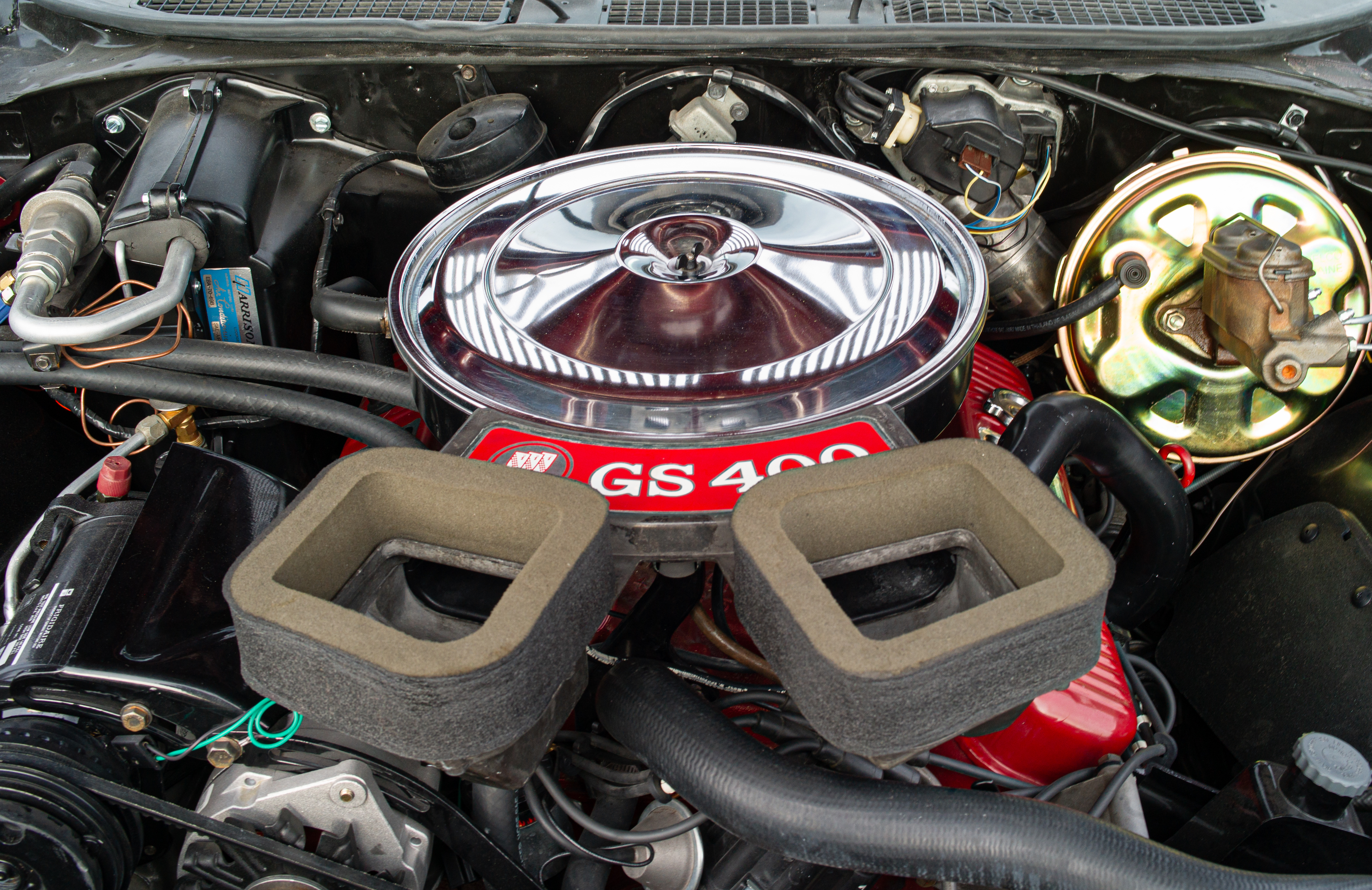
The 399.95 CID big-block V8 was produced from 1967-1969. This engine has a bore and a stroke of 4.04x3.9 in. It was the only large V8 engine available for the intermediate-sized GM A platform Buicks due to GM's 400 cubic inch displacement limit on mid-size cars in effect through 1970. Most parts except the pistons interchange with the 430 and 455. This 400 engine had the distributor towards the front of the engine, as opposed to the 401/400 nailhead, which had its near the firewall.
430

The 430 CID was only produced from 1967 until 1969. This engine had a bore and a stroke of 4.1875x3.9 in, for an actual displacement of 429.69 cuin. The 430 four-barrel engine was rated at 360 hp and 475 lbft of torque. This engine was used in large B-, C- and E-body Buicks. Most parts except the pistons interchange with the 400 and 455.
Applications:
- 1967-1969 Buick Electra
- 1967-1969 Buick Riviera
- 1967-1969 Buick Wildcat
455


The 400-based 455 was produced from 1970–1976, with a bore and stroke of 4.31x3.9 in for an overall displacement of 7459 cc. Most parts (except pistons and heads) interchange between the 400 and the 430. The base model was rated at 350 hp, while the 455 Stage 1 equipped with a single 4-barrel Rochester Quadrajet carburetor was rated at 360 hp at 4600 rpm.{{cite web |access-date=July 5, 2018}} The regular 455 produced a rated 510 lbft of torque at 2,800 rpm, more than any other muscle car engine. The horsepower was somewhat reduced in 1971 mainly due to the reduction in compression ratio, a change mandated by GM in response to federal laws mandating new cars use low octane gasoline in an effort to reduce exhaust emissions. Then, starting in 1972, the horsepower rating on paper would be reduced again due to a shift from SAE gross to SAE net, down to approximately 250 hp. Unleaded gasoline and catalytic converters were required in 1975 for all US manufactured cars. Ever-tighter emissions requirements would cause the engine to drop in power still further, a little at a time, through 1976.
The 455 was one of the first "thin-wall casting" engine blocks at GM, and because of this advance in production technology, it weighs significantly less than other engines of comparable size (for example, 150 lb less than a Chevrolet 454 and only 25 lb more than a Chevrolet 350).
Applications:
- 1970-1976 Buick Electra
- 1970-1976 Buick Estate
- 1970-1976 Buick LeSabre
- 1970-1976 Buick Riviera
- 1970-1972 Buick Skylark
- 1970 Buick Wildcat
- 1971-1973 Buick Centurion
- 1973-1974 Buick Century
- 1973-1974 Buick Gran Sport
- 1973-1974 Buick Regal
Other GM V8s used in Buicks
In the mid-1970s, Buick's 455 big block became unable to meet fuel economy/emission requirements and was phased out, with the Buick 350 remaining as a factory option until 1980. In their place a variety of other GM divisions' V8s were offered, both as standard equipment and factory options. These included:
Oldsmobile 260
The 260 CID was an Oldsmobile V8 engine shared with Buick:
- 1975–1977 Buick Skylark
Pontiac 301
The 301 CID was a Pontiac V8 engine shared with Buick.
Chevrolet 305
The 305 CID was a Chevrolet V8 engine shared with Buick:
- 1978–1987 Buick Regal
- 1975–1979 Buick Skylark
Oldsmobile 307
The 307 CID was an Oldsmobile V8 engine shared with Buick:
- 1980–1985 Buick Lesabre
- 1980–1984 Buick Electra
- 1980–1985 Buick Riviera
- 1980–1990 Buick Estate Wagon
- 1986–1987 Buick Regal
Oldsmobile 403
The 403 CID was an Oldsmobile V8 engine shared with Buick:
- 1977 Buick Century estate
- 1977–1979 Buick Riviera
- 1977–1979 Buick Electra
- 1977–1979 Buick Estate Wagon
- 1977–1979 Buick LeSabre
References
References
- "Vintage Buick Engines".
- [https://www.motortrend.com/features/mdmp-1109-ford-and-mercury-horsepower-wars-the-dearborn-diet The 1960s Horsepower Wars - The Dearborn Diet], ''Motor Trend'', August 2011
- [https://autohistorypreservationsociety.org/buick-history-generation-1-nailhead-v8-1953-1966/# Buick History: Generation 1 Nailhead V8 1953-1966], Automotive History Preservation Society
- Flory, J. "Kelly" Jr.. (2008). "American Cars, 1946 to 1959; Every Model, Year by Year". McFarland & Company, Inc., Publishers.
- Flory Jr., J. "Kelly". (2008). "American Cars, 1946-1959 Every Model Every Year". McFarland.
- (8 March 2010). "English: SR-71 Blackbird AG330 start cart, Hill Aerospace Museum, Utah".
- Flory, J. "Kelly", Jr. ''American Cars 1946-1959'' (Jefferson, NC: McFarland & Coy, 2008), p.1021.
- (21 July 2017). "Greatest Buick cars of all time".
- (21 December 2017). "The Rover V8 engine".
- Baechtel, John. "Alternative Engines: Part 2--Buick V8", in ''Hot Rod'' Magazine, 11/84, p.67.
- Flory, J. "Kelly", Jr. ''American Cars 1960-1972'' (Jefferson, NC: McFarland & Coy, 2004), pp.205 & 246.
- Davis, Marian. (March 1985). "Affordable Aluminum V-8's".
- Boddy, William. "Morgan", in Northey, Tom, executive editor. ''World of Automobiles'' (London: Orbis, 1974), Volume 12, p.1419.
- (April 2011). "Buick 215-cu.in. V-8/Rover 3.5L".
- "Buick Engine Colors, Which One is Right For You!". Team Buick.
- Jordan, James. "Buick 350 engine specifications".
- "Jeep Engine: Dauntless Buick 350 V8".
- "1970 Buick Skylark".
- "Dauntless Buick 350".
- "1963-1987 Jeep Gladiator and J-Series Pickups".
- "1973 Buick Centurion".
- "1979 Buick Electra Coupe 350 V8 automatic classic vintage collector".
- "1972 Buick Le Sabre".
- "1974 Buick Apollo four-door, GM 350 four-barrel".
- "1973 Buick Century".
- "1973 Buick Regal".
- "1975 Pontiac Ventura SJ Sprint".
- "1978 Buick Skylark".
- "1978 Buick Estate Wagon limited 5.7L V-8".
- "1977 Buick Riviera".
- "7 fastest cars 1970s".
- Mando, Bob K.. "Visually Identifying a 1960's or '70's GM engine".
- "1967 Buick Electra 225".
- "1967 Buick Riviera".
- "1969 Buick Wildcat".
- "1970 Buick GSX Stage-1 Sport Coupe 4-speed".
- Gittelman, Mark. (24 December 2018). "Inside the 455 Cubic Inch Big Block from General Motors".
- "1976 Buick Electra".
- "1972 Buick Estate Wagon 455-4 V-8 dual exhaust".
- "1973 Buick Riviera".
- "1970 Buick Skylark".
- "1970 Buick Wildcat Custom Sport Coupe".
- "1976 Buick Skylark S 2-door coupe 4.3L V-8 Hydra-Matic".
- "1977 Buick Skylark S 2-door coupe 4.9L V-8 automatic".
- "1978 Buick Regal Limited Coupe 5.0L V-8 4-bbl. automatic".
- "1978 Buick Skylark Custom 2-door Coupe 5.0L V-8 automatic".
- "Oldsmobile 307 Hurst Olds V8".
- "1978 Buick Electra Park Avenue Coupe 6.6L V-8".

This article was imported from Wikipedia and is available under the Creative Commons Attribution-ShareAlike 4.0 License. Content has been adapted to SurfDoc format. Original contributors can be found on the article history page.
Ask Mako anything about Buick V8 engine — get instant answers, deeper analysis, and related topics.
Research with MakoFree with your Surf account
Create a free account to save articles, ask Mako questions, and organize your research.
Sign up freeThis content may have been generated or modified by AI. CloudSurf Software LLC is not responsible for the accuracy, completeness, or reliability of AI-generated content. Always verify important information from primary sources.
Report