From Surf Wiki (app.surf) — the open knowledge base
Buffalo mozzarella
Italian cheese
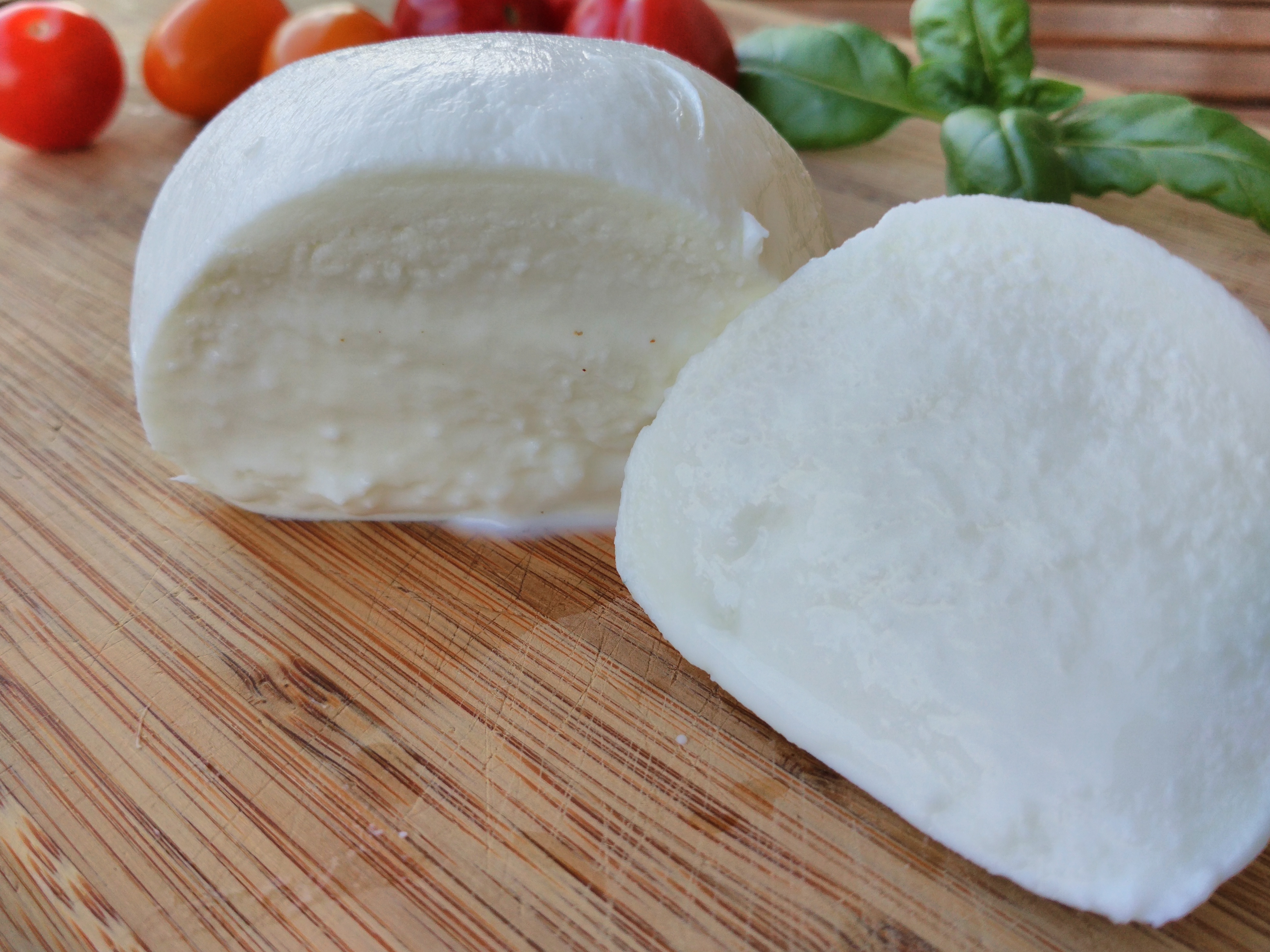
Italian cheese
| Field | Value |
|---|---|
| name | Buffalo mozzarella |
| image | Mozzarella di bufala3.jpg |
| image_size | 250px |
| othernames | , |
| country | Italy |
| region | Campania |
| source | Italian Mediterranean buffalo |
| texture | Fresh |
| certification | Mozzarella di bufala campana: |
| Italy: DOC: 1993 | |
| EU: PDO: 1996 |
Italy: DOC: 1993 EU: PDO: 1996
Buffalo mozzarella (; ) is a mozzarella made from the milk of the Italian Mediterranean buffalo. It is a dairy product traditionally manufactured in Campania, especially in the provinces of Caserta and Salerno.
Since 1996, mozzarella di bufala campana is also registered as an EU and UK protected designation of origin (PDO) product. The protected origin appellation requires that it may only be produced with a traditional recipe in select locations in the regions of Campania, Lazio, Apulia, and Molise.
Areas of production

In Italy, the cheese is produced nationwide using Italian Mediterranean buffalo milk under the government's official name mozzarella di latte di bufala because Italian buffalo are found in all Italian regions. Only the specific type of mozzarella di bufala campana PDO is produced in the area reaching from Rome, Lazio, to Paestum, near Salerno, Campania, and there are also production areas in the province of Foggia, Apulia, and in Venafro, Molise. Buffalo mozzarella is a €300m ($330m) per year industry in Italy, which produces around 33,000 tonnes of it every year, with 16 percent sold abroad (mostly in the European Union). France and Germany are the main importers, but sales to Japan and Russia are growing.
Apart from in Italy, its birthplace, buffalo mozzarella is manufactured in many other countries around the world. There are producers in Switzerland, the United States, Australia, Mexico, Brazil, Canada, China, Japan, Venezuela, Argentina, the United Kingdom, Ireland, Spain, Sweden, Colombia, Thailand, Israel, Egypt, India, and South Africa, all using milk from their own herds of water buffaloes.
{{lang|it|Mozzarella di bufala campana}}
Buffalo mozzarella from Campania bears the trademark mozzarella di bufala campana. In 1993, it was granted denominazione di origine controllata (DOC) status, in 1996 the trademark received the registry number 1107/96, and in 2008 the European Union granted protected geographical status and the PDO designation. The Consorzio per la Tutela del Formaggio di Bufala Campana () is an organization of approximately 200 producers that, under Italian law, is responsible for the "protection, surveillance, promotion and marketing" of mozzarella di bufala campana. PDO The mozzarella industry in Italy resulted from 34,990 recorded females of the Italian Mediterranean breed, which account for ≈30% of the total dairy buffalo population (this percentage does not exist in any other country) and have a mean production of 2,356 kg milk in 270 days of lactation, with 8% fat, and 4.63% protein.
History
The history of water buffalo in Italy is not settled. One theory is that Asian water buffalo were brought to Italy by Goths during the migrations of the early medieval period. However, according to the Consorzio per la Tutela del Formaggio Mozzarella di Bufala Campana, the "most likely hypothesis" is that they were introduced by Normans from Sicily in 1000, and that Arabs had introduced them into Sicily. The Consorzio per la Tutela also refers to fossil evidence (the prehistoric European Water Buffalo, Bubalus murrensis) suggesting that water buffalo may have originated in Italy. A fourth theory is that water buffalo were brought from Mesopotamia into the Near East by Arabs and then introduced into Europe by pilgrims and returning crusaders.
"In ancient times, the buffalo was a familiar sight in the countryside, since it was widely used as a draught animal in ploughing compact and watery terrains, both because of its strength and the size of its hooves, which do not sink too deeply into moist soils."
References to cheese products made from water buffalo milk appeared for the first time at the beginning of the 12th century. Buffalo mozzarella became widespread throughout the south of Italy from the second half of the 18th century, before which it had been produced only in small quantities.
Production in and around Naples was briefly interrupted during World War II, when retreating German troops slaughtered the area's water buffalo herds, and recommenced a few years after the armistice was signed.
2008 dioxin scare
On March 21, 2008, The New York Times published an article which reported the difficulties encountered by the Campania producers of mozzarella in avoiding the contamination of dairy products with dioxins, especially in the Caserta area, and managing the resulting crisis in local sales. The article, later referenced by blogs and other publications, referred to the Naples waste management issue and referred to other pieces published by the International Herald Tribune and various other national and international newspapers.
A chain reaction followed, in which several countries including Japan, China, Russia, and Germany took various measures ranging from the mere raising of the attention threshold to the suspension of imports. The Italian institutions activated almost immediately, even in response to pressing requests from the European Union, a series of checks and suspended, in some cases, the sale of dairy products from the incriminated provinces. Tests had shown levels of dioxins higher than normal in at least 14% of samples taken in the provinces of Naples, Caserta, and Avellino. In the provinces of Salerno and Benevento, no control indicated dioxins positivity.
In any case, the contamination has affected, in a limited defined manner, the farms used to produce buffalo mozzarella PDO. The Italian General Confederation of Labour reported a 40% reduction of workforce in the Terra di Lavoro for 2013. On 19 April, China definitively removed the ban on mozzarella, originally activated on 28 March 2008, and tests held in December 2013 in Germany on behalf of four Italian consumer associations have highlighted dioxin and heavy metal levels at least five times lower than the legal limit.
Production stages
To produce 1 kg of cheese, a cheese maker requires 8 kg of cow milk but only 5 kg of buffalo milk. Producing 1 kg of butter requires 14 kg of cow milk but only 10 kg of buffalo milk.
The steps required to produce buffalo mozzarella are:
- Milk storage (raw buffalo milk stored in steel containers).
- Milk heating (thermic treatment to the liquid, then poured into a cream separator).
- Curdling (by introduction of natural whey).
- Curd maturation (the curd lies in tubs to reduce the acidifying processes and reach a pH value of about 4.95).
- Spinning (hot water is poured on the curd to soften it, obtaining pasta filata).
- Shaping (with special rotating shaper machines).
- Cooling (by immersion in cold water).
- Pickling (by immersion in pickling tubs containing the original whey).
- Packaging (in special films cut as bags or in small basins and plastic).
Nutrition

The digestive system of water buffaloes permits them to turn low grade vegetation into rich milk which, owing to its higher percentage of solids, provides higher levels of protein, fat, and minerals than cow milk.
Contents for 100 g buffalo milk:
- proteins 3.72–4.2%
- fat 7.5%
- vitamin A 0.15 mg
- vitamin B 0.003 mg
- vitamin B1 0.3 mg
- calcium 169 mg
- phosphorus 380 mg
- sodium 0.4 mg
- iron 0.7 mg
- energy content 270 Kcal
Uses

Generally, buffalo mozzarella is eaten with calzone, vegetable, salad (for example, Caprese salad), on pizza (a low moisture content buffalo mozzarella is preferred), on grilled bread, with tomatoes, or by itself accompanied by olive oil.
Notes
References
References
- "Mozzarella di Bufala .org - il marchio dop".
- (2008). "The Product: Production Zone".
- Charter, David. (2008-03-29). "Buffalo mozzarella in crisis after pollution fears at Italian farms". [[The Times]].
- Tagliabue, John. (2006-06-12). "Buffalo Milk in Swiss Mozzarella Adds Italian Accent". [[The New York Times]].
- "Bufalina AC real Mozzarella Cheese".
- (2012-03-08). "Fresh Buffalo Mozzarella". Realmozzarella.com.
- "water buffalo cheese, yogurt, and specialty meats". Bufala di Vermont.
- (2008-06-07). "Water Buffalo Mozzarella". Cookography.
- "Welcome to the Australian Buffalo Industry Council". Buffaloaustralia.org.
- 李齐. "Thank you, Mr Buffalo".
- "Ängsholmens Gårdsmejeri {{!}} Producent av Svensk Buffelmozzarella".
- Seno, L. O.. (2006). "Responses to selection for milk traits in dairy buffaloes". Genetics and Molecular Research.
- Janssen, Peter. (2008-08-11). "Italian mountaineers cut the cheese in Thailand". Expatica.com.
- National Research Council. (2002). "The Water Buffalo: New Prospects for an Underutilized Animal". Books For Business.
- Cox, Antoon. (2008-01-13). "Italian cheese, sold in the US, made in India". [[The Indian Express]].
- (2010-02-10). "South Africa's 1st Real Buffalo Mozzarella". Slow Food (Johannesburg).
- (2008). "The Consortium: History of The Organization".
- European Commission. (2008-02-05). "Commission Regulation (EC) No 103/2008 of 4 February 2008 approving non-minor amendments to the specification for a name entered in the register of protected designations of origin and protected geographical indications — Mozzarella di Bufala Campana (PDO)". [[Official Journal of the European Union]].
- (2008). "The Consortium: History of The Organization".
- (2020). "Bubalus bubalis: A Short Story". Frontiers in Veterinary Science.
- "Mozzarella di Bufala". Forno Bravo, LLC.
- (2008). "History".
- (2008). "History".
- "CAMPANA BUFFALO'S MOZZARELLA CHEESE".
- "Campana Buffalo's Mozzarella Cheese".
- ''The Cheese Companion'' by Judy Ridgway (Running Press, 2004), p. 123.
- ''The Complete Idiot's Guide to Cheeses of the World'' by Steve Ehlers and Jeanette Hurt (Penguin, 2008), p. 96.
- "Mozarella" by Laura Weiss in ''The Oxford companion to American food and drink'', edited by Andrew F. Smith ([[Oxford University Press]], 2007), p. 394.
- ''Brooklyn: a state of mind'' by Michael W. Robbins and Wendy Palitz (Workman Publishing, 2000), p. 306.
- «So it was a blow when health authorities found high levels of dioxins, nasty byproducts of chemical manufacturing, in samples of buffalo milk from farms near Caserta, north of Naples, in recent weeks, and began a sweeping criminal investigation and the quarantine of dozens of herds of buffalo.», in ''[[The New York Times]]'', ''Italy's Mozzarella Makers Fight Dioxin Scare'', 21 March 2008
- Lyons, Patrick J.. (21 March 2008). "Italy's Mozzarella Makers Fight Dioxin Scare". The New York Times.
- "Articolo di ''International Herald Tribune''".
- [https://archive.today/20120908134627/http://www.positanonews.it/menu/default.asp?id=12290 Articoli vari]
- (28 March 2008). "Copia archiviata". Ministero della Salute.
- Palermo, Antonella. (2013-12-19). "Terra dei fuochi, allarme Cgil: in agricoltura persi 4 posti su 10".
- [http://www.repubblica.it/ambiente/2013/12/13/news/mozzarella_bufala_campana_assolta-73512433/ I test tenuti in Germania assolvono la mozzarella bufala campana dop], ''Repubblica.it'', 13-12-2013
- "Mozzarella di Bufala Campana". Formaggio.it.
- (2007-03-12). "How to turn milk into mozzarella cheese". [[YouTube]].
- Caramanica, Susie. (May 2005). "Buffalo Mozzarella: An Italian Original". Trade Environment Database.
- "Campana Buffalo's Mozzarella Cheese: How To Enjoy". MozzarelladiBufal.org.
- (25 March 2007). "Amendment Application Council Regulation (EC) No 510/2006". European Commission.
- (5 February 2008). "Commission Regulation (EC) No 103/2008". European Commission.
This article was imported from Wikipedia and is available under the Creative Commons Attribution-ShareAlike 4.0 License. Content has been adapted to SurfDoc format. Original contributors can be found on the article history page.
Ask Mako anything about Buffalo mozzarella — get instant answers, deeper analysis, and related topics.
Research with MakoFree with your Surf account
Create a free account to save articles, ask Mako questions, and organize your research.
Sign up freeThis content may have been generated or modified by AI. CloudSurf Software LLC is not responsible for the accuracy, completeness, or reliability of AI-generated content. Always verify important information from primary sources.
Report