From Surf Wiki (app.surf) — the open knowledge base
Buckwheat
Species of flowering plant in the family Polygonaceae

Species of flowering plant in the family Polygonaceae
a commonly cultivated crop plant
- Polygonum fagopyrum L. 1753
- Fagopyrum cereale Raf.
- Fagopyrum dryandrii Fenzl
- Fagopyrum emarginatum (Roth) Meisn. 1840
- Fagopyrum emarginatum Moench 1802
- Fagopyrum fagopyrum (L.) H.Karst., invalid tautonym
- Fagopyrum polygonum Macloskie
- Fagopyrum sagittatum Gilib.
- Fagopyrum sarracenicum Dumort.
- Fagopyrum vulgare Hill ex Druce 1913
- Fagopyrum vulgare T.Nees 1853
- Polygonum emarginatum Roth |access-date=3 October 2014 |archive-date=22 December 2019 |archive-url=https://web.archive.org/web/20191222073237/http://www.theplantlist.org/tpl1.1/record/kew-2807310 |}}
Buckwheat (Fagopyrum esculentum) or common buckwheat is a flowering plant in the knotweed family Polygonaceae cultivated for its grain-like seeds and as a cover crop. Buckwheat cultivation originated around the 6th millennium BC in the region of what is now Yunnan Province in southwestern China. The name "buckwheat" is used for several other species, such as Fagopyrum tataricum, a domesticated food plant raised in Asia.
Despite its name, buckwheat is not closely related to wheat, nor is it a cereal or a member of the grass family. It is related to sorrel, knotweed, and rhubarb. Buckwheat is considered a pseudocereal because the high starch content of the seeds enables buckwheat to be cooked and consumed like a cereal.
In the U.S., local varieties of buckwheat, tame buckwheat, is considered an economic threat, since many people in the Asian markets are highly allergic. Grain elevators use a zero tolerance policy where the occurrence of buckwheat in a load of grain means the entire load is rejected. Buckwheat allergy is especially common in Japan, with potential reactions almost as severe as peanut allergy.
Etymology
The name "buckwheat" or "beech wheat" comes from its tetrahedral seeds, which resemble the much larger seeds of the beech nut from the beech tree, and the fact that it is used like wheat. The word may be a translation of Middle Dutch boecweite: boec "beech" (Modern Dutch beuk; see PIE *bhago-) and weite "wheat" (Mod. Dut. tarwe, antiquated weit), or may be a native formation on the same model as the Dutch word.
Description
Buckwheat is a herbaceous annual flowering plant growing to about 60 cm, with red stems and pink and white flowers resembling those of knotweeds. The leaves are arrow-shaped and the fruits are achenes about 5–7 mm with 3 prominent sharp angles.
Distribution
Fagopyrum esculentum is native to south-central China and Tibet, and has been introduced into suitable climates across Eurasia, Africa and the Americas.
History
The wild ancestor of common buckwheat is F. esculentum ssp. ancestrale. F. homotropicum is interfertile with F. esculentum and the wild forms have a common distribution, in Yunnan, a southwestern province of China. The wild ancestor of tartary buckwheat is F. tataricum ssp. potanini.
Common buckwheat was domesticated and first cultivated in inland Southeast Asia, possibly around 6000 BC, and from there spread to Central Asia and Tibet, and then to the Middle East and Europe, which it reached by the 15th century. Domestication most likely took place in the western Yunnan region of China.{{cite journal
The oldest remains found in China so far date to 2600 BC, while buckwheat pollen found in Japan dates from as early as 4000 BC. It is the world's highest-elevation domesticate, being cultivated in Yunnan on the edge of the Tibetan Plateau or on the plateau itself. Buckwheat was one of the earliest crops introduced by Europeans to North America. Dispersal around the globe was complete by 2006, when a variety developed in Canada was widely planted in China. In India, buckwheat flour is known as kuttu ka atta and has long been culturally associated with many festivals like Shivratri, Navaratri and Janmashtami. On the day of these festivals, food items made only from buckwheat are consumed.
Cultivation

Buckwheat is a short-season crop that grows well in low-fertility or acidic soils; too much fertilizer – especially nitrogen – reduces yields, and the soil must be well drained. In hot climates buckwheat can be grown only by sowing late in the season, so that it blooms in cooler weather. The presence of pollinators greatly increases yield. Nectar from flowering buckwheat produces a dark-colored honey.
The buckwheat plant has a branching root system with a primary taproot that reaches deeply into moist soil. It grows 75 to tall. Buckwheat has tetrahedral seeds and produces a flower that is usually white, although can also be pink or yellow. Buckwheat branches freely, as opposed to tillering or producing suckers, enabling more complete adaption to its environment than other cereal crops.
Buckwheat is raised for grain where only a brief time is available for growth, either because the buckwheat is an early or a second crop in the season, or because the total growing season is limited. It establishes quickly, which suppresses summer weeds, and can be a reliable cover crop in summer to fit a small slot of warm season. Buckwheat has a growing period of only 10–12 weeks and it can be grown in high latitude or northern areas. Buckwheat is sometimes used as a green manure, as a plant for erosion control or as wildlife cover and feed.
Production
| Source: FAOSTAT of the United Nations |
|---|
In 2023, world production of buckwheat was 2.2 million tonnes, led by Russia with 52% of the total, with China and Ukraine as secondary producers (table).
Biological control
F. esculentum may be used as a pollen and nectar source to increase natural predator numbers to control crop pests.
Buckwheat Bhutan.jpg|Field of buckwheat in Bumthang (Bhutan) Buckwheat field near Vrchovina in Czech Republic.jpg|Buckwheat field near Vrchovina in the Czech Republic Fagopyrum esculentum1.jpg|Common buckwheat in flower Buckwheat flower macroA Crop1.jpg|Buckwheat flower in close up (thrum) Fagopyrum esculentum seed 001.jpg|Seed and withered flower of buckwheat Fagopyrum_%D0%B3%D1%80%D0%B5%D1%87%D0%BA%D0%B0.jpg|Hulled roasted buckwheat cereal (kasha)
Phytochemicals
Buckwheat contains diverse phytochemicals, including rutin, tannins, catechin-7-O-glucoside in groats,{{cite journal | doi-access=free
Aromatic compounds
Salicylaldehyde (2-hydroxybenzaldehyde) was identified as a characteristic component of buckwheat aroma.{{cite journal
Nutrition
Raw dry buckwheat is 10% water, 72% carbohydrates, 13% protein, and 3% fat (table). In a reference amount of 100 g, dry buckwheat supplies 343 calories of food energy, and is a rich source (20% or more of the Daily Value, DV) of three B vitamins (riboflavin, niacin, pantothenic acid) and several dietary minerals (table).
Gluten-free
As buckwheat contains no gluten, it may be eaten by people with gluten-related disorders, such as celiac disease, non-celiac gluten sensitivity or dermatitis herpetiformis. Nevertheless, buckwheat products may have gluten contamination.
Potential adverse effects
Cases of severe allergic reactions to buckwheat and buckwheat-containing products have been reported. Buckwheat contains fluorescent phototoxic fagopyrins. Seeds, flour, and teas are generally safe when consumed in normal amounts, but fagopyrism can appear in people with diets based on high consumption of buckwheat sprouts, and particularly flowers or fagopyrin-rich buckwheat extracts. Symptoms of fagopyrism in humans may include skin inflammation in sunlight-exposed areas, cold sensitivity, and tingling or numbness in the hands.
Culinary use
.jpg)

The fruit is an achene, similar to sunflower seed, with a single seed inside a hard outer hull. The starchy endosperm is white and makes up most or all of buckwheat flour. The seed coat is green or tan, which darkens buckwheat flour. The hull is dark brown or black, and some may be included in buckwheat flour as dark specks. The dark flour is known as blé noir (black wheat) in French, along with the name sarrasin (saracen). Similarly, in Italy, it is known as grano saraceno (saracen grain). The grain can be prepared by simple dehulling, milling into farina, to whole-grain flour or to white flour. The grain can be fractionated into starch, germ and hull for specialized uses.
Buckwheat groats are commonly used in western Asia and eastern Europe. The porridge was common, and is often considered the definitive peasant dish. It is made from roasted groats that are cooked with broth to a texture similar to rice or bulgur. The dish was taken to America by Jewish, Ukrainian, Russian, and Polish immigrants who called it kasha, as it is known today, who mixed it with pasta or used it as a filling for cabbage rolls (stuffed cabbage), knishes, and blintzes. Groats were the most widely used form of buckwheat worldwide during the 20th century, eaten primarily in Estonia, Latvia, Lithuania, Russia, Ukraine, Belarus, and Poland, called grechka ('Greek grain') in Belarusian, Ukrainian, and Russian languages.
Buckwheat noodles have been eaten in Tibet and northern China for centuries, where the growing season is too short to raise wheat. A wooden press is used to press the dough into hot boiling water when making buckwheat noodles. Old presses found in Tibet and Shanxi share the same basic design features. The Japanese and Koreans may have learned the process of making buckwheat noodles from them.
Buckwheat noodles play a major role in the cuisines of Japan (soba) and Korea (naengmyeon, makguksu and memil-guksu). Soba noodles are the subject of deep cultural importance in Japan. The difficulty of making noodles from flour with no gluten has resulted in a traditional art developed around their manufacture by hand. A jelly called memilmuk in Korea is made from buckwheat starch. Local buckwheat variety from Bongpyeong, Korea, is known as Bongpyeong memil and is a powerful symbol for both cultural and gastronomic reasons.
Noodles also appear in Italy, with pasta di grano saraceno in Apulia region of Southern Italy and pizzoccheri in the Valtellina region of Northern Italy.
Buckwheat pancakes are eaten in several countries. They are known as buckwheat blini in Russia, galettes bretonnes in France, ployes in Acadia, poffertjes in the Netherlands, boûketes in the Wallonia region of Belgium, kuttu ki puri in India and kachhyamba in Nepal. Similar pancakes were a common food in American pioneer days. They are light and airy when baked. The buckwheat flour gives the pancakes an earthy, mildly mushroom-like taste.
Yeasted patties called hrechanyky are made in Ukraine, whereas across the border, in southeastern Poland, a similar name, hreczanyki (also: hreczki), refers to thick patties of ground pork mixed with cooked buckwheat groats (kasza gryczana; see above), typically served with a mushroom sauce.
Buckwheat is a permitted sustenance during fasting in several traditions. In India, on Hindu fasting days (Navaratri, Ekadashi, Janmashtami, Maha Shivaratri, etc.), fasting people in northern states of India eat foods made of buckwheat flour. Eating cereals such as wheat or rice is prohibited during such fasting days. While strict Hindus do not even drink water during their fast, others give up cereals and salt and instead eat non-cereal foods such as buckwheat (kuttu). In the Russian Orthodox tradition, it is eaten on the St. Philip fast.
Buckwheat honey is dark, strong and aromatic. Because it does not complement other honeys, it is normally produced as a monofloral honey.
Japanese Zaru Soba02.jpg|Soba noodles made from buckwheat flour Kuttu Pakoras from India.jpg|Kuttu ke pakore, a snack made from buckwheat flour, India Chalamthang 7.jpg|Buckwheat bread (roti) with potato veg and sour curd, Sikkim, India File:Гречневая_каша.jpg|Grechka of Russia, Ukraine and Belarus, known as kasza gryczana (buckwheat kasha) in Poland Esno4Wkmana_jul_2014_Cassnam_066.jpg|Pizzoccheri, the Northern Italian pasta made with buckwheat
Beverages
Tea
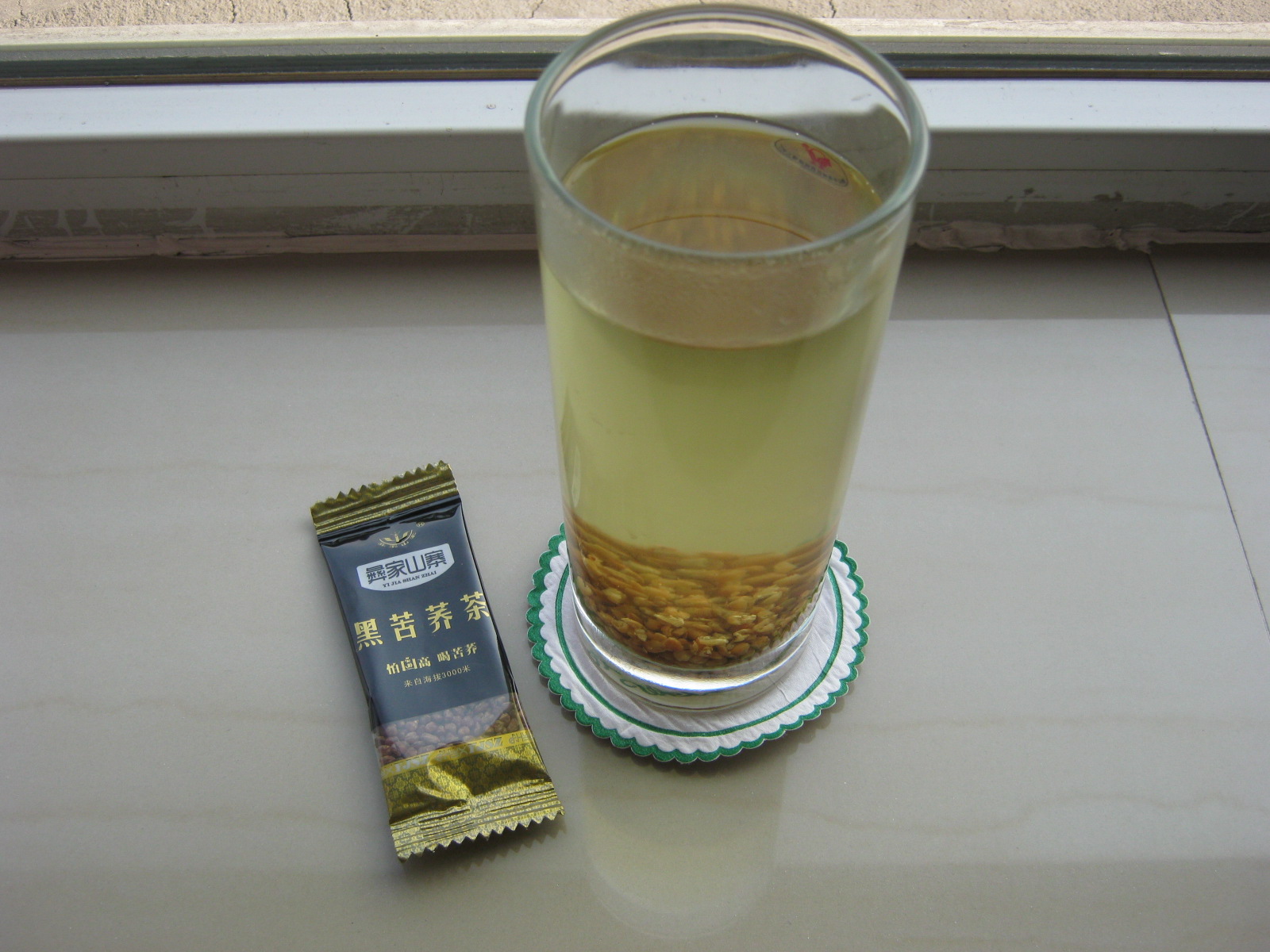
Buckwheat tea, known as kuqiao-cha (苦荞茶) in China, memil-cha (메밀차) in Korea and soba-cha (蕎麦茶) in Japan, is a tea made from roasted buckwheat.
Beer
In recent years, buckwheat has been used as a substitute for other grains in gluten-free beer. Although it is not an actual cereal (being a pseudocereal), buckwheat can be used in the same way as barley to produce a malt that can form the basis of a mash that will brew a beer without gliadin or hordein (together gluten) and therefore can be suitable for coeliacs or others sensitive to certain glycoproteins.{{cite web | access-date=1 October 2021
Whisky
Main article: Buckwheat whisky
Shōchū
Buckwheat is a Japanese distilled beverage produced since the 16th century. The taste is milder than barley shōchū.
Upholstery filling
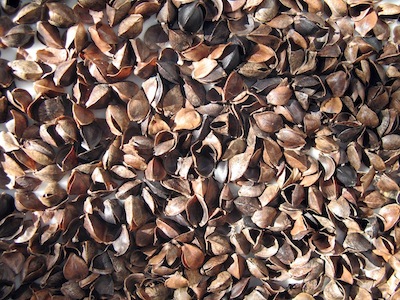
Buckwheat hulls are used as filling for a variety of upholstered goods, including pillows. The hulls are durable and do not insulate or reflect heat as much as synthetic filling. They are sometimes marketed as an alternative natural filling to feathers for those with allergies. However, medical studies to measure the health effects of pillows manufactured with unprocessed and uncleaned hulls concluded that such buckwheat pillows do contain higher levels of a potential allergen that may trigger asthma in susceptible individuals than do new synthetic-filled pillows.{{cite journal | name-list-style=amp
References
References
- (2022-02-24). "The Effects of Plasma-Activated Water Treatment on the Growth of Tartary Buckwheat Sprouts". Frontiers in Nutrition.
- "USDA GRIN Taxonomy".
- https://www.northernag.net/buckwheat-a-hazard-to-montanas-export-markets/
- https://www.thermofisher.com/allergy/wo/en/allergen-fact-sheets/buckwheat.html
- "Online Etymology Dictionary". Etymonline.com.
- (2003). "Wild flowers of Britain and Ireland: The Complete Guide to the British and Irish Flora". A & C Black.
- Stace, C. A.. (2019). "New Flora of the British Isles". C & M Floristics.
- "''Fagopyrum esculentum'' Moench". Royal Botanic Gardens, Kew.
- (1996). "Search for the wild ancestor of buckwheat II. Taxonomy of ''Fagopyrum'' (Polygonaceae) species based on morphology, isozymes and cpDNA variability". Genes and Genetic Systems.
- (1967). "An Etymological Dictionary of Modern English". Dover Publications.
- (2016). "Kuttu (Buckwheat): A Promising Staple Food Grain for Our Diet". Journal of Innovation for Inclusive Development.
- Płażek, Agnieszka. (2023-09-25). "The yield of common buckwheat (Fagopyrum esculentum Moench) depends on the genotype but not on the Pin-to-Thrum ratio". Scientific Reports.
- (2013). "Buckwheat honeys: Screening of composition and properties". Food Chemistry.
- Stone, J.L.. (1906). "Buckwheat". [[Cornell University]].
- (2008). "Buckwheat Cover Crop Handbook". [[Cornell University]].
- (2001). "Advances in the development of functional foods from buckwheat". Food Science and Nutrition.
- (1978). "Growing Buckwheat". [[Canadian Department of Agriculture]].
- (1939). "Growing Buckwheat". [[U.S. Department of Agriculture]].
- (2025). "Buckwheat production in 2023, Crops/Regions/World list/Production Quantity/Year (pick lists)". UN Food and Agriculture Organization, Corporate Statistical Database (FAOSTAT).
- (31 January 2017). "Habitat Management to Suppress Pest Populations: Progress and Prospects". [[Annual Review of Entomology]].
- "Phenol-Explorer: Showing report on Cereals". Phenol-explorer.eu.
- (2013). "The content of fagopyrin and polyphenols in common and tartary buckwheat sprouts". Acta Pharmaceutica.
- (14 February 2017). "Yes, There Is Arsenic In Your Rice. Here's What You Need To Know".
- (2015). "The gluten-free diet and its current application in coeliac disease and dermatitis herpetiformis". [[United European Gastroenterology Journal]].
- (June 2016). "Eating, Diet, & Nutrition for Celiac Disease". [[National Institutes of Health]].
- (2001). "Buckwheat allergy". [[Allergy (journal).
- (2015). "Fagopyrins and Protofagopyrins: Detection, Analysis, and Potential Phototoxicity in Buckwheat". [[Journal of Agricultural and Food Chemistry]].
- "Grano Saraceno".
- P. S. Belton. (2002). "Pseudocereals and Less Common Cereals: grain properties and utilization potential". [[Springer Publishing]].
- "Bongpyeong Buckwheat". [[Slow Food Foundation]].
- Sandra Louise Oliver. (1 January 2005). "Food in Colonial and Federal America". [[Greenwood Publishing Group]].
- "What to Eat During the Fast".
- Kim, Dakota. (22 October 2015). "10 Strange and Wonderful Korean Teas". [[Paste (magazine).
This article was imported from Wikipedia and is available under the Creative Commons Attribution-ShareAlike 4.0 License. Content has been adapted to SurfDoc format. Original contributors can be found on the article history page.
Ask Mako anything about Buckwheat — get instant answers, deeper analysis, and related topics.
Research with MakoFree with your Surf account
Create a free account to save articles, ask Mako questions, and organize your research.
Sign up freeThis content may have been generated or modified by AI. CloudSurf Software LLC is not responsible for the accuracy, completeness, or reliability of AI-generated content. Always verify important information from primary sources.
Report