From Surf Wiki (app.surf) — the open knowledge base
Bucket-brigade device
Network in mathematical dynamics

Network in mathematical dynamics
A bucket brigade or bucket-brigade device (BBD) is a discrete-time analogue delay line,{{cite book
In most signal processing applications, bucket brigades have been replaced by devices that use digital signal processing, manipulating samples in digital form. Bucket brigades still see use in specialty applications, such as guitar effects.
A well-known integrated circuit device around 1976, the Reticon SAD-1024{{Cite web
In 2009, the guitar effects pedal manufacturer Visual Sound recommissioned production of the Panasonic-designed MN3102 and MN3207 BBD chip. The MN3208 (sometimes stylized as MN-3208) is a vintage 8-pin DIP (Dual In-line Package) integrated circuit from Panasonic (formerly Matsushita), introduced in the 1970s–1980s. It's a low-noise Bucket Brigade Device (BBD) designed for analog audio delay effects, such as chorus, flanger, vibrato, and echo in guitar pedals, synthesizers, and portable audio equipment. Specifically, it's a 2048-stage BBD, meaning it uses 2048 discrete "stages" (capacitor-transistor pairs) to sample and shift an analog signal, creating delays up to ~102 ms at a 10 kHz clock rate (down to ~2 ms at 500 kHz). It operates on low voltage (4–10 V, typically 5–9 V for pedal use) and boasts a high signal-to-noise ratio (~71 dB) with low insertion loss (~0 dB typical) and total harmonic distortion (~0.8% at 1 kHz).
Despite being analog in their representation of individual signal voltage samples, these devices are discrete in the time domain and thus are limited by the Nyquist–Shannon sampling theorem; both the input and output signals are generally low-pass filtered. The input must be low-pass filtered to avoid aliasing effects, while the output is low-pass filtered for reconstruction. (A low-pass is used as an approximation to the Whittaker–Shannon interpolation formula.)
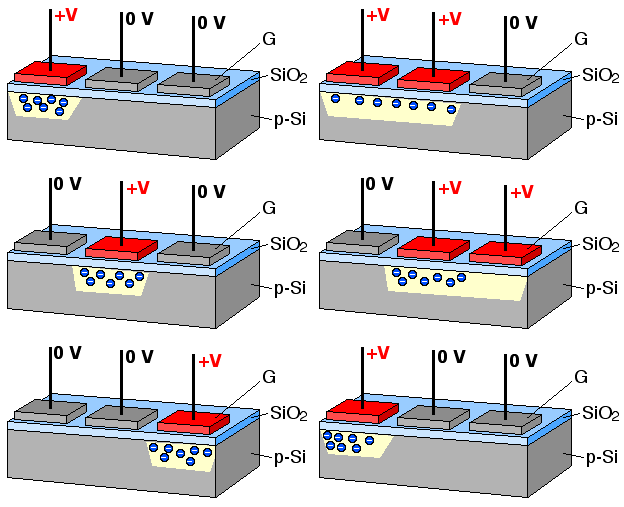
The BBD shares a principle similar to the charge-coupled device (CCD), which was invented by Bell Labs for use in digital cameras. However, the idea of using capacitors to retain a voltage state has older origins than both BBD and CCD; dynamic random-access memory, invented by the American Robert H. Dennard in 1966, also uses capacitors to store charges, but these charges are not propagated, but refreshed, in place.
References
- Theuwissen, A. (1995). Solid-State Imaging with Charge-Coupled Devices.
References
- "Bucket Brigade DELAY LINE for Analogue Signals".
- "MN3005 4096-Stage Long Delay BBD".
- "MN3007 1024-Stage Low Noise BBD".
- "MN3205 4096-Stage Low Voltage Operation Low Noise BBD".
- "MN3102 CMOS Clock Generator/Driver for Low Voltage BBD".
- "MN3207 1024-Stage Low Voltage Operation Low Noise BBD".
This article was imported from Wikipedia and is available under the Creative Commons Attribution-ShareAlike 4.0 License. Content has been adapted to SurfDoc format. Original contributors can be found on the article history page.
Ask Mako anything about Bucket-brigade device — get instant answers, deeper analysis, and related topics.
Research with MakoFree with your Surf account
Create a free account to save articles, ask Mako questions, and organize your research.
Sign up freeThis content may have been generated or modified by AI. CloudSurf Software LLC is not responsible for the accuracy, completeness, or reliability of AI-generated content. Always verify important information from primary sources.
Report