From Surf Wiki (app.surf) — the open knowledge base
Buchanan Street
Street in Glasgow, Scotland

Street in Glasgow, Scotland
| Field | Value |
|---|---|
| name | Buchanan Street |
| image | BuchananStreetDewarstatue.jpg |
| mapframe-zoom | 15 |
| caption | Buchanan Street at night looking southwards, with the Donald Dewar statue overlooking. |
| type | Commercial |
| maint | Glasgow City Council |
| length_mi | 0.5 |
| length_notes | 11.4º from north |
| location | Glasgow |
| postal_code | G1 |
| metro_system | Glasgow Subway |
| metro | Buchanan Street Station |
| inauguration_date | |
| known_for | Glasgow Royal Concert Hall, Buchanan Galleries, Princes Square, House of Fraser and Argyll Arcade. |
| website |
| mapframe-zoom = 15
Buchanan Street is one of the main shopping thoroughfares in Glasgow, the largest city in Scotland. It forms the central stretch of Glasgow's famous shopping district with a generally more upmarket range of shops than the neighbouring streets: Argyle Street, and Sauchiehall Street.
History
The land around the north and northeast of Buchanan Street, heading towards Port Dundas on the canal, became home to Buchanan Street railway station serving northern Scotland, the first railway terminal in the city-centre. Originally owned by the Caledonian Railway, then the London Midland and Scottish Railway and finally British Railways, it closed in 1966 and the area now contains Glasgow Caledonian University. Glasgow Queen Street station, serving the east and north of Scotland, and west to Helensburgh, Oban and Fort William, is immediately east of Buchanan Street at the corner of George Square, and the Buchanan Street station on the Glasgow Subway (which also serves Queen Street Station) is underneath the top half of Buchanan Street. The St. Enoch station of the subway is at the foot of Buchanan Street in St Enoch Square.
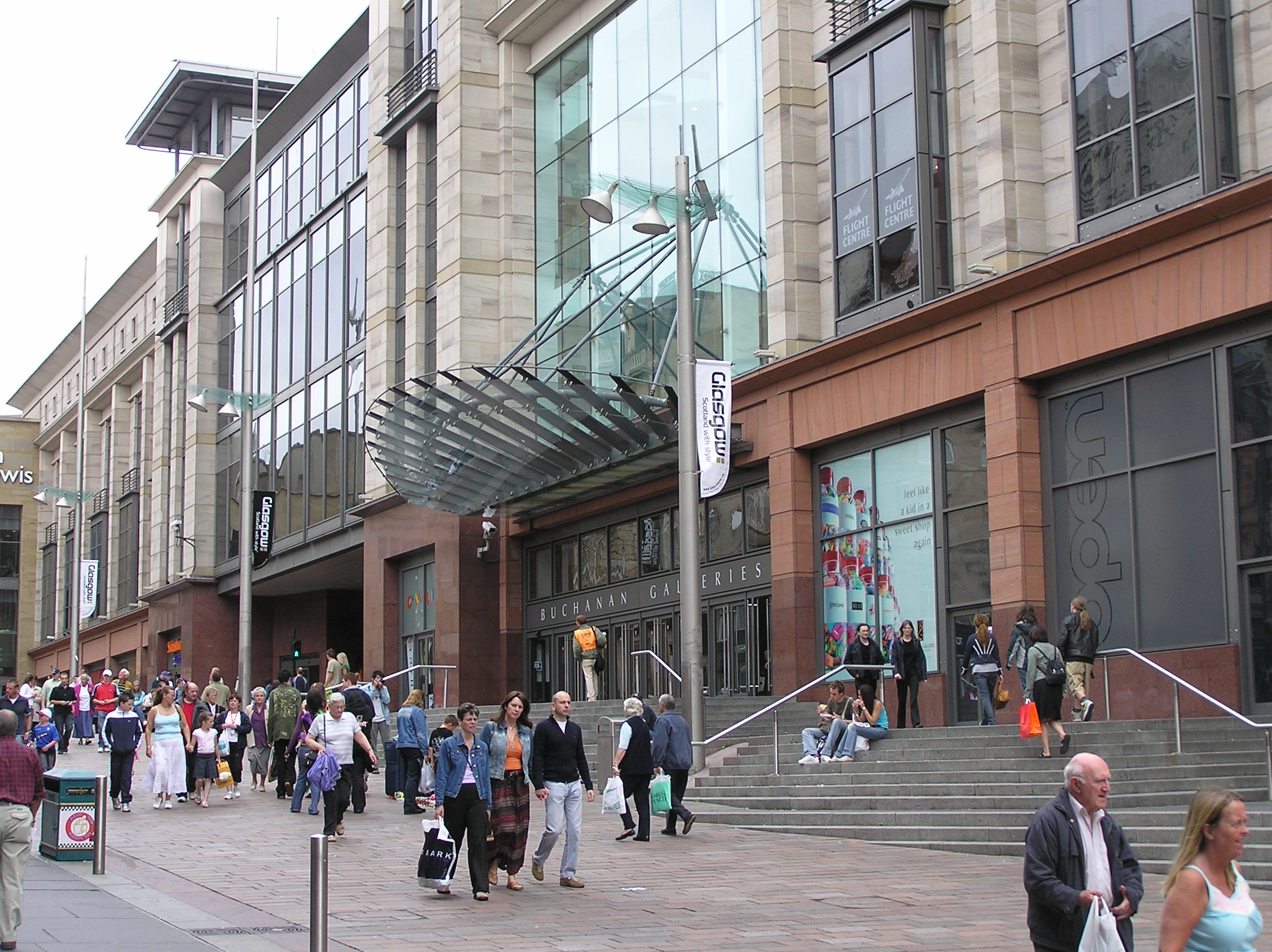
A Glasgow branch of the NAAFI was constructed at the intersection of Sauchiehall Street in 1953, but was not a financial success and closed just seven years later – the building becoming a casino for the Stakis organization which it remained until the 1980s. Buchanan Bus Station was opened nearby the top of the street in 1977, at the same time as the street itself was pedestrianised between Bath Street and Argyle Street. The northern section of the street underwent significant regeneration in the late 1980s when the demolition of the former NAAFI building at the intersection took place in 1988 to allow for the construction of the Glasgow Royal Concert Hall, opening in 1990, and the adjoining Buchanan Galleries shopping mall, which began construction in 1995 and opened in 1999. Both these new buildings spelled the final end for Parliamentary Road – the main easterly thoroughfare into neighbouring Townhead. Also in 1999, the entire street was repaved with high quality granite stonework and blue neon lighting. The combination of impressive Victorian architecture and modern urban design won Buchanan Street the Academy of Urbanism "Great Street Award" 2008, beating both O'Connell Street in Dublin and Regent Street/Portland Place, London. The area between Argyle Street and St. Vincent Street is particularly popular with buskers.
In May 2002, then-Prime Minister Tony Blair unveiled a statue of the late-First Minister of Scotland Donald Dewar at the northern end of the street, the only statue in the street. On the west side across from Buchanan Galleries a further major development of shops and housing opened in 2013 stretching through to West Nile Street at Bath Street.
Location

At the start of the street where it meets Argyle Street and St Enoch Square the historic Argyll Arcade which opened in 1827 with sixty-three shops and is now the oldest Victorian shopping centre in Britain, and its near neighbour award-winning Princes Square indoor mall face across to the stores which make up the iconic House of Fraser – which started in Glasgow and also owned Harrods of London. Buchanan Street is now entirely pedestrianised, but the streets that cross it (St. Vincent Street, George Street and Bath Street) are not.
In the middle, Royal Exchange Square opens out through to Queen Street. Buchanan Street is met by Nelson Mandela Place, which was renamed by the Labour city council from St George's Place, the address of the South African Consulate, as a protest to the African National Congress (ANC) activist Nelson Mandela being a political prisoner of the South African apartheid government at the time. On his release, Glasgow was the first city in the United Kingdom to honour him with the Freedom of the City, October 1993.
Buchanan Street is joined here by St George's-Tron Church and the Glasgow Stock Exchange building, and Royal Exchange Square, which now houses the Gallery of Modern Art.
At its north end, meeting Sauchiehall Street, are the Buchanan Galleries and the Glasgow Royal Concert Hall, which includes the home of the Royal Scottish National Orchestra.


Retail
Buchanan Street is renowned for its variety in high street shopping, including flagship stores, with rents on the street being as much as 250 £/sqft, making it the sixth most expensive street in the United Kingdom for retail rent, only surpassed by five streets in London. Buchanan Street is also the second busiest shopping thoroughfare, second only to Oxford Street in London. Glasgow has been recognised for being the second best shopping destination in the United Kingdom, after London, since 2008.
In 2022, plans were announced to demolish the Buchanan Galleries shopping centre (built in 1999) and create new streets and a mixed use development comprising residential, retail and business properties; however, these plans had been revised by 2024.
Culture
- Glasgow Royal Concert Hall
- Gallery of Modern Art (GoMA) in Royal Exchange Square
- The Lighthouse Centre for Architecture, Design and the City, is located off Buchanan Street, on Mitchell Lane.
References
References
- "Buchanan Street from The Gazetteer for Scotland".
- (26 October 2018). "'Glasgow should own up to its dark secret'".
- "TheGlasgow uni mum".
- "TheGlasgowStory: Royal Bank of Scotland".
- "History – Western Club".
- "The Athenaeum, St George's Place (renamed Nelson Mandela Place) off Buchanan Street, Glasgow".
- ''Glasgow'' by Irene Maver, published in 2000
- ''Glasgow's Blythswood'', by Graeme Smith, 2021.
- "The Academy of Urbanism : Awards".
- "Argyll Arcade – Glasgow's Jewellery Quarter".
- "TheGlasgowStory: Argyll Arcade".
- ''A Legend of Retailing – House of Fraser'' by Michael Moss & Alison Turton, published in 1990
- "Mitchell Library, Glasgow Collection, Bulletin Photographs". Glasgow City Council.
- (1 September 2011). "Glasgow among highest shop rents".
- (21 November 2024). "Buchanan Galleries development 'scaled-down' after demolition plans scrapped".
This article was imported from Wikipedia and is available under the Creative Commons Attribution-ShareAlike 4.0 License. Content has been adapted to SurfDoc format. Original contributors can be found on the article history page.
Ask Mako anything about Buchanan Street — get instant answers, deeper analysis, and related topics.
Research with MakoFree with your Surf account
Create a free account to save articles, ask Mako questions, and organize your research.
Sign up freeThis content may have been generated or modified by AI. CloudSurf Software LLC is not responsible for the accuracy, completeness, or reliability of AI-generated content. Always verify important information from primary sources.
Report