From Surf Wiki (app.surf) — the open knowledge base
Bubble chamber
Vessel filled with a superheated transparent liquid
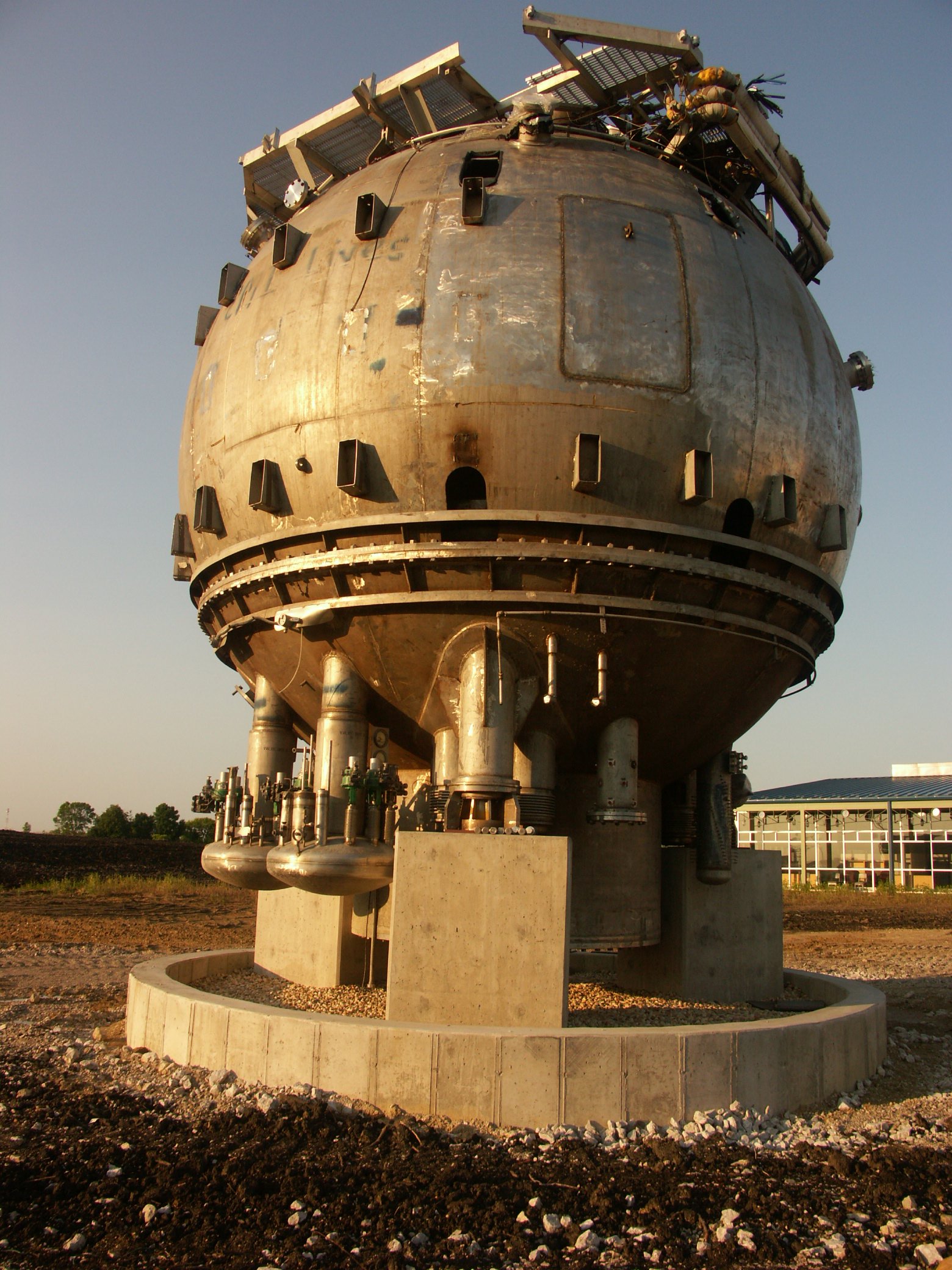
Vessel filled with a superheated transparent liquid

A bubble chamber is a vessel filled with a superheated transparent liquid (most often liquid hydrogen) used to detect electrically charged particles moving through it. It was invented in 1952 by Donald A. Glaser,{{cite journal |access-date=2009-10-03 |access-date=2009-10-03 |archive-date=2017-12-24 |archive-url=https://web.archive.org/web/20171224093552/http://www2.lbl.gov/Publications/Currents/Archive/Jul-21-2006.html#6 |url-status=dead
While bubble chambers were extensively used in the past, they have now mostly been supplanted by wire chambers, spark chambers, drift chambers, and silicon detectors. Notable bubble chambers include the Big European Bubble Chamber (BEBC) and Gargamelle.
TOC
Function and use
The bubble chamber is similar to a cloud chamber, both in application and in basic principle. It is normally made by filling a large cylinder with a liquid heated to just below its boiling point. As particles enter the chamber, a piston suddenly decreases its pressure, and the liquid enters into a superheated, metastable phase. Charged particles create an ionization track, around which the liquid vaporizes, forming microscopic bubbles. Bubble density around a track is proportional to a particle's energy loss.
Bubbles grow in size as the chamber expands, until they are large enough to be seen or photographed. Several cameras are mounted around it, allowing a three-dimensional image of an event to be captured. Bubble chambers with resolutions down to a few micrometers (μm) have been operated.
It is often useful to subject the entire chamber to a constant magnetic field. It acts on charged particles through Lorentz force and causes them to travel in helical paths whose radii are determined by the particles' charge-to-mass ratios and their velocities. Because the magnitude of the charge of all known, charged, long-lived subatomic particles is the same as that of an electron, their radius of curvature must be proportional to their momentum. Thus, by measuring a particle's radius of curvature, its momentum can be determined.
File:Recording bubble chamber.jpg|A bubble chamber recording from CERN Image:Bubble-chamber.svg|A bubble chamber
Notable discoveries
Notable discoveries made by bubble chamber include the discovery of weak neutral currents at Gargamelle in 1973,{{cite web |access-date=2009-10-03 |archive-url=https://web.archive.org/web/20101116170114/http://public.web.cern.ch/public/en/About/History73-en.html |archive-date=2010-11-16 |url-status=dead |access-date=2009-10-03 |access-date=2009-10-03 |access-date=2016-02-22
Drawbacks
Although bubble chambers were very successful in the past, they are of limited use in modern very-high-energy experiments for a variety of reasons:
- The need for a photographic readout rather than three-dimensional electronic data makes it less convenient, especially in experiments which must be reset, repeated and analyzed many times.
- The superheated phase must be ready at the precise moment of collision, which complicates the detection of short-lived particles.
- Bubble chambers are neither large nor massive enough to analyze high-energy collisions, where all products should be contained inside the detector.
- The high-energy particles may have path radii too large to be accurately measured in a relatively small chamber, thereby hindering precise estimation of momentum.
Due to these issues, bubble chambers have largely been replaced by wire chambers, which allow particle energies to be measured at the same time. Another alternative technique is the spark chamber.
Examples
- 30 cm Bubble Chamber (CERN)
- 81 cm Saclay Bubble Chamber
- 2 m Bubble Chamber (CERN)
- Berne Infinitesimal Bubble Chamber
- Bevatron, a particle accelerator with a liquid hydrogen bubble chamber
- Big European Bubble Chamber
- Holographic Lexan Bubble Chamber
- Gargamelle, a heavy liquid bubble chamber which operated in CERN between 1970 and 1979.
- LExan Bubble Chamber
- PICO, liquid freon bubble chamber searching for dark matter
References
This article was imported from Wikipedia and is available under the Creative Commons Attribution-ShareAlike 4.0 License. Content has been adapted to SurfDoc format. Original contributors can be found on the article history page.
Ask Mako anything about Bubble chamber — get instant answers, deeper analysis, and related topics.
Research with MakoFree with your Surf account
Create a free account to save articles, ask Mako questions, and organize your research.
Sign up freeThis content may have been generated or modified by AI. CloudSurf Software LLC is not responsible for the accuracy, completeness, or reliability of AI-generated content. Always verify important information from primary sources.
Report