From Surf Wiki (app.surf) — the open knowledge base
British Rail Class 91
Class of high-speed electric locomotives

Class of high-speed electric locomotives
| Field | Value | |
|---|---|---|
| name | British Rail Class 91 | |
| image | [[File:91127 "Neville Hill" Potters Bar 090923 09.04 KX-Leeds.jpg | 300px]] |
| caption | LNER Class 91 passing | |
| powertype | Electric | |
| designer | GEC Transportation Projects | |
| builder | BREL Crewe Works | |
| builddate | 1988–1991 | |
| totalproduction | 31 | |
| rebuilder | Adtranz | |
| rebuilddate | 2000–2003 | |
| numberrebuilt | 31 | |
| aarwheels | B-B | |
| Britishclass | Bo-Bo | |
| uicclass | Bo′Bo′ | |
| gauge | ||
| bogies | BREL BP52 | |
| wheeldiameter | 970 mm | |
| minimumcurve | 80.000 m | |
| wheelbase | 10.500 m | |
| bogie | 3.350 m | |
| body | 19.400 m | |
| width | 2.740 m | |
| height | 3.757 m | |
| pantodown | ||
| bodyonly | ||
| locoweight | ||
| electricsystem | overhead | |
| collectionmethod | ||
| tractionmotors | 4 × GEC G426AZ DC | |
| gear ratio | 1.741:1 | |
| multipleworking | TDM | |
| trainheating | ||
| locobrakes | ||
| locobrakeforce | ||
| trainbrakes | Pneumatic | |
| safety | ||
| coupling | Drophead Buckeye | |
| maxspeed | ||
| poweroutput start | 4.70 MW at rails | |
| poweroutput cont | 4.54 MW at rails | |
| tractiveeffort | max 190 kN | |
| continuous 107 kN @ 153 km/h | ||
| t/e starting | 190 kN | |
| t/e continuous | ||
| operator | ||
| fleetnumbers | ||
| officialname | Electra | |
| axleloadclass | Route availability 7 | |
| currentowner | ||
| disposition |
| t/m amps 1 hr = | t/m amps cont = continuous 107 kN @ 153 km/h | t/e starting = 190 kN | t/e 1 hr = | t/e continuous = | f/adh starting = | f/adh 1 hr = | f/adh continuous=
The British Rail Class 91 is a high-speed electric locomotive, which produces power of 4830 kW; it was ordered as a component of the East Coast Main Line modernisation and electrification programme of the late 1980s. The Class 91s were given the auxiliary name of InterCity 225 to indicate their envisaged top speed of 140 mph; they were also referred to as Electras by British Rail during their development and throughout the electrification of the East Coast Main Line.
The locomotive body shells are of all-steel construction. Unusually, the motors are body mounted and drive bogie-mounted gearboxes via cardan shafts; this reduces the unsprung mass and hence track wear at high speeds. The locomotive also features an underslung transformer, therefore the body is relatively empty compared to contemporary electric locomotives. Much of the engineering specification for the locomotive was derived from the research and operational experience of the APT-P.
The other end of the InterCity 225 train set is formed of a Mark 4 Driving Van Trailer, built with a similar body shell to the Class 91 locomotives but with only one driving cab.
History
Background
The origins of the Class 91 are closely associated with the East Coast Main Line (ECML) on which it has been primarily operated. During the 1950s, British Rail had considered electrification of the ECML to be of equal importance to the West Coast Main Line (WCML), but various political factors led to the envisioned electrification programme being delayed for decades; as an alternative, high-speed diesel traction, the Deltic and then the InterCity 125, was introduced upon the route during the 1960s and 1970s. During the 1970s, a working group of British Rail and Department of Transport officials determined that, out of all options for further electrification, the ECML represented the best value by far. Its in-house forecasts determined that increases in revenue and considerable reductions in energy and maintenance costs would occur by electrifying the line.
Accordingly, between 1976 and 1991, the ECML was electrified with 25 kV AC overhead lines. The electrification was installed in two phases: The first phase between London (King's Cross) and (including the Hertford Loop Line) was carried out between 1976 and 1978 as the Great Northern Suburban Electrification Project, using Mk. 3A equipment, covering 30 mi in total. In 1984, the second phase commenced to electrify the northern section to Edinburgh and Leeds. During the late 1980s, the programme was claimed to be the longest construction site in the world, spanning more than 250 mi.
In 1989 the InterCity 225 was officially introduced to revenue service. That same year, the ECML had been energised through to York; two years later, electrification had reached Edinburgh, allowing electric services to begin on 8 July 1991, eight weeks later than scheduled. The ECML electrification programme was completed at a cost of £344.4million (at 1983 prices), a minor overrun against its authorised expenditure of £331.9million. 40 per cent of the total cost was on new traction and rolling stock and 60 per cent for the electrification of the line.
Options and selection
The electrification of the ECML necessitated the procurement of new high speed electric traction. The options and requirements for this trainset were hotly deliberated for a number of years. On 7 June 1978, the electric-powered prototype Advanced Passenger Train (APT) was unveiled; it was at one point intended for the APT to be the next major intercity express train. However, due to various factors including technical issues, the APT programme was curtailed during the summer of 1983. Shortly thereafter, two alternative options were explored, an electrified version of the InterCity 125 (known as the HST-E), and the mixed-traffic locomotive; these were both intended to a peak service speed of 125mph.
Some officials within British Rail pushed for more demanding requirements for the future Intercity trainset; reportedly, BR's Director of Mechanical and Electrical Engineering (M&EE) was a strong proponent for increasing the top speed to 140 mph. To facilitate this, tilting train technologies developed for the APT were explored. While BR's board had approved the ordering of a single Class 89 as a prototype, the Strategy Committee queried why the type had been favoured over a proposed 80-tonne Bo-Bo locomotive. While the Class 89 was thought to be a low-risk option for multi-purpose traction, it offered little advantage over the existing in terms of speed. At the time, the 1950s era and electric locomotives were nearing the end of their viable service lives and were quite unreliable, but their withdrawal had effectively been ruled out by a national shortage of newer electric traction, in part caused by the APT's cancellation.
A key advantage of the InterCity 225 concept over a Class 89-hauled consist was the lower weight of the former, resulting in less slippage and greater acceleration over the latter. Appraisals also determined that the Class 89 was comparatively inferior in financial terms, in part due to the InterCity 225's prospective compatibility with WCML traction, reducing its development costs. A further cost-saving measure was the decision to base the InterCity 225's technologies on the APT. BR reportedly stated that it had derived 90% of the former's engineering from the latter. Thus, the study group recommended that the InterCity 225 be pursued as the preferred option, while the Class 89 and HST-E initiatives serve as back-ups. Despite this, the HST-E effort was promptly aborted, while Brush Traction decided to de-prioritise work on the Class 89 after learning that it was unlikely to lead to volume production.
By spring 1984, favour was being given towards the adoption of a tilting carriage, tentatively designated as the Mk 4; this was viewed as superior to the existing Mk 3 and enabled a single design to be shared between the ECML and WCML. At one point, it was envisaged that the InterCity 225 would be extremely ubiquitous, even potentially having the capability built into it to operate over the southern third-rail network and within the Channel Tunnel; by mid 1984, such proposals were curtailed. Furthermore, it was decided to reduce the freight haulage capabilities of the InterCity 225, as traction for this sector was instead intended to be served via other platforms. The emergence of the , derived from the existing Class 87, somewhat reduced the pressure for the InterCity 225, reducing the prospective numbers to be built of the latter. Without tilting carriages, it had little speed advantage over the Class 90 on the WCML.
It was decided to hold a competitive tender for the InterCity 225 programme; this measure was aimed at avoiding the difficulties experienced with the APT programme. A pre-qualification document was formalised, in which various requirements for the type were laid out; these included the need to perform mixed-traffic duties (day and night passenger, parcel and mail, and overnight heavy freight services), the haulage of both tilting and conventional rolling stock, a top speed of 225km/h, a maximum cant deficiency of 9° without the provision of tilt equipment, and that the maximum unsprung mass could not exceed 1.8tonnes. Furthermore, BR stated its readiness to sub-contract with the successful bidder for the supply of technical information, advice and testing. The prequalification document was issued to BREL, Brush Traction and the General Electric Company (GEC), as well as the French firm Alsthom and Germany's Krauss Maffei. The inclusion of foreign manufacturers was in part due to the limited domestic experience with trainsets capable of such high top speeds. A total of three companies, ASEA, Brush Traction and GEC, submitted tenders for the design and construction of the Class 91 locomotive.
On 14 February 1985, the BR board approved the substitution of the Class 91 for Class 89 for the ECML programme. The tendering process was relatively complex, but a decisive move appeared to have been GEC's offer of a sub-contracting arrangement to BREL for the construction of the locomotive's mechanical elements. It would be GEC's submission that would be selected as the winner; after which a contract for the construction of 31 Class 91 locomotives, along with an option for 25 more for the WCML, was awarded during February 1986. Shortly thereafter, BREL established a production line for the type at its Crewe Works.
Post-introduction developments
The first passenger service to be operated by a Class 91 locomotive was the 17:36 King's Cross to Peterborough on 3 March 1989. From 6 March, members of the fleet began to work services between London and Grantham, and from 11 March services between London and Leeds. With the completion of the East Coast Main Line electrification programme, Class 91 trains reached Newcastle upon Tyne for the first time in service on 10 June 1991, then Edinburgh on 12 June.
In service, as a part of the InterCity 225 sets, the fleet worked alongside locomotives and electric multiple units. Diesel trains displaced by the Class 91 introduction were reallocated predominantly to the Midland Main Line. The InterCity 225's introduction correlated with a significant increase in passenger numbers using the ECML within two years; one station recorded a 58 per cent increase in passengers.
In the early 1990s, after the cancellation of InterCity 250, British Rail examined the option of ordering a further set of ten Class 91s to operate on the West Coast Main Line with UK Treasury support, however the business case for these failed to prove sufficiently worthwhile. and led to the electric Networker Classes 365, 465 and 466 EMU Networker stock's procurement being taken forward.


The locomotive body is asymmetric; streamlined at the 'front' (Number 1) end , but left 'blunt' at the Number 2 end so as to visually blend with the fixed sets of Mark 4 coaches in normal push-pull passenger service. Because of a design requirement that the class be able to function as normal locomotives if so required, a full driver's cab is also provided at the Number 2 endbut the locomotive's maximum speed is reduced to 110 mph when this cab is at the front of a train.
During the privatisation of British Rail ownership of the Class 91 fleet passed to Eversholt Rail Group, which in turn leased the fleet to its various operators. Eversholt put all 31 locomotives through a £30million heavy overhaul and refit process () between 2000 and 2003, seeking to improve the fleet's reliability. Rail Magazine described it in March 2001 as being necessary because "eight out of ten failures on Class 91s were caused by the sub-standard electrics", and further noted that problems with relays in particular were the "third-biggest" cause of failures. The refit was performed by Adtranz (later Bombardier Transportation), with technical support from Alstom, and involved upgrades to the bogies, electrical systems, air compressors, and parking brakes; alterations to the cab layout at the Number 1 end; the replacement of the original gearboxes with newly designed Voith models; and the installation of TPWS and a new air-cooling system. Overhauled units had their numbers increased by 100; thus 91001 became 91101 and so onwith the exception of 91023, which was renumbered 91132 due to sensitivity around its involvement in both the Hatfield and Selby accidents.
During the overhaul process, GNER hired in Class 90 locomotives to provide cover for their services.
In November 2012, number 91114 had a second pantograph added as a pilot project conducted jointly by Eversholt, East Coast, DB ESG, Wabtec, and Brecknell Willis. The new design uses the same mounting positions as a conventional pantograph but pairs two pantograph arms in an opposing configuration. If there is an ADD (Automatic Dropping Device) activation or the pantograph becomes detached, the train can keep going, so the system provides redundancy in the event of a pantograph/OLE failure.
Speed records
Locomotive 91010 (now 91110) holds the British speed record for electric locomotives, reaching 161.7 mi/h while on a test run down the East Coast Main Line's Stoke Bank on 17 September 1989. Locomotive 91012 (now 91112) holds the separate record for the fastest non-stop journey between London King's Cross and ; 3hours29minutes on 26 September 1991, running within the 140 mph speed limit but hauling a shortened set of only five coaches plus DVT. The time converts to an average speed of 112.5 mi/h.
Despite these successes, however, Class 91 locomotives have never used their 140mph top speed in regular service, because testing conducted by British Rail in 1988 established that drivers could not interpret and act upon line-side signal aspects with sufficient consistency and accuracy when driving at speeds exceeding 125 mph. Regulations throughout Britain were subsequently amended to require the use of in-cab signalling whenever running service trains at speeds above 125mph, an option that BR were unwilling to pursue at the time.
Fleet

When British Rail was privatised, the InterCity livery was progressively removed and new operator GNER applied their corporate livery of blue and vermilion. When GNER lost their franchise in 2007, the vermilion stripe was replaced by a white stripe containing the words National Express and East Coast. National Express East Coast originally planned to repaint all of their InterCity 225 sets in the white and silver NXEC corporate livery within two years. However, the collapse of NXEC in 2009 and its replacement with East Coast saw this repainting programme cancelled. As a result, 91111 was the only locomotive to receive the full National Express livery.
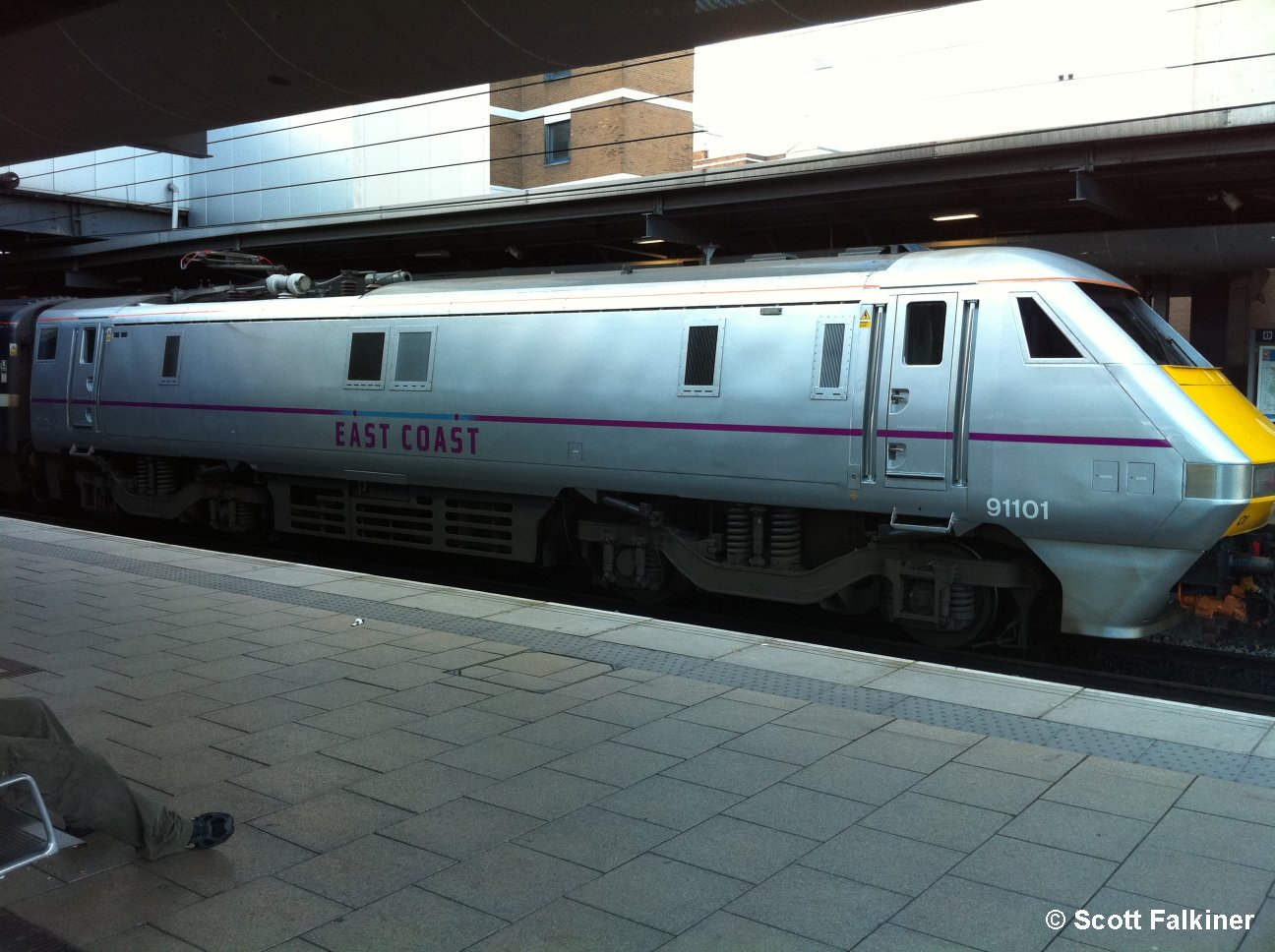
In June 2010, a new silver livery with a purple stripe was unveiled by East Coast. By February 2011, locomotives 91101, 91106, 91107 and 91109 carried this livery. Locomotive 91101 was soon given maroon vinyls, with Flying Scotsman branding. Locomotive 91107 was given promotional "Skyfall" vinyls for a time during 2012–3. The locomotive later returned to conventional Virgin Trains East Coast livery. Locomotive 91110 carries 'BBMF' Battle Of Britain Memorial Flight livery. By 2013, all locomotives carried the standard East Coast livery of silver/grey with a purple stripe. 91118 was the last locomotive to carry GNER/NXEC livery. All Mark 4 coaches and DVTs have since been repainted. On 14 October 2014, at Newcastle station, locomotive 91111 was unveiled in a commemorative World War I livery and named 'For The Fallen'.
The Class 91 fleet has carried nameplates applied in various batches and themes. Immediately after repainting into GNER colours in the late 1990s, all locomotives were briefly nameless. Having initially been applied to only a few locomotives in the early 1990s using cast-iron plates, eventually the whole fleet was named, many multiple times, until all were removed in 2008. In 2011, in response to customer requests, East Coast resumed the practice. It began by naming No. 91109 as Sir Bobby Robson with cast-iron plates, unveiled in a ceremony at Newcastle station on 29 March by his widow Elsie and Alan Shearer.
List of Class 91 locomotives
| Key: |
|---|
| In service |
| Current Number | Previous Number(s) | Current name | Previous name(s) | Current livery | Built | Operator | Status | Notes |
|---|---|---|---|---|---|---|---|---|
| 91101 | 91001 | Flying Scotsman | ** | LNER InterCity | LNER | Operational | ||
| 91102 | 91002 | Scrapped | Scrapped at Sims, Newport, May 2021. | |||||
| 91103 | 91003 | ** | Scrapped | Arrived at C F Booth, Rotherham for scrapping, March 2022. Scrapped in August 2022. | ||||
| 91104 | 91004 | ** | Scrapped | Arrived at C F Booth, Rotherham for scrapping, March 2022. | ||||
| 91105 | 91005 | |||||||
| 91000 | ||||||||
| 91150 | National Railway Museum 50 Years 1975-2025 | ** | National Railway Museum 50th anniversary artwork | LNER | Operational | Named in July 2025 to celebrate 50 years of National Railway Museum in York. | ||
| 91106 | 91006 | Swallow InterCity 225 - Since 1989 | East Lothian | LNER InterCity | LNER | Operational | Named to celebrate LNER's first ‘225 Day’. | |
| 91107 | 91007 | Skyfall | ** | LNER InterCity | LNER | Operational | Was temporarily renumbered back to 91007 for the duration of the Skyfall promotion. | |
| 91108 | 91008 | ** | Scrapped | Went off lease in July 2019; first Class 91 locomotive to be withdrawn. Scrapped at C F Booth, Rotherham, May 2022. | ||||
| 91109 | 91009 | Sir Bobby Robson | ** | LNER InterCity | LNER | Operational | ||
| 91110 | 91010 | Battle of Britain Memorial Flight | ** | Battle of Britain Memorial Flight artwork | LNER | Operational | The locomotive holds the national speed record for electric locomotives of 162 mph attained at Stoke Bank near Peterborough on 17 September 1989. Selected for preservation in the National Collection. | |
| 91111 | 91011 | For the Fallen | Terence Cuneo | For the Fallen artwork | LNER | Operational | World War I commemoration. | |
| 91112 | 91012 | County of Cambridgeshire | Scrapped | Hauled to Sims, Newport, on 3 February 2023 | ||||
| 91113 | 91013 | ** | Scrapped | Scrapped at Sims, Newport, May 2021. | ||||
| 91114 | 91014 | Durham Cathedral | ** | LNER InterCity | LNER | Operational | Previously fitted with experimental two-in-one pantograph. | |
| 91115 | 91015 | Scrapped | Hauled to Sims, Newport, on 3 February 2023 | |||||
| 91116 | 91016 | Strathclyde | LNER red/white | LNER | Stored | Currently in warm storage at Belmont Yard, Doncaster. | ||
| 91117 | 91017 | ** | Europhoenix | Europhoenix | Stored | Went off-lease on 25 September 2019. Currently stored at Barrow Hill. To be used as a spares donor in the project to reactivate 89001 Avocet. | ||
| 91118 | 91018 | The Fusiliers | ** | LNER red/white | LNER | Stored | Currently in warm storage at Belmont Yard, Doncaster. | |
| 91119 | 91019 | Bounds Green Intercity Depot | ** | BR InterCity 'Swallow' | LNER | Operational | ||
| 91120 | 91020 | Royal Armouries | BR Intercity 'Swallow' | Europhoenix | Stored | On display at Crewe Heritage Centre on long-term loan from Europhoenix. | ||
| 91121 | 91021 | ** | LNER red/white | LNER | Stored | Formerly carried pride decorations and was known as the "Trainbow". Currently in warm storage at Belmont Yard, Doncaster. | ||
| 91122 | 91022 | ** | Scrapped | Used following withdrawal in testing of overhead wires on the Midland Main Line, scrapped in October 2022. | ||||
| 91124 | 91024 | Reverend W Awdry | LNER InterCity | LNER | Operational | |||
| 91125 | 91025 | ** | Scrapped | Previously carried promotional livery for Sky 1 HD. Hauled to Sims, Newport, on 3 February 2023. | ||||
| 91126 | 91026 | ** | Scrapped | Scrapped at Sims, Newport, May 2021. | ||||
| 91127 | 91027 | Neville Hill | ** | LNER InterCity | LNER | Operational | First locomotive in LNER InterCity livery. | |
| 91128 | 91028 | ** | Scrapped | Used following withdrawal in testing of overhead wires on the Midland Main Line, scrapped in July 2022. | ||||
| 91129 | 91029 | Queen Elizabeth II | Scrapped | Scrapped at Sims, Newport, May 2021. | ||||
| 91130 | 91030 | Lord Mayor of Newcastle | ** | LNER InterCity | LNER | Operational | ||
| 91131 | 91031 | ** | LNER red/white | Preserved | Last locomotive built at Crewe Works. Preserved at the Museum of Scottish Railways. | |||
| 91132 | 91023 | City of Durham | Scrapped | Involved in both Hatfield and Great Heck accidents. Renumbered 91132 (rather than 91123) after 2001 refurbishment. Scrapped at Sims, Beeston, March 2021. |
| Year | Quantity in | ||
|---|---|---|---|
| service at | |||
| start of year | Quantity | ||
| withdrawn | Locomotives withdrawn | ||
| 2019 | 31 | 4 | 91103, 91108, 91117, 91120 |
| 2020 | 27 | 15 | 91102, 91104, 91112–91113, 91115–91116, 91118, 91121–91122, 91125–91126, 91128–91129, 91131–91132 |
Operators
| Operator | Years | Livery | Image | |||||||||
|---|---|---|---|---|---|---|---|---|---|---|---|---|
| InterCity | 19881996 | Intercity Swallow (red, white, and black) | [[File:Peterborough Station, 1992 geograph-3967343-by-Ben-Brooksbank.jpg | 200px | 91021 at Peterborough in 1992.]] | |||||||
| Great North Eastern Railway | 19962007 | GNER navy blue with gold and vermilion detailing | [[File:Hugh_llewelyn_91_101_(6749175251).jpg | 200px | 91101 "City of London" at King's Cross in July 2007.]] | |||||||
| National Express East Coast | 20072009 | Interim livery (GNER navy blue with white stripe) | [[File:Hugh_llewelyn_91_101_(5631916483).jpg | 200px]] | ||||||||
| 20082009 | National Express corporate grey (only used on 91111) | [[File:Hugh llewelyn 91 111 (5624186675).jpg | 200px | 91111 at Kings Cross in March 2009.]] | ||||||||
| East Coast | 20102015 | East Coast Navy with white stripe (National Express Interim livery) | [[File:EAST COAST RAILWAYS CLASS 91 LOCO HAULED TRAIN AT LEEDS STATION SEP 2013 (9988337115).jpg | frameless | 200x200px]] | |||||||
| East Coast silver with purple stripe | [[File:91 106 Kings Cross(8077572452).jpg | 200px | 91106 at King's Cross in August 2012.]] | |||||||||
| Virgin Trains East Coast | 20152016 | Interim livery (East Coast silver with purple stripe and Virgin Trains large red strip) | [[File:Virgin Trains East Coast Class 91.jpg | 200px]] | ||||||||
| 20152018 | Virgin Trains corporate red and white | [[File:York - VTEC 91124 leaving for London.JPG | 200px | 91124 at York in April 2015.]] | ||||||||
| London North Eastern Railway | 20182023 | LNER red and white (VTEC red/white with LNER branding) | [[File:Kings Cross - LNER 91125 ecs.JPG | 200px | 91125 at King's Cross in July 2018.]] | |||||||
| 2022present | title=New Livery for LNER InterCity 225 Fleet as Part of Essential Maintenance | url=https://www.lner.co.uk/news/new-livery-for-lner-intercity-225-fleet-as-part-of-essential-maintenance | access-date=6 September 2022 | publisher=London North Eastern Railway | date=13 June 2022 | archive-date=17 July 2022 | archive-url=https://web.archive.org/web/20220717004341/https://www.lner.co.uk/news/new-livery-for-lner-intercity-225-fleet-as-part-of-essential-maintenance/ | url-status=dead }} | [[File:British Rail Class 91, 91130 at York railway station.png | 200px | 91130 at York railway station in October 2022]] | |
| Europhoenix | 2019present | Europhoenix grey, silver, and red (with a phoenix motif branding) | [[File:Leicester TMD - Europhoenix 91117.JPG | 200px | 91117 at Leicester TMD in October 2019.]] |
Current operations
The fleet, which was previously operated by InterCity and then GNER, National Express East Coast, East Coast and Virgin Trains East Coast, is currently run by London North Eastern Railway.
In July 2019, 91108 was the first of the class to be withdrawn. Following the withdrawal of the InterCity 125 fleet in December 2019, it was previously thought that the InterCity 225 fleet would be fully withdrawn by June 2020. However, LNER announced on 29 January 2020 that they would be retaining a limited number of the InterCity 225 fleet to deliver all of the benefits of their December 2021 timetable. LNER later confirmed that they would be keeping 10 sets in service.
In September 2020, Eversholt Rail Group and London North Eastern Railway extended their lease to ten by 2023. In addition, there are options to make it operational until 2024. It will be overhauled at the Wabtec Doncaster plant.
At the end of service on 15 January 2021, the remaining serviceable InterCity 225 sets went into storage temporarily as part of the East Coast Upgrade. Originally, the plan was to return the sets to service for 7 June 2021, but instead the first set re-entered service on 11 May 2021 due to a number of Azuma sets having to be taken out of service.
Future operations
Europhoenix purchased 91117 and 91120 in September 2019. They were repainted at Bounds Green TMD before moving to UK Rail Leasing's Leicester depot. They were to be re-geared for freight operation in Europe. In September 2022, 91120 moved to Crewe Heritage Centre on long-term loan from Europhoenix.
Rail Operations Group have taken a pair of Class 91s for use in testing of the newly electrified Midland Main Line prior to the introduction of regular electric services between and . The company has also expressed interest in using the Class 91s on high speed logistics trains.
Grand Union proposed to operate InterCity 225s on London Paddington to Cardiff Central and London Euston to Stirling services.
Scrapping
91132 was the first Class 91 to be scrapped, at Sims Metals scrapyard in Nottingham in 2021.
Preservation
91131 was nominated by the Railway Heritage Committee to be preserved upon its retirement; in March 2023, it moved to preservation at the Museum of Scottish Railways at the Bo'ness and Kinneil Railway.
In June 2021, the 225 Group was launched; their intention is to preserve a further Class 91 and an InterCity 225 set.
In September 2022, Crewe Heritage Centre received 91120 on long-term loan from Europhoenix.
Notes
References
Literature
References
- (1988). "Grossbritanniens Neue Eisenbahnen / Britain's New Railways". British Railways Board.
- (April 2008). "Vehicle Diagram Book - Class 91 Locomotive". HSBC Rail UK.
- (22 June 2011). "System Data for Mechanical and Electrical Coupling of Rail Vehicles in support of GM/RT2190". Rail Safety and Standards Board.
- (1995). "Traction électrique". Presses polytechniques et universitaires romandes.
- (10 October 2019). "Europhoenix earmarks '91s' for European freight use". Bauer Consumer Media.
- (September 1989). "The design and development of the Class 91 locomotive". International Conference on Main Line Railway Electrification 1989.
- (23 November 2017). "ECML Power Supply Upgrade". RailStaff Publications.
- "ECML: Electrification as it used to be". Rail Media Group.
- (1973). "Your New Electric Railway: The Great Northern Suburban Electrification". British Rail.
- Semmens, Peter. (March 1991). "Electrifying the East Coast Route: Making of Britain's First 140 m.p.h. Railway". Patrick Stephens.
- (24 April 2017). "Back to the future as history made with East Coast rail icons". National Railway Museum.
- (August 1978). "First impressions of ATP-P". Ian Allan.
- "Class 91s... promise unfulfilled". Bauer Consumer Media.
- Ford, Roger. (April 1988). "Managing Electra". [[Modern Railways]].
- Vincent, Mike. (2013). "InterCity Story 1964-2012". Oxford Publishing Company.
- (20 March 2013). "No rest for the '91s'". Bauer Consumer Media.
- (April 2007). "British Railways Locomotives & Coaching Stock 2007". Platform 5 Publishing.
- (28 November 2012). "Second pantograph fitted to '91' in bid to cut failures". Bauer Consumer Media.
- (1 February 2013). "Duplex pantograph prototype unveiled". Schofield Publishing.
- (5–18 October 1989). "Class 91 hits 162 mph". EMAP National Publications.
- (June 2006). "RPS listing of 'special' runs". Railway Performance Society.
- (15 November 2018). "The digital railway – progresses to the East Coast Main Line". Rail Media Group.
- (August 1994). "Discussion: Electrification of British Railway's East Coast Main Line". Proceedings of the Institution of Civil Engineers - Transport.
- Cover, Ron. (9 August 2010). "East Coast goes silver and purple!". Railway Herald.
- (5 October 2010). "91101 at Leeds".
- (14 October 2014). "East Coast unveils tribute "For the Fallen"". East Coast.
- (29 March 2011). "Sir Bobby Robson name given to train".
- (29 March 2011). "East Coast Names Train Sir Bobby Robson". East Coast.
- (28 October 2015). "First Minister launches new Virgin Flying Scotsman train". Virgin Trains East Coast.
- (April 2023). "More Class 91s head for scrap". Mortons Media Group.
- (1 December 2011). "Reg's return heralds unveiling of iconic train name". East Coast.
- (June 2021). "Four more Class 91s dispatched for scrap to Newport".
- Butlin, Ashley. (April 2022). "Stock Update".
- (November 2022). "Class 91 disposals continue".
- (10 January 2024). "Meet 91000: 'our' Class 91 will be operating on the East Coast Mainline".
- (8 July 2025). "LNER Launches Poppy Train 'Thank You' In Recognition Of Those Who Have Served". London North Eastern Railway.
- (January 2023). "LNER operational Class 91 liveries".
- (7 June 2025). "LNER Declares 22nd Of May "225 Day" - Celebrating Its InterCity Stalwarts". London North Eastern Railway.
- "Now arriving at Platform 007".
- (21 July 2019). ""On Monday 22nd July after thirty years of service, we bid a final farewell to locomotive 91108."".
- Newton, Grace. (22 July 2019). "Watch: Train driver's poignant horn blast as retiring LNER locomotive leaves York for the final time". [[The Yorkshire Post]].
- (29 March 2011). "East Coast names train "Sir Bobby Robson"". East Coast.
- "Lot 328, GCR Auction, Sale 122".
- (10 November 2022). "LNER's InterCity Swallow liveried Class 91 locomotive is latest to be repainted". RailAdvent.
- (14 October 2014). "East Coast unveils moving tribute "For The Fallen"".
- (3 July 2013). "East Coast train named "Durham Cathedral"".
- (6 June 2012). "Famous North East anthem 'Blaydon Races' takes to the tracks". East Coast.
- "InterCity 225 Fleet List Class 91 Locomotives". 225 Group.
- (13 September 2012). "West Riding region honoured at train naming ceremony". East Coast.
- (25 September 2019). "Today, we say goodbye to 91117 (West Riding Limited)".
- (28 March 2018). "Virgin Trains reveal 'The Fusiliers' train". RailAdvent.
- (14 October 2017). "Bounds Green depot celebrates 40 years of HST maintenance by naming a Class 91!". Steven Knight Media.
- (3 October 2023). "Back in time for europhoenix 91120". Readly.
- (29 September 2022). "91 120 Loaned To Crewe Heritage Centre".
- (26 August 2019). "LNER Celebrates Summer of Pride on East Coast Route". London North Eastern Railway.
- "Radio Rewind - BBC Radio 1 Timeline - 1978 to 1992".
- (21 November 2017). "Virgin Loco 91 126 Named Darlington Hippodrome".
- "''Neville Hill'' name for Class 91". ''Rail Express''. No. 329. Horncastle: Mortons Media Group. October 2023. p. 12.
- "Intercity 50".
- (7 December 2016). "All aboard the Lord Mayor of Newcastle as train celebrates city anniversary".
- Bo'ness & Kinneil Railway. (10 March 2023). "Class 91131 has arrived safely at B&KR. You can see the loco in our @Mus_Scot_Rways from April 2023.".
- (13 June 2022). "New Livery for LNER InterCity 225 Fleet as Part of Essential Maintenance". London North Eastern Railway.
- (31 July 2019). "First Class 91 withdrawn from traffic by LNER".
- "FROM THE ARCHIVES: Traction transition: HST to Azuma".
- (29 January 2020). "If you're a fan of our IC225 trains, you can continue to enjoy them for a bit longer. We are retaining a number of them in order to deliver all of the benefits of our Dec 2021 timetable plans.".
- (5 February 2020). "18 currently and we are keeping 10 till the end of 2021.".
- (10 September 2020). "IC225 Fleet Lease Extension and Overhaul".
- (10 September 2020). "LNER to retain 10 Class 91s up to 2023, as overhaul contracts awarded".
- (15 January 2021). "Last day in service for our speed record-breaking #Class91 locomotives today... for a while.".
- "LNER reintroduces stored InterCity 225 trains into service".
- (10 October 2019). "Europhoenix earmarks '91s' for European freight use".
- Clinnick, Richard. (5 February 2020). "ROG to use Class 91s for Midland Main Line electrification testing". Bauer Media.
- (24 April 2019). "May start for withdrawal of LNER's redundant trains". Bauer Media.
- (19 June 2019). "Cardiff – London open access plan".
- (27 August 2019). "Grand Union Trains notification form on an open access service that may be subject to the Economic Equilibrium Test {{!}} Office of Rail and Road".
- (19 March 2021). "First LNER Class 91 locomotive set to be scrapped in Nottingham".
- (7 September 2011). "Class 60 to be saved for preservation".
- (6 January 2023). "Crewe's record-breaking '91' saved for Bo'ness museum". Bauer Consumer Media.
- "The 225 Group". In house.
This article was imported from Wikipedia and is available under the Creative Commons Attribution-ShareAlike 4.0 License. Content has been adapted to SurfDoc format. Original contributors can be found on the article history page.
Ask Mako anything about British Rail Class 91 — get instant answers, deeper analysis, and related topics.
Research with MakoFree with your Surf account
Create a free account to save articles, ask Mako questions, and organize your research.
Sign up freeThis content may have been generated or modified by AI. CloudSurf Software LLC is not responsible for the accuracy, completeness, or reliability of AI-generated content. Always verify important information from primary sources.
Report