From Surf Wiki (app.surf) — the open knowledge base
Bristol Old Vic
Theatre in Bristol, England

Theatre in Bristol, England
| Field | Value |
|---|---|
| name | Bristol Old Vic Theatre Company |
| image | Bristol Old Vic old and new exterior.jpg |
| image_size | 250px |
| caption | New and old exterior in 2019 |
| address | King Street |
| BS1 4ED | |
| city | Bristol |
| country | United Kingdom |
| designation | Grade I listed building |
| coordinates | |
| owner | Trustees of the Theatre Royal |
| capacity | 540 (Theatre Royal) |
| 188 (Weston Studio) | |
| type | Repertory |
| opened | 1766 |
| rebuilt | 1970–1972; 2016–2018 |
| website | Bristol Old Vic |
Bristol Old Vic Theatre Company
BS1 4ED 188 (Weston Studio)
Bristol Old Vic is a British theatre company based at the Theatre Royal, Bristol. The present company was established in 1946 as an offshoot of the Old Vic in London. It is associated with the Bristol Old Vic Theatre School, which became a financially independent organisation in the 1990s. Bristol Old Vic runs a Young Company for those aged 7–25.
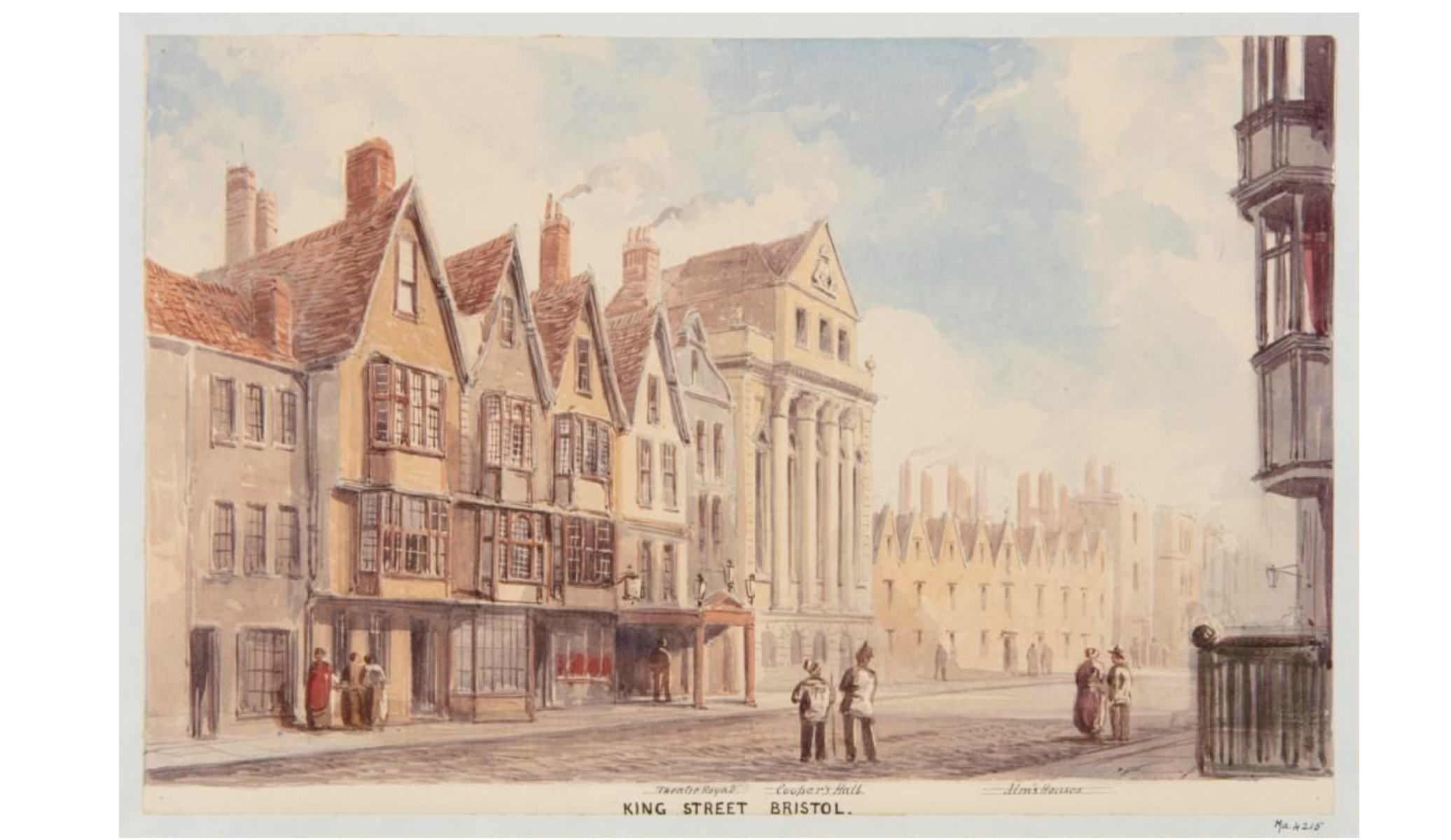
The Theatre Royal, the oldest continually-operating theatre in the English-speaking world, was built between 1764 and 1766 on King Street in Bristol. The Coopers' Hall, built 1743–1744, was incorporated as the theatre's foyer during 1970–1972. Together, they are designated a Grade I listed building by Historic England. Daniel Day-Lewis called it "the most beautiful theatre in England."
In 2012, the theatre complex completed the first phase of a £19 million refurbishment, increasing the seating capacity and providing up to ten flexible performance spaces. Besides the main Theatre Royal auditorium, the complex includes the Studio theatre and the Side Stage, Paint Shop and Basement performance areas. Whilst the theatre was closed, the company continued to present work in the Studio and Basement spaces, as well as at other sites around Bristol. The Theatre Royal re-opened in 2012 with Wild Oats.
History of the theatre
The theatre is situated on King Street, a few yards from the Floating Harbour. From 1972 until 2016, the public entrance was through the Coopers' Hall, the earliest surviving building on the site. The Coopers' Hall was built in 1744 for the Coopers' Company, the guild of coopers in Bristol, by architect William Halfpenny. It has a "debased Palladian" façade with four Corinthian columns. It only remained in the hands of the Coopers until 1785, subsequently becoming a public assembly room, a wine warehouse, a Baptist chapel and eventually a fruit and vegetable warehouse.
The theatre was built between 1764 and 1766. The design of the auditorium has traditionally been taken to have been based, with some variations, on that of the Theatre Royal, Drury Lane in London. Although Bristol architect Thomas Paty supervised construction, the theatre was built to designs by James Saunders, David Garrick's carpenter at Drury Lane. Saunders had provided drawings for the theatre in Richmond, Surrey, built in 1765. A long section (1790, at Harvard University Theatre Collection) and a survey plan (1842, at the Local Studies Library) of the Richmond theatre show close similarities with the Bristol theatre in the proportions and in the relationship between the actors on stage and the spectators surrounding them on three sides. The site chosen was Rackhay Yard, a roughly rectangular empty site behind a row of medieval houses and to one side of the Coopers' Hall. Two (and possibly three) new passageways built through the ground floor of the houses fronting King Street gave access to Rackhay Yard and the "New Theatre" inside it.
Fifty numbered silver tickets were issued to shareholders, granting them unlimited free access to shows at the theatre, in return for each of them donating £50 to fund its construction. Two special golden tickets were issued to cabinet maker Edward Crump and his wife Ann Crump, for "the great trouble and expense" they had gone to to convince the landowners to allow the construction of the theatre.
The theatre opened on 30 May 1766 with a performance which included a prologue and epilogue given by David Garrick. As the proprietors were not able to obtain a royal licence, productions were announced as "a concert with a specimen of rhetorick" to evade the restrictions imposed on theatres by the Licensing Act 1737. This ruse was soon abandoned, but a production in the neighbouring Coopers' Hall in 1773 did fall foul of this law.{{cite web |access-date=19 April 2009 |url-status=dead |archive-url=https://archive.today/20121224100001/http://www.englandspastforeveryone.org.uk/Counties/Bristol/Projects/SlaveryTrail/Items/TheatreRoyal |archive-date=24 December 2012 Legal concerns were alleviated when the royal letters patent were eventually granted following the passing of the Bristol Theatre Act 1778 (18 Geo. 3. c. 8), and the theatre became a patent theatre and took up the name "Theatre Royal". At this time the theatre also started opening for the winter season, and a joint company was established to perform at both the Bath Theatre Royal and in Bristol, featuring performers such as Sarah Siddons,{{cite news |access-date=8 April 2009 |url-status=live |archive-url=https://web.archive.org/web/20090409163319/http://www.nytimes.com/books/first/j/jones-sisterhood.html |archive-date= 9 April 2009
From 1819 the theatre was managed by William M'Cready the elder, with little success, and then, following his death in 1834 by his widow, the actress Sarah M'Cready. Following her death in 1853 the M'Creadys' son-in-law James Chute took over. However, he became overcommitted, running the Bath Theatre Royal, the Theatre Royal Bristol and the new Prince's Theatre, opened in 1867. In 1881 the lease on the theatre was taken up by popular actor George Melville, who invested heavily in it, carrying out heavy refurbishment. Despite the popularity of his pantomime performances, he struggled to make a profit and gave up the lease in 1893. Failures to invest in the decaying fabric of the building in the late nineteenth century and early twentieth century, legal battles between the proprietors and the managers, as well as the shifting nature of popular entertainment, saw the theatre struggle up to the time it was taken over by the Old Vic in 1943.
Historic documents from the history of the Theatre Royal and Bristol Old Vic can be found at Bristol Archives and University of Bristol Theatre Collection.
Formation of the Bristol Old Vic
In 1942, the lease owners put the building up for sale.{{cite web |access-date=19 April 2009 |url-status=live |archive-url=https://web.archive.org/web/20160506205551/http://www.bristol.ac.uk/theatre-collection/explore/theatre/bristol-old-vic-company-archive/ |archive-date= 6 May 2016
Early members of the company included Peter O'Toole (making his first appearance in Major Barbara in 1956), John Neville,{{cite web |access-date=7 April 2009 |url-status=live |archive-url=https://web.archive.org/web/20090416231353/http://www.filmreference.com/film/51/John-Neville.html |archive-date=16 April 2009 |access-date=7 April 2009 |url-status=live |archive-url=https://web.archive.org/web/20100203071733/http://www.filmreference.com/film/73/Timothy-West.html |archive-date= 3 February 2010 |access-date=7 April 2009 |url-status=live |archive-url=https://web.archive.org/web/20090705085939/http://www.filmreference.com/film/41/Barbara-Leigh-Hunt.html |archive-date= 5 July 2009 |access-date=7 April 2009 |url-status=dead |archive-url=https://web.archive.org/web/20090402085950/http://www.tcm.com/tcmdb/participant.jsp?spid=195297 |archive-date= 2 April 2009 |access-date=23 February 2009 |url-status=dead |archive-url=https://web.archive.org/web/20090906190319/http://www.bris.ac.uk/theatrecollection/bov.html |archive-date= 6 September 2009
An early triumph for the Bristol Old Vic occurred when the 1954 première production of Salad Days transferred to the West End and became the longest-running musical on the London stage at that time.{{cite news |access-date=7 April 2009 |url-status=live |archive-url=https://web.archive.org/web/20121111104759/http://www.telegraph.co.uk/news/obituaries/1521907/Julian-Slade.html |archive-date=11 November 2012
A new theatre complex, designed by Peter Moro, was completed in 1972. The 1903 entrance building was demolished, as were a number of surrounding buildings and, more controversially, the stage area of the 1766 theatre. A new stage and fly tower were built along with technical facilities and offices. The 150-seat New Vic studio theatre (later known as the Studio) was built in place of the old entrance, and the Coopers' Hall provided the theatre with the grand façade and foyer area it had previously lacked.
Throughout the 1970s and 1980s, Bristol Old Vic productions were well received both locally and on tour, but by the late 1980s faced significant underfunding. A revival under the leadership of Andrew (Andy) Hay brought an increase in audience numbers; there followed a new Arts Council funding package, and in 2003 the appointment of joint artistic directors David Farr and Simon Reade. They briefly branded the organisation the "new bristol old vic".
In 2005, Reade became the sole artistic director. Artistic highlights during these times included the production of A. C. H. Smith's Up The Feeder, Down the Mouth and Back Again during Andy Hay's tenure, and some well-received Shakespeare productions under David Farr and Simon Reade.
Refurbishment

In February 2009, the company announced that Tom Morris, at that time an associate director at the Royal National Theatre and formerly artistic director at Battersea Arts Centre, had been appointed as artistic director. Emma Stenning, who had previously worked with Tom Morris at BAC, became executive director.
In October 2010, there was a merger of the Old Vic and the Theatre Royal Bristol Trust, into a combined charity to be chaired by Laura Marshall, the managing director of Icon Films.

A fundraising campaign for the £19 million planned refurbishment was assisted by appearances from, among others, Richard Briers, Stephanie Cole, Judi Dench, Prunella Scales, Timothy West and Patrick Stewart. £5.3 million was provided by the Arts Council. During the closure the company staged productions in the Studio theatre, the Basement and in other locations around Bristol, including Sally Cookson's adaptation of Treasure Island on King Street in summer 2011 and Melly Still's revival of Coram Boy at the Colston Hall at Christmas 2011.
The plan was for a flexible theatre complex, where up to ten areas are available for performance. Tom Morris has cited as inspiration the Théâtre des Bouffes du Nord in Paris. The main auditorium gained an optional thrust stage, and an increase in seating to 540. The Side Stage area was redeveloped, with additional capacity of 250, creating the option of a separate second auditorium. Other spaces redeveloped as performance areas included the Paint Shop and the rehearsal room. The Theatre Royal re-opened in September 2012, with Wild Oats.
A further round of redevelopment, designed by architects Haworth Tompkins, was undertaken between June 2016 and September 2018. The street side of the 1970s Peter Moro building, containing the Studio theatre (originally the New Vic), was demolished and replaced by a new foyer with bar and box office, which makes a feature of the previously hidden theatre walls. The Coopers' Hall was adapted to house new performance and event spaces, including a studio theatre in the barrel vaults in its basement.
Touring
The Bristol Old Vic has a long history of taking productions on tour both within the United Kingdom and overseas. Production which have toured include Hamlet, Arms and the Man and A Man for All Seasons to Ceylon and Pakistan in 1962–63;{{cite web |access-date=19 April 2009 |url-status=dead |archive-url=https://web.archive.org/web/20090419010101/http://www.bristol.ac.uk/theatrecollection/search/play_report?play_string=hamlet&season_select=all&theatre_select=Bristol+Old+Vic+Tour&image_view=Yes&query_image=&SUBMIT=Submit |archive-date=19 April 2009 |access-date=19 April 2009 |url-status=dead |archive-url=https://web.archive.org/web/20090419010101/http://www.bris.ac.uk/theatrecollection/search/play_report?play_string=man+and+superman&season_select=all&theatre_select=all&image_view=Yes&query_image=&SUBMIT=Submit |archive-date=19 April 2009 The company has also made frequent visits to the Edinburgh Festival and productions have toured to the Theatre Royal Bath, Oxford Playhouse, Royal Court Theatre, London and the Young Vic, London amongst others. Co-productions have taken Bristol Old Vic plays to most of Britain's major theatres. Bristol Old Vic has co-produced with companies such as Kneehigh Theatre, the Royal National Theatre, West Yorkshire Playhouse and other regional theatres and companies across the UK.
Tom Morris’ production of Swallows and Amazons transferred to the Vaudeville Theatre in London's West End followed by a major UK tour. Simon Godwin's production of Brian Friel's Faith Healer is playing in the 2012 Hong Kong Arts Festival. Other recent touring productions include the Bristol Old Vic/Shakespeare at the Tobacco Factory co-production of Uncle Vanya.
Bristol Old Vic's Ferment artist development strand also sees work developed at the theatre touring across the UK and internationally.
Artistic directors of the Bristol Old Vic
| Name | Period | Notable productions | |||||
|---|---|---|---|---|---|---|---|
| Hugh Hunt | 1946–1949 | The Beaux' Stratagem, The Playboy of the Western World, An Inspector Calls, Romeo and Juliet | |||||
| Allan Davis | 1950 | Arms and the Man, Julius Caesar | |||||
| Denis Carey | 1950–1954 | The Merry Wives of Windsor, Macbeth, An Italian Straw Hat, The Alchemist | |||||
| John Moody | 1954–1959 | The Crucible, The Cherry Orchard, Uncle Vanya, The Recruiting Officer, As You Like It | |||||
| url=http://infotrac.galegroup.com/itw/infomark/942/630/61501925w16/purl=rc1_TTDA_0_CS218848457&dyn=3!xrn_6_0_CS218848457&hst_1 | title=Bristol Old Vic – Mr. John Hale | date=9 June 1959 | work=The Times | page=13 | access-date=23 April 2009}} | 1959–1962 | The Clandestine Marriage, A Taste of Honey, Rhinoceros, Richard II |
| url=http://infotrac.galegroup.com/itw/infomark/942/630/61501925w16/purl=rc1_TTDA_0_CS220946986&dyn=11!xrn_12_0_CS220946986&hst_1 | title=Picator Adapts Tolstoy | date=10 January 1962 | work=The Times | page=13 | access-date=23 April 2009}} | 1962–1975 | Brand, The Killing of Sister George, Hamlet, The Italian Girl, Uncle Vanya |
| Richard Cottrell | 1975–1980 | The National Health, Hedda Gabler, As You Like It, A Doll's House, A Midsummer Night's Dream | |||||
| John David | 1980–1986 | Judy, King Lear, Wild Oats, Arturo Ui, The Tempest | |||||
| Leon Rubin{{cite web | url=http://www.east15.ac.uk/news-director.asp | title=East 15 Acting School at the University of Essex, News New Director | |||||
| Paul Unwin{{cite news | url=https://www.theguardian.com/culture/2008/oct/11/theatre-television | title=Obituary: Peter Copley | |||||
| Andy Hay | 1991–2002 | Blue Remembered Hills, The Duchess of Malfi, The Hairy Ape, The Rise and Fall of Little Voice, Marat/Sade, A Streetcar Named Desire | |||||
| David Farr and Simon Reade | 2003–2005 | Loot (Farr), The Odyssey (Farr), Private Peaceful (Reade) | |||||
| Simon Reade | 2005–2007 | The Birthday Party | |||||
| Tom Morris | 2009–2022 | Juliet and Her Romeo, Swallows and Amazons, and The Crucible | |||||
| Nancy Medina | 2023–present | Choir Boy, A Good House, The Beautiful Future is Coming |
Bristol Old Vic Theatre School
Main article: Bristol Old Vic Theatre School

The Bristol Old Vic Theatre School, opened by Laurence Olivier in 1946, is an affiliate of the Conservatoire for Dance and Drama,{{cite web |access-date=19 April 2009 |url-status=live |archive-url=https://web.archive.org/web/20090303215841/http://www.cdd.ac.uk/affiliate-schools/ |archive-date= 3 March 2009
The School continued in these premises until 1954 when royalties from the musical, Salad Days by Julian Slade and Dorothy Reynolds were given to the School towards the purchase and conversion of two large adjoining Victorian villas in Clifton, which remain their base today.
In 1995, that donation was formally recognised when a new custom-built dance and movement studio in the School's back garden was named the Slade/Reynolds Studio. The School provides comprehensive training courses for theatre, radio, film, and television professionals and its graduates are to be found in key positions as actors, directors, set designers, costumer designers, lighting designers and stage and company managers throughout the world.{{cite web |archive-url=https://web.archive.org/web/20080705093650/http://www.oldvic.ac.uk/training.html |archive-date=5 July 2008 |access-date=19 April 2009
Among the most notable of the many distinguished actors on the School's list of alumni are the Academy Award winners Daniel Day-Lewis and Jeremy Irons.{{cite web |archive-url=https://web.archive.org/web/20080217040857/http://www.oldvic.ac.uk/past_graduates.html |archive-date=17 February 2008 |access-date=19 April 2009
See Alumni of Bristol Old Vic Theatre School.
Peter O'Toole Prize
To coincide with their re-opening in 2012, the theatre launched an award called the Patron's Prize, which was later renamed the Peter O’Toole prize following the actor's death. The award is a six-month contract at the Bristol Old Vic offered to two graduating actors from the Bristol Old Vic Theatre School. The inaugural winners were Emily May Smith and Isaac Stanmore.
| Year | Recipients | Productions | 2012 | 2013 | 2014 | |||||
|---|---|---|---|---|---|---|---|---|---|---|
| Emily May Smith and Isaac Stanmore | Wild Oats, Does My Society Look Big in This? and Peter Pan | |||||||||
| Martin Bassindale and Lindsay Dukes | Great Expectations and The Little Mermaid | |||||||||
| url=https://www.thestage.co.uk/news/winners-of-bristol-old-vics-peter-otoole-prize-announced | title=Winners of Bristol Old Vic's Peter O'Toole Prize announced | News | the Stage | access-date=2015-05-15 | url-status=live | archive-url=https://web.archive.org/web/20160304080701/https://www.thestage.co.uk/news/2014/winners-bristol-old-vics-peter-otoole-prize-announced/ | archive-date=4 March 2016}} | Juno and the Paycock | ||||
| Bethan Nash and Millie Corser | Swallows and Amazons |
Notes
References
References
- "Education Overview". Bristol Old Vic.
- [https://archive.org/details/bha003 Kathleen Barker, ''The Theatre Royal : The First Seventy Years'' (Bristol Historical Association pamphlets, no. 3, 1961, third edition, 1969), 28 pp.]
- (30 May 2016). "Bristol Old Vic Theatre marks 250th anniversary".
- {{NHLE
- "Redeveloping Bristol Old Vic". Bristol Old Vic.
- Manser, José. (1 December 1972). "Theatrical renaissance in Bristol". Design.
- "Theatre Royal (Bristol) – The Theatres Trust". theatrestrust.org.uk.
- "The Theatre Royal – Buildings". British History Online.
- (9 September 2012). "Secrets of the rowdy past revealed as Bristol Old Vic reopens". The Guardian.
- "Bristol Old Vic Redevelopment". Andrzej Blonski Architects.
- (2014). "Imaginative Genius: Spectators on Stage at Shakespeare's Playhouses & Bristol's Old Vic". Mark Howell.
- (28 June 2015). "Bristol Old Vic theatre tickets 'return home' to Bristol". [[BBC News]].
- Moody, Jane. "Theatrical Geographies and the Birth of a National Stage".
- Moody, Jane. "Theatrical Geographies and the Birth of a National Stage".
- [https://archive.org/details/bha014 Kathleen Barker, ''The Theatre Royal Bristol: Decline and Rebirth (1834-1943)'' (Bristol Historical Association pamphlets, no. 14, 1966)]
- [https://archive.org/details/bha014/page/6/mode/2up Kathleen Barker, ''The Theatre Royal Bristol: Decline and Rebirth (1834-1943)'' (Bristol Historical Association pamphlets, no. 14, 1966), pp. 6-10]
- [https://archive.org/details/bha014/page/10/mode/2up Kathleen Barker, ''The Theatre Royal Bristol: Decline and Rebirth (1834-1943)'' (Bristol Historical Association pamphlets, no. 14, 1966), p. 10]
- [https://archive.org/details/bha014/page/12/mode/2up Kathleen Barker, ''The Theatre Royal Bristol: Decline and Rebirth (1834-1943)'' (Bristol Historical Association pamphlets, no. 14, 1966), p9. 12-20]
- (2018-06-03). "Archives of the Theatre Royal available online {{!}} Bristol Archives".
- "Theatre Royal, Bristol (Bristol Old Vic)". [[Bristol Museum & Art Gallery.
- Smith, A. C. H.. (18 June 2007). "A tall story too Farr". The Stage.
- Christiansen, Rupert. (13 November 2002). "Innovator ready for a fight". The Telegraph.
- Arendt, Paul. (21 October 2004). "Farr says bye to Bristol". The Guardian.
- (28 June 2001). "Musical charts maritime history". BBC News.
- Gardner, Lyn. (15 May 2003). "A Midsummer Night's Dream Review". The Guardian.
- (10 May 2007). "Theatre shuts for refurbishment". BBC News Bristol.
- Gardner, Lyn. (11 May 2007). "Is Bristol's Old Vic about to go dark for good?". The Guardian.
- (16 May 2007). "ACE blamed for shock Bristol Old Vic closure". The Stage.
- (30 July 2007). "Theatre stars demand Bristol Old Vic remains a producing company". The Stage.
- "Bristol old vic aims for 2009 reopening".
- (25 February 2009). "New directors at Bristol Old Vic". BBC News Bristol.
- Gardner, Lyn. (25 February 2009). "Lyn Gardner: Tom Morris's role at Bristol Old Vic is crucial for all regional theatres". The Guardian.
- Shenton, Mark. (25 February 2009). "Mamma Mia!'s Johnson Pens New Play for Bristol Old Vic; New Artistic and Executive Directors Appointed". Playbill.
- (1 October 2010). "Trust merger 'will secure Vic's future'". [[Bristol Evening Post]].
- (2 April 2010). "£5.3m windfall for the Bristol Old Vic". [[Bristol Evening Post]].
- "Coram Boy". Bristol Old Vic.
- Alistair Smith. (12 May 2010). "Bristol Old Vic launches £19m plan to transform home". [[The Stage]].
- Robert Gore-Langton. (11 September 2012). "Bristol Old Vic: Curtain up on a Georgian time capsule". [[The Daily Telegraph]].
- (25 November 2019). "Bristol Old Vic by Haworth Tompkins". [[Architects' Journal]].
- "Redevelopment".
- (24 September 2018). "Bristol Old Vic Theatre unveils £26m major refurbishment". BBC News.
- Kemp, David. (1992). "The Pleasures and Treasures of Britain". Dundurn Group.
- [http://www.bristol.ac.uk/theatrecollection/ University of Bristol Theatre Collection] {{webarchive. link. (9 July 2009 . Bristol Old Vic Collection. Programmes from Bristol Old Vic tours (1946–2002).)
- (9 June 1959). "Bristol Old Vic – Mr. John Hale". [[The Times]].
- (10 January 1962). "Picator Adapts Tolstoy". [[The Times]].
- (21 May 1975). "Latest appointments". [[The Times]].
- "Tom Morris".
- Wiegand, Chris. (2022-05-30). "Nancy Medina named as new artistic director of Bristol Old Vic". The Guardian.
- [http://www.bristol.ac.uk/theatrecollection/ University of Bristol Theatre Collection] {{webarchive. link. (9 July 2009. Bristol Old Vic Collection. Bristol Old Vic brochures and papers. (1946–2002).)
- "The Bristol Old Vic Theatre School". Enhanced.
- Brown, Shirley. (1996). "Bristol Old Vic Theatre School: the first 50 years". Bristol Old Vic Theatre School.
- Brown, Shirley. (1996). "Bristol Old Vic Theatre School: the first 50 years". Bristol Old Vic Theatre School.
- Brown, Shirley. (1996). "Bristol Old Vic Theatre School: the first 50 years". Bristol Old Vic Theatre School.
- Ltd, Supercool. (6 May 2021). "Donate".
- "Bristol Old Vic revives links".
- "Theatrical partnership revived in Bristol".
- (26 November 2012). "An Interview with Emily May Smith and Isaac Stanmore, Patron's Prize Winners".
- (26 September 2013). "Feature: Bristol Old Vic Theatre School's Patrons' Prize - A Younger TheatreA Younger Theatre".
- "Winners of Bristol Old Vic's Peter O'Toole Prize announced | News | the Stage".
This article was imported from Wikipedia and is available under the Creative Commons Attribution-ShareAlike 4.0 License. Content has been adapted to SurfDoc format. Original contributors can be found on the article history page.
Ask Mako anything about Bristol Old Vic — get instant answers, deeper analysis, and related topics.
Research with MakoFree with your Surf account
Create a free account to save articles, ask Mako questions, and organize your research.
Sign up freeThis content may have been generated or modified by AI. CloudSurf Software LLC is not responsible for the accuracy, completeness, or reliability of AI-generated content. Always verify important information from primary sources.
Report