From Surf Wiki (app.surf) — the open knowledge base
Brillouin zone
Primitive cell in the reciprocal space lattice of crystals
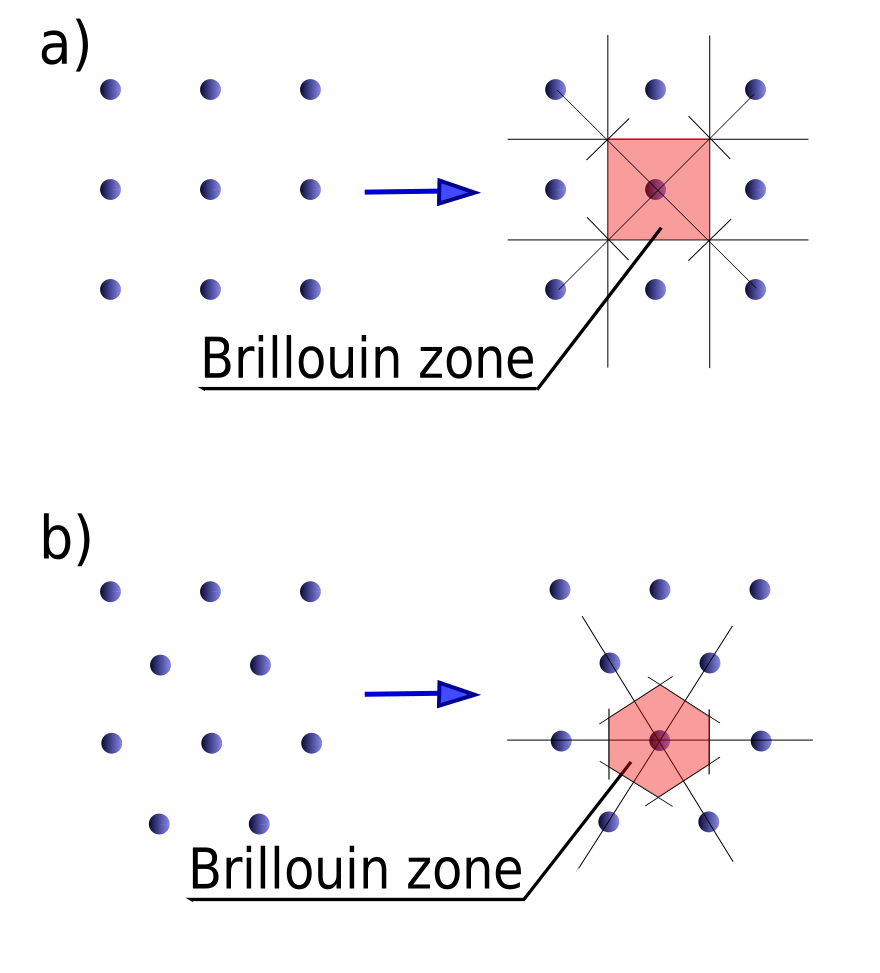
Primitive cell in the reciprocal space lattice of crystals
In mathematics and solid state physics, the first Brillouin zone (named after Léon Brillouin) is a uniquely defined primitive cell in reciprocal space. In the same way the Bravais lattice is divided up into Wigner–Seitz cells in the real lattice, the reciprocal lattice is broken up into Brillouin zones. The boundaries of this cell are given by planes related to points on the reciprocal lattice. The importance of the Brillouin zone stems from the description of waves in a periodic medium given by Bloch's theorem, in which it is found that the solutions can be completely characterized by their behavior in a single Brillouin zone.
The first Brillouin zone is the locus of points in reciprocal space that are closer to the origin of the reciprocal lattice than they are to any other reciprocal lattice points (see the derivation of the Wigner–Seitz cell). Another definition is as the set of points in k-space that can be reached from the origin without crossing any Bragg plane. Equivalently, this is the Voronoi cell around the origin of the reciprocal lattice.

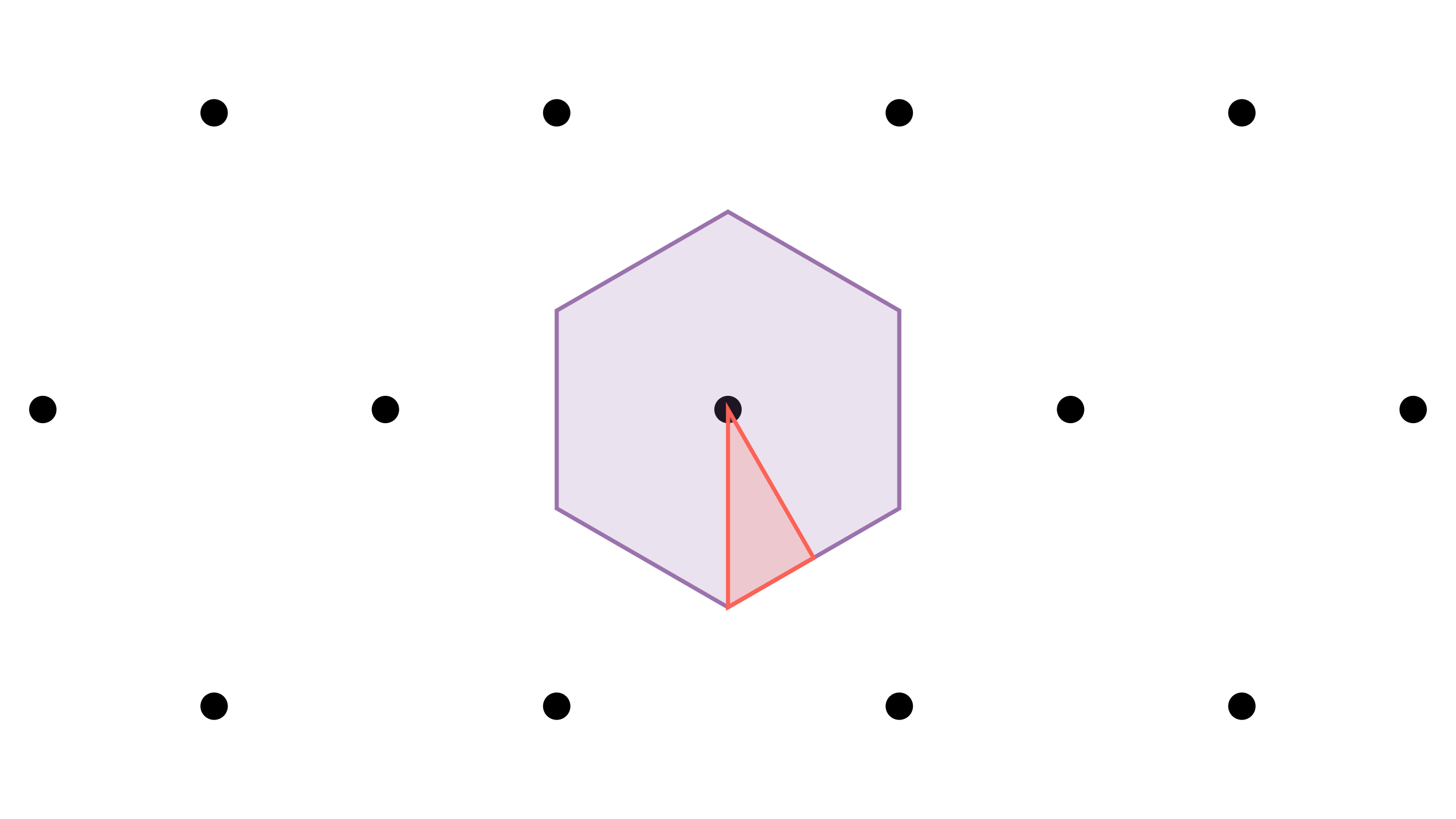
There are also second, third, etc., Brillouin zones, corresponding to a sequence of disjoint regions (all with the same volume) at increasing distances from the origin, but these are used less frequently. As a result, the first Brillouin zone is often called simply the Brillouin zone. In general, the n-th Brillouin zone consists of the set of points that can be reached from the origin by crossing exactly n − 1 distinct Bragg planes. A related concept is that of the irreducible Brillouin zone, which is the first Brillouin zone reduced by all of the symmetries in the point group of the lattice (point group of the crystal).
The concept of a Brillouin zone was developed by Léon Brillouin (1889–1969), a French physicist.
Within the Brillouin zone, a constant-energy surface represents the loci of all the \vec{k}-points (that is, all the electron momentum values) that have the same energy. Fermi surface is a special constant-energy surface that separates the unfilled orbitals from the filled ones at zero kelvin.
Critical points
.svg)
Several points of high symmetry are of special interest – these are called critical points.
| Symbol | Description | Simple cube | Face-centered cubic | Body-centered cubic | Hexagonal |
|---|---|---|---|---|---|
| Γ | Center of the Brillouin zone | ||||
| M | Center of an edge | ||||
| R | Corner point | ||||
| X | Center of a face | ||||
| K | Middle of an edge joining two hexagonal faces | ||||
| L | Center of a hexagonal face | ||||
| U | Middle of an edge joining a hexagonal and a square face | ||||
| W | Corner point | ||||
| X | Center of a square face | ||||
| H | Corner point joining four edges | ||||
| N | Center of a face | ||||
| P | Corner point joining three edges | ||||
| A | Center of a hexagonal face | ||||
| H | Corner point | ||||
| K | Middle of an edge joining two rectangular faces | ||||
| L | Middle of an edge joining a hexagonal and a rectangular face | ||||
| M | Center of a rectangular face |
Other lattices have different types of high-symmetry points. They can be found in the illustrations below.
| Lattice system | Bravais lattice | Triclinic | Primitive triclinic | Monoclinic | Primitive monoclinic | Base-centered monoclinic | Orthorhombic | Primitive orthorhombic | Base-centered orthorhombic | Body-centered orthorhombic | Face-centered orthorhombic | Tetragonal | Primitive tetragonal | Body-centered Tetragonal | Rhombohedral | Primitive rhombohederal | Hexagonal | Primitive hexagonal | Cubic | Primitive cubic | Body-centered cubic | Face-centered cubic |
|---|---|---|---|---|---|---|---|---|---|---|---|---|---|---|---|---|---|---|---|---|---|---|
| Triclinic Lattice type 1a (TRI1a) | Triclinic Lattice type 1b (TRI1b) | Triclinic Lattice type 2a (TRI2a) | Triclinic Lattice type 2b (TRI2b) | |||||||||||||||||||
| Monoclinic Lattice (MCL) | ||||||||||||||||||||||
| Base-centered monoclinic lattice type 1 (MCLC1) | Base-centered monoclinic lattice type 2 (MCLC2) | Base-centered monoclinic lattice type 3 (MCLC3) | Base-centered monoclinic lattice type 4 (MCLC4) | Base-centered monoclinic lattice type 5 (MCLC5) | ||||||||||||||||||
| Simple orthorhombic lattice (ORC) | ||||||||||||||||||||||
| Base-centered orthorhombic lattice (ORCC) | ||||||||||||||||||||||
| Body-centered orthorhombic lattice (ORCI) | ||||||||||||||||||||||
| Face-centered orthorhombic lattice type 1 (ORCF1) | Face-centered orthorhombic lattice type 2 (ORCF2) | Face-centered orthorhombic lattice type 3 (ORCF3) | ||||||||||||||||||||
| Simple tetragonal lattice (TET) | ||||||||||||||||||||||
| Body-centered tetragonal lattice type 1 (BCT1) | Body-centered tetragonal lattice type 2 (BCT2) | |||||||||||||||||||||
| Rhombohedral lattice type 1 (RHL1) | Rhombohedral lattice type 2 (RHL2) | |||||||||||||||||||||
| Hexagonal lattice (HEX) | ||||||||||||||||||||||
| Simple cubic lattice (CUB) | ||||||||||||||||||||||
| Body-centered cubic lattice (BCC) | ||||||||||||||||||||||
| Face-centered cubic lattice (FCC) |
References
Bibliography
References
- "Topic 5-2: Nyquist Frequency and Group Velocity". [[Colorado School of Mines]].
- Brillouin, L.. (1930). "Les électrons libres dans les métaux et le role des réflexions de Bragg". EDP Sciences.
- (1996). "Solid-State Physics, An Introduction to Principles of Materials Science". Springer-Verlag.
- "High-throughput electronic band structure calculations: Challenges and tools". [[Computational Materials Science]]. (2010)
This article was imported from Wikipedia and is available under the Creative Commons Attribution-ShareAlike 4.0 License. Content has been adapted to SurfDoc format. Original contributors can be found on the article history page.
Ask Mako anything about Brillouin zone — get instant answers, deeper analysis, and related topics.
Research with MakoFree with your Surf account
Create a free account to save articles, ask Mako questions, and organize your research.
Sign up freeThis content may have been generated or modified by AI. CloudSurf Software LLC is not responsible for the accuracy, completeness, or reliability of AI-generated content. Always verify important information from primary sources.
Report