From Surf Wiki (app.surf) — the open knowledge base
Bridging ligand
Ligand which connects two or more (usually metal) atoms in a coordination complex

Ligand which connects two or more (usually metal) atoms in a coordination complex
In coordination chemistry, a bridging ligand is a ligand that connects two or more atoms, usually metal ions. The ligand may be atomic or polyatomic. Virtually all complex organic compounds can serve as bridging ligands, so the term is usually restricted to small ligands such as pseudohalides or to ligands that are specifically designed to link two metals.
In naming a complex wherein a single atom bridges two metals, the bridging ligand is preceded by the Greek letter mu, μ, with a subscript number denoting the number of metals bound to the bridging ligand. μ2 is often denoted simply as μ. When describing coordination complexes care should be taken not to confuse μ with η ('eta'), which relates to hapticity. Ligands that are not bridging are called terminal ligands.
List of bridging ligands
Virtually all ligands are known to bridge, with the exception of amines and ammonia. Common bridging ligands include most of the common anions.
| Bridging ligand | Name | Example |
|---|---|---|
| hydroxide | , see olation | |
| oxide | , see polyoxometalate | |
| hydrosulfido | ||
| amido | ||
| nitride | , see metal nitrido complex | |
| carbonyl | , see bridging carbonyl | |
| chloride | , see halide ligands | |
| hydride | ||
| cyanide | approx. (prussian blue), see cyanometalate | |
| diphenylphosphide | see transition metal phosphido complexes |
Many simple organic ligands form strong bridges between metal centers. Many common examples include organic derivatives of the above inorganic ligands (R = alkyl, aryl): , , , (imido), (phosphido, note the ambiguity with the preceding entry), (phosphinidino), and many more.
Examples
File:Ru-Cl.png|In this ruthenium complex ((benzene)ruthenium dichloride dimer), two chloride ligands are terminal and two are μ2 bridging. File:Creutz-Taube-Ion.svg|Pyrazine is a bridging ligand in this diruthenium compound, called the Creutz–Taube complex. File:Mu3 compound.svg|In the cobalt cluster , the ligand is triply bridging, although this aspect is typically not indicated in the formula. File:Fe3(CO)12lessFe-Fe.png|In triiron dodecacarbonyl, two CO ligands are bridging and ten are terminal ligands. The terminal and bridging CO ligands interchange rapidly. File:Niobium-pentachloride-dimer-2D.png|In NbCl5, there are two bridging and eight terminal chloride ligands. File:Au6C(PPh3)6.png|The cluster features a μ6-carbide ligand, although again, the designator "μ" is not usually used. File:Aluminium-trifluoride-3D-polyhedra.png|In rhenium trioxide, the oxide ligands are all μ2. These oxide ligands "glue" together the metal centres. File:Zirconium-tetrachloride-3D-balls-A.png|In the case of , there are both terminal and doubly bridging chloride ligands. File:Rhodium(II)-acetate-hydrate-dimer-from-xtal-1971-3D-balls.png|In rhodium(II) acetate, the four acetate groups are bridging ligands. File:VO(HPO4)0.5H2O.tif|In , pairs of vanadium(IV) centers are bridged by water ligands.
Bonding
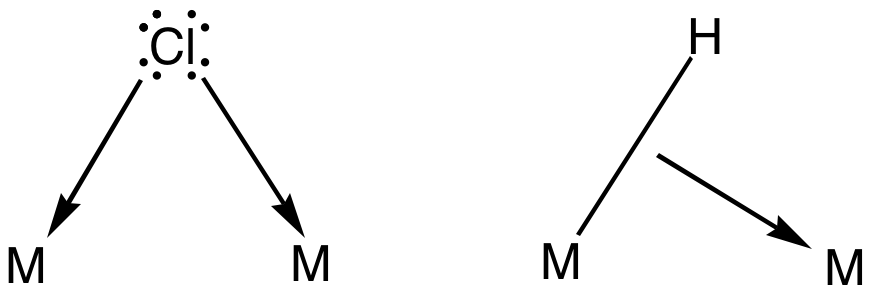
For doubly bridging (μ2-) ligands, two limiting representation are 4-electron and 2-electron bonding interactions. These cases are illustrated in main group chemistry by and . Complicating this analysis is the possibility of metal–metal bonding. Computational studies suggest that metal-metal bonding is absent in many compounds where the metals are separated by bridging ligands. For example, calculations suggest that lacks an iron–iron bond by virtue of a 3-center 2-electron bond involving one of three bridging CO ligands.
Bridge-terminal exchange
The interchange of bridging and terminal ligands is called bridge-terminal exchange. The process is invoked to explain the fluxional properties of metal carbonyl and metal isocyanide complexes. Some complexes that exhibit this process are cobalt carbonyl and cyclopentadienyliron dicarbonyl dimer: :Co2(μ-CO)2(CO)6 Co2(μ-CO)2(CO)4(CO)2 :(C5H5)2Fe2(μ-CO)2(CO)2 (C5H5)2Fe2(μ-CO)2(CO)2
These dynamic processes, which are degenerate, proceed via an intermediate where the CO ligands are all terminal, i.e., .
Bridge-terminal exchange is common for metal complexes of borohydride where the M-H-B and B-Hterminal sites interchange with low barriers.
Polyfunctional ligands
Polyfunctional ligands can attach to metals in many ways and thus can bridge metals in diverse ways, including sharing of one atom or using several atoms. Examples of such polyatomic ligands are the oxoanions and the related carboxylates, , and the polyoxometalates. Several organophosphorus ligands have been developed that bridge pairs of metals, a well-known example being .
References
References
- "bridging ligand".
- {{RedBook2005
- Werner, H.. (2004). "The Way into the Bridge: A New Bonding Mode of Tertiary Phosphanes, Arsanes, and Stibanes". [[Angew. Chem. Int. Ed.]].
- (2002). "Flux growth of vanadyl pyrophosphate, (VO)2P2O7, and spin dimer analysis of the spin exchange interactions of (VO)2P2O7 and vanadyl hydrogen phosphate, VO(HPO4).0.5H2O.". [[Inorg. Chem.]].
- (2012). "The occurrence and representation of three-centre two-electron bonds in covalent inorganic compounds". [[Chem. Commun.]].
- (1973). "Pathway of Bridge-Terminal Ligand Exchange in Some Binuclear Metal Carbonyls. Bis(pentahapto-cyclopentadienyldicarbonyliron) and Its Di(methyl Isocyanide) Derivative and Bis(pentahapto-cyclopentadienylcarbonylnitrosylmanganese)". Journal of the American Chemical Society.
- (2000). "Structural and Dynamic Properties of Tetrahydroborate Complexes". Russian Chemical Reviews.
This article was imported from Wikipedia and is available under the Creative Commons Attribution-ShareAlike 4.0 License. Content has been adapted to SurfDoc format. Original contributors can be found on the article history page.
Ask Mako anything about Bridging ligand — get instant answers, deeper analysis, and related topics.
Research with MakoFree with your Surf account
Create a free account to save articles, ask Mako questions, and organize your research.
Sign up freeThis content may have been generated or modified by AI. CloudSurf Software LLC is not responsible for the accuracy, completeness, or reliability of AI-generated content. Always verify important information from primary sources.
Report