From Surf Wiki (app.surf) — the open knowledge base
Bridge
Structure built to span physical obstacles

Structure built to span physical obstacles
A bridge is a structure designed to span an obstacle, such as a river or valley, allowing vehicles, pedestrians, and other loads to pass across. Most bridges consist of a flat deck, supported by beams, arches, or cables. These structures rest on a foundation that is carefully designed to transfer the weight of the bridge to the subsoil without settling.
Bridges can be constructed in a wide variety of forms, determined by the location, intended purpose, and available construction technologies. Simple bridge structures include beam bridges made from logs, and suspension bridges made of ropes or vines. The Romans and ancient Chinese built major arch bridges of timber, stone, and brick. During the Renaissance, advances in science and engineering led to wider bridge spans and more elegant designs. Concrete was perfected in the early nineteenth century, and arch bridges are now built primarily of concrete or steel.
With the Industrial Revolution came mass-produced steel, which enabled the creation of more complex formsincluding truss and cantilever bridgesthat permitted bridges to cross wide rivers or deep valleys. The longest spans use suspension or cable-stayed designs, both of which rely on high-strength steel cables to support the deck. Over time, the maximum achievable span of bridges has steadily increased, reaching 2 km in 2022. Other bridge forms include multi-span viaducts, which can cross wide valleys; trestles, a common design for carrying heavy trains; and movable bridges including drawbridges and swing bridges.
The design of a bridge must satisfy many requirements, namely connecting to a transportation network, providing adequate clearances, and safely transporting its users. A bridge must be strong enough to support its own weight as well as the weight of the traffic passing over it. It must also tolerate violent, unpredictable stresses imposed by the environment, including winds, floods, and earthquakes. To meet all these goals, bridge engineers typically use limit state design processes and the finite element method.
Many bridges are admired for their beauty, and some spectacular bridges serve as iconic landmarks that provide a sense of pride and identity for the local community. In art and literature, bridges are frequently used as metaphors to represent connection or transition. Bridges can create beneficial impacts on a community, including shorter transport times and increased gross domestic product; and also negative effects such as increased pollution and contributions to global warming.
History
Main article: History of bridges
Antiquity
The earliest forms of bridges were simple structures for crossing wetlands and creeks, consisting of wooden boardwalks or logs.{{Multiref |. |. |. |. |. |. |.
The ancient Romans built many durable bridges using advanced engineering techniques.{{Multiref |. |. |. |. |. |. |. |. Pont du Gard. |. |. |. |. Caption. |. |. |.
300 to 1400

The oldest surviving stone bridge in China is the Anji Bridge, built from 595 to 605 AD during the Sui dynasty. This bridge is also historically significant as it is the world's oldest open-spandrel stone segmental arch bridge.{{Multiref |. |. -- Rope bridges, a simple type of suspension bridge, were used by the Inca civilization in the Andes mountains of South America prior to European colonization in the 16th century.{{Multiref |. |.
In Medieval Europe, bridge design capabilities declined after the fall of Rome, but revived in the High Middle Ages in France, England, and Italy with the construction of bridges like the Pont d'Avignon, bridges of the Durance river, and the Old London Bridge.{{Multiref |. |. |. |.
1400 to 1750

In 15th- and 16th-century Europe, the Renaissance brought a new emphasis on science and engineering.{{Multiref |. |. |. |. |. |. |.
1750 to 1900
In the late eighteenth century, the design of arch bridges was revolutionized in Europe by Jean-Rodolphe Perronet and John Rennie. They designed arches that were flatter than semicircular Roman arches, which yielded faster construction times, better water flow under the bridge, and slimmer piers. These designs were used for Pont de la Concorde and New London Bridge.{{Multiref |. |.

With the advent of the Industrial Revolution, iron became an important construction material for bridges. Both cast iron (which is strong under compression, but brittle) and wrought iron (which was more ductile and better under tension) were used for building bridges.{{Multiref |. |. |. |.
The age of railways began in the 1820s, and led to major innovations in bridge design. Britain is representative of how railways influenced bridge-building in industrialized nations: led by designers Isambard Kingdom Brunel, Robert Stephenson, and Joseph Locke, British railway bridges steadily grew in size as the decades passed. Notable bridges of that era include the High Level Bridge (1849), Royal Border Bridge (1850), Britannia Bridge (1850), Royal Albert Bridge (1859), and Clifton Suspension Bridge (1864). The number of railway bridges in Britain increased from 30,000 to 60,000 during the Railway Mania era.{{Multiref |. |. |. |. |.
The mass production of steel in the late nineteenth century provided a new material for bridges, enabling lighter, stronger truss bridges and cantilever bridges; and steel wires replaced iron bars as the preferred material for suspension bridge cables.{{Multiref |. |. --{{Multiref |. |. |. |.
1900 to present
![A suspension bridge crossing a deep rocky [[ravine]]](https://upload.wikimedia.org/wikipedia/commons/9/9c/1_Pont_de_Sidi_M'Cid.JPG)
Throughout the 20th century, new bridgesby designer Othmar Ammann and othersrepeatedly broke records for span distances, enabling transportation networks to cross increasingly wider rivers and valleys.{{Multiref |. |. |. |. |. |.
Etymology
The Oxford English Dictionary traces the origin of the word bridge to the Old English word brycg, of Germanic origin. There is a possibility that the word can be traced farther back to Proto-Indo-European *bʰrēw-.
Uses

-- The purpose of any bridge is to traverse an obstacle. A bridge can provide support and transport for railways, cars, pedestrians, pipelines, cables, or any combination of these. Aqueducts were developed early in human history, and carried water to towns and cities. Canal systems sometimes include navigable aqueducts (also called canal bridges) to carry boats across a valley or ravine.
Transportation

Until the early 19th century, most bridges were designed to carry pedestrians, horses, and horse-drawn carriages. Following the invention of railways, many rail bridges were built; in Britain the number of bridges doubled during the railway-building boom in the mid-nineteenth century. Railway bridges have unique requirements because of the heavy loads they carrya single locomotive can weigh 197 tonnes. Railway bridges are designed to minimize deflection (bending under load), to maximize robustness (localize the damage caused by accidents), and to tolerate heavy impacts (sudden shocks from, for example, rail wheels striking an imperfection in the track). These requirements led railways to avoid curved bridges, suspension bridges, and cable-stayed bridges; instead, straight beam or truss bridges are commonly used. The explosive growth of motorway networks in the 20th century required bridges to span ever longer distances to reach islands and cross valleys.
Grade separation
An important application of bridges is improving safety and traffic flow at traffic junctions where roads or railways cross at ground level. Such intersections require vehicles to stop, and lead to slower traffic, wasted fuel, and higher incidence of collisions. One technique to mitigate these issues is to build a bridge, enabling one of the roads to pass over the other: this process is known as grade separation.{{multiref |. |.
Pedestrians
Some bridges, known as footbridges, are devoted to pedestrian traffic. They range from simple boardwalks enabling passage over marshy land to elevated skybridgesincluding the Minneapolis Skyway Systemwhich shield pedestrians from harsh winter weather.{{Multiref |. |. |. |. |.
Military
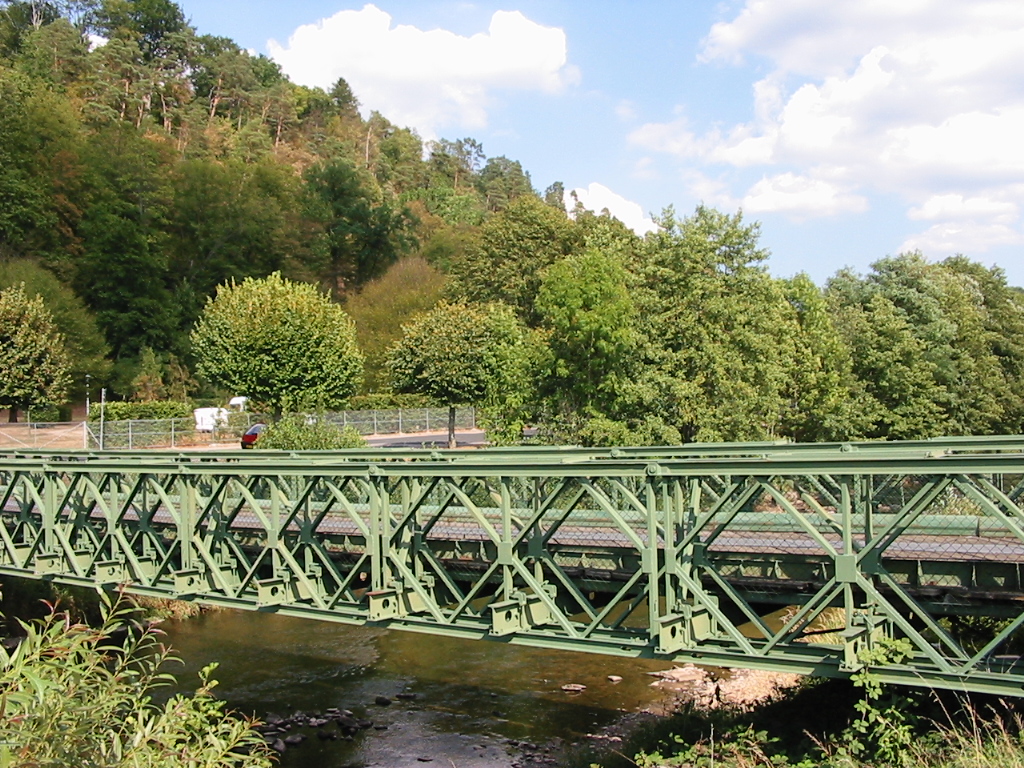
| Invented for wartime use, Bailey bridges found civilian use after WW II.]]
Military bridges are an important type of equipment in the field of military engineering. They perform a variety of wartime roles, namely quickly traversing obstacles in the midst of battle, or facilitating resupply behind front lines. Military bridges can be categorized as wet bridges that rest on pontoon floats, and dry bridges that rest on piers, river banks, or anchorages. A crude mechanism to cross a small ravine is to place a fascine (a large bundle of pipes or logs) into the ravine to enable vehicles to drive across.
Armoured vehicle-launched bridges, are carried on purpose-built vehicles. These vehicles typically have the same cross-country performance as a tank, and can carry a bridge to an obstacle and deploy ("launch") the bridge.{{Multiref |. |.
During wartime, bridges are often damaged by bombing or by combat engineers. Bridges can be valuable targets because they are immobile, relatively easy to spot from the air, and damage to the bridge can disrupt the enemy's transportation network.{{Multiref |. |. |. |.
Other
Some bridges accommodate uses other than transportation. Pipeline bridges carry oil pipes or water pipes across valleys or rivers. Many historical bridges supported buildings, including shrines, factories, shops, restaurants, and houses. Notable examples were the Old London Bridge and Ponte Vecchio. Some bridges built in Europe in the Middle Ages incorporated chapels into their design. In the modern era, bridge-restaurants can be found at some highway rest areas; these support a restaurant or shops directly above the highway and are accessible to drivers moving in both directions. An example is Will Rogers Archway over the Oklahoma Turnpike. The Nový Most bridge in Bratislava features a restaurant set atop its single tower. Conservationists use wildlife bridges to reduce habitat fragmentation and animal-vehicle collisions.{{Multiref |. |.
Structure and form
Bridges are primarily classified by their basic structural design: arch, truss, cantilever, suspension, cable-stayed, or beam.{{Multiref |. |.
Basic structures
The choice of bridge structure to use in a particular situation is based on many factors, including aesthetics, environment, cost, and purpose. Some bridge spans combine two types of basic structures; for instance, the Brooklyn Bridge is primarily a suspension structure, but also uses cable-stays.{{Multiref |. Two types of structures. |. Brooklyn bridge example.
Arch bridge
Arch bridges consist of a curved arch, under compression, which supports the deck either above or below the arch. The shape of the arch can be a semicircle, elliptical, a pointed arch, or a segment of a circle.{{Multiref |. |. |.
Truss bridge
A truss bridge is composed of multiple, connected triangular elements. -- The set of triangles form a rigid whole, which rests on the foundation at both ends, applying a vertical force downward. The deck can be carried on top of the truss ("deck truss") or at the bottom of the truss ("through truss").{{Multiref |. |.
Cantilever bridge
Cantilever bridges consist of beams or trusses that are rigidly attached to a support (pier or anchorage) and extend horizontally from the support without additional supports.{{Multiref |. |. |. |. |.}} In the 1880s, some early cantilever bridges were built from wrought iron, but steel became common starting in the late nineteenth century.{{Multiref |. |.}} A balanced cantilever bridge consists of two connected cantilevers extending outward in opposite directions from a single central support.{{Multiref |. |. Some cantilever bridges have a suspended span (beam or truss) in the center, connecting the two cantilevers where they meet.{{Multiref |. |. |. -- Cantilever construction is a method of building a bridge superstructure, which can be utilized for arch and cable-stayed bridges, as well as cantilever bridges. In this technique, construction begins at a support (specifically a pier, abutment, or tower) and extends outwards across the obstacle, with no support from below.{{Multiref |. |. |. |.
Suspension bridge
Suspension bridges have large, curved cables attached to the tops of tall towers, and suspend the bridge deck from the cables. In the early nineteenth century, the first modern suspension bridgessuch as the Jacob's Creek Bridgewere chain bridges that used iron bars rather than bundled wires for the cables. After steel wire became widely available, longer cables could be built by stringing hundreds of wires between the towers and bundling them, enabling suspension bridges to achieve spans 2 km long. When the bridge crosses a river, stringing the wires across the large span is a complex process.{{Multiref |. |.
Cable-stayed bridge
Cable-stayed bridges are similar to suspension bridges, but the cables that support the deck connect directly to the towers. The inclined cables may be arranged in a fan pattern or a harp pattern.{{Multiref |. |. |. |. |.
Beam bridge
Beam bridges are simple structures consisting of one or more parallel, horizontal beams or girders that span an obstacle.{{multiref |. |. |. |. |. |. |. |. |.
Other forms
In addition to the basic bridge structures, there are many other forms of bridges. The following sections describe some of the more common forms, but are not an exhaustive list.
Movable bridge
.jpg)
Movable bridges are designed so that all or part of the bridge deck can be moved, usually to permit tall trafficsuch as tall boats or shipsto pass by.{{Multiref |. |. |. |.}} Swing bridges pivot horizontally around an anchor point on the bank of a canal, or sometimes from a pier in the middle of the water.{{Multiref |. |. |. |.
Long multi-span bridge

There are a variety of terms that describe long, multi-span bridgesincluding viaduct, trestle, continuous, and causeway. The usage of the terms can overlap, but each has a specific focus.{{Multiref |. |. |. |.
A trestle bridgecommonly used in the 19th century for railway bridges consists of multiple short spans supported by closely spaced structural elements. A trestle is similar to a viaduct, but viaducts typically have taller piers and longer spans. A continuous truss bridge is a long, single truss that rests upon multiple supports. A continuous truss bridge may use less material than a series of simple trusses because a continuous truss distributes live loads across all the spans (in contrast to a series of simple trusses, where each truss must be capable of supporting the entire live load). Visually, a continuous truss looks similar to a cantilever bridge, but a continuous truss experiences hogging stresses at the supports and sagging stresses between the supports.{{Multiref |. |. | . | . | .
Extradosed
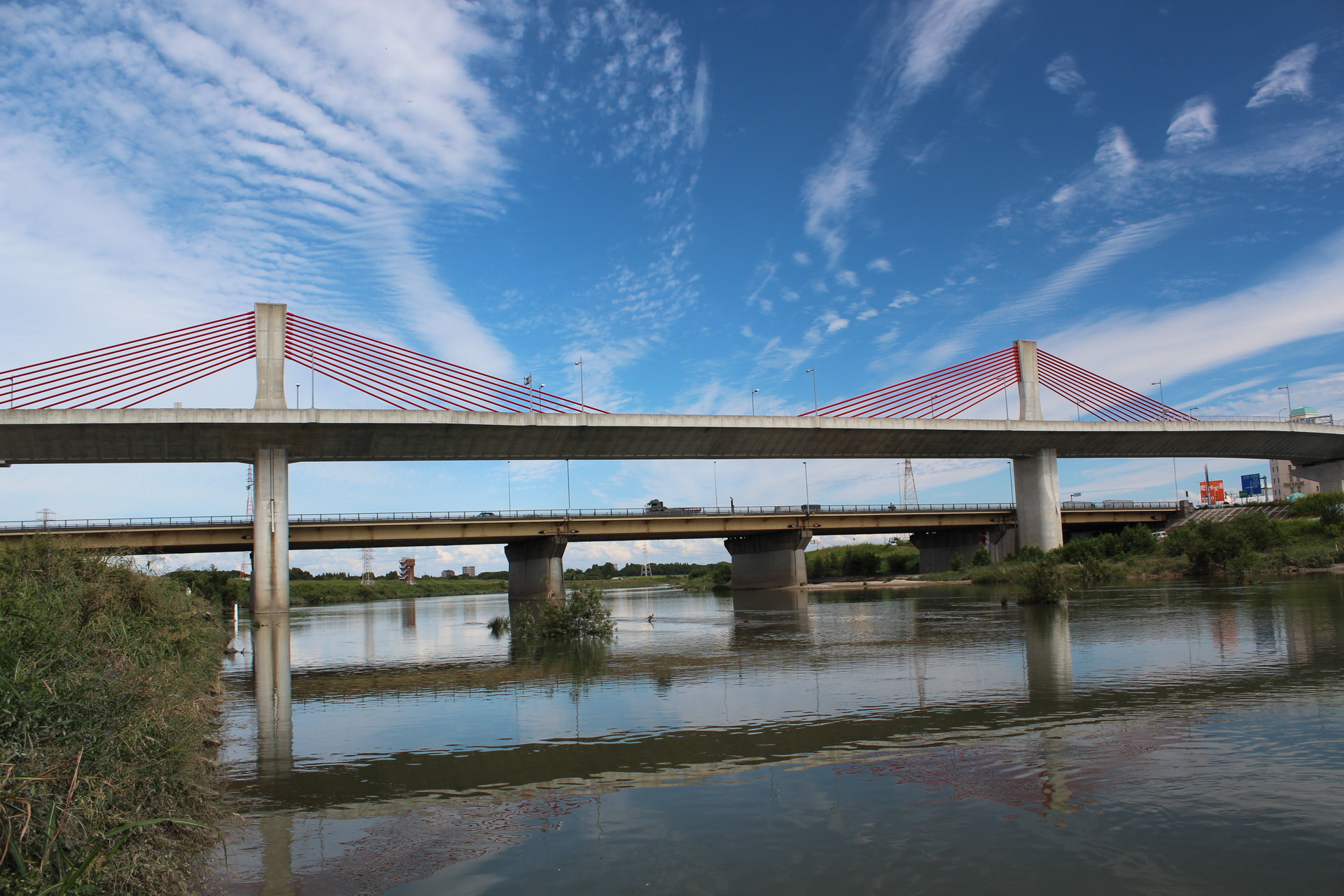
An extradosed bridge combines features of a box girder bridge and a cable-stayed bridge.{{Multiref |. |. |. -- Extradosed bridges are appropriate for spans ranging from 100 meters to 250 meters. Unlike suspension bridges or cable-stayed bridges, the towers of an extradosed bridge often rest on the deck (rather than on a footing) and are solidly connected to the deck. Because of the relatively flat angle of the cables, the cables of an extradosed bridge compress the deck horizontally, performing a function comparable to prestressing wires that are used within concrete girders. Extradosed bridges may be appropriate in applications where the deck must have a shallow depth to maximize clearance under the bridge; or where towers must be relatively short to abide by aviation safety constraints.
Pontoon bridge
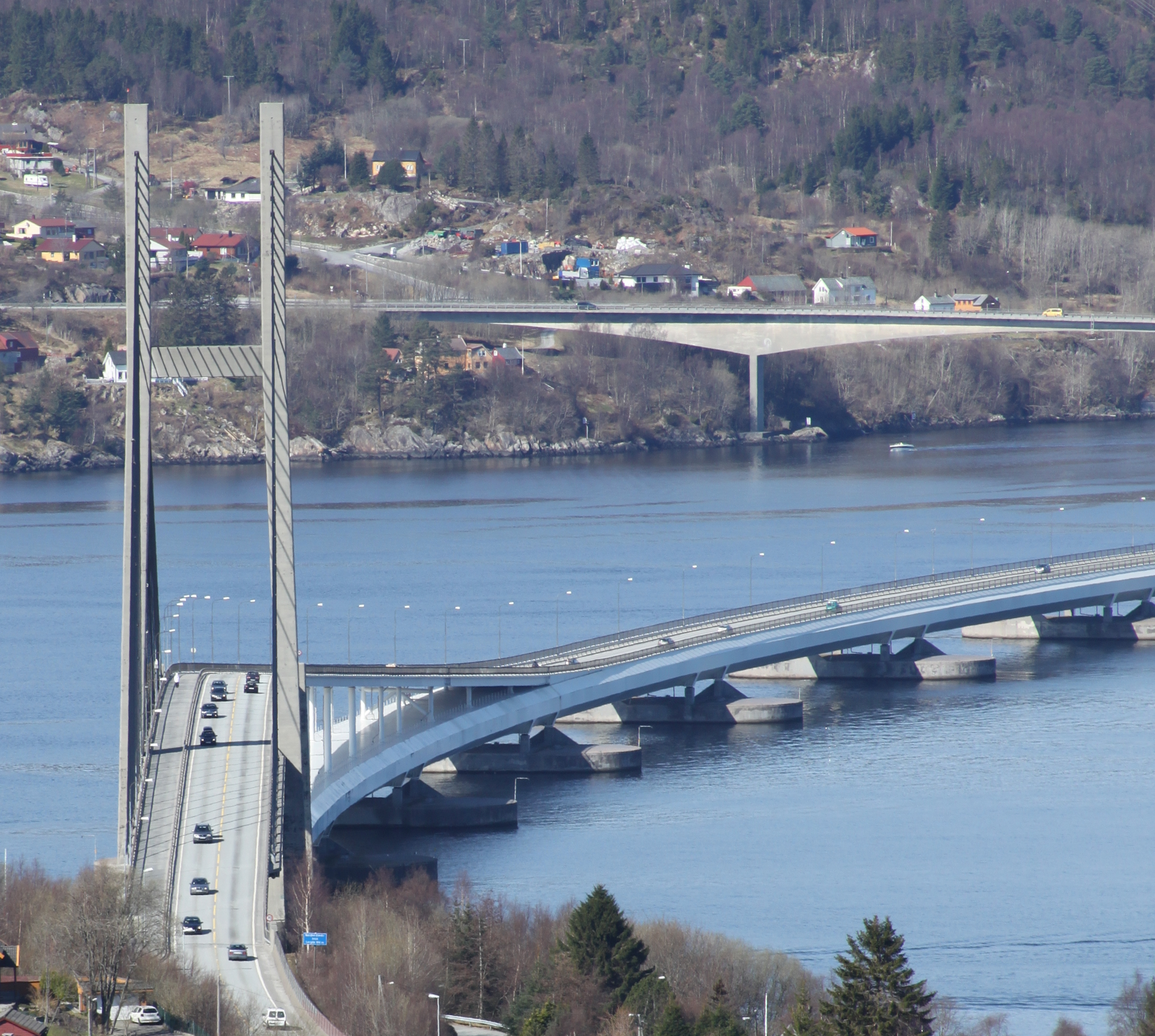
]] A pontoon bridge, also known as a floating bridge, uses floats or shallow-draft boats to support a continuous deck for pedestrian or vehicle travel over water.{{Multiref |. |. |. Pontoon bridges were used in ancient China.{{Multiref |. |. |.
During the Second Persian invasion of Greece, Persian ruler Xerxes built a large pontoon bridge across the Hellespont, consisting of two parallel rows of 360 boats.{{Multiref |. |.
Several pontoon bridges are in use in the modern world. Washington State in the US has several, including Hood Canal Bridge. In Norway, Nordhordland Bridge crosses a deep fjord by resting on floating concrete pontoons. Many armies have pontoon bridges that can be rapidly deployed, including the PMP Floating Bridge, designed by the USSR.
Design
Main article: Bridge design
Design process

-- The process for designing a new bridge typically goes through several stages, progressively refining the design. An early step in the design processsometimes called conceptual designis to consider the multiple requirements that a bridge must satisfy. Requirements that are directly related to function include lifespan, safety, climate, soil condition, traffic volume, the size and nature of the obstacle to be traversed, and clearance required for passage underneath.{{Multiref |. |. |. |.
An important requirement considered during the design process is the service life, which is a specific number of years that the bridge is expected to remain in operation with routine maintenance (and without requiring major repairs).{{Multiref |. |. |.
Specifications and standards
One of the requirements a new bridge must satisfy is compliance with the local bridge design specifications and codes whichin some countriesmay be legally binding requirements.{{Multiref |. |. |. Aviation. |. Navigable waterways.
Aesthetics

]]
A bridge's appearance is one of the factors considered during its design. Attractive bridges can have a positive impact on a community, and some bridges can even be considered as works of art.{{Multiref |. |. |. |. Telford, Eiffel, Roebling. |. Calatrava. |. Maillart.
The art historian Dan Cruickshank notes that bridges are regarded as manifestations of human imagination and ambition, and that many bridges transcend their original utilitarian role and become a work of art. He writes "[a] great bridge has an emotional impact, it has a sublime quality and a heroic beauty that moves even those who are not accustomed to having their senses inflamed by the visual arts."
Material
_(29075882214).jpg)
--

-- A bridge designer can select from a wide variety of materials, including wood, brick, rope, stone, iron, steel, and concrete.{{Multiref |. |.
Wood is an inexpensive, renewable resource with a high strength-to-weight ratio, but it is rarely used for modern roadway bridges because it is prone to degradation from the environment, and is much weaker than steel or concrete. Wood is primarily used in beam or truss bridges, and is also used to build large trestle bridges for railways.{{Multiref |. |. |. |.
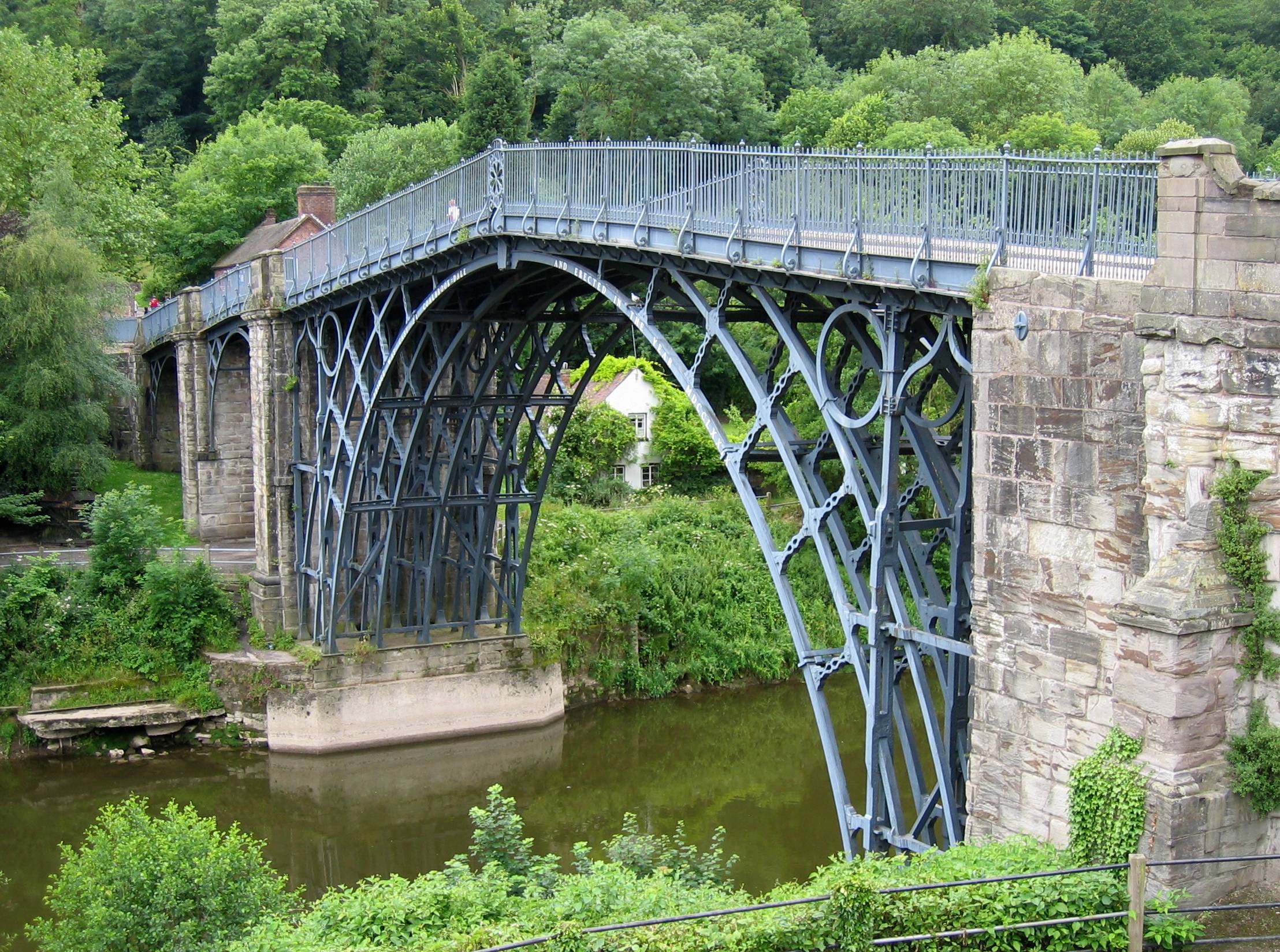
Ironincluding cast iron and wrought ironwas used extensively from the late eighteenth century to late nineteenth century, primarily for arch and truss structures. Iron is relatively brittle, and has been replaced by steel for all but ornamental uses.{{Multiref |. |. |. |. |. |. |. |. |. |. |. |.
Concrete is commonly used in modern bridges, and many roadway bridges are built primarily with a reinforced concrete beam structure, often of the box girder variety.{{efn| High-performance concrete is becoming more commonly used in bridges (compared to conventional concrete) because it suffers less damage from heavy traffic and lasts longer. Conventional concrete has strength about 25 to 50 MPa, whereas high-performance concrete has strength about 50 to 100 MPa. |. |. |, |. |. |. |. |. |. |. |. |. |.
Double-deck bridge
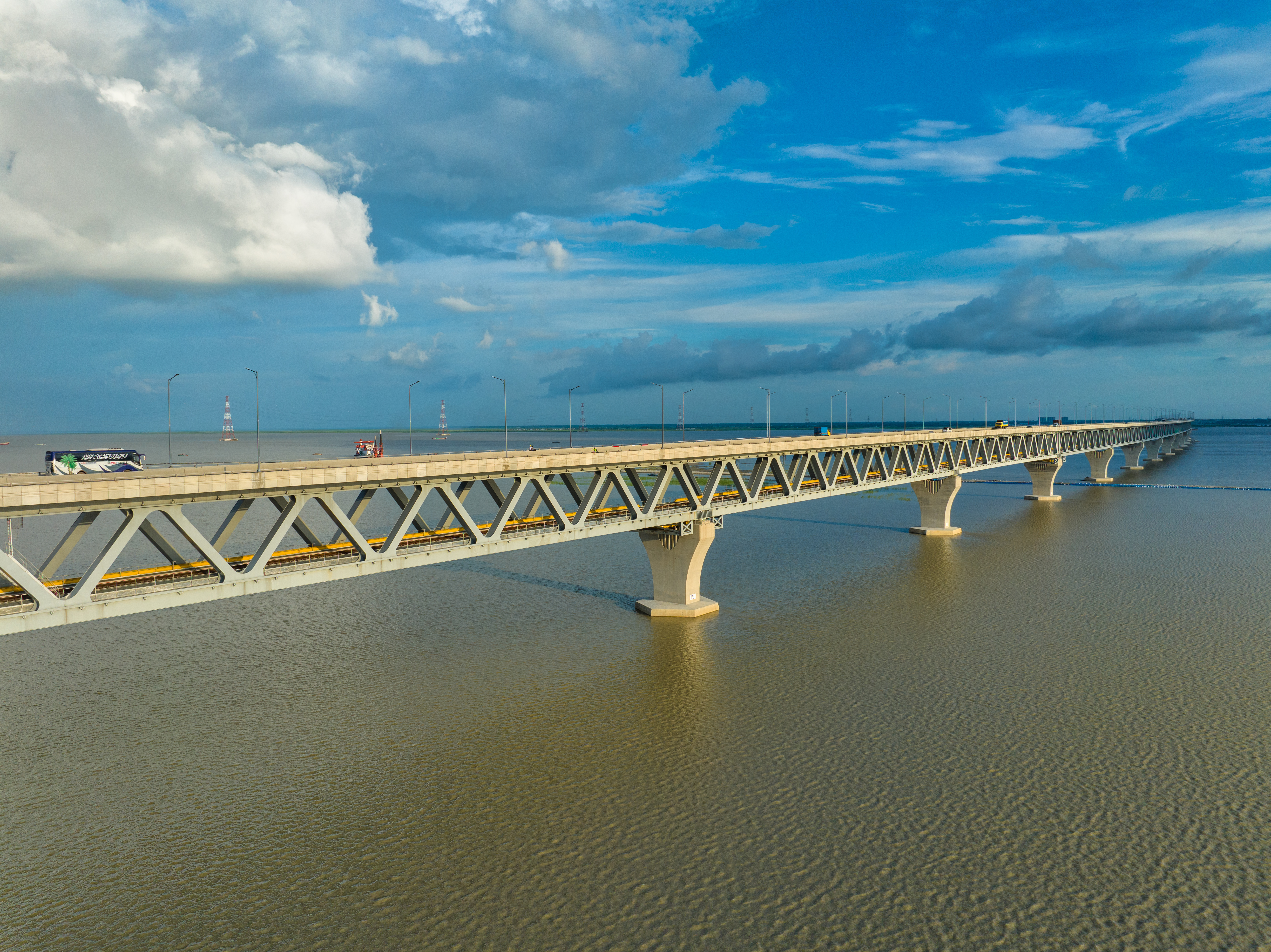
-- Designers may choose to use a double-deck design (also known as double-decked or double-decker), that carries two decks on top of each other. This technique can be used to increase the amount of traffic a bridge can carry; or when the location constrains the size of the bridge. Double-deck bridges also permit two different kinds of traffic to be safely carried. For example, motor vehicles can be separated from pedestrians or railways. Some double-deck bridges carry rail on one deck, and vehicles on the other deck. An early example was Niagara Falls Suspension Bridge, and a modern example is the Dom Luís I Bridge in Portugal. Because of their ability to carry large amounts of motor vehicles, double-deck bridges are often found near large cities carrying cars on both decks, for example, Tsing Ma Bridge in Hong Kong, Øresund Bridge connecting Copenhagen and Malmö, and Shimotsui-Seto Bridge near Kurashiki. George Washington Bridge in New York carries 14 motor vehicle lanes (eight above, six below), and is the world's busiest bridge, carrying over 100 million vehicles annually.
Load analysis

]] A bridge design must accommodate all loads and forces that the bridge might reasonably experience. The totality of the forces that the bridge must tolerate is the structural load, which is often divided into three components: dead load, live load, and environmental load. The dead load is the weight of the bridge itself. The live load is all forces and vibrations caused by traffic passing over the bridge, including weight, braking, and acceleration. An important component of the live load carried by a bridge is the vehicle and rail traffic the bridge carries.{{multiref |. |. In addition to the weight of the vehicle, other forces must be considered, including braking, acceleration, centrifugal forces, and resonant vibrations.. For roadways, the loads imposed by truck traffic far exceed the loads imposed by passenger cars, and so the bridge design process focuses on trucks. The loads created by trains and vehicles can be determined by modelling, or by relying on data and algorithms contained in engineering specifications published by Eurocode or AASHTO organizations. Alternatively, weigh-in-motion technology can measure loads on existing bridges with comparable traffic patterns, providing real-world data which can be used to evaluate a proposed bridge design. -- The environmental load encompasses all forces applied by the bridge's surroundings, including weather, earthquakes, mudslides, water currents, flooding, soil subsidence, frost heaving, temperature fluctuations, and collisions.{{Multiref |. |. |. |. |. |. |.
For sporadic events like floods, earthquakes, collisions, and hurricanes, bridge designers select a maximum severity that the design must accommodate. The severity is based on the return period, which is average time between events of a given magnitude. Return periods range from 10 to 2,500 years, depending on type of event and the country in which the bridge is located.{{Multiref |. |. |. Authors discussing international bridge design policies provide return period examples of 10, 50, 350, 475, 500, 1000, 2000, and 2500 years.
Stress and strain
The load forces acting on a bridge cause the components of the bridge to become stressed. Stress is a measure of the internal force experienced within a material. Strain is a measure of how much a bridge component bends, stretches, or twists in response to stress. Some strain (bending or twisting) may be acceptable in a bridge component if the material is elastic. For example, steel can tolerate some stretching or bending without failing. In contrast, concrete is inelastic, and the change in its shape when stressed is negligible (until the stress becomes excessive and the concrete fails).{{Multiref |. |.
A critical phase of the design process is calculating the maximum stress that each bridge component will experience, and selecting an appropriate design and size for the components to ensure they will safely tolerate the loads on the bridge. Stresses are categorized based on the nature of the force that causes the stress, namely: compression, tension, shear, and torsion. Compression forces compact a component by pushing inward (for example, as felt by a bridge foundation when a heavy tower is resting on it). Tension is a stretching force experienced by a component when pulled (for example by the cables of a suspension bridge). Shear is a sliding force experienced by a component when two offset external forces are applied in opposite directions (for example, during an earthquake when the upper part of a structure is pulled north, and the lower part is pulled south). Torsion is a twisting force.{{multiref |. |.

|. |. ]]
The bridge design process typically employs structural analysis methods that divide the bridge into smaller components, and analyze the components individually, subject to certain constraints. A proposed bridge design is then usually modeled with formulas or computer applications.{{Multiref |. |. |. |. |. -- To ensure that a proposed bridge design is sufficiently strong to endure foreseeable stresses, many bridge designers use limit state design methodologies (used in Europe and China) or Load and Resistance Factor Design (LRFD) methodologies (used in US).{{Multiref |. |. |. These methodologies add a margin of safety to the bridge design by incorporating safety factors into the design process. The safety factors are applied two ways: (a) increasing the assumed loads and stresses the bridge will experience; and (b) decreasing the assumed strength of the bridge's structure.
A bridge designer evaluates the output of the models to determine if the design meets the design goals. Many criteria are evaluated when determining if a bridge design is sufficient, including deflection, cracking, fatigue, flexure, shear, torsion, buckling, settlement, bearing, and sliding. The criteria, and their allowable values, are termed limit states. The set of limit states selected for a design are based on the bridge's structure and purpose.{{Multiref |. |.
Vibration
Many loads imposed on a bridgewind, earthquakes, and vehicular trafficcan cause a bridge to experience irregular or periodic forces, which may cause bridge components to vibrate or oscillate.{{Multiref |. |. |. |. |. |.

|The 1994 Northridge earthquake damaged several bridges.{{Multiref |. |. Winds can produce a variety of vibrational forces on a bridge, including flutter, galloping, and vortex shedding.{{Multiref |. |. |. |. |. |. |. |. The Eurocode guideline for bridge design specifies that vibration stress due to moving vehicles should be accounted for by including an additional 10% to 70% of the vehicles' static load; the exact value depends on the span length, the number of traffic lanes, and the type of stress (bending moment or shear force).
Bridges can suffer severe damage when subjected to earthquake ground motions.{{Multiref |. |. efn|Government agencies that have published earthquake engineering standards for bridges include: Chinese Ministry of Transport, Japan Road Association, European Committee for Standardization, American Association of State Highway and Transportation Officials, and California Department of Transportation.
Construction
The structural elements of a bridge are generally divided into the substructure and the superstructure. The substructure consists of the lower portions of the bridge, including the footings, abutments, piers, pilings, anchorages, and bearings. The superstructure rests upon the substructure, and consists of the deck, trusses, arches, towers, cables, beams, and girders.{{Multiref |. |.
Construction process

|. |. Construction of a bridge is typically managed by construction engineers, who are responsible for planning and supervising the construction process. Important aspects of this role include budgeting, scheduling, periodically conducting formal design reviews, and communicating with the bridge designers to interpret and update the design plans.{{Multiref |. |.
The forces experienced by a bridge during construction can be larger or have a different nature to the forces it will experience after completion. The bridge design process typically focuses on the strength of the fully completed bridge, but it should also consider the unusual stresses that individual elements will experience during construction. Special techniques may be required during construction to avoid excessive stresses, such as temporary supports under the bridge, temporary bracing or reinforcement, or permanently strengthening specific elements.{{Multiref |. |. |.
Substructure

Construction of all bridge types begins by creating the substructure. The first elements built are usually the footings and abutments, which are typically large blocks of reinforced concrete, entirely or partially buried underground. The footings and abutments support the entire weight of the bridge, and transfer the weight to the subsoil.{{Multiref |. |. |. |. |. |. |. |. |.
Abutments are usually located at the ends of a bridge deck, where it reaches the subsoil. They direct the weight into the subsoil, either vertically or diagonally.{{Multiref |. |. |. |. |. |. |. |. |.
Constructing supports in water
,_enclosed_column.jpg)
| This concrete bridge pier is being built within a steel cofferdam. ]]
-- When bridge supports (piers or towers) are built in a river, lake, or ocean, special technologies must be utilized. Caissons can be used to provide a workspace while constructing the submerged portion of the supports. A caisson is a large, watertight, hollow structure, open on the bottom. It is usually sunk to the bottom of the water and workers can work inside, preparing the ground for the footings. When excavation is complete, a caisson is typically filled with concrete to create all or part of the footing.{{multiref |. |. |. |. |. |.
Another approach for constructing foundations in water is a box caisson, which is a large steel or concrete box, open on top, which is towed by tugboats to the bridge site, then sunk to the bottom and filled with concrete.{{Multiref |. |. |. |. |. |.
Bearings
Main article: Bridge bearing

Bearings are often placed between the superstructure and the substructure at the points of contact. Bearings are mechanical devices that enable small movementswhich may result from thermal expansion and contraction, material creep, or minor seismic events. Without bearings, the bridge structure may be damaged when such movements occur. Bearings can be selected to permit small rotational or slipping movements in a specific direction, without permitting movements in other directions. Types of bearings used on bridges include hinge bearings, roller bearings, rocker bearings, sliding bearings, spring bearings, and elastomeric bearings.{{Multiref |. |.
Superstructure
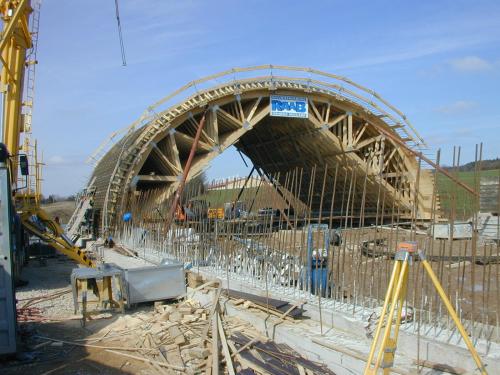
-- After the substructure is complete, the superstructure is built, resting on the substructure. Beam bridge superstructures may be built in place, or fabricated off-site (precast) and transported to the bridge site.{{Multiref |. |. |. |. |.

|. |. ]]
Arch bridge superstructure construction methods depend on the material. Concrete or stone arches use a temporary wood structure known as falsework or centering to support the arch while it is built.{{Multiref |. |. |. |. |. |. |. |
Cantilever bridge superstructures are usually built incrementally by proceeding outward from anchorages or piers. Most cantilever superstructures can be built without temporary support piers, as the bridge can support itself as it extends outward. A similar process is used for steel or concrete cantilevers: prefabricated sections may be positioned at ground (or water) level and hoisted into place with a gantry, or may be transported horizontally along the previously completed portion of the cantilever. Concrete cantilevers require steel prestressing cables to be passed through tubes within each section and tightened, which will put the concrete into compression.{{Multiref |. |. |. |. |.
Cable-stayed bridge superstructures begin with the construction of one or more towers which rest directly on footings that are part of the substructure. The deck is constructed in pieces beginning at the towers and moving outward. The pieces can be put into place by hoisting, supporting from below, launching, or cantilevering from the portion of the deck that has been assembled.{{Multiref |. |. If the deck is made of concrete, steel prestressing cables are inserted through tubes inside each deck section, and tightened to put the concrete into compression.{{Multiref |. |. |.
Suspension bridge superstructure construction usually begins with the towers. The towers may be steel or concrete, and rest directly on footings. The large cables are created by hauling a large pulley back and forth across the span, stringing multiple wires between the anchorages in each pass, in a process termed spinning. After the wires are spun, they are bundled together to form the cables. The cables are securely fastened to the anchorages at both ends. Vertical wires called hangers are suspended from the cables, then small sections of the deck are attached to the hangers, and the sections are attached to each other.{{Multiref |. |. |. |.
Towers


--
[[ File:CableStayedBridge Multi-Strand Anchor.jpg|thumb|alt= A steel cylinder with several thick wires passing through it. | Anchors like this are used at both ends of a cable in a cable-stayed bridge, to attach the cable to the tower and to the deck. ]]
Towers, made of either concrete or steel, are an important component of the superstructure of cable-stayed bridges and suspension bridges. Concrete is generally suitable for towers up to about 250 meters tall, whereas steel towers can be taller.{{Multiref |. |. |. |.
Cables
.jpg)
| A spinning wheels pulls two wires at a time to gradually build up a suspension bridge cable. ]] |. Wires within a strand. |. Strands within a cable.
Steel cables are an element of both cable-stayed bridges and suspension bridges. Cables are made of one or more strands, and each strand consists of multiple wires. A wire is a thin, flexible piece of solid steel, of higher tensile strength than normal steel, and with a diameter of 3mm to 7mm. Cables are typically constructed at the bridge site by unspooling wires or strands from large reels.{{Multiref |. |. -- Large suspension bridges may use cables that are over 1 meter in diameter and weigh over 20000 tonne.{{Multiref |. Diameter over 1m. |. 290 strands per cable. |. 94 tonnes per strand.
Before building the cables of a suspension bridge, temporary catwalks must be constructed to support the wires while they are drawn across the span and over the tops of the towers.{{Multiref |. |. |. |.
The air spinning method was used for all suspension bridges until the prefabricated strand method was invented in the 1960s. The air spinning method is slower because it requires the spinning pulley to cross the span thousands of times, pulling a pair of wires each time.{{Multiref |. |. |.
After 300 to 500 wires are pulled, aluminum bands are used to bundle them into strands. The wires within a strand may be parallel, or they may wrap around each other in a twisted (spiral) pattern. Air spinning always produces strands that contain parallel wires. The prefabricated strand method can utilize strands with parallel or twisted wires. After all the wires have been drawn across the full span and are connected to the towers, they are compacted into a tight bundle by a hydraulic device that moves along the cable and compresses the wires together.{{Multiref |. |
Deck
Main article: Deck (bridge)

|. |. | |. ]]
The deck of a bridge is the flat, horizontal surface that extends across the full span of a bridge. Decks generally rest on beams or box girders. When a deck is rigidly attached to its supporting beams or girders they function together as a single structure.{{Multiref |. |. |. |. Uses term girder to refer to deck/girder structure. -- Two common types of decks are concrete decks and orthotropic steel decks.{{Multiref |. |. |. |. |. |.
Many decks have a wearing surface on top, which is a layer of material designed to be periodically replaced after it is worn away by vehicular traffic. Wearing surfaces are typically made of aggregate (small rocks) mixed with a binder such as asphalt, polyurethane, epoxy resins, or polyester. asphalt, polyurethane, epoxy resins, or polyester. --{{Multiref |. |.
Constructing the deck (and its supporting beams or girders) can be difficult when the bridge is over water or a deep valley. A variety of techniques are available, and the choice depends on the topography of the site, the deck material (concrete or steel), traffic or obstacles under the bridge, and whether sections can be built off-site and transported to the bridge. Methods of deck construction include building atop temporary supports, jacking up from the ground, incremental launching (building the entire deck on the approach road and pushing it horizontally), lifting from below with a hoist mounted on the bridge, cantilevering (incrementally extending the deck, starting from towers or abutments), and lifting with a floating crane.{{Multiref | . | . | .
Protection

-- To achieve the designed service life, a bridge must be protected from deterioration by incorporating certain features into the design. Bridges can deteriorate due to a variety of causes, including rust, corrosion, chemical actions, and mechanical abrasion. Deterioration is sometimes visible as rust on steel components, or cracks and spalling in concrete. Deterioration can be slowed with various measures, primarily aimed at excluding water and oxygen from the bridge elements. Techniques to prevent water-based damage include drainage systems, waterproofing membranes (such as polymer films), and eliminating expansion joints. Concrete bridge elements can be protected with waterproof seals and coatings. Reinforcing steel within concrete can be protected by using high-quality concrete and increasing the thickness of the concrete surrounding the steel. Steel elements of a bridge can be protected by paints or by galvanizing with zinc.{{Multiref |. |. |. |.
Bridge scour is a potentially serious problem when bridge footings are located in water. Currents in the water can cause the sand and rocks around and below the footings to wash away over time. This effect can be mitigated by placing a cofferdam around the footings, or surrounding the footings with large, carefully placed rocks.{{Multiref |. |. |. |.
Operation and financing
Management
After a bridge is completed and becomes operational, management processes are employed to ensure that it remains open to traffic, avoids safety incidents, and achieves its intended lifespan. These processescollectively referred to as bridge management include technical activitiesnamely, maintenance, inspection, monitoring, and testing. In addition to technical tasks, management encompasses planning, budgeting, and prioritization of maintenance activities. Bridge managers use bridge management systems and life-cycle cost analysis methodologies to manage a bridge and estimate the maintenance costs of a bridge throughout its lifetime.{{Multiref |. |.
Maintenance
Maintenance activities seek to prolong the life of the bridge, reduce lifecycle costs, and ensure the safety of the community. Maintenance tasks can be categorized as corrective tasks and preventive tasks. Corrective tasks are implemented in response to unexpected issues that arise, for example, repairing structural elements (piers, beams, girders, towers, or cables) and replacing bearings.
Preventive tasks include washing, painting, lubricating bearings, sealing the deck, filling cracks, removing snow, filling potholes, and repairing minor issues with structures and electrical fixtures. Some preventive tasks are performed on a periodic schedule. An example schedule for periodic bridge maintenance tasks is: washing entire structure (1–2 years); sealing deck surface (4–6 years); lubricating bearings (4 years); painting steel bridge components (12–15 years); replacing the deck's wearing surface (12 years); sealing sidewalks (5 years); filling cracks (4 years); and cleaning drains (2 years).
Inspection and monitoring

--
An important part of maintenance is inspecting a bridge for damage or degradation, and taking steps to mitigate any issues detected. Degradation can come from environmental sources, including expansion/contraction from freeze/thaw cycles, rain, oxidation of steel, and sea spray. Human activities may also cause damage, for example: vehicular traffic, mechanical abrasion, poor bridge design, and improper repair procedures.{{Multiref |. |.
Relying solely on visual inspection to assess degradation of a bridge can be unreliable, so inspectors use a variety of nondestructive testing techniques. These techniques include hammer strike tests, ultrasonic pulse velocity tests, seismic tomography, and ground penetrating radar.{{Multiref |. |. |.
SHM places permanent sensors at critical locations in the bridge, which may be sampled at any time to obtain data about stresses and chemical degradation. The sensors may be placed in the bridge during construction, or while it is in operationfor example, to monitor the quality of a repair.{{Multiref |. |.
To evaluate the condition of large steel cables, electrical coils are moved along the cable, measuring the induction of the cable, which can reveal corrosion issues. Detailed measurements of the external surface of a bridge can be recorded using lidar technology. Comparing measurements taken at multiple points in time can reveal long-term changes.
A variety of structural tests may be performed to evaluate a bridge's condition. One test involves placing loads in selected locations on the bridge, and measuring the resulting deflections: sensitive instruments measure how much the bridge elements bend or twist, and the results can reveal if the element is not performing within expected limits. Another test involves jacking the bridge deck off its supports slightly, and measuring the force required. Cables can be evaluated by vibrating them and measuring their dynamic response.
Financing
Funding for bridge construction and operation comes from a variety of sources, including fuel taxes, annual vehicle registration fees, tolls, congestion fees, and usage fees based on satellite tracking. Some bridgesparticularly in developing countriesare financed by international sources including the World Bank or China's Belt and Road Initiative.{{Multiref |. |.
The cost of building a bridge is typically borne by government agencies, but since 1990 an increasing number of bridges are built and paid for by private companies using a public–private partnership (PPP) agreement. In a PPP project, the government grants the right to build the bridge to a company, and the company recoups its expenses by collecting tolls for a fixed period of time.{{Multiref |. |.
Failures
Bridge failures

|The Nanfang'ao Bridge in Taiwan collapsed because of excessive corrosion that went undetected. ]]

-- Bridge failures are of special importance to structural engineers, because the analyses of the failures provide lessons learned that serve to improve design and construction processes.{{Multiref |. |. |. (improper design and construction method, collision, overloading, fire, corrosion, and lack of inspection and maintenance). Over time, bridge failures have led to significant improvements in bridge design, construction, and maintenance practices.{{Multiref |. |. |. |.
In the modern era, in spite of advances in bridge engineering methodologies, bridge failures continue to occur regularly.{{Multiref |. |. -- It did not open until two years laterafter dampers were installed.{{Multiref |. |. | . | . | .
Society and culture
Signature bridges

Many bridgesknown as signature bridgesare strongly identified with a particular community.{{Multiref |. |. |. |. |. Dagu bridge.
Economic and environmental impact
Bridges can have significant impactsboth positive and negative on a community's environment, society, and economy. During the bridge design process, these effects may be modeled with life cycle sustainability assessment or building information modeling, and the results can be used to adjust the bridge's design to improve its effect on the environment, society, and economy.{{Multiref |. |.
Positive effects of a new bridge can include shorter transport times, employment opportunities, improvements to social equity, improved productivity, and increases to the gross domestic product (GDP). Construction of a new bridge can increase wages in the surrounding region, but can also increase income inequity between genders (men see larger wage gains than women) and between education levels (higher-educated persons see more gains than lower-educated persons).{{Multiref |. |.
Global warming can be exacerbated by the creation of a new bridge, because the production of concrete significantly contributes to the greenhouse effect. Although bridges can boost the economy of the surrounding region, they also increase environmental pollution proportionally. Corruption endemic in the construction industry (including bridge building) can produce negative societal and economic consequences.{{Multiref |. |.
Suicide
Suicides are sometimes carried out by jumping off bridges. This method can account for 20% to 70% of suicides in urban areas with access to tall bridges. In some regions, suicide by jumping disproportionately affects young adults, who tend to have lower inhibitory control. Specific bridges can gain notoriety and attract persons experiencing a suicidal crisis, which creates a feedback loop. High-risk bridges often have suicide prevention barriers installed, which dramatically decrease the suicide rate on the bridge. Installing barriers on a high-risk bridge generally reduces the jumping suicide rate in a region, although in some instances, other bridges become substitutes.
Profession and regulation

-- The profession of civil engineeringwhich includes the discipline of bridge building began to be formalized in the eighteenth century when a school of engineering was created in France within the Corps des Ponts et Chaussées at the École de Paris, under the direction of Jacques Gabriel. In 1747 the first school dedicated to bridge building was founded: the École Nationale des Ponts et Chaussées -- led by French engineers Daniel-Charles Trudaine and Jean-Rodolphe Perronet. The first professional organization focused on civil engineering was the Institution of Civil Engineers founded in 1818 in the UK, initially led by Thomas Telford.
In the modern era, bridge engineering is regulated by national organizations, such as the National Council of Examiners for Engineering and Surveying (US), the Canadian Council of Professional Engineers (Canada), and the Engineering Council (UK). In many countries, bridge engineers must be licensed or meet minimal educational requirements. Some countries require engineers to pass qualification examinations, for example, in the US engineers must pass the Fundamentals of Engineering exam followed by the Principles and Practice of Engineering exam. In Poland, bridge engineers are required to obtain certification by accumulating several years of experience under a senior engineer, and passing an exam administered by the Polish Chamber of Civil Engineers. International cooperation in the field of engineering is facilitated by the World Federation of Engineering Organizations.
.jpg)
Bridges have been featured on coins since antiquity. In 1996, the European Commission held a competition to select art for the euro banknotes. Robert Kalina, an Austrian designer, won with a set of illustrations of bridges, chosen because they symbolize links between states in the union and with the future. The designs were supposed to be devoid of any identifiable characteristics, so as to not show favoritism to specific countries. But the initial designs by Kalina were discovered to be of specific bridges, including the Rialto and the Pont de Neuilly, and so were changed to be more generic. Each banknote denomination depicts a bridge design representative of a certain architectural era.{{Multiref |. |. |. The eras utilized for bridge images on Euro banknotes are: Classical (€5), Romanesque (€10), Gothic (€20), Renaissance (€50), Baroque and Rococo (€100), 19th century iron and glass (€200), and 20th century (€500).}}--
Art and culture

Reaching for the world, as our lives do, As all lives do, reaching that we may give The best of what we are and hold as true: Always it is by bridges that we live. |. |.
Bridges occur extensively in art, legend, and literature, often employed as metaphors or symbols of human accomplishment, lifespan, or experience.{{Multiref |. |.
In the modern era, bridges continue to feature prominently in culture. Bridges are often the setting for pageants, celebrations, and processions. Authors have used bridges as the centerpiece of novels, notably The Bridge on the Drina by Ivo Andrić and Thornton Wilder's The Bridge of San Luis Rey. British poet Philip Larkin, inspired by the construction of the Humber Bridge near his home, wrote "Bridge for the Living" in 1981.{{Multiref |. |. |. |. |. |. |.
References
Footnotes
Citations
Sources
Books
-
{{cite book | editor-last=Ryall | editor-first= Michael | chapter-url=https://archive.org/details/manualofbridgeen0000unse/page/883 | access-date=1 September 2025
-
{{cite book | author-link = Charles Kendall Adams |access-date=September 1, 2022
-
{{cite book | editor-last1=Chen | editor-first1= Wai-Fah | editor-last2 = Duan | editor-first2 = Lian
-
{{cite book | editor-last1=Chen | editor-first1= Wai-Fah | editor-last2 = Duan | editor-first2 = Lian
-
{{Cite book | access-date=1 September 2025
-
{{Cite book | author-link = Ferdinand P. Beer | access-date=17 September 2025
-
{{Cite book | access-date=1 September 2025
-
{{cite book | editor-last=Ryall | editor-first= Michael | chapter-url=https://archive.org/details/manualofbridgeen0000unse/page/1 | access-date=1 September 2025
-
{{cite book | display-authors=etal | editor-last1 =Chen | editor-first1= Wai-Fah | editor-last2 = Duan | editor-first2= Lian | access-date= 1 September 2025
-
{{cite book | editor-last=Ryall | editor-first= Michael | chapter-url=https://archive.org/details/manualofbridgeen0000unse/page/663 | access-date=1 September 2025
-
{{cite book | display-authors=etal | editor-last1=Chen | editor-first1= Wai-Fah | editor-last2 = Duan | editor-first2 = Lian
-
{{Cite book | access-date=1 September 2025
-
{{cite book | display-authors=etal | editor-last1=Chen | editor-first1= Wai-Fah | editor-last2 = Duan | editor-first2 = Lian
-
{{cite book | chapter-url=https://www.aisc.org/globalassets/nsba/design-resources/steel-bridge-design-handbook/b917_sbdh_chapter17.pdf | access-date=4 November 2025
-
{{cite book | editor-last1 =Chen | editor-first1= Wai-Fah | editor-last2 = Duan | editor-first2= Lian | access-date= 1 September 2025
-
{{cite book | editor-last1=Chen | editor-first1= Wai-Fah | editor-last2 = Duan | editor-first2 = Lian | access-date= 31 October 2025
-
{{cite book | chapter-url = https://www.iabse-bd.org/session/k2.pdf | access-date=4 November 2025
-
{{cite book | editor-last=Ryall | editor-first= Michael | chapter-url=https://archive.org/details/manualofbridgeen0000unse/page/407 | access-date=1 September 2025
-
{{cite book | editor-last1=Chen | editor-first1= Wai-Fah | editor-last2 = Duan | editor-first2 = Lian | access-date= 31 October 2025
-
{{cite book | author-link=Dan Cruickshank | access-date= 1 September 2025
-
{{Cite book |access-date=15 September 2025 --
-
{{cite book | access-date= 1 September 2025
-
{{cite book |orig-year=1932 |access-date = 20 September 2025
-
{{cite book | editor-last1=Chen | editor-first1= Wai-Fah | editor-last2 = Duan | editor-first2 = Lian | access-date= 31 October 2025
-
{{cite book | editor-last1=Chen | editor-first1= Wai-Fah | editor-last2 = Duan | editor-first2 = Lian | access-date= 31 October 2025
-
{{cite book
-
{{cite book | access-date= 1 September 2025
-
{{cite book | editor-last=Ryall | editor-first= Michael | chapter-url=https://archive.org/details/manualofbridgeen0000unse/page/519 | access-date=1 September 2025
-
{{cite book | editor-last=Ryall | editor-first= Michael | chapter-url=https://archive.org/details/manualofbridgeen0000unse/page/549 | access-date=1 September 2025 --
-
{{cite book | display-authors=etal | editor-last1=Chen | editor-first1= Wai-Fah | editor-last2 = Duan | editor-first2 = Lian | access-date= 31 October 2025
-
{{cite book | editor-last1=Chen | editor-first1= Wai-Fah | editor-last2 = Duan | editor-first2 = Lian | access-date= 31 October 2025
-
{{cite book | editor-last1=Chen | editor-first1= Wai-Fah | editor-last2 = Duan | editor-first2 = Lian | access-date= 31 October 2025
-
{{cite book | editor-last1=Chen | editor-first1= Wai-Fah | editor-last2 = Duan | editor-first2 = Lian | access-date= 31 October 2025
-
{{cite book | access-date=1 September 2025
-
{{cite book | editor-last1=Chen | editor-first1= Wai-Fah | editor-last2 = Duan | editor-first2 = Lian | access-date= 31 October 2025
-
{{cite book | access-date= 1 September 2025
-
{{cite book | editor-last=Ryall | editor-first= Michael | chapter-url=https://archive.org/details/manualofbridgeen0000unse/page/241 | access-date=1 September 2025
-
{{cite book | access-date=15 September 2025 --
-
{{cite book | access-date=10 September 2025
-
{{cite book | editor-last1=Chen | editor-first1= Wai-Fah | editor-last2 = Duan | editor-first2 = Lian | access-date= 31 October 2025
-
{{cite book | editor-last=Ryall | editor-first= Michael | chapter-url=https://archive.org/details/manualofbridgeen0000unse/page/595 | access-date=1 September 2025
-
{{cite book | editor-last1=Chen | editor-first1= Wai-Fah | editor-last2 = Duan | editor-first2 = Lian | access-date= 31 October 2025
-
{{cite book | editor-last1=Chen | editor-first1= Wai-Fah | editor-last2 = Duan | editor-first2 = Lian | access-date= 31 October 2025
-
{{cite book | editor-last1=Chen | editor-first1= Wai-Fah | editor-last2 = Duan | editor-first2 = Lian | access-date= 31 October 2025
-
{{cite book | editor-last1=Chen | editor-first1= Wai-Fah | editor-last2 = Duan | editor-first2 = Lian | access-date= 31 October 2025
-
{{cite book | editor-last1=Chen | editor-first1= Wai-Fah | editor-last2 = Duan | editor-first2 = Lian | access-date= 31 October 2025
-
{{cite book | editor-last1=Chen | editor-first1= Wai-Fah | editor-last2 = Duan | editor-first2 = Lian | access-date= 31 October 2025
-
{{cite book | editor-last1=Chen | editor-first1= Wai-Fah | editor-last2 = Duan | editor-first2 = Lian | access-date= 31 October 2025
-
{{cite book | editor-last=Ryall | editor-first= Michael | chapter-url=https://archive.org/details/manualofbridgeen0000unse/page/805 | access-date=1 September 2025
-
{{cite book | author-link =Ram Nath |access-date= 17 September 2025
-
{{cite book | access-date=12 September 2025
-
{{cite book |access-date= 7 December 2025
-
{{cite book | author-link=Henry Petroski | access-date=20 September 2025
-
{{cite book | author-link = J. N. Reddy (engineer) | access-date=10 September 2025
-
{{cite book | editor-last=Ryall | editor-first= Michael | chapter-url=https://archive.org/details/manualofbridgeen0000unse/page/43 | access-date=1 September 2025
-
{{cite book | editor-last1 =Chen | editor-first1= Wai-Fah | editor-last2 = Duan | editor-first2= Lian | access-date= 1 September 2025
-
{{cite book | access-date=1 September 2025
-
{{cite book |access-date=16 October 2025 |author-last=Schlaich |author-first=Mike |editor-last1=Schlaich |editor-first1=Mike
-
{{cite book | editor-last=Ryall | editor-first= Michael | chapter-url=https://archive.org/details/manualofbridgeen0000unse/page/95 | access-date=1 September 2025 --
-
{{cite book | display-authors=etal | editor-last1=Chen | editor-first1= Wai-Fah | editor-last2 = Duan | editor-first2 = Lian | access-date= 31 October 2025
-
{{cite book | editor-last1=Chen | editor-first1= Wai-Fah | editor-last2 = Duan | editor-first2 = Lian | access-date= 31 October 2025
-
{{cite book | display-authors=etal | editor-last1=Chen | editor-first1= Wai-Fah | editor-last2 = Duan | editor-first2 = Lian | access-date= 31 October 2025
-
{{cite book | author-link=E. G. Squier | access-date=13 September 2025
-
{{cite book | display-authors=etal | editor-last1=Chen | editor-first1= Wai-Fah | editor-last2 = Duan | editor-first2 = Lian | access-date= 31 October 2025
-
{{cite book |author-link=Gay Talese |orig-year=1964
-
{{cite book | editor-last1=Chen | editor-first1= Wai-Fah | editor-last2 = Duan | editor-first2 = Lian | access-date= 31 October 2025
-
{{cite book | author-link = Man-Chung Tang | editor-last1=Chen | editor-first1= Wai-Fah | editor-last2 = Duan | editor-first2 = Lian | access-date= 31 October 2025
-
{{cite book | editor-last1=Chen | editor-first1= Wai-Fah | editor-last2 = Duan | editor-first2 = Lian | access-date= 31 October 2025
-
{{cite book | access-date=1 September 2025
-
{{cite book | access-date= 25 October 2025
-
{{cite book | display-authors=etal | access-date=13 September 2025
-
{{cite book | editor-last=Ryall | editor-first= Michael | chapter-url=https://archive.org/details/manualofbridgeen0000unse/page/849 | access-date=1 September 2025
-
{{cite book | editor-last1=Chen | editor-first1= Wai-Fah | editor-last2 = Duan | editor-first2 = Lian | access-date= 31 October 2025
-
{{cite book | editor-last1=Chen | editor-first1= Wai-Fah | editor-last2 = Duan | editor-first2 = Lian | access-date= 31 October 2025
-
{{cite book | access-date=1 September 2025
-
{{cite book | access-date= 31 October 2025
-
{{cite book |author-link=Ivor Wilks |access-date= 29 December 2020
-
{{Cite book | chapter-url=https://www.aisc.org/globalassets/nsba/design-resources/steel-bridge-design-handbook/b905_sbdh_chapter5.pdf |access-date=18 September 2025
-
{{cite book |display-authors = etal --
-
{{cite book | editor-last1=Chen | editor-first1= Wai-Fah | editor-last2 = Duan | editor-first2 = Lian | access-date= 31 October 2025
-
{{cite book | display-authors=etal | editor-last1=Chen | editor-first1= Wai-Fah | editor-last2 = Duan | editor-first2 = Lian | access-date= 31 October 2025
-
{{cite book |display-authors = etal | access-date=16 September 2025
Journals and websites
-
{{Cite journal |article-number= 2853 |doi-access=free
-
{{Cite journal
-
{{cite magazine | access-date = 20 November 2025 | display-authors=etal
-
{{cite journal
-
{{cite journal |article-number=700038
-
{{cite journal | display-authors = etal
-
{{cite journal |article-number= 1565
-
{{ cite journal
-
{{cite web |access-date=21 September 2025 |author-link =J. Richard Capka --
-
{{cite web |access-date= 7 December 2025 |display-authors=etal
-
{{cite thesis |access-date=2 October 2025
-
{{cite web | display-authors=etal | access-date= 10 November 2025
-
{{cite journal |display-authors=etal
-
{{cite journal | article-number= 104133 |display-authors=etal
-
{{cite journal
-
{{cite journal
-
{{cite book
-
{{cite web |display-authors=etal |access-date=3 December 2025
-
{{cite journal
-
{{Cite news |url-status=live |archive-url=https://web.archive.org/web/20210123083528/https://www.theguardian.com/environment/2021/jan/23/how-wildlife-crossings-are-helping-reindeer-bears-and-even-crabs-aoe |archive-date=23 January 2021 |access-date=2021-01-26
-
{{cite journal
-
{{cite journal |access-date = 15 January 2026
-
{{Cite magazine |access-date=2020-09-11
-
{{cite web |access-date=2 October 2025 |display-authors = etal
-
{{cite web |access-date=17 September 2025 |display-authors = etal
-
{{Cite journal
-
{{cite journal |display-authors = etal | article-number = 20
-
{{cite news |access-date=11 December 2025
-
{{Cite web |access-date=18 January 2026
-
{{cite journal | article-number = 102745
-
{{cite magazine |access-date=21 February 2019
-
{{cite magazine |access-date= 17 November 2025
-
{{cite journal | display-authors = etal |article-number=3788 |doi-access= free
-
{{cite web | display-authors = etal |access-date= 17 November 2025 --
-
{{Cite web |access-date=10 September 2025
-
{{cite magazine | access-date = 17 January 2026 | author-link = Alfred Price (author)
-
{{Cite web |display-authors=etal |access-date=7 December 2025
-
{{Cite web |access-date=21 September 2025
-
{{Cite journal
-
{{Cite web |access-date=20 September 2025
-
{{Cite web | display-authors = etal |access-date=2 October 2025
-
{{cite news |access-date=23 September 2025
-
{{Cite encyclopedia |author-link=Hubert Shirley-Smith |access-date=19 September 2025
-
{{cite journal
-
{{cite journal | article-number= 101161
-
{{cite journal
-
{{cite news |access-date = 6 November 2025
-
{{cite journal
-
{{cite journal
-
{{cite journal | article-number = 2021 |display-authors=etal | doi-access = free
Unknown author
-
{{Cite web |access-date= 12 September 2025
-
{{ cite web |access-date=11 December 2025
-
{{cite book |access-date=2 November 2025
-
{{Cite news |access-date=17 September 2025
-
{{Cite book |chapter-url= https://archive.org/details/conciseoxforddic0000unse_t1j9/page/66 |access-date=27 December 2022
-
{{Cite web |access-date=25 January 2012 |url-status=dead |archive-url=https://web.archive.org/web/20120610192737/http://www.polytec.com/us/solutions/vibration-measurement/basic-principles-of-vibrometry/ |archive-date=10 June 2012 --
-
{{Cite web |access-date=17 September 2025
-
{{Cite web |access-date=2 October 2025
-
{{Cite web |access-date=17 September 2025 --
-
{{Cite web |access-date=12 November 2025
-
{{Cite web | access-date= 16 September 2025
-
{{Cite web |url-access=subscription |access-date=14 November 2025
-
{{Cite web |archive-url=https://web.archive.org/web/20111126032356/http://army.mod.uk/royalengineers/equipment/702.aspx |archive-date=2011-11-26 |url-status=dead
-
{{Cite report |access-date=May 15, 2024 --
-
{{Cite web |access-date=17 September 2025
-
{{Cite journal
-
{{Cite web |access-date= 18 January 2026
-
{{Cite book | access-date=26 October 2025
-
{{Cite web |access-date=17 September 2025
-
{{Cite web | access-date= 11 December 2025
-
{{Cite book | access-date=1 September 2025
-
{{Cite web |access-date=2 October 2025
-
{{cite book
-
{{Cite web |access-date=10 December 2020 --
-
{{Cite web | access-date=1 September 2025
-
{{Cite web | access-date=13 November 2025
-
{{Cite web | access-date=16 November 2025
-
{{Cite book | access-date=26 October 2025
-
{{Cite web |access-date=August 20, 2007 |archive-date=August 22, 2011 |archive-url=https://web.archive.org/web/20110822071258/http://www.goldengatebridge.org/research/factsGGBIntOrngPaint.php |url-status=dead --
-
{{Cite web |access-date=12 September 2025
-
{{Cite web |access-date=14 September 2025
-
{{Cite web |access-date=June 24, 2012 |archive-url=https://web.archive.org/web/20120625142735/http://baybridgeinfo.org/sas-travelers-page |url-status=dead |archive-date=June 25, 2012
-
{{Cite web |access-date=18 September 2025
-
{{Cite web |access-date=25 October 2025
-
{{Cite news |access-date=16 September 2025
-
{{Cite book |chapter-url= https://archive.org/details/conciseoxforddic0000unse_t1j9/page/1596 |access-date=27 December 2022
-
{{Cite web |access-date=19 September 2025
-
{{Cite web |access-date=17 September 2025
References
- {{harvnb. Alampalli. 2014
- {{harvnb. Zhou. 2021. Value as of 2021.
This article was imported from Wikipedia and is available under the Creative Commons Attribution-ShareAlike 4.0 License. Content has been adapted to SurfDoc format. Original contributors can be found on the article history page.
Ask Mako anything about Bridge — get instant answers, deeper analysis, and related topics.
Research with MakoFree with your Surf account
Create a free account to save articles, ask Mako questions, and organize your research.
Sign up freeThis content may have been generated or modified by AI. CloudSurf Software LLC is not responsible for the accuracy, completeness, or reliability of AI-generated content. Always verify important information from primary sources.
Report