From Surf Wiki (app.surf) — the open knowledge base
Box Hill, Surrey
Hill and beauty spot in Surrey, England

Hill and beauty spot in Surrey, England
| Field | Value |
|---|---|
| name | Box Hill |
| alt_name | Part of the Mole Gap to Reigate Escarpment SSSI |
| iucn_category | IV |
| photo | Towards Box Hill - geograph.org.uk - 1805314.jpg |
| photo_width | 290 |
| photo_caption | Box Hill viewed from the south. |
| Photograph taken from Betchworth Park Golf Course. | |
| map | United Kingdom Surrey |
| relief | 1 |
| label | Box Hill |
| label_position | top |
| nearest_town | Dorking, Surrey, England |
| coordinates | |
| area_km2 | 11 |
| name | Box Hill |
| elevation_m | 224 |
| elevation_ref | |
| prominence_m | 49 |
| parent | North Downs |
| map_image | Box hill map.png |
| map_caption | Map of Box Hill, showing the areas managed by the National Trust (purple), Surrey Wildlife Trust (turquoise) and Surrey County Council (green). The urban area of Box Hill village is shown in grey. |
| grid_ref_UK | TQ 178 514 |
| topo_map | OS Landranger 187 |
| mountain_type | Cuesta |
| geology | |
| age | Cretaceous and Eocene |
| child | yes |
Photograph taken from Betchworth Park Golf Course. Box Hill is a summit of the North Downs in Surrey, approximately 31 km south-west of London. It is named after the ancient box woodland found on the steepest west-facing chalk slopes overlooking the River Mole. The western part of the hill is owned and managed by the National Trust, whilst the village of Box Hill lies on higher ground to the east. The highest point is Betchworth Clump at 224 m above OD,
Box Hill is part of the Surrey Hills National Landscape and forms part of the Mole Gap to Reigate Escarpment Site of Special Scientific Interest. The north- and south-facing slopes support an area of chalk downland, noted for its orchids and other rare plant species. The hill provides a habitat for 38 species of butterfly, and has given its name to a species of squash bug, now found throughout south-east England.
An estimated 850,000 people visit Box Hill each year.
Geography
Box Hill, approximately 31 km south-west of central London, stands at the south-eastern corner of the Mole Gap, the valley carved by the River Mole through the North Downs. Its summit, 224 m above Ordnance Datum, is the 12th highest in Surrey. The western boundary of the hill is defined by the River Mole, which has cut a steep cliff, exposing the chalk bedrock. The Vale of Holmesdale lies immediately to the south, below the scarp slope. The northern and eastern boundaries are defined by dry river valleys, which were created during the last Ice Age. The total area of the hill is approximately 11 km2, of which half is owned by the National Trust.
The village
The village of Box Hill is to the east of the summit and to the west of the Country Park owned by the National Trust. The earliest flint cottages date from the 1800s, although much of the village was constructed in the first half of the 20th century. By 2005 there were more than 800 dwellings, of which over five hundred were mobile homes. An estimated 41% of the community is aged 60 or over. St Andrew's Church, part of the ecclesiastical parish of Headley, was consecrated in 1969 and the village hall opened in 1974. The village is not part of a civil parish.
History
Early history
Two Bronze Age round barrows, located close to the Salomons Memorial, provide the earliest archaeological evidence of human activity on Box Hill. The larger barrow is 20 m in diameter and 2.2 m high and, in medieval times, was used as a boundary marker or mere for the parish of Mickleham. Traces of prehistoric field boundaries are visible on Burford Spur and the low flint banks on the steeper and more wooded White Hill may be contemporaneous.
An ancient trackway along the North Downs escarpment can be dated to around 600–450 BC, but has probably been in existence since the Stone Age and may have crossed the River Mole at a ford close to the location of the present day stepping stones. In Victorian times this route was dubbed the Pilgrims' Way and was supposedly followed by visitors to the shrines of Thomas Becket and Swithun at Canterbury and Winchester respectively.
Stane Street was constructed by the Romans in around 60–70 AD to link London (Londinium) to Chichester (Noviomagus Reginorum) on the south coast of England. The course of the road runs in a southwesterly direction across Mickleham Downs, before turning south to cross the River Mole at a ford close to the site of the Burford Bridge Hotel. A hoard of nine Roman coins, including bronze folles dating from the reigns of Diocletian, Maximian and Constantius I, was discovered on Box Hill close to Broadwood's Folly in 1979.
Medieval and early modern periods
The pillow mounds to the north-east of the Salomons Memorial are thought to date from the medieval period and were probably constructed as artificial warrens for rabbits. High Ashurst warren is recorded as remaining in use until the late 18th century. A second warren was probably situated close to Warren Farm in the Headley Valley and it has been speculated that the present farmhouse was originally the warrener's cottage.

The origin of the box trees growing on the hill is disputed. Several sources from the late 18th century suggest that they were planted by Thomas Howard, 21st Earl of Arundel during the reign of Charles I. However Howard never owned the Box Hill estate and older medieval documents make reference to local individuals with surnames including Atteboxe, de la Boxe and Buxeto, suggesting that the trees were already common in the area by the 13th century. The diarist John Evelyn records a visit to the hill in August 1655 to view "those natural bowers, cabinets and shady walks in the box copses."
The close grain of the box wood made it highly prized for its timber for carving and there are numerous accounts of the sale of trees from the hill throughout the 17th and 18th centuries. At the end of the eighteenth century, imports from Portugal reduced the market value of box wood and commercial exploitation of timber from Box Hill appears to have ended with a final sale in 1797.
Agriculture
Despite the commercial importance of timber in the early modern period, the woodland on Box Hill was much less extensive at the start of the 19th century than at the start of the 21st. The 1801 Betchworth Estate Map shows that there was a network of irregularly shaped fields on the top of the hill, where the more fertile clay-with-flints overlays the chalk. These ‘clearings’ (each up to 1 ha) were cultivated for arable crops, but by the 1830s changes in farming practices meant that they were too small to be worked economically and many were over-planted with beech (with some oak). These deciduous plantations may be distinguished from older yew- and box-dominated woodland on the hill by the uniform age of the trees.
Remnants of a few of these arable fields still exist, notably at the head of Juniper Bottom and around the old Box Hill Fort and Swiss Cottage. The Donkey Green (immediately north of the Salomons Memorial) was used as a cricket ground in the 1850s. It acquired its current name in Edwardian times, when donkey rides were offered to younger day trippers, although this practice had ceased by World War II.
The soil covering the north- and south-facing chalk slopes of the hill is too thin and insufficiently fertile to allow cultivation. These areas are indicated as sheep-walk on the 1801 map and were used as pasture, especially during the winter months when lower ground was too wet for productive grazing.
.jpg)
Throughout its history, Headley Heath has been used for grazing and local villagers have collected heather, gorse and turf for bedding and making fires.
Ownership and public access
The hill was purchased by Thomas Hope, shortly before his death in 1831. (Hope was the owner of The Deepdene, the mansion to the east of Dorking.) The Mickleham Parish Records credit Hope's widow, Louisa de la Poer Beresford (whom he had married six years previously), with allowing "free access to the beauties of this hill", however day-trippers had been arriving in significant numbers for more than a century before that.
Developments in local transport infrastructure over the course of the 18th and 19th centuries, enabled increasing numbers to visit the area. Following the completion of the turnpike road between Leatherhead and Dorking in 1750, stagecoaches stopped regularly at the Burford Bridge Hotel. As late as 1879, a daily coach ran non-stop to Box Hill from Piccadilly with a journey time of 2.5 hours.
The South Eastern Railway opened the first railway station in Dorking in 1849, followed by the London, Brighton and South Coast Railway (LBSCR), which opened the station in the village of Westhumble in 1867. The LBSCR ran dedicated excursion trains to Box Hill on Bank Holiday weekends and over 1300 day-trippers were recorded arriving at Westhumble station on 6 August 1883.

The proposals for a land value tax outlined by Chancellor David Lloyd George in his People's Budget of 1909 prompted the trustees of the Deepdene estate to start to sell the unimproved land on the western side of Box Hill. As a result of negotiations led by Sir Robert Hunter, Leopold Salomons of Norbury Park purchased 95 ha of Box Hill in 1913 for £16,000. The following year, Salomons donated the land, which included the Old Fort, Swiss Cottage and the western flank of the hill above the River Mole, to the National Trust.
Two further purchases of 28 ha and 102 ha transferred Lodge Hill and Ashurst Rough to National Trust ownership in 1921 and 1923. Following World War II, National Trust acquired Headley Heath, a geologically distinct area of heathland which lies to the north-east of Box Hill village, the majority of which was given as a single donation in 1946. The Trust continued to purchase land, and by the mid-1980s the estate comprised some 500 ha. The most recent additions to the Box Hill Estate include farmland at Westhumble and at the foot of the hill, purchased in the late 1990s.
Military history
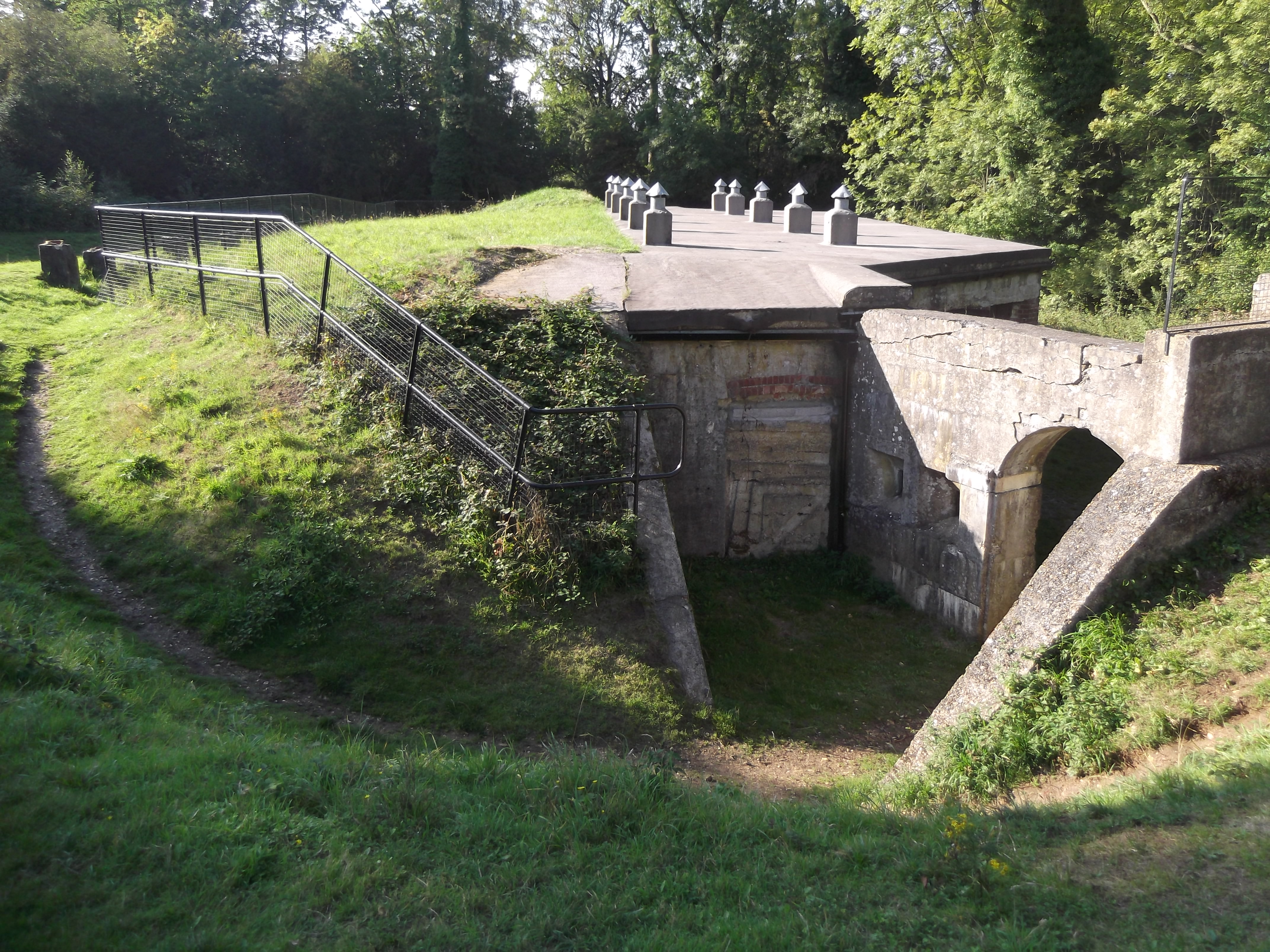
In the latter half of the 19th century, growing public concern over the ability of the British armed forces to repel an invasion (stoked, in part, by the serialisation of George Tomkyns Chesney's 1871 novella The Battle of Dorking), prompted the government to announce the construction of thirteen fortified mobilisation centres, collectively known as the London Defence Positions. Two centres were built on Box Hill, approximately 2.5 km apart: one close to the present National Trust visitor centre (commonly called Box Hill Fort) and the other close to the summit of the hill, to the south of the present day Box Hill village (known as Betchworth Fort).
The sites were purchased from the trustees of the Hope estate by the Ministry of Defence in 1891, and construction began in 1899. (In common with the majority of the eleven other mobilisation centres, the forts were designed for the use of the infantry only and the stored ammunition was intended for the use of mobile field artillery which would be deployed nearby as required.) The main flat-roofed buildings were built in brick and reinforced concrete and were protected from artillery fire by crescent-shaped earth blast banks, surrounded by an outer ditch.
A reform of defence policy by the Secretary of War Viscount Haldane in 1905 resulted in all 13 centres being declared redundant, and both forts were sold back to the estate trustees in 1908. Both forts are protected by a Scheduled Monument listing. The National Trust owns the Box Hill Fort and a metal grill has been placed over the entrance to allow bats to access to their roosts. The Betchworth Fort is in private ownership and is not accessible to the public.
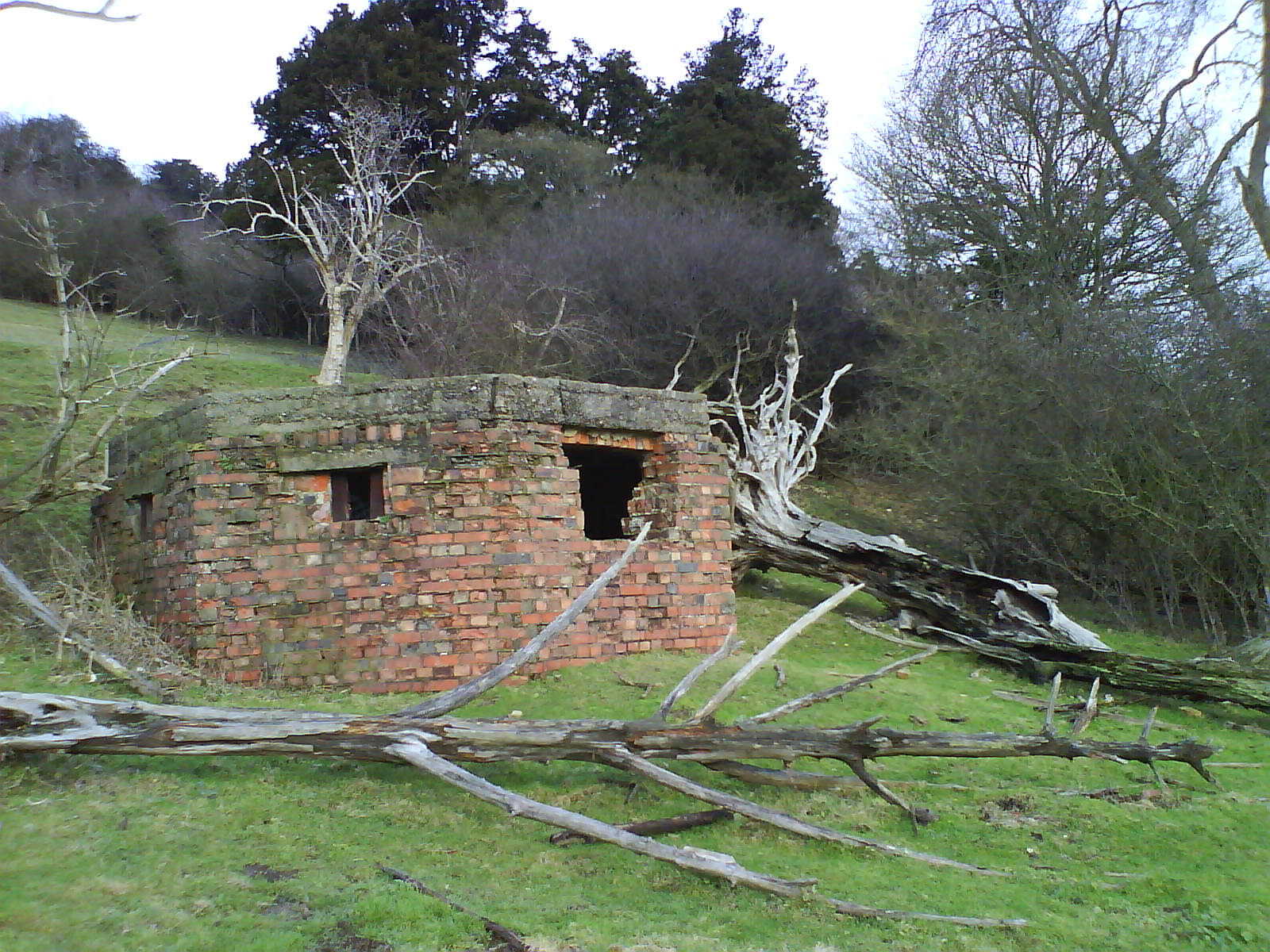
During World War II, the River Mole comprised part of the fortified GHQ Line B. This defensive line ran along the North Downs from Farnham via Guildford to Dorking, before following the river to Horley. Between Betchworth and Box Hill, the north bank of the River Mole was stabilised and made steeper to prevent wheeled vehicles from crossing. At Boxhill Farm, where access to the river from the north bank was required for the herd of dairy cows, a row of twelve concrete cylinders were cast as an anti-tank measure. Gun mounts were also installed to protect both Boxhill and Deepdene bridges and several pillboxes were constructed. The Stepping Stones at the foot of the hill were removed as an anti-invasion measure.
From 1940, Headley Court was used as the Headquarters for the VII Corps and later for the Canadian Corps and Canadian troops were billeted at High Ashurst. Bellasis House was used as training centre both for Czech agents of the Special Operations Executive and for German Prisoners of War. In preparation for D-Day, Headley Heath was used for tank and combat training by the Canadian armed forces, and the area known as The Pyramids is named after the piles of ammunition that they kept on the heath.
Geology
Rock types

The chalk which comprises the majority of Box Hill (and the rest of the North Downs), has its origins in the late Cretaceous (approximately 100 – 66 million years ago). For the entirety of this period, south east England was covered by a warm, shallow sea in which coccolithophores, single-celled algae with small calcite skeletons, thrived. As the phytoplankton died, their calcium-rich shells were deposited on the sea bed and, over time, formed the chalk we know today.
Overlying the chalk across much of the higher ground on the hill, is a deposit of clay-with-flints. Although the origins of this layer are uncertain, the clay is thought to have been formed during several periods of glaciation and was produced by cryoturbation and decalcification of the chalk. This hypothesis is supported by the presence of flint, which is also found in the underlying strata.
The sandy deposits on Headley Heath have their origin in the Quaternary. The sand and gravels found in this area, indicate the presence of the sea shore. On Headley Heath, these deposits are thin and the chalk also comes to the surface in several places, allowing acid-loving plants to thrive alongside those that prefer alkaline conditions, producing the rare chalk heath habitat.
Wealden uplift and erosion of the North Downs escarpment
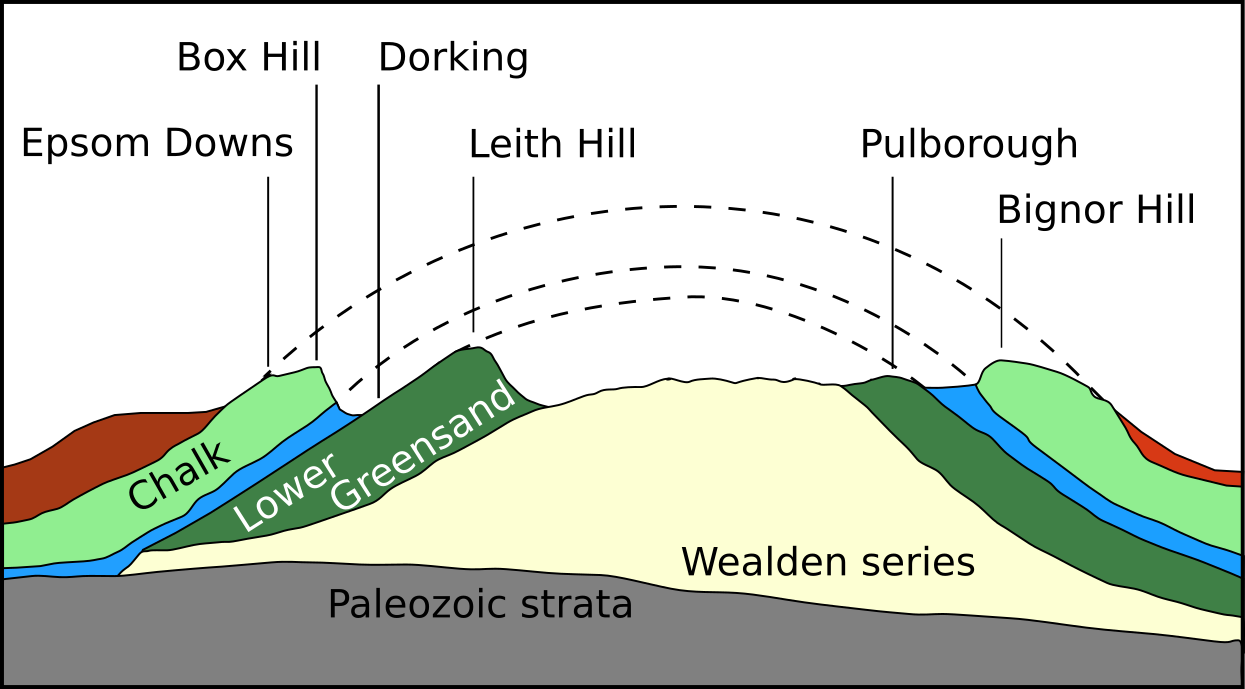
Following the Cretaceous, the sea covering the south of England began to retreat and the land was pushed higher. The Weald (the area covering modern day south Surrey, south Kent and north Sussex) was lifted by the same geological processes that created the Alps, resulting in an anticline which stretched across the English Channel to the Artois region of northern France. Initially an island, this dome-like structure was drained by the ancestors of the rivers which today cut through the North and South Downs (including the Mole, Wey, Arun and Adur). The dome was eroded away over the course of the Cenozoic, exposing the strata beneath and resulting in the escarpments of the Downs and the Greensand Ridge.
Chalk is a relatively soft rock that may be eroded or weathered in a number of different ways. It is porous, able to absorb up to 20% of its dry weight in water, and therefore highly susceptible to weathering by freeze-thaw action, which may occur over repeated annual or diurnal cycles. This frost weathering produces a mix of rubble and viscous mud, which may be washed downhill, further eroding the landscape (a process known as solifluction). At the west side of Box Hill, the hydraulic action of the River Mole has cut a cliff known as The Whites and the river bed contains coarse chalk rubble (clast), which has fallen from the steep slopes above.
.jpg)
The eastern and northern boundaries of Box Hill are defined by dry river valleys, now occupied by Pebblehill Road and Headley Lane respectively. These valleys were active during the last ice age, when the chalk bedrock became frozen and impermeable, forcing water to run over the surface in streams rather than percolating into the ground.|group=note}}
The northern side of Box Hill (corresponding to the dip slope of the cuesta of the North Downs) is cut by six combes, also created by Ice Age watercourses.
Quarries and lime kilns

Chalk and flint have been quarried from Box Hill and the surrounding area for many centuries. There are limited surviving examples of the incorporation of chalk blocks (or clunch) into the stonework of local buildings (including Mickleham Church). Walls made of flints, bound together by lime mortar, are particularly common in Surrey and quicklime could be produced with relative ease, by heating chalk above 825 C in a kiln.
Evidence remains of the small-scale chalk quarrying that occurred prior to the Industrial Revolution, including chalk pits both at Warren Farm and close to the Burford Bridge Hotel. and Betchworth. A wide range of bat species now roost in the former kilns.
Gravel was quarried on the northern side of Headley Heath during the 18th and early 19th centuries, most likely to provide material for building local roads.
Fossils
Numerous fossils, typical of species living in a warm, shallow sea, have been found in the chalk at Box Hill, including brachiopods (Terebratulina gracilis, Terebratulina carnea and Rhynchonella cuvieri), arthropods (Janira quinquecostatus), bivalves (Spondylus spinosus and Ostrea hippodium), urchins (Holaster planus, Micraster leskei) and sponges (Plinthosella squamata).
Ecology
Conservation

Box Hill is part of the Surrey Hills National Landscape. The vast majority of the publicly accessible areas of the hill that are managed by the National Trust and Surrey Wildlife Trust, form part of the Mole Gap to Reigate Escarpment Site of Special Scientific Interest and have been designated a Special Area of Conservation.
The chalk downland of Box Hill provides a habitat for a wide range of plant species, which in turn support a varied population of insect species. The alkaline soils are thin and nutrient poor, which prevents deeper-rooted lush grasses (with a high water demand) from dominating. Each square metre of chalk downland may support up to 40 different species.
Without careful management, the grassland would revert to woodland and so these areas of the hill are grazed in order to prevent scrub from becoming overestablished.|group=note}} Both the National Trust and Surrey Wildlife Trust use Belted Galloway cattle (affectionately nicknamed 'Belties'), which crop the grass less hard than other grazers and allow the more delicate wild flowers (including orchids) to flourish.

For any conservation area, it is important to find a balance between the interests of people visiting and the needs of the wildlife that it seeks to protect. After the announcement that the Olympic cycling road races would be routed over the hill, concerns were expressed that habitats would be damaged during the event. Scrub clearance along the side of the Zig Zag Road to provide space for spectators began in January 2012, after a pre-race survey (commissioned by the London Organising Committee of the Olympic and Paralympic Games) showed that the work was likely to increase biodiversity. A second ecological survey, performed after the Games, showed that no significant damage had occurred, although some areas were subsequently reseeded.
Biodiversity
The chalk downland environment supports notable populations of bats, lepidopterans, orchids and the hill's namesake, the box tree (Buxus sempervirens).
Orchids
A large number of species of orchid have been recorded on Box Hill, including autumn lady's-tresses, bee orchids, bird's-nest orchids, broad-leaved helleborines, common spotted orchids, common twayblades, fragrant orchids, pyramidal orchids and white helleborines.
Other wild flowers
Wild garlic grows alongside bluebells under the tree canopy beside the River Mole at the western edge of the hill, giving the area its distinctive smell in springtime.
Aquatic plants
Damasonium alisma (starfruit) was reintroduced to Headley Heath in 2013 using seeds from the Millennium Seed Bank, having been absent since 2000. It is now found in Brimmer Pond (half of which is enclosed to prevent habitat disturbance by dogs) and also in Heath House Pond.
Trees

The box and yew woodland, on the steep-sloping sides of the hill above the River Mole, is of international importance. Common canopy-layer species include beech, ash and oak. Understorey species include holly, hazel, elder and honeysuckle.
Invasive species found on the hill include buddleia, cherry laurel, Japanese knot weed and Canadian goldenrod. Boxwood blight, a fungal disease caused by Cylindrocladium buxicola, is widespread.
Bats
Several abandoned brick and concrete structures provide habitats for bats and grills have been placed over their entrances to protect the roosting sites. The brown long-eared bat, Natterer's bat, the whiskered bat and Daubenton's bat have been recorded at both Betchworth and Brockham quarries. Brandt's bat has been recorded at Betchworth; Bechstein's bat and the common pipistrelle have been recorded at Brockham.
Butterflies and moths
Box Hill supports 38 different species of butterflies. The small pearl-bordered fritillary was present on the hill in the 1970s, but has not been recorded locally since 1997.
Kidney vetch, growing in the Zig Zag Valley and below the Viewpoint, supports populations of the small blue. To create new habitats for the butterflies, a number of ‘scrapes’ were excavated in the late 2010s, exposing bare chalk on which vetch can become established with minimal competition. Buddleia removal was also initiated as part of the same programme.
Rare moth species found on the hill include the straw belle, chalk carpet, lace border, orange-tailed clearwing and the Surrey midget moth.
Other insects
The hill has given its name to a species of squash bug, now found throughout south-east England.
Recreation

Box Hill Country Park
The western part of Box Hill, managed by the National Trust, was designated a Country Park in 1971 and some of the outbuildings associated with the Box Hill Fort are in use as a visitor centre, gift shop and servery.
On the hill there are car parks and a panoramic view over the Weald towards the South Downs may be enjoyed from the Salomons Memorial (more commonly known as the viewpoint). Juniper Top, on the northern side of the hill, offers views to the northwest towards Windsor Castle.
The Country Park is crisscrossed by a large number of footpaths and bridleways, and there are several signposted, self-guided trails.
Cycling
Box Hill has been popular with cyclists since the 1880s and by the 1890s, Dorking Cycle Club was organising camps for amateur cyclists from across the south east of England. The 2012 Summer Olympic cycling road races included 15.8 km mid-race circuits of Box Hill. An estimated 15,000 spectators travelled to the hill on 28 July 2012 to watch the men's race, which included nine circuits and the following day, competitors in the women's race climbed Box Hill twice.
The 15.8 km Box Hill Olympic circuit is generally cycled in an anticlockwise direction and begins to the south of the village of Mickleham with an ascent of the hill via the Zig Zag Road. From the National Trust Visitor Centre, the route turns eastwards, running along the escarpment and through the urban area of Box Hill village, reaching a maximum elevation of 216 m above Ordnance Datum. After 6.6 km the route turns northwest along the B2033, passing through the village of Headley. After 9.5 km, the circuit begins a continuous descent to the valley of the River Mole, passing to the south of Leatherhead, before turning southwards again through Mickleham to return to the start.
The Zig Zag Road is a steady climb of 120 m over 2.5 km and has, although on a much smaller scale, been likened to the Alpe d'Huez in the French Alps. The exact date of construction is uncertain: The road first appears on the Ordnance Survey map of 1869, but is not shown in a watercolour painting dated 1861 by William Leighton Leitch, which is owned by the Royal Collection. The Zig Zag Road is not a public right of way and is closed for one day each year by the National Trust, to preserve its private road status.
As part of the 2011 London Prepares series, the London–Surrey Cycle Classic for professional cyclists was organised to test the Olympic course. The Prudential RideLondon-Surrey 100 and London–Surrey Classic, for amateur and professional cyclists respectively, have taken place annually following the Games and, although the course has undergone several alterations from the 2012 Olympic course, the two races always include a climb of Box Hill.
High Ashurst
Main article: High Ashurst
High Ashurst is an outdoor education and activity centre on the northern side of Box Hill, adjacent to Headley Heath. The centre is run by Surrey Outdoor Learning and Development on behalf of Surrey County Council. Previously the site comprised the grounds of a country house, which was demolished in the 1970s, having been derelict for several decades.
Boidier Hurst campsite
The District Scout Associations of Leatherhead and Epsom and Ewell own a 10 acre campsite, located between Box Hill village and Headley Heath. There are 11 areas for pitching groups of tents, set within coppiced chestnut woodland. Washing, toilet facilities and a kitchen are available. Use of Boidier Hurst is restricted to members of The Scout Association, The Guide Association and to local school groups on Duke of Edinburgh's Award expeditions.
Points of interest
Betchworth Clump
The highest point on Box Hill is immediately to the east of Box Hill village at 224 m above OD. Today, the dense woodland at the summit conceals a water tower and transmitter mast, neither of which are accessible to the public.
The concrete water tower was built in 1930 by East Surrey Water, the forerunner of SES Water. The structure was refurbished in 2009 to extend its working life by at least 25 years; modifications included the relining of the water bowl, repair of cracks in the walls and roof, as well as the provision of a new access staircase.
The 30m-high mobile phone mast was constructed in 2003 and is operated by Vodafone and EE Limited.
Broadwood's Folly

The circular flint tower located on the northern tip of Lodge Hill was built for the piano maker Thomas Broadwood, who purchased Juniper Hall in 1815. It is approximately 8 m high and originally had two internal floors, linked by a spiral staircase. The original doorway is visible on the east side, but has been sealed with rough flints. An avenue of beech trees linked the folly to Juniper Hall, although these were destroyed by the Great Storm of 1987.
A sparkling wine, produced by Denbies Wine Estate for the Lidl supermarket chain, has been named after the folly.
Labilliere's grave

Peter Labilliere was born in Dublin on 30 May 1725 to a family of French Huguenot descent. He joined the British Army at the age of 14, becoming a major in 1760. After leaving the army he became a political agitator and was accused in 1775 of bribing British troops not to fight in the American War of Independence, although he was never tried for treason.
After moving to Dorking in around 1789, With old age he became increasingly eccentric and neglected his own personal hygiene to such an extent that he acquired the nickname "the walking dung-hill". In accordance with his wishes he was buried head downwards, on 11 June on the western side of Box Hill above The Whites. In the presence of a crowd of thousands that included visitors from London as well as the local "quality gentry", Labilliere was buried without any religious ceremony, having reportedly said that the world was "topsy-turvey" and that it would be righted in the end if he were interred thus. However, in his "Book of Devotions", he wrote that he wished to emulate the example of St Peter, who was crucified upside-down according to tradition.
The current memorial stone on Box Hill is not believed to mark the exact location of his burial (which is thought to be several metres to the west on a steep incline). There are two errors on the stone itself: He was buried in June 1800 (rather than July) and all surviving manuscripts indicate that he spelt his name Labilliere (rather than Labelliere).
Weypole and Stepping Stones
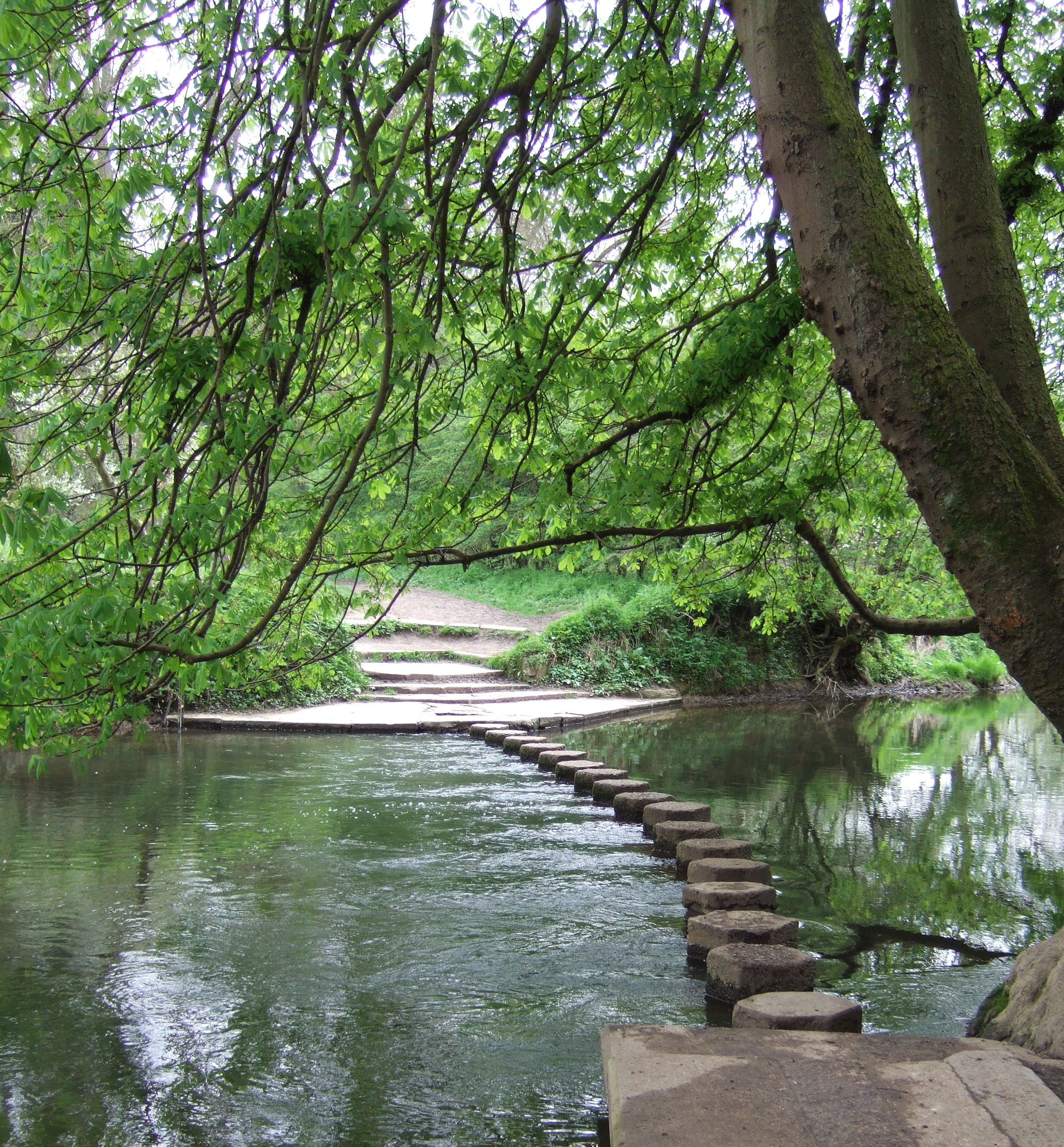
The Weypole (or Waypole) is a roughly semi-circular 2.4 ha area of level ground at the foot of Box Hill, between The Whites and the River Mole. It was originally part of the grounds of Burford Lodge, built by John Eckersall in 1776, and the prevalence of apple and cherry trees suggests that it was used as an orchard for a time. The Burford Lodge estate was later owned by the horticulturalist Sir Trevor Lawrence, who created a garden along the banks of the Mole for his collection of orchids.
A ford across the River Mole is thought to have existed here since prehistoric times. The way-pole was a notched post, secured in the riverbed to indicate the depth of the water. Stepping stones at this site are first recorded in 1841 and they may have been installed by an owner of Burford Lodge to facilitate access to the Weypole orchard. The crossing was formally reopened on 11 September 1946 by Prime Minister Clement Attlee, at the request of James Chuter Ede, a local politician and Attlee's Home Secretary. The new stones replaced those removed during the Second World War as an anti-invasion measure.
The location is popular with both anglers and families, although swimming is strongly discouraged. The stones give their name to the pub in the nearby village of Westhumble.
Other
The Burford Bridge Hotel and Juniper Hall Field Studies Centre lie at the foot of Box Hill close to the river Mole. Both are rich in historical associations with famous visitors and residents.
Notable former residents
John Logie Baird
John Logie Baird (1888-1946), the inventor of the first working television system, lived at Box Hill from 1929 until 1932. He had first demonstrated the new technology in early 1926, and continued with his work when he moved to Swiss Cottage on the top of the hill. He installed a small-scale electricity generating plant in a purpose-built outbuilding, to provide electrical power for his experiments, which included test transmissions to the roof of the Red Lion pub in Dorking High Street. He also demonstrated his Noctovisor, an infrared viewing device, which was designed to enable ships to see each other at night or in fog.
Swiss Cottage was built in the mid-19th century and is protected by a Grade II listing. It is not accessible to the public.
Brodie family
Brockham Warren was the family seat of the Brodie baronets. Sir Benjamin Collins Brodie, 1st Baronet (1783-1862) was a physiologist and surgeon, who performed pioneering research into bone and joint diseases. He served as sergeant-surgeon to both William IV and subsequently Queen Victoria. He was made a baronet in 1834 and was President of the Royal Society from 1858 to 1861. His son, Sir Benjamin Collins Brodie, 2nd Baronet (1817-1880), was a Chemistry Professor at Oxford University from 1865 to 1872, and is chiefly known for his investigations into the allotropic states of carbon and for his discovery of graphitic acid.
George Meredith

The author George Meredith (1828-1909) lived in Flint Cottage from 1868 until his death. He built a chalet in the garden in which he wrote. Today the house is protected by a Grade II listing and is not accessible to the public.
Among several works written at Box Hill, Meredith's poem The Lark Ascending, published in 1881, inspired Ralph Vaughan Williams to compose the musical work of the same name. A second poem, Love in the Valley (published in 1883 as part of a collection entitled Poems and Lyrics of the Joy of Earth), is said to have been inspired by the part of Box Hill known as Juniper Bottom or Happy Valley.
The part of the hill immediately opposite the cottage is known as Barrie's Bank, because the author J. M. Barrie supposedly waited there, while summoning the courage to introduce himself to Meredith.
E. F. Warburg
The botanist Edmund Frederic ("Heff") Warburg (1908-1966) grew up at Boidier, a house close to the southeastern corner of Headley Heath. His father was a keen gardener and had assembled a large collection of exotic plants at the family home. Heff became reader in plant taxonomy at Oxford University and was a fellow of New College.
His mother, Lady Warburg, gave the land for Boidier Hurst Camp Site to the District Scout Associations of Leatherhead and Epsom and Ewell in 1946 and her family donated the neighbouring, 9 ha Heath Plantation to the National Trust following her death in 1952.
Edvard Westermarck
The Finnish philosopher and sociologist Edvard Westermarck (1862-1939) rented Keeper's Cottage as his summer residence between 1910 and 1927.
Registered charities
The National Trust owns around half of the land on Box Hill (principally the Country Park in the west and Headley Heath in the north-east). Surrey Wildlife Trust manage Brockham Limeworks (owned by Surrey County Council) as well as Betchworth Quarry and Lime Kilns (privately owned). Both Trusts rely on the support of volunteer groups, working alongside paid employees, to carry out conservation and education work.
The Friends of Box Hill (FoBH) is a local organisation, which supports the National Trust in its work in the Country Park. Several of its members advise the Trust on its wildlife management plans and the FoBH also fund specific projects, including the purchase of equipment and improvement of visitor facilities. They also organise a programme of social events, which includes regular talks by Trust staff.
The Friends of Headley Heath (FoHH) coordinate volunteer working parties to assist National Trust Rangers and also run a series of social events.
(Both the FoBH and FoHH are independent of the National Trust.)
Transport links
Public transport
is the closest railway station to the National Trust Country Park (approximately 500 m) and is served by trains from both London Victoria and London Waterloo. Both and Dorking (Main) stations are around 1 km from the south western corner of the hill. station is at the south eastern corner of the hill.

Box Hill is served by local and London bus routes.
Access for motor vehicles
Access to the National Trust Country Park from the A24 dual carriageway is via the B2209 and the Zig Zag Road, however this route is not suitable for buses or coaches. Alternative access is via the B2033 and Boxhill Road, which leads through Box Hill village and approaches the Country Park from the west.
Cycle routes
National Cycle Route 22 runs along the northern boundary of the hill via Lodgebottom Road and Headley Lane, before turning south along the A24 close to the western boundary. The Surrey Cycleway approaches Box Hill from the west via Westhumble, before turning to the south towards Dorking.
Walking
The North Downs Way long-distance footpath from Farnham to Dover, crosses the River Mole at the Stepping Stones and then runs from west to east at the top of the scarp slope, passing in front of the Salomons Memorial.
The Thames Down Link follows the course of Stane Street across Mickleham Downs, to the north of Box Hill, and meets the North Downs Way close to the Burford Bridge Hotel.
Cultural references

Art

In 1733, George Lambert painted two views of Box Hill, now held by The Tate and the Yale Center for British Art.
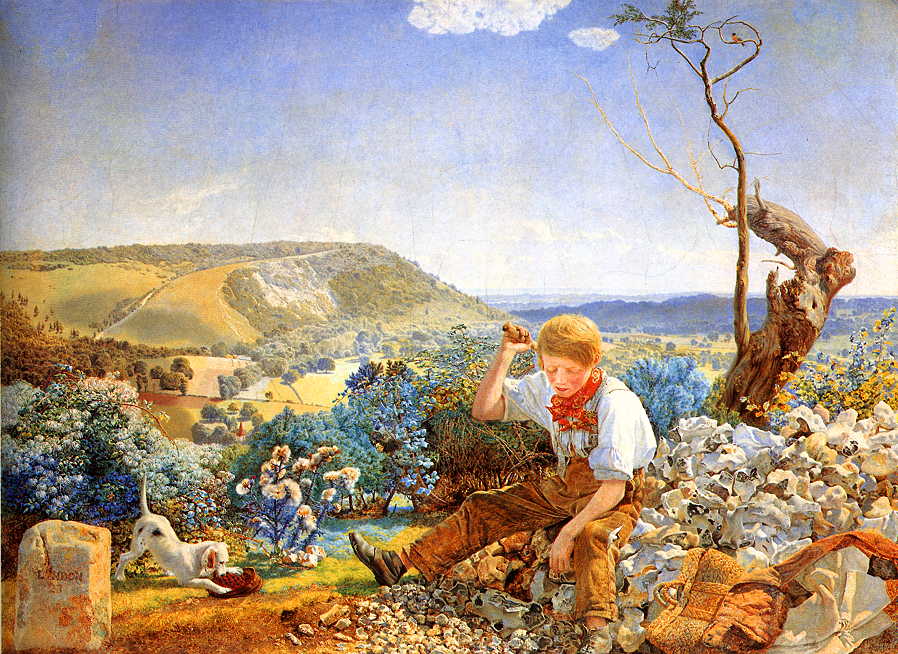
The Stonebreaker (1857 -1858), a painting by John Brett (1831–1902), depicts a young boy breaking stones for road mending, with Box Hill in the background.
A watercolour entitled Box Hill, Surrey dated 1861 by William Leighton Leitch (1804–1883), which depicts the view looking northwards from the top of the Burford Spur before the Zig Zag Road was built, is part of the Royal Collection.
The Box Hill Road River, a highly curved, 100 m line painted onto the surface of the Zig Zag Road by the British sculptor and land artist Richard Long, was commissioned jointly by the London 2012 Festival and the National Trust to celebrate the route of the Olympic Cycling road races.
Literature
John Evelyn notes in his Diary in 1662 that Box Hill was frequented by the ladies and gentlemen from nearby Epsom spa.
Daniel Defoe (the author of Robinson Crusoe) was educated for five years (until around the age of fourteen) at the Rev. James Fisher's boarding school in Pixham Lane, Dorking. He writes extensively about the area around Box Hill in his travelogue, A tour thro' the whole island of Great Britain (1724–1727), which describes the country shortly before the start of the Industrial Revolution. He records that in the late 17th century, Sir Adam Browne the then landowner, approved the fitting out of a cave or vault close to what is now the Salomons Memorial, to supply 'refreshment' to visitors to the hill. A group of young Dissenters from Dorking were so disgusted by the 'debauched' behaviour that the sale of alcohol encouraged (which took place even on Sundays), that they stormed up the hill one Saturday night and blew up the cavern with gunpowder.
The writer Edward Beavan describes the hill and the surrounding area of Surrey in his poem Box-Hill, a descriptive poem, published in 1777.
.jpg)
The 'picnic scene', a pivotal passage of Jane Austen's novel Emma (first published in 1815) is set at Box Hill.
Celia Fiennes, a contemporary of Defoe, described Box Hill in her travel memoirs, which were published in 1888 (almost 150 years after her death) under the title Through England on a Side Saddle. :"Box Hill… is the Continuation of the Ridge of hills I mentiond by Maidstone; its a Greate height and shows you a vast precipice down on the farther side, and such a vast vale full of woods Enclosures and Little towns. There is a very good river that runs by a Little town Called Darken just at the foote of this hill, very famous for good troutts and great store of ffish. On this hill the top is Cover'd with box whence its name proceeds, and there is other wood but its all Cutt in Long private walks very shady and pleasant, and this is a great diversion to the Company and would be more ffrequented if nearer Epsom town."
In England: A Nation, (London: R. Brimley Johnson, 1904), edited by Lucian Oldershaw, and in a chapter entitled "The Patriotic Idea" written by G. K. Chesterton, the beauty of Box Hill violated by an invading army is used to express a healthy patriot's love for his nation as opposed to the jingoistic nationalism of tabloid newspapers: :"But just as a man who has been in love will find it difficult to write a whole frantic epic about a flirtation, so all that kind of rhetoric about the Union Jack and the Anglo-Saxon blood, which has made amusing the journalism of this country for the last six years, will be merely impossible to the man who has for one moment called up before himself what would be the real sensation of hearing that a foreign army was encamped on Box Hill."
Mystery author Cyril Hare sets his 1954 novel, That Yew Tree's Shade (published in the US as Death Walks the Woods), at "Yew Hill", which Hare admits in an introduction is modelled on Box Hill.
In his novel, Box Hill, published in 2020, British author Adam Mars-Jones tells the story of a same-sex relationship between a teenager and an older man, set within the Surrey motorbiking fraternity of the mid-1970s.
Music
British biker rock band Dumpy's Rusty Nuts released a single called Box Hill or Bust in 1984. The song is something of a cult anthem for bikers and reflects the popularity of Box Hill among the biking community.
In Public Image Limited's song Flowers of Romance, John Lydon sings "I've got binoculars. On top of Box Hill".
In Richard Thompson's song 1952 Vincent Black Lightning (released in 1991), Box Hill is the location to which James and Red Molly ride on James' motorcycle. In cover versions of this song by American musicians, Box Hill is sometimes changed to Knoxville, a city in Tennessee.
The first song on Ben Watt's 1983 debut album North Marine Drive is entitled On Box Hill.
Actor and singer Tom Felton's song called Time Well Spent mentions him going to "chill out on Box Hill".
Film
The racing scenes during the opening credits of the 1968 film Chitty Chitty Bang Bang were filmed on the Zig Zag Road.
The 2012 British film Berberian Sound Studio contains a short film-within-the-film – a spoof 1970s-style documentary about the outstanding natural and man-made features of Box Hill.
In the news
In 1963 Great Train Robber, Jimmy White, hid £30,440 (approximately one fifth of his share of the stolen cash), in a caravan at Clovelly Caravan Park at the top of Box Hill.
In 1995 teenager Ruth Wilson disappeared after being dropped off by taxi on Box Hill.
In 2013 a body that had lain undiscovered for two years was found on Box Hill. It was identified as missing teacher Brian Hynard who had left two suicide notes before disappearing.
Notes
.jpg)
References
Bibliography
- {{cite book |last1= Littledale |first1= H |last2= Locock |first2= L M |last3= Sankey | first3=J H P
References
- {{harvnb. Wooldridge. Hutchings. 1957
- "Box Hill Visitor Facilities and Car Park: Planning Application for Proposed Improvements". Mole Valley District Council.
- Oates M. (2008). "Box Hill". National Trust.
- Jeffcoate, Gail. (2013). "News from Box Hill". Butterfly Conservation.
- Bantock T and Botting J. (2010). "''Gonocerus acuteangulatus'' Box Bug". britishbugs.org.uk.
- (11 February 2011). "Olympics 2012: cycling road race route". Guardian.
- {{harvnb. Bannister. 1999
- [http://www.hills-database.co.uk/downloads.html Database of British and Irish Hills] {{Webarchive. link. (5 August 2018 Retrieved 6 March 2015)
- {{harvnb. Hutchings. Bridges. Sankey. 1969
- (30 October 2020). "City Population Estimate 2019-06-30".
- {{harvnb. Mountford. 1974
- Fry R. (2006). "Box Hill Project". The Connected Surrey Partnership.
- Langley D. (2000). "History". Friends of St Andrews Box Hill.
- {{harvnb. Mountford. 1974
- {{harvnb. Bannister. 1999
- {{National Heritage List for England
- {{National Heritage List for England
- {{harvnb. Bannister. 1999
- {{harvnb. Brayley. Britton. 1841
- Fagg, C. C.. (1928). "Great Britain: essays in regional geography". Cambridge University Press.
- (1952). "The North Downs' Main Trackways". Surrey Archaeological Collections.
- {{harvnb. Margary. 1948
- {{harvnb. Margary. 1948
- Hall A. (2008). "The archaeological evidence for the route of Stane Street from Mickleham Downs to London Road, Ewell". Surrey Archaeological Society.
- . (25 March 1937). "The Mole Crossing at Burford". *The Times*.
- (1980). "Box Hill Roman coins: TQ 179 519". Surrey Archaeological Society Bulletin.
- {{harvnb. Bannister. 1999
- {{harvnb. Littledale. Locock. Sankey. 1984
- {{harvnb. Brayley. Britton. 1841
- {{harvnb. Evelyn. 1870
- {{harvnb. Littledale. Locock. Sankey. 1984
- {{harvnb. Hutchings. Bridges. Sankey. 1969
- {{harvnb. Littledale. Locock. Sankey. 1984
- {{harvnb. Tuson. 2013
- . ["Conservation grazing"](https://www.surreywildlifetrust.org/what-we-do/restoring-surreys-nature/conservation-grazing).
- . ["Conservation grazing"](https://www.nationaltrust.org.uk/features/conservation-grazing).
- Denyer, Peter. (2015). "Lords of the manor and Headley Heath". National Trust.
- Macky, John. (1714). "A journey through England. In familiar letters. From a gentleman here, to his friend abroad". J. Hooke.
- {{harvnb. Shepperd. 1991
- . (31 March 1879). "The Boxhill Coach". *Daily News*.
- {{harvnb. Shepperd. 1991
- {{harvnb. Shepperd. 1991
- . (7 August 1883). "The Bank Holiday". *The Times*.
- (17 August 1920). "Memorial To Donor Of Box Hill".
- Edwards, Mark. (11 September 2014). "Box Hill viewing point reopens to mark 100th anniversary". Surrey Live.
- {{harvnb. Littledale. Locock. Sankey. 1984
- {{harvnb. Littledale. Locock. Sankey. 1984
- (2010). "National Trust Acquisition Data". National Trust.
- {{National Heritage List for England
- {{harvnb. Tuson. 2013
- (2006). "Box Hill Fort". waymarking.com.
- (14 March 1887). "Defences of the Empire - Coast defences of Great Britain".
- {{harvnb. Beanse. Gill. 2011
- {{harvnb. Beanse. Gill. 2011
- {{harvnb. Littledale. Locock. Sankey. 1984
- {{harvnb. Beanse. Gill. 2011
- infantry redoubts]] typical of the period, but also included [[magazine (artillery). magazines]] (partially below ground level) for the storage of [[Shell (projectile). shells]] and [[Cartridge (firearms). Littledale. Locock. Sankey. 1984
- Bannister. 1999
- {{National Heritage List for England|num=1020370}}
- Foot W. (2009). "Defence Area 12: Dorking Gap". English Heritage.
- Marchington T. (2000). "Wartime Defences: A Second Look". Leatherhead and District Local History Society.
- (2 March 2011). "Box Hill, Surrey: walk of the week". Daily Telegraph.
- "On Guard in Britain, 1940–1941". The Department of National Defense, Government of Canada.
- Denyer, Peter. "The Second World War on Headley Heath". The National Trust.
- . (14 July 2021). ["National Trust Information Board Unveiled at Bellasis House, Headley Heath, Box Hill, Surrey – formerly SOE's Special Training School STS 2"](https://www.secret-ww2.net/copy-of-belgian-soe-agent-s-name). *Secret WW2*.
- "Wartime at Dorking's mansions". Dorking Museum.
- {{harvnb. Tuson. 2013
- Matharu, Hardeep. (21 September 2012). "Unexploded mortar shells discovered on Headley Heath". Sutton and Croydon Guardian.
- [[Betchworth Quarry and Lime Kilns. Betchworth Quarry]] was used by the British Army in early 1944, to test the firing capabilities of [[Churchill tank]]s.{{harvnb. Chapman. Young. 1979
- (1975). "The petrology of the chalk". Proc. Geol. Assoc..
- (2009). "The origin of the Clay-with-flints: the missing link". Geoscience in South-West England.
- "Clay-with Flints formation". BGS.
- {{harvnb. Chapman. Young. 1979
- (1965). "The Wealden District". British Geological Survey.
- {{harvnb. Chapman. Young. 1979
- (1993). "The depth and productivity of chalky soils". Soil Use and Management.
- Lester, DE. (2015). "Geomorphology of the Mole Valley".
- (1972). "Some observations on swallow holes and mines in the chalk". Quarterly Journal of Engineering Geology.
- (2011). "Pleistocene Glaciation Limits in Great Britain". Developments in Quaternary Science.
- {{National Heritage List for England
- {{harvnb. Shepperd. 1991
- {{harvnb. Bannister. 1999
- Stecher, Paul G. (1968). "The Merck index : an encyclopedia of chemicals and drugs". Merck.
- The opening of the [[North Downs Line
- . ["Betchworth Quarry & Lime Kilns"](https://www.surreywildlifetrust.org/nature-reserves/betchworth-quarry-lime-kilns). *Surrey Wildlife Trust*.
- . ["Brockham Limeworks"](https://www.surreywildlifetrust.org/nature-reserves/brockham-limeworks). *Surrey Wildlife Trust*.
- (1905). "The chalk area of north-east Surrey". Proc. Geol. Assoc..
- . ["Map of the AONB"](https://www.surreyhills.org/board/map-of-the-aonb/). *Surrey Hills Society*.
- "Designated Sites View: Mole Gap to Reigate Escarpment". Natural England.
- "Map of Mole Gap to Reigate Escarpment". Natural England.
- {{harvnb. Tuson. 2013
- . ["What's special about chalk grassland?"](https://www.nationaltrust.org.uk/features/whats-special-about-chalk-grassland).
- (2009). "Box Hill Woodland Plan 2009: The condition and habitat management of the woodland compartments of Box Hill".
- . (20 July 2012). ["London 2012: Box Hill Olympic road race rings unveiled"](https://www.bbc.co.uk/news/uk-england-surrey-18920560). *BBC News*.
- Bingham, Keith. (15 December 2010). "Olympics road race: Not in our Box Hill".
- . (19 February 2012). ["London 2012: Box Hill woodland scrub cleared for spectators"](https://www.bbc.co.uk/news/uk-england-surrey-17090065). *BBC News*.
- Martin, Guy. (3 August 2012). "'Gold medal' for Box Hill cycling wildlife protection". Surrey Live.
- [http://www.boxhill.org.uk/visitors/downland.html Box Hill Community Website] {{webarchive. link. (6 March 2008 Retrieved 4 February 2008)
- {{harvnb. Sankey. 2000
- Wheeler, Belinda. (13 February 2007). "I Damasonium alisma Miller". Plant Lifeg.
- (September 2019). "Notes on surveys of sites known to have supported Damasonium alisma in recent years".
- . ["Sites & Species"](https://butterfly-conservation.org/in-your-area/surrey-and-sw-london-branch/sites-species).
- {{harvnb. Chapman. Young. 1979
- "Box Hill Ecological Report, November, 2011".
- Jeffcoate, Gail. (2017). "Small Blue update". Butterfly Conservation.
- Haynes, Fiona. (2019). "Report: Surrey Small Blue Stepping Stones Project 2017 to 2019". Butterfly Conservation.
- {{harvnb. Littledale. Locock. Sankey. 1984
- Brien, Emma. (24 November 2011). "National Trust's new natural play trail at Box Hill".
- . (2 March 2011). ["Box Hill, Surrey: walk of the week"](https://www.telegraph.co.uk/travel/activityandadventure/walkingholidays/8356605/Box-Hill-Surrey-walk-of-the-week.html). *Daily Telegraph*.
- (1883). "Unknown title". London Bicycle Club Gazette.
- {{harvnb. Tuson. 2013
- Hookham, M. (12 February 2017). "Roundabout is UK's deadliest spot for cyclists". News International.
- . ["Box Hill Olympic Route"](https://www.surreyhills.org/discover-route/box-hill-olympic-route/).
- {{harvnb. Tuson. 2013
- {{harvnb. Tuson. 2013
- {{harvnb. Warren. 2010
- Smurthwaite, T. (16 August 2014). "Everest attempt succeeds at Box Hill". Trinity Mirror.
- {{harvnb. Bannister. 1999
- . ["Box Hill, Surrey – WILLIAM LEIGHTON LEITCH, 1861"](https://www.rct.uk/collection/923641/box-hill-surrey). *Royal Collection Trust*.
- . (18 January 1962). "Box Hill May Get Toll". *The Times*.
- Ollie Williams. (14 August 2011). "Mark Cavendish wins London 2012 road race test event". BBC Sport.
- . ["Surrey Outdoor Learning and Development"](https://www.surreyoutdoorlearning.uk).
- . ["Boidier Hurst Scout campsite"](http://www.boidierhurst.org.uk/index.html).
- . ["The site"](http://www.boidierhurst.org.uk/the-site.html).
- . ["The Manly Building"](http://www.boidierhurst.org.uk/manly-building.html).
- . (10 June 2009). ["CRL gets started on water tower repairs"](https://www.edie.net/library/CRL-gets-started-on-water-tower-repairs/5046).
- {{National Heritage List for England
- {{harvnb. Wainwright. 1982
- Goodge M. (2005). "The Broadwood Folly at Juniper Hall, Mickleham". British Listed Buildings.
- The tower may have been built to commemorate the [[Battle of Waterloo]].{{harvnb. Headley. Meulenkamp. 1986
- Williams, David. (18 September 2016). "National treasures: Welcome to the new world of English and Welsh wines". The Guardian.
- {{harvnb. Lander. 2000
- {{harvnb. Lander. 2000
- Lander. 2000
- Timbs. 1877
- [https://www.getsurrey.co.uk/news/nostalgia/major-peter-labelliere-strange-history-13643026 Major Peter Labelliere: Strange history of man buried upside down atop Box Hill] {{Webarchive. link. (26 February 2018 , Surrey Mirror, by W. H. Chouler, July 1963)
- {{harvnb. Lander. 2000
- Gittings, Clare. (20 November 2017). "Eccentric or enlightened? Unusual burial and commemoration in England, 1689 - 1823". Mortality.
- {{harvnb. Lander. 2000
- No, Doilum. "Box Hill, Surrey sur Flickr : partage de photos !". Flickr.com.
- {{harvnb. Chapman. Young. 1979
- {{harvnb. Chadwick. Chadwick. 2006
- {{harvnb. Ashton. Blight. 2006
- A Son of the Marshed. (1890). "A Surrey River". Littell.
- {{harvnb. Brayley. Britton. 1841
- Chuter Ede papers collection, Surrey History Centre, 6408/13
- (1946). "Picture of the Week". Time Inc..
- {{harvnb. Hart. 2021
- {{harvnb. Burns. 2000
- (2014). "The Achievement of Television: The Quality and Features of John Logie Baird's System in 1926". International Journal for the History of Engineering & Technology.
- {{National Heritage List for England
- (27 October 2009). "Baird".
- "Parishes: Betchworth". [[Victoria County History]].
- Hines, T. "Sir Benjamin Collins Brodie".
- {{EB1911
- (1859). "On the Atomic Weight of Graphite". Philosophical Transactions of the Royal Society of London.
- {{National Heritage List for England
- . ["Ralph Vaughan Williams: The Lark Ascending"](https://www.bl.uk/collection-items/vaughan-williams-the-lark-ascending). *British Library*.
- Pevy, M. (2003). "Box Hill". Surrey Archaeological Society Bulletin.
- {{harvnb. Tuson. 2013
- (1967). "Obituary: Dr E F Warburg". Proc. Bot. Soc. Br. Isl..
- . ["History of Boidier Hurst Scout Campsite"](http://www.boidierhurst.org.uk/files/history-of-boidier-hurst-scout-campsite.pdf).
- {{harvnb. Hutchings. Bridges. Sankey. 1969
- Westermarck, Edvard. (1929). "Memories of my life". Allen & Unwin.
- "What we do".
- "Friends of Headley Heath".
- . ["Box Hill: How to get here"](https://www.nationaltrust.org.uk/box-hill#How%20to%20get%20here). *National Trust*.
- "Surrey County Council – 516 bus timetable via Box Hill visitor centre".
- "Surrey County Council – 465 bus timetable via foot of Box Hill".
- . ["Route 22"](https://www.sustrans.org.uk/find-a-route-on-the-national-cycle-network/route-22). *Sustrans*.
- . (7 July 2019). ["The Surrey Cycleway"](https://www.surreycc.gov.uk/__data/assets/pdf_file/0007/132001/Surrey-Cycleway-Map-updated-July-2019.pdf). *Surrey County Council*.
- Saunders, Colin. (2016). "North Downs Way". Aurum Press.
- . (2 September 2020). ["The Thames Down Link"](https://www.surreycc.gov.uk/culture-and-leisure/countryside/walking/long-walks/the-thames-down-link). *Surrey County Council*.
- link. (7 June 2011 at [[Tate). The Tate]]
- . ["Box Hill, Surrey, with Dorking in the distance"](https://collections.britishart.yale.edu/vufind/Record/1669128). *Yale University*.
- . ["The Stonebreaker JOHN BRETT, 1857–1858"](https://www.liverpoolmuseums.org.uk/walker/collections/paintings/19c/item-236997.aspx). *National Museums Liverpool*.
- Jones, Jonathan. (30 July 2012). "Olympics 2012: Richard Long's cycling art shows British landscape at its best". The Guardian.
- Noted in Alice M. Coats, ''Garden Shrubs and Their Histories'' (1964) 1992, ''s.v.'' "Buxus".
- Bastian F. (1957). "Daniel Defoe and the Dorking District". Surrey Archaeological Collections.
- "Emma".
- {{harvnb. Fiennes. 1888
- (1948). "England of the Glorious Revolution". The Geographical Journal.
- Chesterton, GK. (1904). "England: A Nation". R. Brimley Johnson.
- Hare, Cyril. (1986). "That Yew Tree's Shade". Faber.
- Cummins, Anthony. (16 March 2020). "Box Hill by Adam Mars-Jones review – the mystery of love". The Guardian.
- Huey, Steve. "Dumpy's Rusty Nuts – Biography". AllMusic.
- "Songlyrics.com".
- Beviglia, Jim. (12 August 2012). "'1952 Vincent Black Lightning,' By Richard Thompson". [[American Songwriter]].
- Himes, Geoffrey. (21 August 2018). "The Curmudgeon: How an English Song about an English Motorcycle Became an American Classic".
- Dennis, Jon. (10 April 2014). "Ben Watt: Hendra review – excellent, decorous new set of alt-folk songs". The Guardian.
- . ["Time Well Spent – Tom Felton"](http://feltbeats.com/music/time-well-spent-lyrics/).
- Cholton, Martin. (20 December 2018). "10 things you didn't know about Chitty Chitty Bang Bang". The Independent.
- Peter Bradshaw. (30 August 2012). "Berberian Sound Studio – review".
- Wallis, Nick. (21 December 2014). "The Great Train Robbery, Ronnie Biggs and the Surrey connection". Surrey Life.
- Bright, Martin. (15 December 2002). "The vanishing".
- Martin, Guy. (28 May 2013). "Body on Box Hill identified as missing man". getsurrey.
- Boggan, Steve. (11 August 2013). "The vanishing". The Sunday Times.
This article was imported from Wikipedia and is available under the Creative Commons Attribution-ShareAlike 4.0 License. Content has been adapted to SurfDoc format. Original contributors can be found on the article history page.
Ask Mako anything about Box Hill, Surrey — get instant answers, deeper analysis, and related topics.
Research with MakoFree with your Surf account
Create a free account to save articles, ask Mako questions, and organize your research.
Sign up freeThis content may have been generated or modified by AI. CloudSurf Software LLC is not responsible for the accuracy, completeness, or reliability of AI-generated content. Always verify important information from primary sources.
Report