From Surf Wiki (app.surf) — the open knowledge base
Bow Road tube station
London Underground station
_railway_station_1866821_ec289c7a.jpg)
London Underground station
| Field | Value |
|---|---|
| name | Bow Road |
| symbol | underground |
| manager | London Underground |
| owner | Transport for London |
| locale | Bow |
| borough | London Borough of Tower Hamlets |
| platforms | 2 |
| fare_zone | 2 |
| image_name | File:Bow Road tube station - geograph.org.uk - 574727.jpg |
| coordinates | |
| original | Whitechapel and Bow Railway |
| years1 | 11 June 1902 |
| years2 | 1950 |
| events1 | Opened |
| events2 | Ownership transferred to London Transport |
| listing_grade | II |
| listing_start | |
| listing_entry | 1357787 |
| listing_reference | |
| tubeexits04 | 3.401 |
| tubeexits06 | 4.115 |
| tubeexits07 | 4.591 |
| tubeexits08 | 5.320 |
| tubeexits09 | 5.084-- |
| interchange | Bow Church |
| interchange_note |
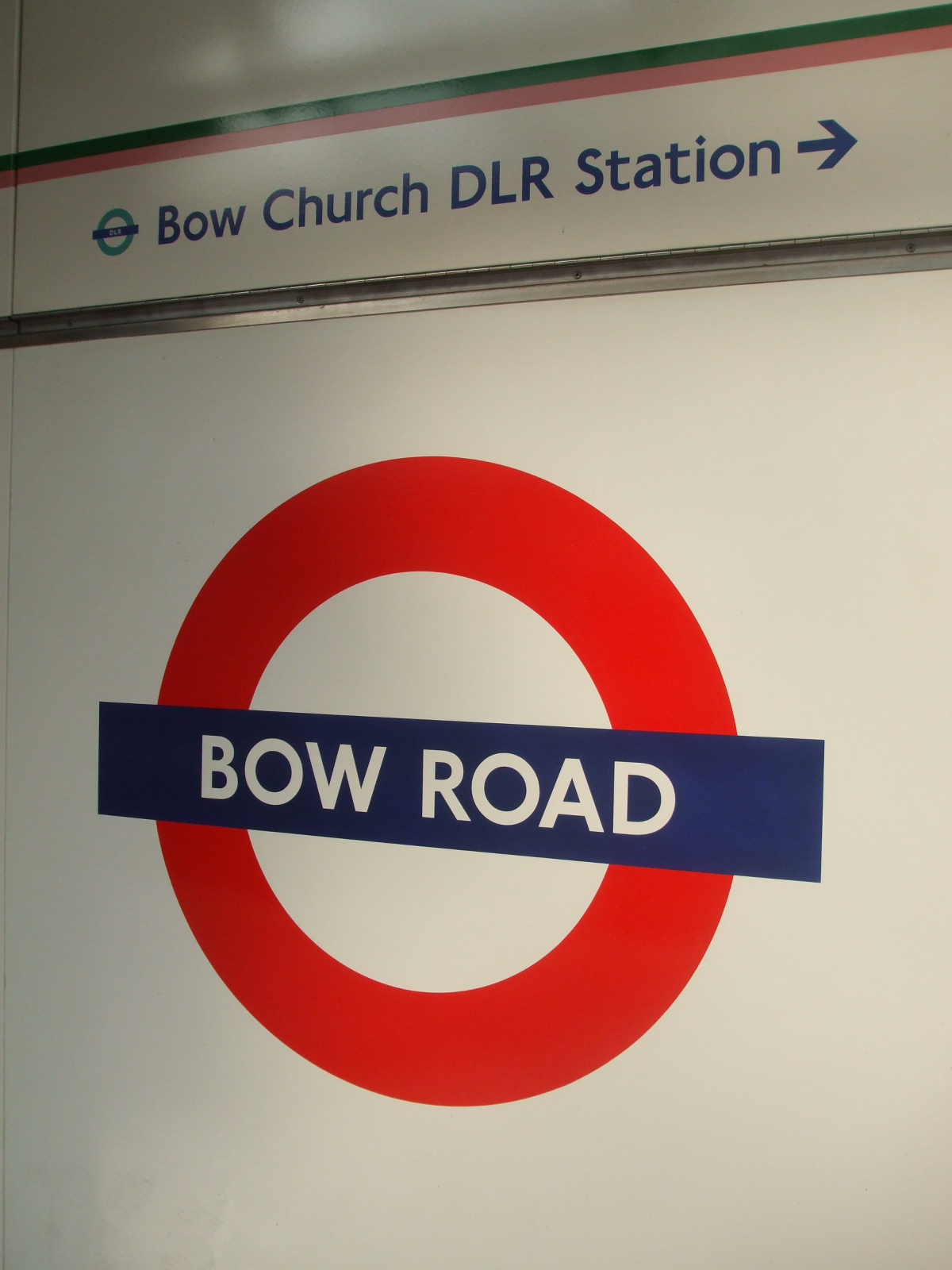
Bow Road () is a London Underground station located on Bow Road in Bow, London, England. It is on the District and Hammersmith & City lines. The station is interlinked as an out of station interchange (OSI) with Bow Church station on the Docklands Light Railway which is about 300 metres away via Bow Road. The two stations are classed as a single station for ticketing purposes as well as on tube maps but both are managed separately.
History
The station was opened on 11 June 1902 by the Whitechapel and Bow Railway in the Metropolitan Borough of Poplar, (which was later incorporated into the District line), with the Hammersmith & City line (then the Metropolitan line) following in 1936.
The Great Eastern Railway Bow Road railway station, which closed in 1949, stood on the opposite side of Bow Road.
Ownership of the station passed to London Underground in 1950.
Design
The station building is Grade II listed since 27 September 1973. Red bricks form the exterior facade, featuring stone eaves cornice and brick blocking course. The structure is topped with a slate roof, and has round arched doors. The doors are finished with fanlights, with four windows arranged alternately. An enclosed footbridge hangs across the platforms sheltered with canopies, both of which are made of wood. The canopies are barrel-vaulted, supported by cast iron beams and wall brackets, and hexagonal cast iron pillars. The pillars are arranged in line, following the curvature of the platforms. There are 12 pillars on one platform, while the other has 14.

Bow Road station has two platforms, and marks the point where westbound trains from Upminster and Barking enter a tunnel; the gradient of the tunnel approach, which is to the east of the station, is 1 in 28, the steepest on the tube network. The station platforms are below street level, where the western end of the platforms is in tunnel while the eastern end is in an open cutting. Other stations on the District Line are designed in a similar way, such as High Street Kensington and Sloane Square.
Location
The station is situated on the road that reflects its own name, while a fire exit leads to Wellington Way. The National Rail tracks of the Bow Curve and Mornington Grove Road cross above the District line to the east of the platforms. Nearby landmarks include the Minnie Lansbury Memorial, Phoenix Primary and Secondary School, Thames Magistrates' Court, Bow Road police station and Tower Hamlets Cemetery Park. The station serves a medium-sized population, as part of its catchment overlaps Mile End station.
London Buses services routes 25 and 205, local route 425, and night route N25 and N205 serve the station.
Bow Road is connected eastwards via the thoroughfare of the same name to Bow Church station on the Docklands Light Railway (DLR) as an out of station interchange (OSI); they are classed as a single station for ticketing purposes but managed as separate stations.
Services
Bow Road is served by both the District and Hammersmith & City lines, between Mile End and Bromley-by-Bow stations, in London fare zone 2. Off-peak services on the District line generally run between Richmond or Ealing Broadway to Upminster. During peak hours, trains also operate to Wimbledon. The typical off-peak services, in trains per hour (tph) are:
- District line:
- 12 tph eastbound to Upminster
- 6 tph westbound to Richmond
- 6 tph westbound Ealing Broadway
- Hammersmith & City line:
- 6 tph eastbound to Barking
- 6 tph westbound to Hammersmith
References
References
- {{NHLE
- {{citation London station interchange January 2016
- (27 January 1950). "Transport Act, 1947". The London Gazette.
- "London Underground Statistics". trainweb.org.
- "Bow Road tube station".
- "Bow Road Station". [[Transport for London]].
- Feather, Clive. (17 September 2018). "District line". Clive's Underground Line Guides.
- Feather, Clive. (16 November 2018). "Hammersmith & City line". Clive's Underground Line Guides.
This article was imported from Wikipedia and is available under the Creative Commons Attribution-ShareAlike 4.0 License. Content has been adapted to SurfDoc format. Original contributors can be found on the article history page.
Ask Mako anything about Bow Road tube station — get instant answers, deeper analysis, and related topics.
Research with MakoFree with your Surf account
Create a free account to save articles, ask Mako questions, and organize your research.
Sign up freeThis content may have been generated or modified by AI. CloudSurf Software LLC is not responsible for the accuracy, completeness, or reliability of AI-generated content. Always verify important information from primary sources.
Report