From Surf Wiki (app.surf) — the open knowledge base
Boulevard Anspach
Thoroughfare in Brussels, Belgium
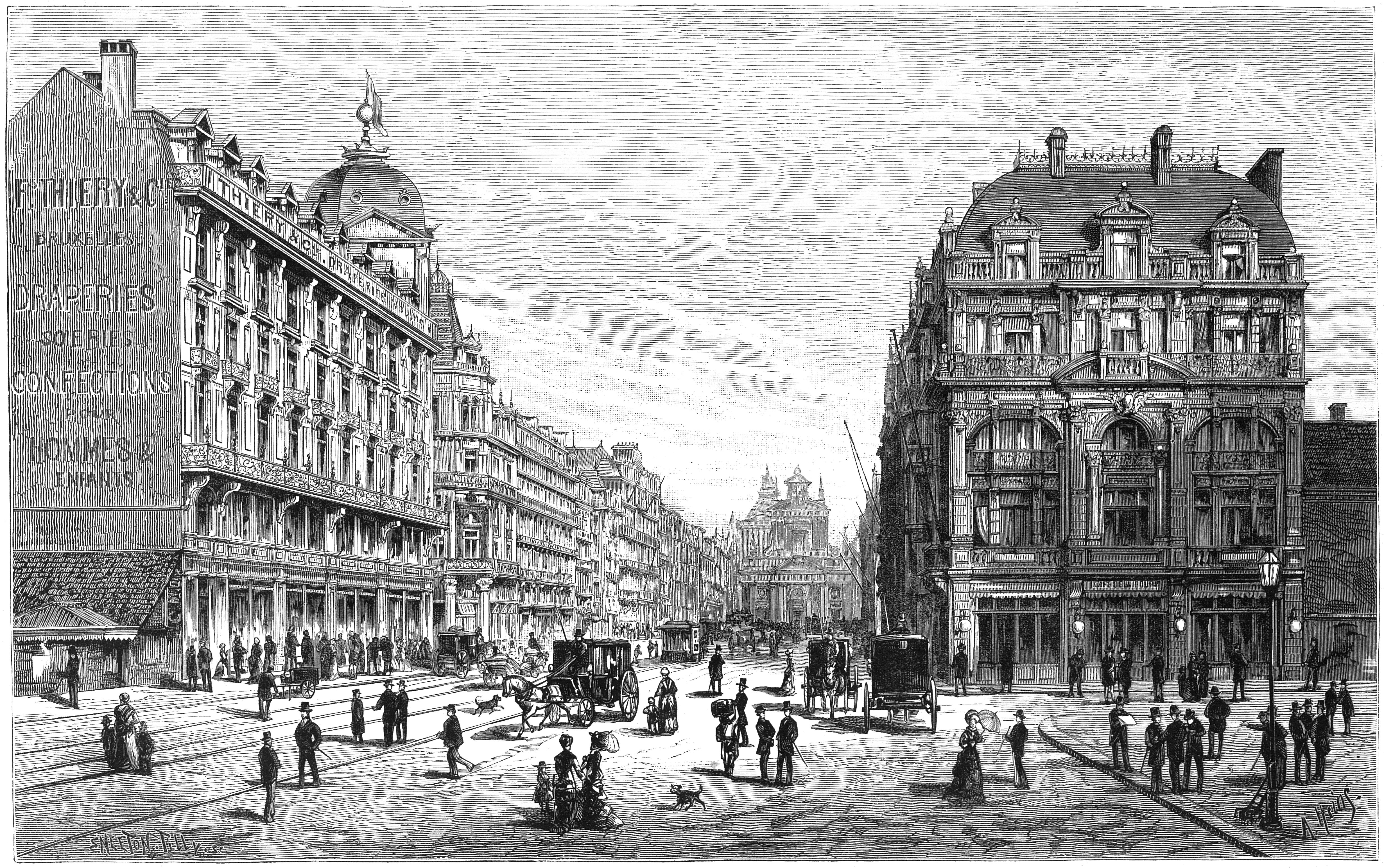
Thoroughfare in Brussels, Belgium
| Field | Value |
|---|---|
| name | |
| image | Pictures taken from former Actiris Building on Anspach, Brussels 19.jpg |
| image_size | 250px |
| caption | View on the Boulevard Anspach/Anspachlaan from the former Actiris building |
| map_type | Belgium Brussels#Belgium |
| map_caption | Location within Brussels |
| former_names | |
| part_of | Central Boulevards of Brussels |
| namesake | Jules Anspach |
| type | Boulevard |
| location | City of Brussels, Brussels-Capital Region, Belgium |
| quarter | Central Quarter |
| postal_code | 1000 |
| coordinates | |
| completion_date | 1868–1871 |
| inauguration_date | |
| designer | Léon Suys |
| website |
The Boulevard Anspach (French) or Anspachlaan (Dutch) is a central boulevard in Brussels, Belgium, connecting the Place de Brouckère/De Brouckèreplein to the Place Fontainas/Fontainasplein. It was created following the covering of the river Senne (1867–1871), and bears the name of Jules Anspach, a former mayor of the City of Brussels.
The Boulevard Anspach is continued to the north by both the Boulevard Émile Jacqmain/Émile Jacqmainlaan and the Boulevard Adolphe Max/Adolphe Maxlaan, forming a "Y" crossroad at the Place de Brouckère. To the south, it crosses the Place de la Bourse/Beursplein about halfway through, and continues towards the Place Fontainas where it becomes the Boulevard Maurice Lemonnier/Maurice Lemonnierlaan.
Many places of interest lie along the Boulevard Anspach, for instance the Bourse Palace, the Ancienne Belgique concert hall, the Pathé Palace cinema (officially named the Cinéma Palace since 2018), as well as numerous shops and restaurants. De Brouckère metro station on lines 1 and 5 of the Brussels Metro is accessible from the Boulevard Anspach, as well as Bourse/Beurs premetro (underground tram) station.
History
The Boulevard Anspach was built between 1868 and 1871, as part of the Central Boulevards, which were created after the covering of the river Senne, although the river no longer flows underneath it. Prior to 1879, it was named the Boulevard Central/Centraallaan ("Central Boulevard"), when it was renamed in honour of Jules Anspach (1829–1879), the former mayor of the City of Brussels who instigated these works.
On 4 September 1944, the Boulevard Anspach was the scene of great jubilation during the liberation of Brussels by the British Guards Armoured Division. In 1976, as part of the North–South line, the premetro took the place of the river, which was then diverted along the Small Ring (Brussels' inner ring road).
In June 2012, "protest picnics" were held on the Boulevard Anspach to express dissatisfaction with the City of Brussels' mobility policy. Following these events, the city's then-mayor, Freddy Thielemans, decided to make the boulevard car-free every Sunday afternoon for the entire summer. His successor, Yvan Mayeur, wished to expand the Boulevard Anspach into a permanent pedestrian zone with a new street cover, equipped with fountains, works of art, benches and trees. On 29 June 2015, the boulevard finally became completely car-free between the Place de la Bourse/Beursplein and the Place de Brouckère/De Brouckèreplein, as part of a broader pedestrianisation of Brussels' city centre ().
Notable buildings
The Boulevard Anspach is home to many buildings in neoclassical, Beaux-Arts, Art Nouveau, Art Deco and eclectic styles. Some examples include:
- No. 3: Café Sésino (1875), an eclectic building by . It won the fifth prize in the architectural competition of 1876, and was demolished in 1967.
- No. 56–58: Modernist building (1939) by , originally built for Wielemans-Ceuppens breweries. It once housed the famous café Aux Armes des Brasseurs.
- No. 59–61: Eclectic apartment building (1872) by Gédéon Bordiau, decorated with caryatids by Julien Dillens
- No. 78: Café de la Bourse (1874), neo-Baroque building by
- No. 85: Pathé Palace (1913), an Art Nouveau cinema by
File:Café Sesino.png|Café Sésino (De Keyser, 1875) (demolished) File:Aux Armes des Brasseurs.JPG|Aux Armes des Brasseurs (Blomme, 1939) File:Bruxelles Immeuble de rapport éclectique 2043-02210.jpg|Apartment building (Bordiau and Dillens, 1872) File:Café de la Bourse (2).jpg|Café de la Bourse (Janlet, 1874) File:Pathé Palace (1).jpg|Pathé Palace cinema (Hamesse, 1913)
References
Citations
Bibliography
References
- Fabienne Bradfer, Gaëlle Moury, ''Réapprendre à voir un film grâce au Palace'', ''Le Soir'', 12 February 2018, p. 23
- Map of Suys' proposal. [[Archives of the City of Brussels. City Archives of Brussels]]: p.p. 1.169
- "eBru {{!}} Le boulevard Anspach {{!}} Bruxelles Pentagone".
- NWS, VRT. (2012-06-15). "Anspachlaan wordt elke zondagmiddag autovrij".
- (7 January 2014). "Europe's Most Congested City Contemplates Going Car-Free". The Atlantic.
- (6 February 2015). "Centrale lanen: twee fonteinen en twee fietsparkings". Brussel Nieuws.
- (2017-02-28). "Project. Pedestrian zone".
- "Bruxelles Pentagone - Boulevard Anspach 56-58 - BLOMME A.".
- "Bruxelles Pentagone - Boulevard Anspach 59-61 - Rue du Marche aux Poulets 16-18-20 - BORDIAU Gedeon".
- "Bruxelles Pentagone - Boulevard Anspach 76-78 - Rue de la Bourse 2 - JANLET E.".
- "Bruxelles Pentagone - Pathe Palace - Boulevard Anspach 85-87 - Borgval 19-21-23 - Rue Jules Van Praet 24-26-28 - HAMESSE Paul".
This article was imported from Wikipedia and is available under the Creative Commons Attribution-ShareAlike 4.0 License. Content has been adapted to SurfDoc format. Original contributors can be found on the article history page.
Ask Mako anything about Boulevard Anspach — get instant answers, deeper analysis, and related topics.
Research with MakoFree with your Surf account
Create a free account to save articles, ask Mako questions, and organize your research.
Sign up freeThis content may have been generated or modified by AI. CloudSurf Software LLC is not responsible for the accuracy, completeness, or reliability of AI-generated content. Always verify important information from primary sources.
Report