From Surf Wiki (app.surf) — the open knowledge base
Bothrops lanceolatus
Species of snake
Species of snake
Laurenti, 1768
- [Coluber] glaucus Gmelin, 1788
- C[oluber]. Lanceolatus Lacépède, 1789
- C[oluber]. Brasiliensis Lacépède, 1789
- C[oluber]. Tigrinus Lacépède, 1789
- C[oluber]. lanceolatus – Bonaterre, 1790
- C[oluber]. hastatus Suckow, 1798
- Vipera lanceolata – Latreille In Sonnini & Latreille, 1801
- Vipera brasiliniana Latreille In Sonnini & Latreille, 1801
- Coluber Megaera Shaw, 1802
- Vipera tigrina – Daudin, 1803
- Vipera brasiliana Daudin, 1803
- Trigonocephalus lanceolatus – Oppel, 1811
- [Trigonocephalus] tigrinus – Oppel, 1811
- [Cophias] lanceolatus – Merrem, 1820
- Trigonoceph[alus]. lanceolatus – Schinz, 1822
- Craspedocephalus lanceolatus – Fitzinger, 1826
- [Bothrops] lanceolatus – Wagler, 1830
- T[rigonocephalus]. lanceolatus – Schlegel, 1837
- Bothrops cenereus Gray, 1842
- C[rasedocephalus]. brasiliensis – Wucherer, 1863
- Bothrops brasiliensis – Cope, 1875
- Bothrops glaucus – Vaillant, 1887
- Lachesis lanceolatus – Boulenger, 1896
- Lachesis lanceolata – Boettger, 1898
- Bothrops lanceolata – Hoge, 1953
- Vipera coerulescens Hoge & Romano-Hoge, 1981
- Bothrops l[anceolatus]. lanceolatus – Sandner-Montilla, 1990
- Bothrops lanceolatus – Golay et al., 1993
- Vipera coerulescens – Golay et al., 1993
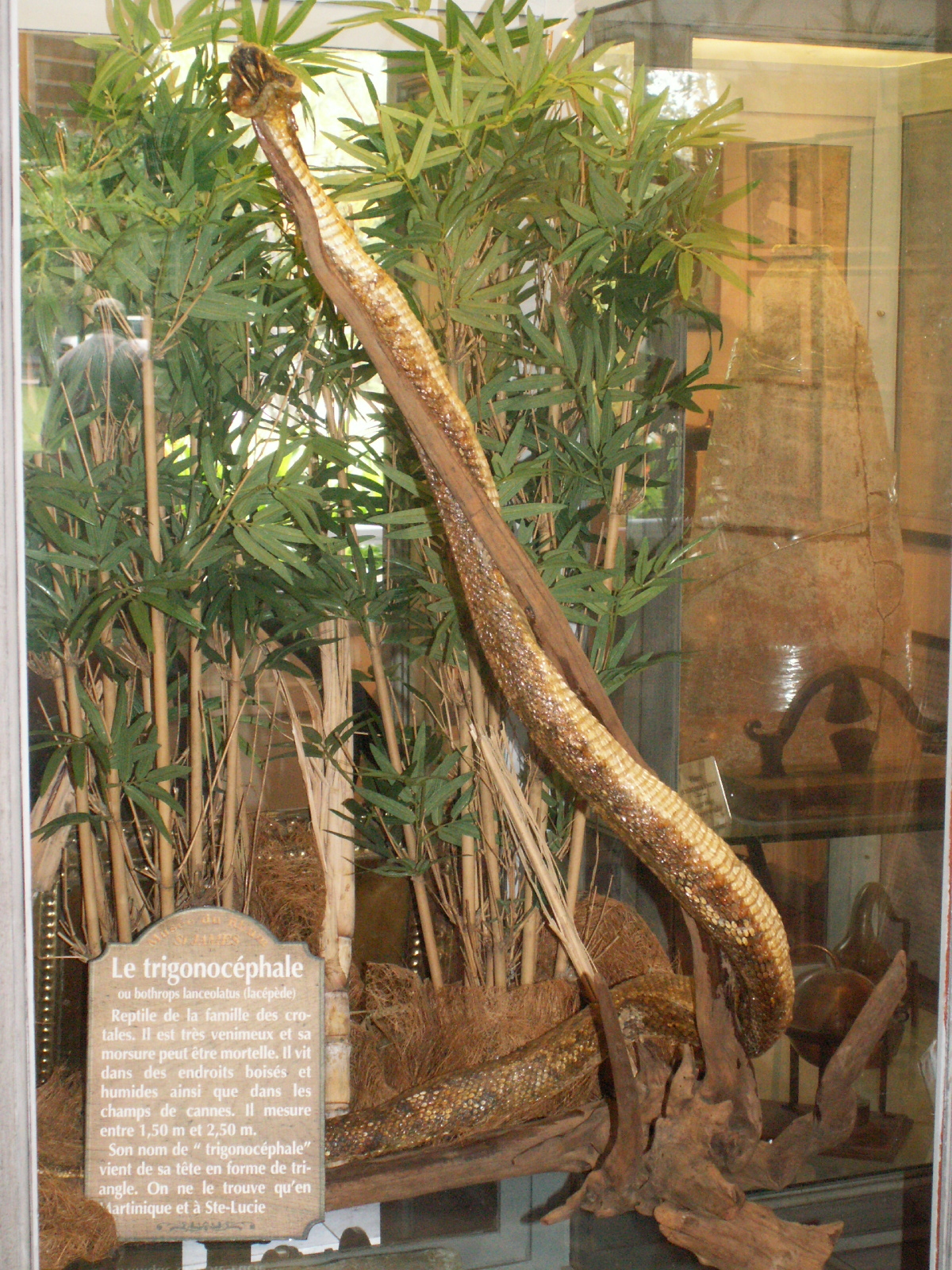
Bothrops lanceolatus — known as the fer-de-lance, Martinican pit viper, and Martinique lancehead — is a species of pit viper endemic to the Caribbean island of Martinique.
Geographic range
Bothrops lanceolatus is generally considered endemic to the island of Martinique in the Lesser Antilles. Along with Bothrops caribbaeus and B. atrox, it is one of three Bothrops species found in the West Indies. The type locality according to Bonnaterre (1790:11) is "La Martinique".
Description
It measures 1.50 to 2 m (5 feet) long. Its color is brown, black and gray.
Behavior
As ambush predators, Martinique lanceheads typically wait patiently somewhere for unsuspecting prey to wander by.They are known to select a specific ambush site and return to it every year in time for the spring migration of birds. Studies have indicated these snakes learn to improve their strike accuracy over time.
Diet
All of the various species are carnivorous, and eat other animals. Their diet primarily changes based on size and location. Larger individuals can feed on larger prey, while smaller species must eat smaller prey items. Martinican pit vipers hunt rats, mice, birds, rabbits, lizards, frogs, snakes, bats, and more.
Reproduction
With few exceptions, crotalines are ovoviviparous, meaning that the embryos develop within eggs that remain inside the mother's body until the offspring are ready to hatch, at which time the hatchlings emerge as functionally free-living young. In such species, the eggshells are reduced to soft membranes that the young shed, either within the reproductive tract, or immediately after emerging.
Venom
Their venom has toxins that can cause clotting and bleeding in humans, as well as muscle damage and swelling.
Vexillological trivia
The species is depicted on the 'snake flag' of Martinique, though the usage of this flag has been largely discontinued in recent years. This forms one of the few examples (the Gadsden flag and the First Navy Jack of the United States, and the flag of Mexico being others) of snakes being depicted on flags.
References
References
- Dewynter, M.. (2019). "''Bothrops lanceolatus''".
- McDiarmid RW, [[Jonathan A. Campbell. Campbell JA]], Touré T. 1999. ''Snake Species of the World: A Taxonomic and Geographic Reference, Volume 1''. Herpetologists' League. 511 pp. {{ISBN. 1-893777-00-6 (series). {{ISBN. 1-893777-01-4 (volume).
- Brown JH. 1973. ''Toxicology and Pharmacology of Venoms from Poisonous Snakes''. Springfield, Illinois: Charles C. Thomas. 184 pp. LCCCN 73-229. {{ISBN. 0-398-02808-7.
- 0-8014-4141-2.
- {{NRDB species
This article was imported from Wikipedia and is available under the Creative Commons Attribution-ShareAlike 4.0 License. Content has been adapted to SurfDoc format. Original contributors can be found on the article history page.
Ask Mako anything about Bothrops lanceolatus — get instant answers, deeper analysis, and related topics.
Research with MakoFree with your Surf account
Create a free account to save articles, ask Mako questions, and organize your research.
Sign up freeThis content may have been generated or modified by AI. CloudSurf Software LLC is not responsible for the accuracy, completeness, or reliability of AI-generated content. Always verify important information from primary sources.
Report