From Surf Wiki (app.surf) — the open knowledge base
Boston Marathon
World's oldest regularly run marathon

World's oldest regularly run marathon
| Field | Value |
|---|---|
| bgcolour | #273574 |
| image | Boston_Marathon_logo_(updated_2024).png |
| image_upright | .6 |
| caption | Current logo, introduced in June 2024 |
| date | Usually the third Monday of April (Patriots' Day) |
| location | Eastern Massachusetts, ending in Boston |
| type | Road |
| distance | Marathon |
| est | |
| record | Men: 2:03:02 (2011) |
| Geoffrey Mutai | |
| Women: 2:17:22 (2025) | |
| Sharon Lokedi | |
| homepage | |
| current | yes |
Geoffrey Mutai Women: 2:17:22 (2025) Sharon Lokedi
The Boston Marathon is an annual marathon race hosted by eight cities and towns in greater Boston in eastern Massachusetts, United States. It is traditionally held on Patriots' Day, the third Monday of April. Begun in 1897, the event was inspired by the success of the first marathon competition in the 1896 Summer Olympics. The Boston Marathon is the world's oldest annual marathon and ranks as one of the world's best-known road racing events. It is one of seven World Marathon Majors. Its course runs from Hopkinton in southern Middlesex County to Boylston Street, near Copley Square, in Boston.
The Boston Athletic Association (B.A.A.) has organized this event annually since 1897, including a "virtual alternative" after the 2020 road race was canceled due to the COVID-19 pandemic. The race has been managed by DMSE Sports since 1988. Amateur and professional runners from all over the world compete in the Boston Marathon each year, braving the hilly Massachusetts terrain and varying weather to take part in the race.
The event attracts 500,000 spectators along the route, making it New England's most viewed sporting event. The Centennial Boston Marathon in 1996 established a record as the world's largest marathon with 38,708 entrants, 36,748 starters, and 35,868 finishers.
History
Men have competed in the event since its inaugural edition in 1897. Women were officially allowed to enter the event starting in 1972, although organizers now recognize 1966 as the first edition officially completed by a woman. Wheelchair divisions were added in 1975 for men and in 1977 for women. The first person to officially race in Boston in a wheelchair was Bob Hall. Handcycle divisions were added in 2017 for both men and women.
The Boston Marathon was first run in April 1897, having been inspired by the revival of the marathon for the 1896 Summer Olympics in Athens, Greece. Until 2020 it was the second oldest continuously running marathon, and the third longest continuously running footrace in North America, having debuted five months after the five mile Buffalo Turkey Trot race.
On April 19, 1897, ten years after the establishment of the B.A.A., the association held the 24.5 mi marathon to conclude its athletic competition, the B.A.A. Games. The race, which became known as the Boston Marathon, has been held in some form every year since then, even during the World War years and the Great Depression, making it the world's oldest annual marathon. In 1924, the starting line was moved from Metcalf's Mill in Ashland to the neighboring town of Hopkinton. The course was lengthened to 26 mi to conform to the standard set by the 1908 Summer Olympics and codified by the IAAF in 1921. The first 1.9 mile are run in Hopkinton before the runners enter Ashland.
The Boston Marathon was originally a local event, but its fame and status have attracted runners from all over the world. For most of its history, the Boston Marathon was a free event, and the only prize awarded for winning the race was a wreath woven from olive branches. However, corporate-sponsored cash prizes began to be awarded in the 1980s, when professional athletes refused to run the race unless a cash award was available. The first cash prize for winning the marathon was awarded in 1986.
Walter A. Brown was the President of the Boston Athletic Association from 1941 to 1964. During the height of the Korean War in 1951, Brown denied Koreans entry into the Boston Marathon. He stated: "While American soldiers are fighting and dying in Korea, every Korean should be fighting to protect his country instead of training for marathons. As long as the war continues there, we positively will not accept Korean entries for our race on April 19."
Bobbi Gibb, Kathrine Switzer, and Nina Kuscik

The Boston Marathon rule book made no mention of gender until after the 1967 race. |access-date=2020-04-24 |archive-url=https://web.archive.org/web/20200420232514/https://kathrineswitzer.com/1967-boston-marathon-the-real-story/ |archive-date=2020-04-20 |url-status=live |access-date=April 25, 2020 |archive-url=https://web.archive.org/web/20191204153307/http://www.runningpast.com/gibb_story.htm |archive-date=December 4, 2019 |url-status=live Gibb nevertheless ran unregistered and finished the 1966 race in three hours, twenty-one minutes and forty seconds, ahead of two-thirds of the runners. Much later, she would be recognized by the race organizers as the first woman to run the entire Boston Marathon.
In 1967, Kathrine Switzer, who registered for the race using her official AAU registration number, paying the entry fee, providing a properly acquired fitness certificate, and signing her entry form with her usual signature 'K. V. Switzer', was the first woman to run and finish with a valid official race registration. As a result of Switzer's completion of the race as the first officially registered woman runner, the AAU changed its rules to ban women from competing in races against men. |url-access = registration |editor-last = O'Neill |editor-first = Lois Decker Switzer finished the race despite race official Jock Semple repeatedly assaulting her in an attempt to rip off her race numbers and eject her from the race. Afterwards, Semple and Switzer became friends.
Nina Kuscsik was instrumental in influencing the Amateur Athletic Union, in late 1971, to increase its maximum distance for sanctioned women's races, leading to official participation by women in marathons, beginning at Boston in 1972. Kuscsik was the first woman to officially win the Boston Marathon, which occurred in 1972.
In 1996, the B.A.A. retroactively recognized as champions the unofficial women's leaders of 1966 through 1971. In 2022, about 43 percent of the entrants were women.
Rosie Ruiz, the impostor
In 1980, Rosie Ruiz crossed the finish line first in the women's race. However, marathon officials became suspicious, and it was discovered that she did not appear in race videotapes until near the end of the race, with a subsequent investigation concluding that she had skipped most of the race and blended into the crowd about a half-mile (800m) from the finish line, where she then ran to her false victory. She was disqualified eight days later, and Canadian Jacqueline Gareau was proclaimed the winner.
Participant deaths
In 1905, James Edward Brooks of North Adams, Massachusetts, died of pneumonia shortly after running the marathon. In 1996, a 61-year-old Swedish man, Humphrey Siesage, died of a heart attack during the 100th running. In 2002, Cynthia Lucero, 28, died of hyponatremia.
2011: Geoffrey Mutai and the IAAF
Main article: 2011 Boston Marathon
On April 18, 2011, Geoffrey Mutai of Kenya won the 2011 Boston Marathon in a time of 2:03:02:00. Although this was the fastest marathon ever run at the time, the International Association of Athletics Federations noted that the performance was not eligible for world record status given that the course did not satisfy rules that regarded elevation drop and start/finish separation (the latter requirement being intended to prevent advantages gained from a strong tailwind, as was the case in 2011). The Associated Press (AP) reported that Mutai had the support of other runners who describe the IAAF's rules as "flawed". According to the Boston Herald, race director Dave McGillivray said he was sending paperwork to the IAAF in an attempt to have Mutai's mark ratified as a world record. Although this was not successful, the AP indicated that the attempt to have the mark certified as a world record "would force the governing bodies to reject an unprecedented performance on the world's most prestigious marathon course".
2013: Bombing
Main article: Boston Marathon bombing
On April 15, 2013, the Boston Marathon was still in progress at 2:49p.m. EDT (nearly three hours after the winner crossed the finish line), when two homemade bombs were set off about 200 yd apart on Boylston Street, in approximately the last 225 yd of the course. The race was halted, preventing many from finishing.
2014: Women's race disqualification
Bizunesh Deba of Ethiopia was eventually named women's winner of the 2014 Boston Marathon, following the disqualification of Kenyan Rita Jeptoo from the event due to confirmed doping. Deba finished in a time of 2:19:59, and became the course record holder. Her performance bested that of Margaret Okayo, who ran a time of 2:20:43 in 2002.
2016: Bobbi Gibb as grand marshal
In the 2016 Boston Marathon, Jami Marseilles, an American, became the first female double amputee to finish the Boston Marathon. Bobbi Gibb, the first woman to have run the entire Boston Marathon (1966), was the grand marshal of the race. The Women's Open division winner, Atsede Baysa, gave Gibb her trophy; Gibb said that she would go to Baysa's native Ethiopia in 2017 and return it to her.
2020: Cancellation
2020 Boston Marathon Due to the COVID-19 pandemic, the 2020 Boston Marathon was initially rescheduled from April 20 to September 14. It was the first postponement in the more than 100 year uninterrupted history of the event.
On May 28, 2020, it was announced that the rescheduled marathon set for September 14 was canceled. Boston Mayor Marty Walsh said of the decision to cancel the race, "There's no way to hold this usual race format without bringing large numbers of people into close proximity. While our goal and our hope was to make progress in containing the virus and recovering our economy, this kind of event would not be responsible or realistic on September 14 or any time this year."
Runners were issued full refunds of entry fees. Organizers later staged a "virtual alternative" in September 2020 as the 124th running of the marathon. This was the second time that the format of the marathon was modified, the first having been in 1918, when the race was changed from a marathon to a military relay race (ekiden) because of World War I.
2021: Rescheduled to October
Main article: 2021 Boston Marathon
On October 28, 2020, the B.A.A. announced that the 2021 edition of the marathon would not be held in April; organizers stated that they hoped to stage the event later in the year, possibly in the autumn. In late January 2021, organizers announced October 11 as the date for the marathon, contingent upon road races being allowed in Massachusetts at that time. In March, organizers announced that the field would be limited to 20,000 runners. The race was the fourth of the five World Marathon Majors held in 2021; all the events in the series were run in the space of six weeks between late September and early November. In 2021, the B.A.A. also offered a virtual alternative to the in-person race to be completed anytime between 8–10 October.
Race
Qualifying
| Age | Men | Women |
|---|---|---|
| 18–34 | 2h 55min | 3h 25min |
| 35–39 | 3 h 00 min | 3 h 30 min |
| 40–44 | 3 h 05 min | 3 h 35 min |
| 45–49 | 3 h 15 min | 3 h 45 min |
| 50–54 | 3 h 20 min | 3 h 50 min |
| 55–59 | 3 h 30 min | 4 h 00 min |
| 60–64 | 3 h 50 min | 4 h 20 min |
| 65–69 | 4 h 05 min | 4 h 35 min |
| 70–74 | 4 h 20 min | 4 h 50 min |
| 75–79 | 4 h 35 min | 5 h 05 min |
| ≥80 | 4 h 50 min | 5 h 20 min |
The Boston Marathon is open to runners 18 or older from any nation, but they must meet certain qualifying standards. To qualify, a runner must first complete a standard marathon course certified by a national governing body affiliated with the World Athletics within a certain period of time before the date of the desired Boston Marathon (usually within approximately 18 months prior).
In the 1980s and 1990s, membership in USA Track & Field was required of all runners, but this requirement has been eliminated.
Qualifying standards for the 2013 race were tightened on February 15, 2011, by five minutes in each age-gender group for marathons run after September 23, 2011.
An exception to the qualification times is for runners who receive entries from partners. About one-fifth of the marathon's spots are reserved each year for charities, sponsors, vendors, licensees, consultants, municipal officials, local running clubs, and marketers. In 2010, about 5,470 additional runners received entries through partners, including 2,515 charity runners.
On October 18, 2010, the 20,000 spots reserved for qualifiers were filled in a record-setting eight hours and three minutes. The speed of registration prompted the B.A.A. to change its qualifying standards for the 2013 marathon onward. In addition to lowering qualifying times, the change includes a rolling application process, which gives faster runners priority. Organizers decided not to significantly adjust the number of non-qualifiers.
On September 27, 2018, the B.A.A. announced that they were lowering the qualifying times for the 2020 marathon by another five minutes, with male runners in the 18-34 age group required to run a time of 3:00:00 (3 hours) or less and female runners in the 18-34 age group required to run a time of 3:30:00 (3 hours, 30 minutes) or less in order to qualify.
In September 2024, the B.A.A. announced new qualifying times for the 2026 race, lowering the former qualifying times by five minutes for most age groups. The 18-34 age group needs to run a time of 2:55 (two hours, 55 minutes) for males, and 3:25 (3 hours, 25 minutes) for female and non-binary runners to qualify for the 2026 race.
Race day
The race has traditionally been held on Patriots' Day, Since 1969, the holiday has been observed on the third Monday in April, with the event held then, often referred to locally as "Marathon Monday".
Starting times
Through 2005, the race began at noon (wheelchair race at 11:25a.m., and elite women at 11:31a.m.), at the official starting point in Hopkinton, Massachusetts. In 2006, the race used a staggered "wave start", where top-seeded runners (the elite men's group) and a first batch of up to 10,000 runners started at noon, with a second group starting at 12:30. The next year the starting times for the race were moved up, allowing runners to take advantage of cooler temperatures and enabling the roads to be reopened earlier. The marathon later added third and fourth waves to help further stagger the runners and reduce congestion.
The starting times for 2019 were:
- Men's Push Rim Wheelchair: 9:02 a.m.
- Women's Push Rim Wheelchair: 9:04 a.m.
- Handcycles and Duos: 9:25 a.m.
- Elite Women: 9:32 a.m.
- Elite Men: 10 a.m.
- Wave One: 10:02 a.m.
- Wave Two: 10:25 a.m.
- Wave Three: 10:50 a.m.
- Wave Four: 11:15 a.m.
Course
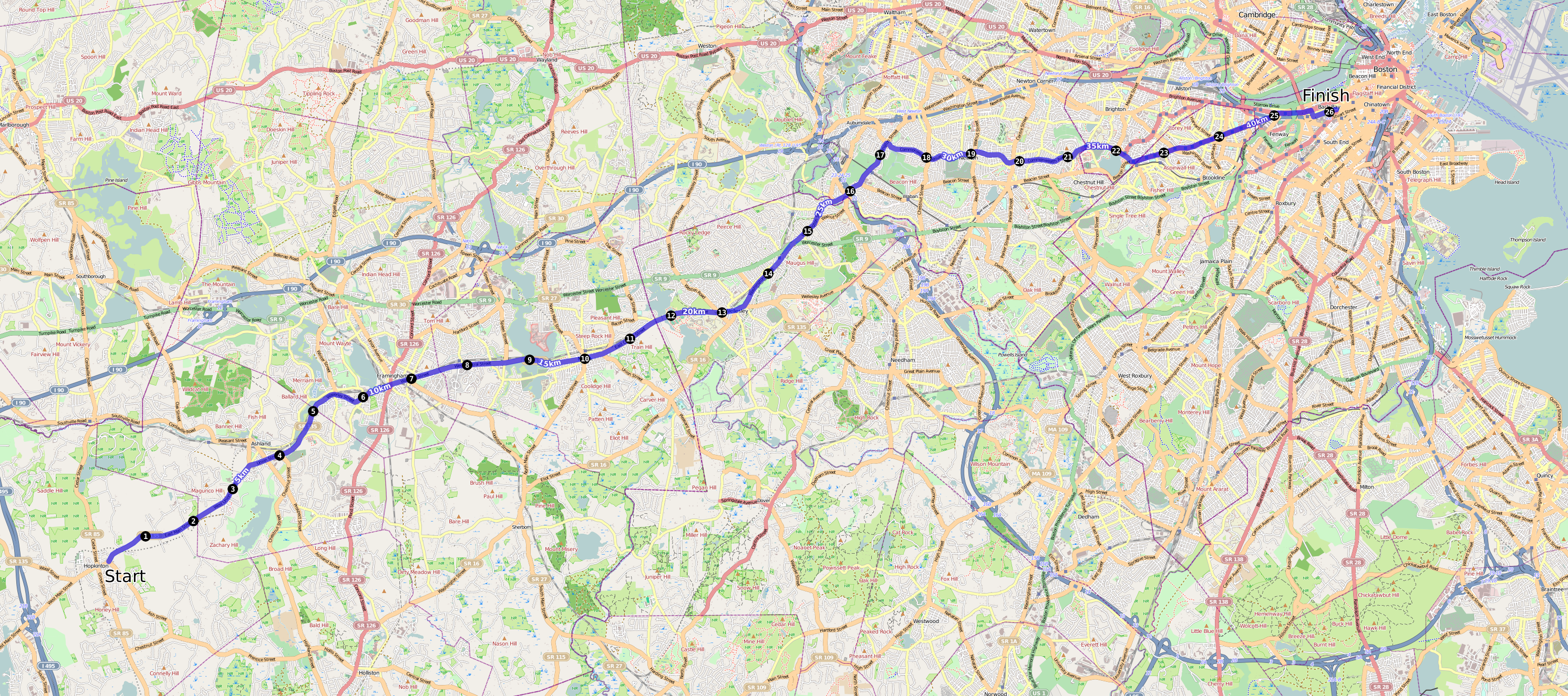
The course runs through 26 mi of winding roads, following Route 135, Route 16, Route 30 and city streets into the center of Boston, where the official finish line is located at Copley Square, alongside the Boston Public Library. The race runs through eight Massachusetts cities and towns: Hopkinton, Ashland, Framingham, Natick, Wellesley, Newton, Brookline, and Boston.

The Boston Marathon is considered to be one of the more difficult marathon courses because of the Newton hills, which culminate in Heartbreak Hill near Boston College. While the three hills on Commonwealth Avenue (Route 30) are better known, a preceding hill on Washington Street (Route 16), climbing from the Charles River crossing at 16 mi, is regarded by Dave McGillivray, the long-term race director, as the course's most difficult challenge. This hill, which follows a 150 ft rise over a 1/2 mi stretch, forces many lesser-trained runners to a walking pace.
Heartbreak Hill
Heartbreak Hill is an ascent over 0.4 mi between the 20- and 21-mile (32- and 34-km) marks, near Boston College. It is the last of four "Newton hills", which begin at the 16 mi mark and challenge contestants with late (if modest) climbs after the course's general downhill trend to that point. Though Heartbreak Hill itself rises only 88 ft vertically (from an elevation of 148 to), it comes in the portion of a marathon distance where muscle glycogen stores are most likely to be depleted—a phenomenon referred to by marathoners as "hitting the wall".
It was on this hill that, in 1936, defending champion John A. "Johnny" Kelley overtook Ellison "Tarzan" Brown, giving him a consolatory pat on the shoulder as he passed. This gesture renewed the competitive drive in Brown, who rallied, pulled ahead of Kelley, and went on to win—thereby, it was said, breaking Kelley's heart.
Records

Because the course drops 459 ft from start to finish and the start is quite far west of the finish, allowing a helpful tailwind, the Boston Marathon does not satisfy two of the criteria necessary for the ratification of world or American records.
At the 2011 Boston Marathon on April 18, 2011, Geoffrey Mutai of Kenya ran a time of 2:03:02, which was the fastest ever marathon at the time (since surpassed by Eliud Kipchoge's 2:01:39 in Berlin 2018). However, due to the reasons listed above, Mutai's performance was not ratified as an official world record. Bezunesh Deba from Ethiopia set the women's course record with a 2:19:59 performance on April 21, 2014. This was declared after Rita Jeptoo from Kenya was disqualified following a confirmed doping violation.{{cite web |access-date=October 16, 2017 |archive-url=https://web.archive.org/web/20171016174215/http://www.baa.org/races/boston-marathon/boston-marathon-history/course-records.aspx |archive-date=October 16, 2017 |url-status=live
Other course records include:
- Men's Masters: John Campbell (New Zealand), 2:11:04 (set in 1990)
- Women's Masters: Firiya Sultanova-Zhdanova (Russia), 2:27:58 (set in 2002)
- Men's Push Rim Wheelchair: Marcel Hug (Switzerland), 1:17:06 (set in 2023)
- Women's Push Rim Wheelchair: Manuela Schär (Switzerland), 1:28:17 (set in 2017)
- Men's Handcycle: Tom Davis (United States), 0:58:36 (set in 2017)
- Women's Handcycle: Alicia Dana (United States), 1:18:15 (set in 2023)
On only four occasions have world record times for marathon running been set in Boston. In 1947, the men's record time set was 2:25:39, by Suh Yun-Bok of South Korea. In 1975, a women's world record of 2:42:24 was set by Liane Winter of West Germany, and in 1983, Joan Benoit Samuelson of the United States ran a women's world record time of 2:22:43. In 2012 Joshua Cassidy of Canada set a men's wheelchair marathon world-record time of 1:18:25.
In 2007, astronaut Sunita Williams was an official entrant of the race, running a marathon distance while on the International Space Station, becoming the first person to run a marathon in space. She was sent a specialty bib and medal by the B.A.A. on the STS-117 flight of the Space Shuttle Atlantis.
The race's organizers keep a standard time clock for all entries, though official timekeeping ceases after the six-hour mark.
The B.A.A.
Main article: Boston Athletic Association
The Boston Athletic Association is a non-profit, organized sports association that organizes the Boston Marathon and other events.
Divisions
The 1975 Boston Marathon became the first major marathon to include a wheelchair division competition.
Also in 1975, the Boston Marathon first included a women's masters division, which Sylvia Weiner won, at age 44 with a time of 3:21:38.
Handcyclists have competed in the race since at least 2014. Starting in 2017, handcyclists are honored the same way runners and wheelchair racers are: with wreaths, prize money, and the playing of the men's and women's winners' national anthems.
In addition to the push rim wheelchair division, the Boston Marathon also hosts a blind/visually impaired division, and a mobility impaired program. Similar to the running divisions, a set of qualifying times has been developed for these divisions to motivate aspiring athletes and ensure competitive excellence. In 1986, the introduction of prize money at the Boston Marathon gave the push rim wheelchair division the richest prize purse in the sport. More than 1,000 people with disabilities and impairments have participated in the wheelchair division, while the other divisions have gained popularity each year. In 2013, 40 blind runners participated.
The nonbinary division of the Boston Marathon was first included in 2023; it was won by Kae Ravichandran with a time of 2:38:57.
Memorial
The Boston Marathon Memorial in Copley Square, which is near the finish line, was installed to mark the one-hundredth running of the race. A circle of granite blocks set in the ground surrounds a central medallion that traces the race course and other segments that show an elevation map of the course and the names of the winners.
Notable features
Spectators
With approximately 500,000 spectators, the Boston Marathon is New England's most widely viewed sporting event. About 1,000 media members from more than 100 outlets received media credentials in 2011.
For the entire distance of the race, thousands line the sides of the course to cheer the runners on, encourage them, and provide free water and snacks to the runners.
Scream Tunnel

At Wellesley College, a historically women's college, it is traditional for the students to cheer on the runners in what is referred to as the Scream Tunnel. For about a quarter of a mile (400m), the students line the course, scream, and offer kisses. The Scream Tunnel is so loud runners claim it can be heard from a mile away. The tunnel is roughly half a mile (0.8km) prior to the halfway mark of the course.
Boston Red Sox
Every year, the Boston Red Sox play a home game at Fenway Park, starting at 11:05a.m. When the game ends, the crowd empties into Kenmore Square to cheer as the runners enter the final mile. This tradition started in 1903. while 2020 saw the game not played resulting from the pandemic.
In 2021, when City Connect uniforms were introduced, the Red Sox chose a design inspired by the marathon. The colors were yellow and blue, and a number "617" - the area code for Boston - was added to the left sleeve in a way reminiscent of a racing bib. They were worn on the weekend leading up to Patriots' Day; on the holiday itself, the Boston Strong uniforms commemorating the 2013 bombing were worn. A new City Connect uniform was chosen in 2025, with the marathon-themed one remaining as an alternate.
Dick and Rick Hoyt

|url-access = limited |access-date = June 5, 2023 |archive-date = June 4, 2023 |archive-url = https://web.archive.org/web/20230604215420/https://www.bostonglobe.com/2023/05/22/metro/rick-hoyt-obituary/ |url-status = live
Bandits
Unlike many other races, the Boston Marathon tolerated "bandits" (runners who do not register and obtain a bib number). Boston Marathon race director Dave McGillivray was once a teenage bandit.
Given the increased field that was expected for the 2014 Marathon, however, organizers planned "more than ever" to discourage bandits from running. As of September 2015 the B.A.A. website states:
Q: Can I run in the Boston Marathon as an unofficial or "bandit" runner? A: No, please do NOT run if you have not been officially entered in the race. Race amenities along the course and at the finish, such as fluids, medical care, and traffic safety, are provided based on the number of expected official entrants. Any addition to this by way of unofficial participants, adversely affects our ability to ensure a safe race for everyone.
Costumes
A number of people choose to run the course in a variety of costumes each year.
Ondekoza ''taiko'' drummers

Starting in 1975, members of Ondekoza, a group from Japan, would run the marathon and right after finishing the race would start playing their taiko drums at the finish line. They repeated the tradition several times in the 1970s and 1990s. The 700 lb drum would be set up at the finish line to encourage runners finishing the marathon. Bill Rodgers, who inspired member's running, was a guest on Sado Island and ran marathons in Japan with Ondekoza members. The group also ran the New York City Marathon and Los Angeles Marathon, and ran 10000 mi of the perimeter of the United States from 1990 to 1993.
References
|url-access=registration
|access-date=April 16, 2013 |archive-url=https://web.archive.org/web/20160304064147/http://216.235.243.43/news-and-press/news-listing/2011/february/boston-athletic-association-announces-new-registration-process.aspx |archive-date=March 4, 2016 |url-status=dead
|author-link=Boston Athletic Association |access-date=April 16, 2013 |archive-url=https://web.archive.org/web/20130620101600/http://216.235.243.43/races/boston-marathon/boston-marathon-history/race-summaries/1976-1980.aspx |archive-date=June 20, 2013 |url-status=dead
|access-date=February 18, 2011 |archive-url=https://web.archive.org/web/20110403095138/http://www.marathon-training-schedule.com/boston-marathon.html |archive-date=April 3, 2011 |url-status=live
|access-date=April 16, 2013 |url-status=dead |archive-url=https://web.archive.org/web/20130418085749/http://todayhealth.today.com/_news/2013/04/15/17723634-running-blind-40-sightless-runners-competing-in-boston-marathon |archive-date=April 18, 2013
|access-date=March 9, 2011 |archive-url=https://web.archive.org/web/20160511205547/https://news.google.com/newspapers?id=svROAAAAIBAJ&sjid=ro0DAAAAIBAJ&pg=7021,3978965 |archive-date=May 11, 2016 |url-status=live
|access-date=December 13, 2012 |archive-url=https://web.archive.org/web/20130730161734/http://www.telegram.com/article/20120415/NEWS/104159918/0 |archive-date=July 30, 2013 |url-status=live
|access-date=April 16, 2013 |archive-url=https://web.archive.org/web/20130313070821/http://www.runnersworld.com/boston-marathon/all-timing |archive-date=March 13, 2013 |url-status=live
|access-date=April 16, 2013 |archive-url=https://web.archive.org/web/20130421062645/http://216.235.243.43/utilities/charities.aspx |archive-date=April 21, 2013 |url-status=dead
|access-date=April 15, 2013 |archive-url=https://web.archive.org/web/20130415213534/http://www.cnn.com/2013/04/15/us/boston-marathon-explosions/index.html |archive-date=April 15, 2013 |url-status=live
|url-access=registration
| access-date = November 5, 2013 | archive-url = https://web.archive.org/web/20140101080915/http://www.boston.com/sports/marathon/gallery/2011/costumes/ | archive-date = January 1, 2014 | url-status = live
| access-date = November 5, 2013 | archive-url = https://web.archive.org/web/20130915154445/http://www.boston.com/sports/marathon/boston-marathon-costumed-runners/OVBuaJthGkyjMDNcMr1U0J/gallery.html | archive-date = September 15, 2013 | url-status = live
|access-date=April 16, 2013 |archive-url=https://web.archive.org/web/20130531143350/http://www.timeanddate.com/holidays/us/patriots-day |archive-date=May 31, 2013 |url-status=live
|access-date=May 26, 2017 |archive-date=August 24, 2018 |archive-url=https://web.archive.org/web/20180824110332/https://apnews.com/b3e0e3d3c1fee5e0b3e67f41ea7b47f7 |url-status=live
|access-date=April 16, 2013 |archive-url=https://web.archive.org/web/20130509181245/http://216.235.243.43/races/boston-marathon/participant-information/athletes-with-disabilities.aspx |archive-date=May 9, 2013 |url-status=dead
|access-date=April 17, 2011 |archive-url=https://web.archive.org/web/20121005102901/http://www.bostonherald.com/sports/other_sports/marathon/view/2011_0416driven_to_repeat_after_car_crash_cheruiyot_to_defend/srvc%3Dsports%26position%3Drecent_bullet |archive-date=October 5, 2012 |url-status=live
|access-date=April 15, 2013 |url-status=dead |archive-url=https://web.archive.org/web/20130415231647/http://bigstory.ap.org/article/two-explosions-boston-marathon-finish-line-0 |archive-date=April 15, 2013
|access-date=April 16, 2013 |url-status=dead |archive-url=https://web.archive.org/web/20140811182423/http://216.235.243.43/races/boston-marathon/boston-marathon-history/boston-marathon-facts.aspx |archive-date=August 11, 2014
|access-date=April 16, 2013 |archive-url=https://web.archive.org/web/20140424013642/http://216.235.243.43/races/boston-marathon/boston-marathon-history.aspx |archive-date=April 24, 2014 |url-status=dead
| access-date=April 16, 2013 | archive-url=https://web.archive.org/web/20121103072818/http://www.boston.com/news/local/massachusetts/articles/2011/04/19/so_much_for_that_tough_boston_marathon_course/ | archive-date=November 3, 2012 | url-status=live
|access-date=April 17, 2011 |archive-url=https://web.archive.org/web/20160304121013/http://www.boston.com/sports/marathon/articles/2011/02/17/marathon_qualifying_is_revised/ |archive-date=March 4, 2016 |url-status=live
|access-date=April 16, 2013 |archive-url=https://web.archive.org/web/20120908092804/http://boston.cbslocal.com/2012/04/16/dick-and-rick-hoyt-complete-30th-boston-marathon/ |archive-date=September 8, 2012 |url-status=live
|access-date=April 16, 2013 |archive-url=https://web.archive.org/web/20130523003541/http://www.boston.com/yourtown/wellesley/gallery/wellesley_scream_tunnel_marathon/ |archive-date=May 23, 2013 |url-status=live
|access-date=April 18, 2011 |archive-url=https://web.archive.org/web/20110421035130/http://www.reuters.com/article/2011/04/18/us-boston-marathon-idUSTRE73H3L220110418 |archive-date=April 21, 2011 |url-status=live
|access-date=April 16, 2013 |archive-url=https://web.archive.org/web/20130623052804/http://www.runnersworld.com/boston-marathon/bq-or-die |archive-date=June 23, 2013 |url-status=live
|access-date=April 16, 2013 |archive-url=https://web.archive.org/web/20140419014128/http://www.apnewsarchive.com/2002/Fluid-Cited-in-Marathoner-s-Death/id-424edce6ed89d8adcb14d4d97c0448a3 |archive-date=April 19, 2014 |url-status=live
| access-date = November 5, 2013 | archive-url = https://web.archive.org/web/20131028070906/http://www.runnersworld.com/races/qa-with-baa-executive-director-and-boston-marathon-race-director | archive-date = October 28, 2013 | url-status = live
|access-date=April 14, 2011 |archive-url=https://web.archive.org/web/20110415073910/http://running.competitor.com/2011/04/news/boston-marathon-news-news/recalling-the-most-memorable-boston-moments_25106 |archive-date=April 15, 2011 |url-status=live
|access-date=January 13, 2016 |archive-url=https://web.archive.org/web/20160304122159/http://publicartboston.com/PDF/100-PublicArtworks-interpretation.pdf |archive-date=March 4, 2016 |url-status=usurped
|access-date=April 16, 2013 |archive-url=https://web.archive.org/web/20170222165752/http://www.timesonline.com/news/local_news/potter-twp-native-recalls-marathon-monday/article_93b18b86-a848-5655-8b5d-4c6b92ff68ff.html |archive-date=February 22, 2017 |url-status=live
|access-date=April 16, 2013 |archive-url=https://web.archive.org/web/20130419110505/http://www.theatlanticcities.com/politics/2013/04/boston-marathon-held-patriots-day-which-has-become-unofficial-anti-government-day-action/5296/ |archive-date=April 19, 2013 |url-status=live
|access-date=March 30, 2009 |archive-url=https://web.archive.org/web/20081007052953/http://www.boston.com/marathon/stories/2003/Resounding_Wellesley_message_voices_carry+.shtml |archive-date=October 7, 2008 |url-status=live
|access-date=April 14, 2011 |archive-url=https://web.archive.org/web/20080517014711/http://bostonmarathon.com/BostonMarathon/Qualifying.asp |archive-date=May 17, 2008 |url-status=dead
|access-date=April 14, 2011 |archive-url=https://web.archive.org/web/20120523135252/http://www.usatf.org/about/rules/2008/2008USATFRules_Article5.pdf |archive-date=May 23, 2012 |url-status=live
|access-date = November 6, 2016 |archive-url = https://web.archive.org/web/20161107011001/http://www.baa.org/races/boston-marathon/marathon-weekend/marathon-monday.aspx |archive-date = November 7, 2016 |url-status = dead
|access-date=April 16, 2013 |archive-url=https://web.archive.org/web/20180430113839/http://www.wellesley.edu/about/collegehistory/traditions/marathonmonday |archive-date=April 30, 2018 |url-status=live
|access-date=March 30, 2009 |archive-url=https://web.archive.org/web/20130423032419/http://www.runnersworld.com/photos/boston-marathon-girls-wellesley |archive-date=April 23, 2013 |url-status=live
|access-date=April 16, 2013 |archive-url=https://web.archive.org/web/20130417180357/http://www.bujournalism.com/marathon2011/?p=282 |archive-date=April 17, 2013 |url-status=live
|access-date=April 14, 2011 |archive-url=https://web.archive.org/web/20110628232714/http://www.boston.com/sports/marathon/articles/2010/10/19/marathon_fills_its_field_in_a_record_8_hours/?page=1 |archive-date=June 28, 2011 |url-status=live
|access-date=April 16, 2013 |archive-url=https://web.archive.org/web/20150406084937/http://216.235.243.43/races/boston-marathon/event-information/spectator-information.aspx |archive-date=April 6, 2015 |url-status=dead
|access-date=June 27, 2013 |archive-url=https://web.archive.org/web/20130610023725/http://news.yahoo.com/blogs/lookout/boston-marathon-finish-race-bombings-173554827.html |archive-date=June 10, 2013 |url-status=live
|access-date=April 16, 2013 |archive-url=https://web.archive.org/web/20161021110444/http://216.235.243.43/news-and-press/news-listing/2011/march/new-start-structure-for-2011-boston-marathon.aspx |archive-date=October 21, 2016 |url-status=dead
|access-date=April 16, 2013 |archive-date=February 18, 2023 |archive-url=https://web.archive.org/web/20230218131147/https://www.runnersworld.com/races-places/a20790076/boston-marathon-course-tips-for-runners/ |url-status=live
|access-date=April 14, 2011 |archive-url=https://web.archive.org/web/20121102155849/http://www.boston.com/video/viral_page/?%2Fservices%2Fplayer%2Fbcpid6936117001&bclid=1497991385&bctid=20229297001 |archive-date=November 2, 2012 |url-status=dead
|access-date=April 14, 2011 |archive-url=https://web.archive.org/web/20110421064857/http://www.boston.com/sports/specials/obituaries/kelley/archives_041993/ |archive-date=April 21, 2011 |url-status=live
|access-date=April 14, 2011 |archive-url=https://web.archive.org/web/20110719120727/http://www.visitingnewengland.com/boston-marathon-monday.html |archive-date=July 19, 2011 |url-status=live
|access-date=April 16, 2013 |url-status=dead |archive-url=https://archive.today/20130703070915/http://blogs.myweather.net/winterweather/index.php/2009/04/20/patriots-day-weather/ |archive-date=July 3, 2013
|access-date=April 16, 2013
|access-date = November 5, 2013 |archive-url = https://web.archive.org/web/20160208145911/http://www.wsj.com/news/articles/SB10001424052970203716204577015830896749236 |archive-date = February 8, 2016 |url-status = dead
References
- (June 5, 2024). "Launch of new Boston Marathon logo on Global Running Day symbolizes moving forward together". [[Boston Athletic Association]].
- "Marathon Dates".
- "About Us".
- "Boston Marathon Race Statistics, 2015". Boston Athletic Association.
- (2011-07-27). "Against the Wind: Racing the Wind 2".
- Graham, Tim. (November 24, 2011). "Pollow takes third consecutive Turkey Trot amid the goofballs". The Buffalo News.
- (April 17, 2013). "The History of the Boston Marathon: A Perfect Way to Celebrate Patriot's Day". The Atlantic.
- "Timeline of Events". Boston Athletic Association.
- (12 April 2023). "'There's a big buzz' as Hopkinton sets up for upcoming Boston Marathon".
- (April 20, 2010). "Q&A: The Boston Marathon". Wasabi Media Group.
- "De Castella and Kristiansen Win First Cash Prize". NY Times Co..
- Pave, Marvin. (April 17, 2008). "Legacy on the line". [[The Boston Globe]].
- "Koreans and the Boston Marathon {{!}} Center for Global Christianity & Mission".
- (February 12, 1951). "Sport: Banned in Boston".
- Derderian, Tom (1996). ''Boston Marathon: The History of the World's Premier Running Event''. Champaign, Illinois: Human Kinetics Publishers.
- (April 15, 2002). "NPR: Marathon Women". NPR.
- (2017-04-10). "Who Was That Guy Who Attacked Kathrine Switzer 50 Years Ago?".
- Butler, Charles. (October 19, 2012). "40 Years Ago, Six Women Changed Racing Forever". Runner's World.
- "Nina Kuscsik".
- Tumin, Remy. (18 April 2022). "In 1972, only 8 women ran the race. Today, 12,100 are running.". New York Times.
- Johanne Grewell. "Eleanor Brooks Fairs." ''American Communal Societies Quarterly'', October 2009.
- Connolly, John. (April 20, 2011). "BAA on record: Geoffrey Mutai's No. 1". Boston Herald.
- Monti, David. (April 18, 2011). "Strong winds and ideal conditions propel Mutai to fastest Marathon ever - Boston Marathon report". International Association of Athletics Federations.
- "In Watertown, one brother's decision led to death of another".
- (2017-04-16). "What Happened To Dzhokhar Tsarnaev? Update On Boston Marathon Bomber Sentenced To Death". International Business Times.
- Boston Athletic Association. "Buzunesh Deba Named 2014 Boston Marathon Champion". B.A.A..
- Bruce Gellerman. (April 19, 2016). "Bilateral Amputee Jami Marseilles Makes Boston Marathon History". wbur.
- (October 14, 2015). "Bilateral Amputee Jami Marseilles Completes the Chicago Marathon". Runner's World.
- "Bobbi Gibb serves as grand marshal of 2016 Boston Marathon". Wicked Local Rockport.
- "Atsede Baysa gives her Boston Marathon trophy to Bobbi Gibb". [[The Boston Globe]].
- Logan, Tim. (March 13, 2020). "Boston Marathon postponed to September due to coronavirus". [[The Boston Globe]].
- Yang, Nicole. (March 13, 2020). "2020 Boston Marathon postponed to Monday, Sept. 14".
- (May 28, 2020). "The 2020 Boston Marathon has been canceled".
- Golen, Jimmy. (May 28, 2020). "Boston Marathon canceled for 1st time in 124-year history".
- (May 28, 2020). "124th Boston Marathon to be Held Virtually". [[Boston Athletic Association]].
- (September 25, 2020). "124th Boston Marathon Virtual Experience Features More Than 15,900 Finishers". [[Boston Athletic Association]].
- Golen, Jimmy. (March 15, 2018). "Boston Marathon relay to commemorate World War I race".
- McInerney, Katie. (October 28, 2020). "Boston Marathon will not be held in April 2021, BAA announces".
- Sobey, Rick. (January 26, 2021). "Boston Marathon set for Oct. 11 — if road races are allowed in Massachusetts coronavirus reopening plan".
- Cain, Jonathan. (March 15, 2021). "This Year's Boston Marathon, Rescheduled For October, Will Be Capped At 20,000 Runners".
- (31 January 2021). "A look at the tightly packed fall marathon schedule".
- "Virtual 125th Boston Marathon Fact Sheet {{!}} Boston Athletic Association".
- "Qualify {{!}} Boston Athletic Association".
- (2024-09-17). "Boston Marathon lowers qualifying times for most prospective runners for 2026 race".
- Hanc, Jon. (29 January 1999). "Marathoner Hits Bottom Of the World". Newsday.
- Prospective runners in the age range of 18–34 must run a time of no more than 3:00:00 (3 hours) if male, or 3:30:00 (3 hours 30 minutes) if female; the qualifying time is adjusted upward as age increases. In addition, the 59-second grace period on qualifying times has been eliminated; for example, a 40- to 44-year-old male will no longer qualify with a time of 3:10:01. For many marathoners, to qualify for Boston (to "BQ") is a goal and achievement in itself. This leads many runners to find intrinsic motivation in qualifying for the elusive marathon by setting the specific, time-based, and difficult goals associated with the age-based time standard.Victoria Stewart, Sara S McMillan, Jie Hu, Jack C Collins, Sarira El-Den, Claire L O’Reilly, Amanda J Wheeler, Are SMART goals fit-for-purpose? Goal planning with mental health service-users in Australian community pharmacies, International Journal for Quality in Health Care, Volume 36, Issue 1, 2024, mzae009, https://doi.org/10.1093/intqhc/mzae009
- (2017-06-29). "2017 Boston Marathon Charity Runners Raised $34.2 Million". Competitor.com.
- [https://www.baa.org/2019-boston-marathon-qualifier-acceptances "2019 Boston Marathon Qualifier Acceptances"] {{Webarchive. link. (October 8, 2018 , ''BAA.org'' 2018-09-27, Retrieved 2018-10-26)
- Touri, Amin. (16 September 2024). "The Boston Marathon's qualifying standards just got harder. Here's what you need to know".
- Bird, Hayden. (April 15, 2017). "The Boston Marathon wasn't always held on a Monday".
- (2019-03-18). "What time does the Boston Marathon start?". Boston.com.
- Doyle, Peyton. (April 17, 2023). "Zachary Stinson and Alicia Dana take Boston Marathon handcycle titles: Dana set a course record for women's handcycling". Boston.com.
- Jimmy Golen for [[The Associated Press]]. (2007). "Astronaut to run Boston Marathon — in space". [[NBC News]].
- NASA. (2007). "NASA Astronaut to Run Boston Marathon in Space". NASA.
- Lorge Butler, Sarah. (8 May 2024). "Controversy Arises Over Boston's Moving 6-Hour Results Cutoff". Runner's World.
- (13 April 2015). "84-Year-Old Holocaust Survivor Says Running Saved Her Life". Runner's World.
- "BAA to honor handcycle winners, expand field".
- "Marine veteran who crawled to the Boston Marathon finish line was inspired by fallen comrades".
- (April 18, 2023). "Kae Ravichandran Wins Nonbinary Division at the 2023 Boston Marathon".
- "Boston Marathon Memorial". Boston Art Commission.
- "Red Sox announce postponement of Monday's game". The Boston Globe.
- "Red Sox unveil Patriots' Day-inspired unis".
- "Green Monster the headliner of Red Sox City Connect unis".
- (September 2023}} The team completed their 30th Boston Marathon in 2012, when Dick was 72 and Rick was 50. They had intended the 2013 marathon to be their final one, but due to the [[Boston Marathon bombing]], they were stopped a mile short of completing their run, and decided to run one more marathon the following year. They completed the 2014 marathon on April 21, 2014, having previously announced that it would be their last.{{cite web). "Team Hoyt – father and son Dick and Rick Hoyt – finish final Boston Marathon".
- Butler, Sarah Lorge. (March 17, 2021). "Dick Hoyt, Part of Legendary Boston Marathon Duo, Dies at 80".
- link. (May 13, 2016 , ''The Boston Globe''.)
- [http://www.boston.com/news/local/massachusetts/articles/2011/04/17/boston_marathon_race_director_puts_in_a_long_long_race_day/ "Running Last, But Not Least"] {{Webarchive. link. (December 25, 2014 ,''The Boston Globe''.)
- "Frequently Asked Questions". Boston Athletic Association.
- link. (December 25, 2014, ''Runner's World''.)
- Hughes, Alan. (30 April 1978). "The Fierce Dedication of The 'Demon' Drummers". New York Times.
- Fitzgerald, Ray. (19 April 1975). "These Japanese run with rhythm". Boston Globe.
- Wald, Elijah. (12 December 1994). "Ondekoza, Not Your Humdrum Drummers". Boston Globe.
- Gilbert, Andrew. (2011-03-13). "Drumming up drama". Boston.com.
- Taylor, Robert. (11 May 1976). "Drum-beating, flute-playing marathoners in lively show". Boston Globe.
- Concannon, Joe. (17 April 1977). "Just a little warm-up:360-mile relay race". Boston Globe.
- . (10 April 1980). "Calendar". *Boston Globe*.
- . (23 April 1987). "Calendar Choice". *Boston Globe*.
- Wald, Elijah. (10 January 1993). "Ondekoza: Japan's Demon Drummers". Boston Globe.
- Longman, Jere. (10 November 1993). "NEW YORK CITY MARATHON; After 9,319-Mile Run, 26.2 Should Be a Mere Stroll". New York Times.
- Gaffney, Jim. (4 November 1990). "New York Marathon Sets a First". Modesto Bee.
- Kotz, Deborah. (April 24, 2013). "Injury toll from Marathon bombs reduced to 264". The Boston Globe.
- ''Boston Marathon Official Program'', April 2005, p.68
This article was imported from Wikipedia and is available under the Creative Commons Attribution-ShareAlike 4.0 License. Content has been adapted to SurfDoc format. Original contributors can be found on the article history page.
Ask Mako anything about Boston Marathon — get instant answers, deeper analysis, and related topics.
Research with MakoFree with your Surf account
Create a free account to save articles, ask Mako questions, and organize your research.
Sign up freeThis content may have been generated or modified by AI. CloudSurf Software LLC is not responsible for the accuracy, completeness, or reliability of AI-generated content. Always verify important information from primary sources.
Report