From Surf Wiki (app.surf) — the open knowledge base
Boston Latin School
First public school in the United States

First public school in the United States
| Field | Value |
|---|---|
| name | Boston Latin School |
| logo | Boston Latin School Logo 2019.jpg |
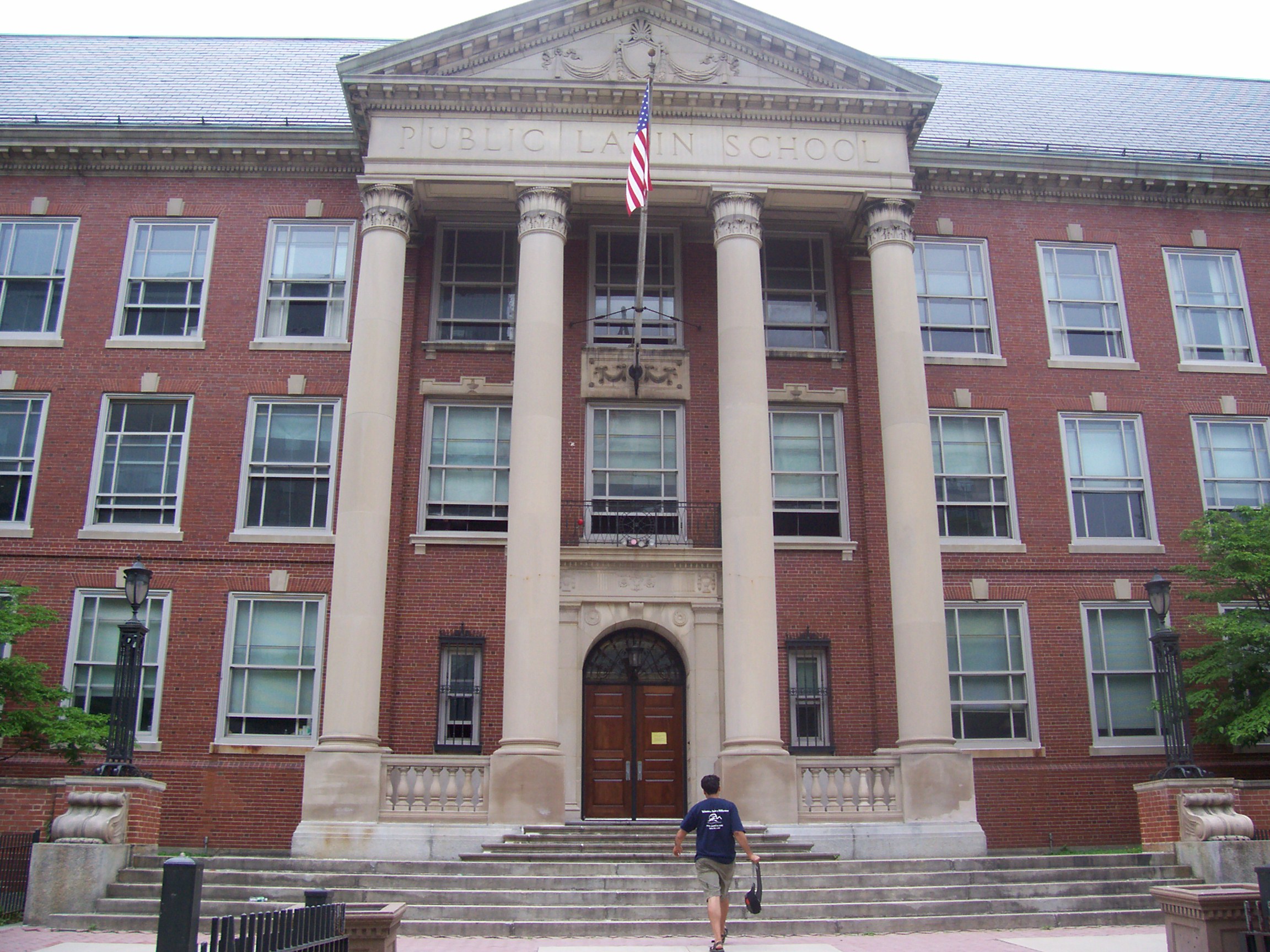
| image | Boston Latin School, Avenue Louis Pasteur.jpg |
| motto | Sumus Primi (Latin) |
| motto_translation | "We are first" |
| city | Boston |
| state | Massachusetts, 02115 |
| country | United States |
| coordinates | |
| type | Magnet Latin grammar state school |
| established | |
| district | Boston Public Schools |
| head | Jason Gallagher |
| head_name | Head of School |
| teaching_staff | 130.54 (FTE) |
| ratio | 18.39 |
| grades | 7–12 |
| gender | Single-sex education only/mostly for males |
| (from 1635 until 1972) | |
| Mixed-sex education | |
| (since 1972) | |
| conference | Massachusetts Interscholastic Athletic Association (MIAA) District A – Dual County League |
| mascot | "Wolfie" |
| nickname | "The Wolfpack", "BLS" |
| rival | The English High School (Boston English) |
| accreditation | New England Association of Schools and Colleges (NEASC) |
| newspaper | The Argo |
| yearbook | Liber Actorum |
| website | bls.org |
| students | 2,401 (2023–2024) |
| grades_label | Grades |
| address | 78 Avenue Louis Pasteur |
| campus_type | Urban |
| colors | Purple and White |
| mapframe | yes |
| mapframe-zoom | 13 |
(from 1635 until 1972) Mixed-sex education (since 1972) | mapframe-zoom = 13
The Boston Latin School is a magnet Latin grammar state school in Boston, Massachusetts. It has been in continuous operation since it was established on April 23, 1635, and is one of the oldest existing schools in the United States, the other being Collegiate School in New York City.{{cite web|title=Boston Latin School|url=http://www.nndb.com/edu/712/000068508/
History
17th and 18th centuries
Boston Latin School was founded on April 23, 1635, by the Town of Boston. The school was modeled after the Free Grammar School of Boston in England under the influence of Reverend John Cotton. The first classes were held in the home of the Master, Philemon Pormort. John Hull was the first student to graduate (1637).John Hull is, therefore, the earliest scholar who can now be named of Phi¬ lemon Pormort, whose school, the only one in Boston, was established April 23d of the same year, — the first school of public instruction in Massachusetts https://archive.org/details/diariesofjohnhul00hull/page/n21/mode/2up footnote 1, page 22 It was intended to educate young men of all social classes in the classics. The school was initially funded by donations and land rentals rather than by taxes. A school established in nearby Dedham was the first tax-supported public school.
Latin is the mother of modern Romance languages and was an educational priority in the 17th century. The ability to read at least Cicero and Virgil was a requirement of all colonial colleges, and to write and speak Latin in verse and prose was the first of the “Harvard College Laws” of 1642. Boston Latin prepared many students for admission to Harvard, with a total of seven years devoted to the classics. However, most graduates of Boston Latin did not go on to college, since business and professions did not require college training.
Until the 19th century, the Latin School admitted only male students and hired only male teachers. Helen Magill White was the school's first female graduate and the first American woman to earn a doctorate. Magill White was the only female pupil at the school when she attended.
19th century

Until the middle of the 19th century, BLS was popular among the Boston upper class. Under the headmastership of Epes Sargent Dixwell (1836-1851), the school moved into a new facility on Bedford Street. In 1844, Dixwell organized the Boston Latin School Association to support the school.
At mid-century, the City of Boston banned BLS from employing or teaching individuals who lived outside city limits. In response, Dixwell (who lived in Cambridge) broke away and started the Dixwell School, an exclusive private school that drew away affluent families from BLS.
In 1877, the Girls' Latin School was founded. A cadet corps was founded during the American Civil War but was later disbanded in the early 1960s.
20th century
In 1967, the school appointed Marie Frisardi Cleary and Juanita Ponte as the first two women in its academic faculty. Cornelia Kelley was the school's first female headmaster, serving from 1998 until her retirement in 2007, after which Lynne Mooney Teta became headmaster. Boston Latin admitted its first co-educational class in 1972.
21st century
In 2016, Mooney Teta resigned amid a federal probe into racially charged incidents at the school. In 2017, Rachel Skerritt became the first person of color to serve as headmaster. Skerritt resigned at the conclusion of the 2021–22 school year and was succeeded in the retitled position of Head of School by elementary principal and fellow Latin School alumnus Jason Gallagher.
Location history
| Photo | Point | Coordinates | ||
|---|---|---|---|---|
| (links to map & photo sources) | Notes | |||
| [[File:Boston Latin School original.jpg | 100px]] | First Boston Latin School House was a series of homes of each head master beginning with Philemon Pormort 1635 to 1638 and his successor Daniel Maude's home from 1638 to 1643. Ezekiel Cheever was an early head master of the Boston Latin School. He taught for seventy years, the last thirty-eight as master of the Boston Latin School. A formal single storey was the school's first permanent home from 1745 to 1812 to replace last temporary building which was demolished in 1745 to make way for King's Chapel expansion. Site was later used for Suffolk County Courthouse from 1810 to 1841, converted as City Hall until it was demolished and replaced by Old City Hall in 1865. | ||
| [[File:BLS SECOND SCHOOL HOUSE ON SOUTH SIDE OF SCHOOL STREET.jpg | 100px]] | Second BLS school house on south side of School Street. Built in 1812 and demolished in 1844. Now site at 44 School Street is The Berluti and McLaughlin Building circa 1924. | ||
| [[File:BLS Bedford Street School House.jpg | 100px]] | Third BLS school house on Bedford Street was built 1844 and shared the site with English High School until 1881. Part of the site became home to R. H. White department store in 1876. It was torn down for a parking lot before becoming LaFayette Place Mall in 1984 (now Lafayette City Center complex). | ||
| [[File:1920 English High School Boston 2589540239.jpg | 100px]] | Fourth location of BLS school house on Warren Avenue, (shared with the English High School of Boston), 1881–1922. Now site of the Melvin H. King South End Academy. | ||
| [[File:Boston Latin School - 0403002015a - City of Boston Archives.jpg | 100px]] | Fifth site of BLS school house on Avenue Louis Pasteur. 1922–present. |
Academics
Boston Latin's motto is Sumus Primi, Latin for we are first. This has a double meaning, referring both to the school's date of founding and to its academic stature. Boston Latin has a history of pursuing the same standards as elite New England prep schools while adopting the egalitarian attitude of a public school. Academically, the school regularly outperforms public schools in affluent Boston suburbs, particularly as measured by the yearly MCAS assessment required of all Massachusetts public schools. In 2006, Brooklyn Latin School was founded in New York City, explicitly modeled on Boston Latin, borrowing much from its traditions and curriculum. In 2006, Washington Latin School was founded in Washington, D.C., also modeled on Boston Latin.
Admissions
Admission to Boston Latin School is limited to residents of the city of Boston. Until 2020, admission was determined by a combination of a student's score on the Independent School Entrance Examination (ISEE) and recent grades. As a result of the COVID-19 pandemic, however, the entrance exam was suspended, and admission was based on grades and Boston residency. In 2021, a new exam, the MAP Growth test, was designated for students applying for entrance to the 2023–24 school year and beyond. Students must have a grade point average from their current and previous school years of at least a B to be eligible to apply. In addition to GPA and test scores, students may be eligible to receive additional points if they meet specific criteria, such as living in housing owned by the Boston Housing Authority, in the care of the Department of Children and Families, or experiencing homelessness. They also receive additional points if they attended a school in the year prior to application that has, on average over the past five years, an enrollment of 40% or more economically disadvantaged students.
Although Boston Latin runs from the 7th through the 12th grade, it admits students only into the 7th and 9th grades.
The school has been the subject of controversy concerning its admissions process. Before the 1997 school year, Boston Latin set aside a 35% quota of places in the incoming class for under-represented minorities. The school was forced to drop this policy after a series of lawsuits were brought by white females who were not admitted despite ranking higher (based on test scores and GPA) than admitted minorities.{{cite web |access-date=2008-01-29 |url-status=dead |archive-url=https://web.archive.org/web/20070808133732/http://www.bc.edu/research/csteep/CTESTWEB/blatin/latin.html |archive-date=2007-08-08
After the lawsuits, the percentage of under-represented minorities at Boston Latin fell from 35% in 1997 to under 19% in 2005, despite efforts by Boston Latin, the Boston Public Schools, and the Boston Latin School Association to recruit more minority applicants and retain more minority students.
Boston Latin later defeated a legal effort to end its admissions process entirely in favor of admissions by blind lottery.
In recent years, the admissions exam has continued to cause controversy due to the lack of diversity among admitted students. In 2017, Lawyers for Civil Rights published the demographics of the incoming class, highlighting that Black students are invited to attend Boston Latin at a rate that is more than two and a half times lower than their enrollment rates in Boston Public Schools overall.
From Massachusetts Department of Elementary and Secondary Education|label1=African American|label2=Asian|label3=Hispanic|label4=Native American|label5=White|label6=Native Hawaiian, Pacific Islander|label7=Multi-Race, Non Hispanic|value1=29.3|value2=9.1|value3=42.4|value4=0.3|value5=15.3|value6=0.2|value7=3.4|radius=60}}
The following year in 2018, Harvard Kennedy School released a brief explaining possible reasons for the racial gap in Boston Latin School's admissions. Among the reasons are the lower rates of participation in the ISEE by Black and Hispanic students, lower ISEE scores due to inequitable curriculum and resources in the schools from which these students come, reported GPA differences, and less likelihood of Black and Hispanic students to list Boston Latin School as their top choice in school placement forms.
In 2019, Lawyers for Civil Rights, alongside the Boston chapter of the NAACP, sent a letter to Mayor Walsh, the Boston School Committee, and the superintendent, seeking to redo the admissions policies for Boston Latin School. The organizations cited the disproportionate admission rates of Black and Hispanic students versus white students as a failure of the exam system, and asked for a process that would diversify the school and take into account a student's personal achievements.
The Educational Records Bureau (ERB), the organization responsible for creating and updating the ISEE, reportedly decided to end its yearly contract with the Boston Public Schools (BPS) in April 2019. In an email sent to the school district and other clients, ERB claimed that the test's scoring metric had been incorrectly applied by BPS, resulting in underrepresented race groups failing to be admitted. BPS, however, denied that ERB cut business ties with the school district. BPS claimed instead that it had ended the contract in search of a test enabling “more equitable access” to the exam schools.
In October 2020, the Boston School Committee voted to cancel entrance exams for the city's three exam schools in 2021, due to the COVID-19 pandemic. The School Committee opted for an admissions procedure under which 20% of the incoming class would be accepted based on top grades, and the other 80% based on grades and zip codes. Students coming from zip codes with lower-income communities would receive preferential treatment.
Boston Latin School has received backlash from some parents because of this decision. Opponents of the proposed admissions system created a Change.org petition, garnering almost 6,000 signatures. The petition, directed to Boston City Council, argued that cancelling the test would increase disruption due to the COVID-19 pandemic. A protest was held prior to the vote on the steps of Boston Latin School. One common concern surrounded Chinatown students potentially being excluded based on Chinatown's surrounding area being rapidly gentrified, thus increasing the median income.
Curriculum
Declamation is one of the school's time-honored traditions. Students in the 7th through 10th grades are required to give an oration, known as declamation, in their English class three times during the year. The school also holds Public Declamation, in which students from all grades are welcomed to try out for the chance to declaim a memorized piece in front of an assembly. During Public Declamation, declaimers are scored on categories including "Memorization," "Presentation," and "Voice and Delivery," and those who score well in three of the first four public declamations are given the chance to declaim in front of alumni judges for awards in "Prize Declamation.”
In addition to declamation in English classes, the Modern Languages department holds an annual "World Language Declamation" competition. Once a year, during National Foreign Language Week (usually the first week of March), students in grades 8 through 12 perform orations in languages other than English. Entrants are categorized by level, rather than language. So all students declaiming at the first-year level of various languages are competing against each other, all students declaiming at the second-year level compete against each other, and so on.
In 2001, the school decided to decrease the Latin requirement by one year, starting with the class of 2006. For students admitted for 7th grade, the minimum number of years of Latin required decreased from five years to four years, and for students admitted for 9th grade, from four years to three years. Students, however, can still take Latin (and Greek) electives after their fourth year.
Publications
There are currently three main publications of the Boston Latin School: The Register is the school's literary magazine, The Argo the school newspaper, and Catapulta is the science magazine. George Santayana founded The Register in 1881 to serve as the school newspaper. Over the years, however, it evolved into a purely literary magazine, publishing prose and poetry written by members of the student body, as well as artwork. There are generally three editors-in-chief, and it is published twice per year. The Argo, the school's newspaper, is far younger, having been founded in 1970 after it was clear that the Register had become a purely literary magazine. As of the 2006–2007 school year, it is published seven times a year. Catapulta, the science magazine, highlights popular and recent science and technology and is generally published four times a year. The Register, the Argo, and Catapulta are entirely student-produced, and the "Argo" and the "Register" have won awards from the New England Scholastic Press Association, while Catapulta has won awards from the American Scholastic Press Association.{{cite web |access-date=2007-06-01 |archive-url = https://archive.today/20070927034400/http://bls.org/library/cfml/l3tmpl_archive.cfm?ArchiveID=36 |archive-date = 2007-09-27}} Includes scans of first Argo edition, 1969.
Another Boston Latin publication is "G Mello", published by the Boston Latin School Association, whose president is Peter G. Kelly, '83.
Athletics
Boston Latin's teams are known as the Boston Latin Wolfpack; their colors are purple and white. Boston Latin has played rival Boston English in football every Thanksgiving since 1887, one of the oldest continuous high school rivalries in the United States.
In 2024, the Boys' Ice Hockey Team entered the state playoffs as the 11th seed and completed a magical Cinderella run by defeating the 10th, 6th, 3rd, and 1st ranked teams in the MIAA Division 2 on the way to winning the State Championship.
In popular culture
- April 5, 2000: In "Six Meetings Before Lunch", a first-season episode of The West Wing, Rob Lowe's character Sam Seaborn mentioned Boston Latin School in a discussion of public school reform and school vouchers in American public education. He said, “Boston Latin, the oldest public school in America, is still the best secondary school in New England.” Mallory O'Brien replies "They all can't be Boston Latin and Bronx Science."
- January 8, 2002: President George W. Bush visited the Boston Latin School after signing the No Child Left Behind Act earlier that day.{{cite web
- January 22, 2007: In Season 1, Episode 12 of Studio 60 on the Sunset Strip, Matthew Perry's character Matt Albie mentioned that his nephew had a 3.8 GPA at Boston Latin.
Rankings and awards
In 2008, the school was named number 28 of public high schools in the United States by U.S. News & World Report magazine. It was named a 2011 "Blue Ribbon School of Excellence", the Department of Education's highest award. As of 2018, it is listed under the "gold medal" list, ranking 48 out of the top 100 high schools in the United States by U.S. News & World Report.
In 2024, the school was rated as the top public high school in Massachusetts by U.S. News & World Report and number 27 in national rankings.
Alumni
Main article: List of Boston Latin School alumni
Boston Latin has produced four Harvard University presidents, four Massachusetts governors, and five signers of the United States Declaration of Independence. Benjamin Franklin and Louis Farrakhan are among its well-known dropouts.
Boston Latin has graduated notable Americans in the fields of politics (both local and national), religion, science, journalism, philosophy, and music. Of the 56 men who signed the Declaration of Independence, five were educated at Latin: Adams, Franklin, Hancock, Hooper, and Paine. Graduates and students fought in the Revolutionary War, American Civil War, World War I, World War II, Korean War, and the Vietnam War, and plaques and statues in the school building honor those who died.
Hall of Fame
The Hall of Fame, known casually as "The Wall," refers to the upper frieze in the school's auditorium, where the last names of famous alumni are painted. These names include Adams, Bernstein, Fitzgerald, Franklin, Hancock, Hooper, John Hull, Kennedy, Mather, Paine, Quincy, Santayana, Winthrop and others. The most recent name, Wade McCree Jr., was added to the frieze in 1999, and the selection of the name involved a conscious effort to choose a graduate of color. There are no names of female graduates, mostly because women have attended the school for just 46 years and the honor is only bestowed posthumously. There is also a lower frieze with the names of many other distinguished graduates, and a place on the lower frieze can be awarded while the person is still alive.
References
References
- Caldwell, Dave. (2006-11-10). "Thanksgiving Day Games: Old Rivalries, Then the Turkey". The New York Times.
- "Boston Latin". National Center for Education Statistics.
- "History of Boston Latin School – oldest public school in America". Boston Latin School.
- "Boston Latin School".
- (16 July 2016). "First Public School Site and Ben Franklin Statue". City of Boston.
- "BLS History".
- "Boston Latin School {{!}} American secondary school".
- "BLS History".
- (2007). "American educational history : school, society, and the common good". SAGE Publications.
- (2001). "To run a school : administrative organization and learning". Praeger.
- Sacchetti, Maria. (November 27, 2005). "Schools vie for honor of being the oldest". The Boston Globe.
- (2002). "Latin or the empire of a sign : from the sixteenth to the twentieth centuries". Verso.
- "History of Harvard".
- (1968). "The founding of the Harvard College". Harvard University Press.
- (2006). "Classical antiquity and the politics of America : from George Washington to George W. Bush". Baylor Univ. Press.
- (2005). "Revolutionary generation : Harvard men and the consequences of independence". Univ. of Massachusetts Press.
- (1999). "The origins of the American high school.". Yale University Press.
- Bowditch, Charles P.. (1900). "Epes Sargent Dixwell". Proceedings of the American Academy of Arts and Sciences.
- Elsey, George Mckee. (1941). "The First Education of Henry Adams". The New England Quarterly.
- Eliot, Charles William. (1971). "A Late Harvest: Miscellaneous Papers Written Between Eighty And Ninety". The Atlantic Monthly Press.
- Grant, Robert. (1934). "Fourscore: An Autobiography". Houghton Mifflin.
- (September 10, 1972). "Girls Admitted by Boston Latin". The New York Times.
- (September 30, 2004). "Boston School Cadets". The Bulletin.
- Marie Frisardi Cleary. (May 19, 1985). "The Halls of Boston Latin School". The New York Times.
- Bergeron, Amanda. (July 21, 2007). "Juanita Ponte, 62; taught at Boston Latin". [[Boston Globe]].
- Jan, Tracy. (2007-02-14). "Boston Latin headmaster to retire". [[Boston Globe]].
- (June 26, 2007). "Assistant head is named to Latin's top job". [[The Boston Globe]].
- (21 June 2016). "Amid controversy, Boston Latin headmaster resigns". The Boston Globe.
- (20 September 2022). "What I Learned Leading America's First Public School". [[Education Next]].
- (15 October 2018). "Rachel Skerritt: The First POC Headmaster of the Country's Oldest Public School".
- "Boston Latin School Site/Benjamin Franklin Statue | the Freedom Trail".
- {{coord. 42.357909. -71.059798
- (Estimated from: Plan of Boston showing existing ways and owners on December 25, 1635. Author: Lamb, George. 1635 Location: Boston (Mass.)) [http://maps.bpl.org/details_10923/] [http://maps.bpl.org/details_12280/]
- "44 School St, Boston, MA 02108 - Office for Lease".
- Boston 1842 "Boston" from Tanner, H.S. The American Traveller; or Guide Through the United States. Eighth Edition. New York, 1842 [http://lib.utexas.edu/maps/histus.html]
- {{coord. 42.357640. -71.059679 (Estimated from Tanner map)
- Catalogue of the Boston Public Latin School, Established in 1635: With an Historical Sketch, Henry Fitch Jenks. Boston Latin School Association. 1886. Pages 94–95.
- Map title: Map of Boston, 1865 Photographically Reduced From City Engineer Plans With All The Latest Improvements. A Complete Guide To Strangers. Publisher: L. Prang & Co. Date: 1865 [http://maps.bpl.org/details_11003/]
- {{coord. 42.353840. -71.061060 (Estimated from Prang & Co. map)
- Catalogue of the Boston Public Latin School, Established in 1635: With an Historical Sketch, Henry Fitch Jenks. Boston Latin School Association. 1886. Page 303.
- {{coord. 42.344178. -71.073380 (Estimated from description in Jenks, page 75)
- SCHOLA LATINA BOSTONIENSIS CCCL ANNOS NATA. (BOSTON LATIN AT 350). April 21, 1985. Boston Globe. By John Powers
- Jan, Tracy. (March 4, 2006). "Growing a Boston Latin in Brooklyn". [[The Boston Globe]].
- "Answers to Frequently Asked Questions about Entrance to Boston Latin School".
- "BPS Welcome Services/Exam Schools Admissions Policy".
- See: Wessmann v. Gittens, 160 F. 3d 790 – Court of Appeals, 1st Circuit 1998 [[s:SARAH P. WESSMANN, p.p.a. HENRY ROBERT WESSMANN, v. ROBERT P. GITTENS, CHAIRPERSON OF THE BOSTON SCHOOL COMMITTEE, ET AL.]], and McLAUGHLIN BY McLAUGHLIN v. Boston School Committee, 938 F. Supp. 938 F.Supp. 1001 (1996) Civil Action No. 95-11803-WAG. United States District Court, D. Massachusetts. [[s:938 F.Supp. 1001 (1996) Julia A. McLAUGHLIN, by Catherine McLAUGHLIN, Plaintiff, v. BOSTON SCHOOL COMMITTEE, et al., Defendants.]]
- (2017). "A Broken Mirror: Exam School Admissions Fail to Reflect Boston's Diversity". Lawyers for Civil Rights.
- (October 2018). "Increasing Diversity in Boston's Exam Schools". Harvard Kennedy School.
- Vaughn, Alyssa. (June 19, 2020). "The NAACP and Lawyers for Civil Rights Want Exam School Admissions Overhauled in Boston". Boston Magazine.
- Irons, Meghan. (February 5, 2020). "Test maker accuses Boston schools of misusing exam". [[The Boston Globe]].
- Larkin, Max. (October 22, 2020). "One-Year Pause In Exam-School Tests Sparks Hope – And Hostility". WBUR.
- Cromar, Ainslie. (October 22, 2020). "It's official: No admissions test at Boston exam schools for incoming fall class". Boston.com.
- G, Adam. (October 18, 2020). "On steps of Boston Latin, parents rally to keep the exam in exam schools; across street, other parents rally against it". Universal Hub.
- Schaefer Riley, Naomi. (February 19, 2021). "Exam-School Admissions Come Under Pressure amid Pandemic". Education Next.
- Kate Stevenson (2008). [https://web.archive.org/web/20060903084941/http://www.jc.edu/users/stevenso/FLAND/flwk.html National Foreign Language Week]
- [https://wayback.archive-it.org/all/20080414065452/http://www.bls.org/doc_content/PrizeSchol.pdf Prizes and Scholarships], ''BLS Web Site''
- Vaishnav, Anand. (2001-04-13). "Boston Latin Eases Language Requirement". [[Boston Globe]].
- (Fall 2008). "BLSA Bulletin". Boston Latin School Association.
- Werchadlo, Emily. (2005-11-24). "It's still defined by Latin and English". [[Boston Globe]].
- Dahlbeck, Dwayne. (2007-11-27). "Latin's first conquest comes at last". [[Boston Globe]].
- "2024 MIAA Boys Ice Hockey Division 2".
- (November 29, 2007). "Best High Schools 2008". [[U.S. News & World Report]].
- (November 29, 2007). "The First-Class State—Two examples of how Massachusetts gets it right". U.S. News & World Report.
- [http://www2.ed.gov/programs/nclbbrs/2011/national.pdf 2011 National Blue Ribbon Schools], accessed April 3, 2012
- (2016-04-19). "National Rankings Best High Schools". U.S. News & World Report LP..
- "These Are the Best High Schools in Massachusetts". US News and World Report.
- "Benjamin Franklin". Exodus Provisions.
- John B. Judis. (August 18, 1996). "Maximum Leader". [[The New York Times]].
- Rauseo-Ricupero, Ronaldo. (2002-01-09). "Bush Comes To Boston After Education Victory". [[Harvard Crimson]].
- Lee A. Daniels. (November 22, 1984). "A Homecoming for Bernstein". [[The New York Times]].
- Hill, Tony. (2000-11-12). "To Place a Black Man in Latin's Pantheon: An Alumnus Quietly Raised to the Star-Studded Frieze". [[Boston Globe]].
This article was imported from Wikipedia and is available under the Creative Commons Attribution-ShareAlike 4.0 License. Content has been adapted to SurfDoc format. Original contributors can be found on the article history page.
Ask Mako anything about Boston Latin School — get instant answers, deeper analysis, and related topics.
Research with MakoFree with your Surf account
Create a free account to save articles, ask Mako questions, and organize your research.
Sign up freeThis content may have been generated or modified by AI. CloudSurf Software LLC is not responsible for the accuracy, completeness, or reliability of AI-generated content. Always verify important information from primary sources.
Report