From Surf Wiki (app.surf) — the open knowledge base
Border ruffian
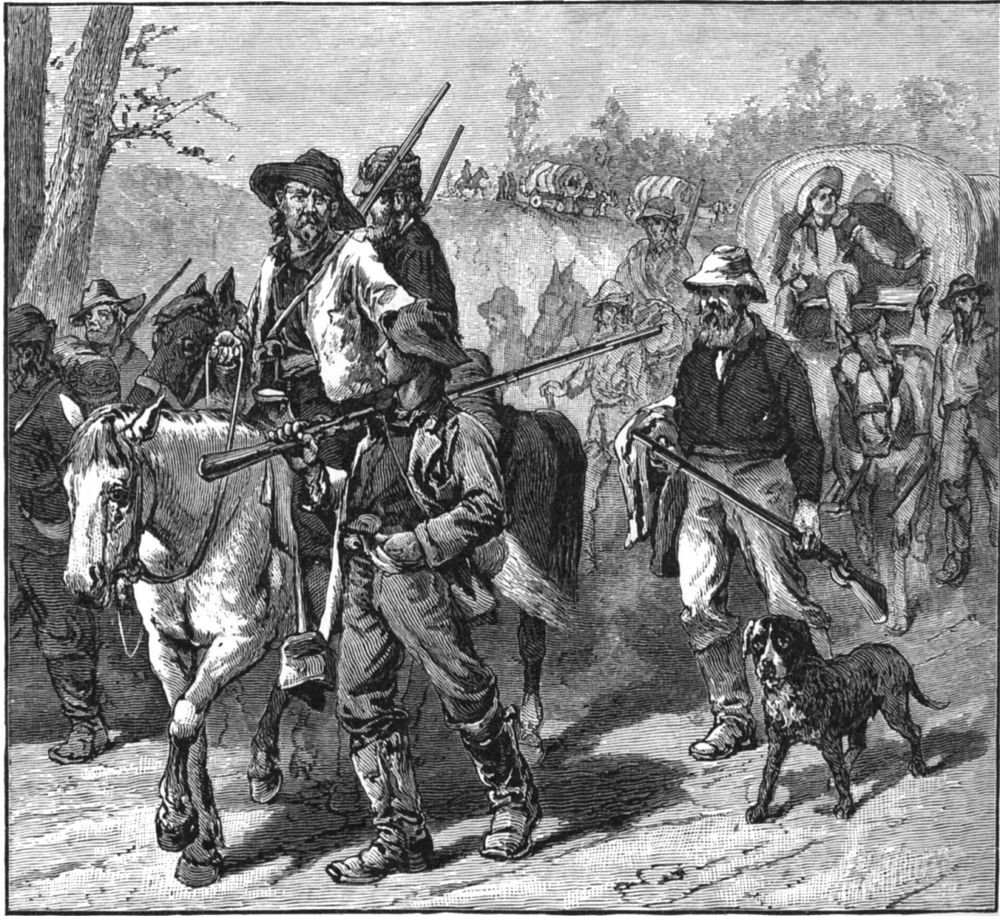
Proslavery Missourian raiders within Kansas Territory
.jpg)
Proslavery Missourian raiders within Kansas Territory
Border ruffians were proslavery raiders who crossed into the Kansas Territory from Missouri during the mid-19th century to help ensure the territory entered the United States as a slave state. Their activities formed a major part of a series of violent civil confrontations known as "Bleeding Kansas", which peaked from 1854 to 1858. Crimes committed by border ruffians included electoral fraud, intimidation, assault, property damage and murder; many border ruffians took pride in their reputation as criminals. After the outbreak of the American Civil War in 1861, many border ruffians fought on the side of the Confederate States of America as irregular bushwhackers.
Origin

_-_Blackall,_photographer,_Clinton,_Iowa_LCCN2016646192.jpg)
The 1913 edition of Webster's Dictionary reflects the 19th century understanding of the word as a "scoundrel, rascal, or unprincipled, deceitful, brutal and unreliable person".
Among the first to use the term border ruffian in connection with the slavery issue in Kansas was the Herald of Freedom, a newspaper published in Lawrence, Kansas. On October 8, 1857, it reported the following: |access-date=March 11, 2021 |archive-date=April 11, 2022 |archive-url=https://web.archive.org/web/20220411204345/http://kansasboguslegislature.org/mo/stringfellow_b_f.html |url-status=live
Armed with revolvers and Bowie knives, border ruffians forcefully interfered in the Kansas row over slavery.{{citation |access-date=March 11, 2021 |archive-date=February 28, 2021 |archive-url=https://web.archive.org/web/20210228222211/https://longreads.com/2018/12/17/bowie-knives-concealed-rifles-and-caning-charles-sumner/ |url-status=live |access-date=March 11, 2021 |archive-date=May 14, 2022 |archive-url=https://web.archive.org/web/20220514124740/https://books.google.com/books?id=A1VuDwAAQBAJ&lpg=PA29&ots=l2DmPNg1rB&dq=Thomas+Gladstone+correspondent+for+the+London+Times&pg=PA29 |url-status=live |access-date=March 16, 2021 |archive-date=May 14, 2022 |archive-url=https://web.archive.org/web/20220514124741/https://americanhistory.si.edu/collections/search/object/nmah_414959 |url-status=live |access-date=March 11, 2021 |archive-date=December 4, 2020 |archive-url=https://web.archive.org/web/20201204215236/https://civilwaronthewesternborder.org/encyclopedia/new-england-emigrant-aid-company |url-status=live
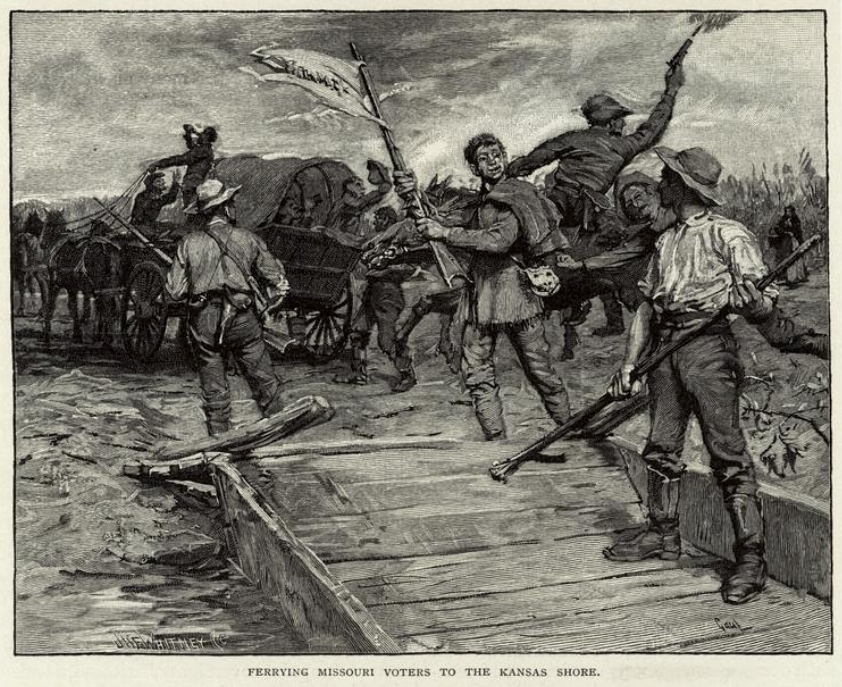
At that time, many Kansas settlers opposed slavery. However, slavery advocates were determined to have their way regardless. When elections were held, bands of armed border ruffians seized polling places, prevented Free-State men from voting, and cast votes illegally, falsely stating they were Kansas residents. |access-date=November 19, 2007 |url-status=dead |archive-url=https://web.archive.org/web/20080621032028/http://www.nps.gov/archive/fosc/bleeding.htm |archive-date=June 21, 2008
Border ruffians operated from Missouri. It was said that they voted and shot in Kansas, but slept in Missouri.{{cite journal |access-date=March 8, 2021 |archive-date=April 16, 2021 |archive-url=https://web.archive.org/web/20210416180041/https://www.kshs.org/p/kansas-history-summer-1985/15209 |url-status=live |access-date=March 13, 2021 |archive-date=January 16, 2021 |archive-url=https://web.archive.org/web/20210116180705/https://www.kshs.org/kansapedia/bleeding-kansas/15145 |url-status=live
The federal government did not interfere to stop the violence.{{cite journal
Border ruffians contributed to the increasingly violent sectional tensions, culminating in the American Civil War.
Leaders and followers
Border ruffians did not constitute an organized group. They never had meetings, had no designated leaders, and no one ever directed any message to them as a body.
Border ruffians were driven by the rhetoric of politicians such as David Rice Atchison, Benjamin Franklin Stringfellow, John H. Stringfellow, editor of the pro-slavery newspaper Squatter Sovereign (Atchison, Kansas), and Speaker of the House in the First Kansas Territorial Legislature, the so-called Bogus Legislature. and Rev. Thomas Johnson, a Methodist preacher. Samuel J. Jones, and Daniel Woodson, a proslavery newspaper editor. In particular, Atchison called Northerners "negro thieves" and "abolitionist tyrants". He encouraged Missourians to defend their institution "with the bayonet and with blood" and, if necessary, "to kill every God-damned abolitionist in the district".{{cite web |author-link=David R. Atchison |access-date=March 8, 2021 |archive-date=November 1, 2020 |archive-url=https://web.archive.org/web/20201101133158/https://www.kansasmemory.org/item/90822 |url-status=live
Few of the ordinary border ruffians actually owned slaves because most were too poor. Their motivation was hatred of Yankees and abolitionists, and fear of free Blacks living nearby. Kansas slavery was small-scale and operated mainly at the household level. Most of the Kansans, according to historian David M. Potter, were concerned primarily about land titles. He pointed out that, "the great anomaly of 'Bleeding Kansas' is that the slavery issue reached a condition of intolerable tension and violence ... in an area where a majority of the inhabitants apparently did not care very much one way or the other about slavery."
Frank W. Blackmar's encyclopedia of Kansas history summarizes how the rank-and-file among border ruffians took pride in both how they were called and what they were doing:
The presence of violent bands of both Kansan and Missourian combatants made it difficult for settlers on the Kansas–Missouri border to remain neutral.

History
Main article: Bleeding Kansas
The history of border ruffians is woven into the historical context of Bleeding Kansas, or the border war, a series of violent civil confrontations in Kansas in 1854–1859. Kansas Territory was created by the Kansas–Nebraska Act of 1854. The Act repealed the previous Federal prohibition on slavery in that area. Instead, the locally elected territorial legislature was to decide on the slavery issue.
The first territorial census, taken in January–February 1855, counted 8601 people; 2905 were deemed eligible to vote; there were 192 enslaved in the Territory.
After the Kansas–Nebraska Act repealed the Missouri Compromise of 1820 and allowed Kansans to vote on slavery, the opponents from both sides of the slavery debate started to recruit settlers to increase support of their causes.
Immigration to Kansas
Proslavery immigrants aided by the Lafayette Emigration Society, and anti-slavery settlers, established their own territorial enclave (such as Atchison and Leavenworth), and Free-State immigrants aided by the New England Emigrant Aid Company established theirs (such as Lawrence, Topeka). This circumstance resulted in a deep partisan divide in regard to the slavery question among settlers and their civic and business leaders. Then extremists on both side resorted to arms. On the pro-slavery side violence was committed by the border ruffians and on the free-state side by the jayhawkers.
On November 29, 1854, border ruffians elected a pro-slavery territorial representative to Congress, John W. Whitfield. It was determined after a Congressional investigation that 60% of the votes were illegal.
On March 30, 1855, border ruffians elected a pro-slavery Territorial Legislature, which introduced harsh penalties for speaking against slavery.{{cite encyclopedia |contribution-url=https://www.kshs.org/kansapedia/bogus-legislature/16700 |orig-date=2011 |access-date=March 14, 2021 |archive-date=April 16, 2021 |archive-url=https://web.archive.org/web/20210416111342/https://www.kshs.org/kansapedia/bogus-legislature/16700 |url-status=live
Despite all border ruffians' attempts to push anti-slavery settlers out of the Territory, far more Free-State immigrants moved to Kansas than pro-slavery. In 1857, the pro-slavery faction in Kansas proposed the Lecompton Constitution for the future state of Kansas. It tried to get the Lecompton Constitution adopted with additional fraud and violence, but by then there were too many Free-Staters there and the U.S. Congress refused to confirm it.
Border ruffians also engaged in general violence against Free-State settlements. They burned farms and sometimes murdered Free-State men. Most notoriously, border ruffians twice attacked Lawrence, the Free-State capital of the Kansas Territory. On December 1, 1855, a small army of border ruffians laid siege to Lawrence, but were driven off. This became the nearly bloodless climax to the "Wakarusa War".
On May 21, 1856, an even larger force of border ruffians and pro-slavery Kansans captured Lawrence, which they sacked.
Free-State settlers struck back. Anti-slavery Kansan irregulars, led by Charles R. Jennison, James Montgomery, and James H. Lane, among others, and known as jayhawkers, attacked proslavery settlers and suspected border ruffian sympathizers. Most notoriously, abolitionist John Brown killed five proslavery men at Pottawatomie. In revenge, a band of border ruffians, led by John W. Reid, sacked the village of Osawatomie, Kansas after the Battle of Osawatomie.
Aid to the Free-State cause
T. W. Higginson, a minister, was instrumental in turning the Massachusetts State Kansas Committee, a former subsidiary of the New England Emigrant Aid Company, into a nationally known organization. It worked to recruit abolitionist settlers, raised funds for them to migrate to Kansas, and equipped them with rifles to use against border ruffians. In 1856 it acquired 200 Sharps rifles for $4,947.88 that were shipped to Kansas via Iowa and ended in John Brown's hands. In September 1858, it invested $3,800 in 190 Sharps rifles for Kansas. Abolitionist Henry W. Beecher pronounced that, It was documented that in 1855–1856 various aid organizations from free states spent at least $43,074.26 on rifles, muskets, revolvers, and ammunition, including one cannon, destined for Kansas.
On July 9, 1856, the Massachusetts State Kansas Committee and the New England Emigrant Aid Company initiated the establishment of the Kansas National Aid Committee headquartered in Chicago. Thaddeus Hyatt, head of the national committee, began collecting money, arms, provisions, clothing, and agricultural supplies to aid the Free-State cause in Kansas. The goal was to transport five thousand settlers to Kansas Territory giving them a year's worth of supplies.
A distribution depot was set up at Mt. Pleasant, Iowa, where immigrants were furnished not only with horses and wagons and other supplies, but also with arms; they were organized into companies and drilled. The National Kansas Committee spent in 1856–1857 around on the Free State cause.
Outcomes
On August 2, 1858, the pro-slavery Lecompton Constitution of 1857 was rejected at the polls, signifying the defeat of border ruffians' cause. On January 29, 1861, President James Buchanan signed the bill that approved the Wyandotte Constitution and Kansas came to the Union as a Free State.
During the Civil War
During the American Civil War, the violence on the Kansas-Missouri border not only continued, but escalated tremendously. Many of the former border ruffians became pro-Confederate guerrillas, or bushwhackers. They operated in western Missouri, sometimes raiding into Kansas, and Union forces campaigned to suppress them. Farms on the Missouri-Kansas state line were looted and burned. Suspected guerrillas were killed; in retaliation, bushwhackers murdered Union sympathizers and suspected informers. Confederate guerrilla leaders, such as "Bloody Bill" Anderson and William Quantrill, were feared in Kansas during the war.
Many of the Union troops fighting bushwackers were former jayhawkers who held deep grudges against border ruffians. Charles R. Jennison recruited the 7th Kansas Cavalry Regiment, which became known as the Jennison's Jayhawkers. In the fall and winter of 1861 and 1862, Jennison's Jayhawkers became infamous for looting and destroying the property of Missourians.
Some of the jayhawkers joined a paramilitary group called the Red Legs. Wearing red gaiters and numbered around 100, Red Legs served as scouts during the punitive expedition of the Union troops in Missouri. Jayhawkers and Red Legs pillaged and burned multiple towns in 1861–1863 in Missouri. The destruction of Osceola, Missouri, is depicted in the movie The Outlaw Josey Wales.{{citation |access-date=March 16, 2021 |archive-date=March 16, 2021 |archive-url=https://web.archive.org/web/20210316220300/http://canteymyerscollection.com/download/redleg.pdf |url-status=live
References
References
- Cecil-Fronsman, Bill. 'Death to All Yankees and Traitors in Kansas': The Squatter Sovereign and the Defense of Slavery in Kansas, ''Kansas History'' 16 (Spring 1993): 22–33.
- Watts, Dale. How Bloody was Bleeding Kansas? Political Killings in Kansas Territory, 1854–1861, ''Kansas History,'' Vol. 18, Summer 1995, pp. 116–129
- Welch, G. Murlin. ''Border Warfare in Southeastern Kansas, 1856–1859''. Pleasanton, Kans.: Linn County Publishers, 1977.
- link. (May 14, 2022 , ''Kansas State Historical Society'')
- [https://www.kansasmemory.org/item/90822 Copy of David R. Atchison speech to proslavery forces] {{Webarchive. link. (November 1, 2020 , ''Kansas State Historical Society'')
- Monaghan, Jay. ''Civil War on the Western Border''. Lincoln: University of Nebraska Press, 1955.{{ISBN?{{page needed. (March 2023)
- "Kansas Bogus Legislature: J. H. Stringfellow, Speaker of the House".
- [https://newsantafetrailer.blogspot.com/2018/03/96-normal-0-false-false-false-en-us-x.html Pious Preacher or Radical Hypocrite? The Reverend Thomas Johnson] {{Webarchive. link. (November 8, 2021 , ''The New Santa Fe Trailer'')
- Matthew E. Stanley. [https://civilwaronthewesternborder.org/encyclopedia/woodson-daniel Woodson, Daniel] {{Webarchive. link. (October 10, 2018 . ''Civil War on the Western Border: The Missouri-Kansas Conflict, 1855–1865'')
- Etcheson, Nicole. ''Bleeding Kansas: Contested Liberty in the Civil War Era''. Lawrence: University Press of Kansas, 2004, p. 116
- Cory, Charles Easterbrook. Slavery in Kansas, ''Kansas Historical Collection'' 7 (1901–1902): 229–242.
- [https://web.archive.org/web/20071206193758/http://skyways.lib.ks.us/genweb/archives/1912/b/border_ruffians.html Kansas: A cyclopedia of state history, embracing events, institutions, industries, counties, cities, towns, prominent persons, etc. ... / with a supplementary volume devoted to selected personal history and reminiscence]. Chicago: Standard Pub. Co., 1912.
- Newlon, Jack, Rob Spooner, and Alicia Spooner. [http://www.u-s-history.com/pages/h84.html Bleeding Kansas: Mid 1850s – Precursor to the Civil War] {{Webarchive. link. (June 30, 2017 , in U-S-History.com. Online Highways, 2021)
- Goodrich, Thomas. ''War to the Knife: Bleeding Kansas, 1854–1861.'' Mechanicsburg, PA: Stackpole Books, 1998.
- Cutler, William G. [http://www.kancoll.org/books/cutler/terrhist/terrhist-p8.html#THE_FIRST_TERRITORIAL_ELECTION ''History of the State of Kansas: Containing a Full Account of Its Growth from an Uninhabited Territory to a Wealthy and Important State; of Its Early Settlements; Its Rapid Increase in Population; and the Marvelous Development of Its Great Natural Resources''] {{Webarchive. link. (April 8, 2022 . Chicago: A. T. Andreas, 1883.)
- [https://www.kshs.org/kansapedia/kansas-territory/14701 Kansapedia: Kansas Territory] {{Webarchive. link. (April 16, 2021 , ''Kansas Historical Society'')
- [http://www.teachushistory.org/kansas-nebraska-act-bleeding-kansas/resources/appeal-southerners-favor-establishing-slavery-kansas Kansas Matters – Appeal to the South] {{Webarchive. link. (October 30, 2020 , ''De Bow's Review'', Vol 20, Issue 5, May 1, 1856, pp. 635-639.)
- Barry, Louise. The Emigrant Aid Company Parties of 1854 and The Emigrant Aid Company Parties of 1855, ''Kansas Historical Quarterly'' 12 (1943): pp. 115–155, 227–268.
- Carruth, William H. New England in Kansas, ''New England Magazine,'' Vol. 16, March 1897, pp. 3–21.
- [https://www.ushistory.org/us/31b.asp Border Ruffians] {{Webarchive. link. (February 27, 2021 , ''U.S. History Online Textbook'')
- Phillips, Christopher. (March 2002). "'The Crime against Missouri': Slavery, Kansas, and the Cant of Southernness in the Border West".
- Godsey, Flora Rosenquist. (1925). "The Early Settlement and Raid on the 'Upper Neosho'".
- [http://www1.assumption.edu/ahc/Kansas/ "Bleeding Kansas"] {{Webarchive. link. (March 16, 2021 , ''The E Pluribus Unum Project: America in the 1770s, 1850s, and 1920s,'' Assumption University)
- Neely, Jeremy. ''The Border Between Them: Violence and Reconciliation on the Kansas-Missouri Line.'' Columbia: University of Missouri Press, 2007.
- Oates, Stephen B. ''To Purge This Land With Blood: A Biography of John Brown''. New York: Harper and Row, 1970.
- Rein, Christopher.[https://civilwaronthewesternborder.org/encyclopedia/battle-osawatomie Battle of Osawatomie] {{Webarchive. link. (January 4, 2020 , ''Civil War on the Western Border: The Missouri-Kansas Conflict, 1854–1865''.)
- link. (May 14, 2022 , ''Territorial Kansas'')
- Poole, W. Scott. (2005). "Higginson, Thomas Wentworth". Oxford.
- [http://www.wvculture.org/history/jbexhibit/bbsms13-0044.html Massachusetts State Kansas Aid Committee Report, September 1858] {{Webarchive. link. (April 27, 2021 , ''West Virginia Archives and History'')
- W. H. Isely. [https://penelope.uchicago.edu/Thayer/E/Journals/AHR/12/3/Sharps_Rifle_Episode*.html The Sharps Rifle Episode in Kansas History] {{Webarchive. link. (May 14, 2022 , ''The American Historical Review'', Vol. 12, No. 3 (Apr. 1907), pp. 546–566.)
- [https://www.kansasmemory.org/item/2416 National Kansas Relief Committee, minutes] {{Webarchive. link. (January 4, 2018 , ''Kansas Historical Society'')
- link. (May 14, 2022 . New York: Funk & Wagnalls, 1894, p. 122.)
- link. (May 14, 2022 . Philadelphia: Lippincott, 1969.)
- O’Bryan, Tony. "Wyandotte Constitution," ''Civil War on the Western Border: The Missouri-Kansas Conflict, 1854–1865''.
- "Bleeding Kansas & the Missouri Border War".
- O’Bryan, Tony. [https://civilwaronthewesternborder.org/encyclopedia/jayhawkers "Jayhawkers,"] {{Webarchive. link. (January 9, 2021 ''Civil War on the Western Border: The Missouri-Kansas Conflict, 1854–1865'')
- O'Bryan, Tony. [https://civilwaronthewesternborder.org/encyclopedia/red-legs "Red Legs,"] {{Webarchive. link. (March 2, 2021 ''Civil War on the Western Border, The Missouri-Kansas Conflict, 1854–1865'')
- Cheatham, Gary L. [https://www.kshs.org/publicat/history/1991autumn_cheatham.pdf 'Desperate Characters': The Development and Impact of the Confederate Guerrilla Conflict in Kansas], ''Kansas History'' 14 (Autumn 1991): 144–161. [https://web.archive.org/web/20210317051809/https://www.kshs.org/publicat/history/1991autumn_cheatham.pdf Archived]
This article was imported from Wikipedia and is available under the Creative Commons Attribution-ShareAlike 4.0 License. Content has been adapted to SurfDoc format. Original contributors can be found on the article history page.
Ask Mako anything about Border ruffian — get instant answers, deeper analysis, and related topics.
Research with MakoFree with your Surf account
Create a free account to save articles, ask Mako questions, and organize your research.
Sign up freeThis content may have been generated or modified by AI. CloudSurf Software LLC is not responsible for the accuracy, completeness, or reliability of AI-generated content. Always verify important information from primary sources.
Report