From Surf Wiki (app.surf) — the open knowledge base
Bohemian Club
Private gentlemen's club in California, United States

Private gentlemen's club in California, United States
| Field | Value |
|---|---|
| name | Bohemian Club |
| logo | File:Bohemian_Club_logo.png |
| logo_size | 150px |
| logo_alt | Logo of the Bohemian Club, depicting a stylized design of an owl |
| image | BohemianClubOwl2.jpg |
| size | |
| alt | Plaque showing an owl, the moon, and text |
| caption | Metal bas relief owl and inscription on the brick wall at 624 Taylor Street, San Francisco |
| formation | |
| extinction | |
| type | Private Men's Social Club IRC 501(c)7 |
| status | |
| purpose | Arts, politics, business |
| headquarters | 624 Taylor Street, San Francisco, California |
| coords | |
| website |
The Bohemian Club is a private club with two locations: a city clubhouse in the Nob Hill district of San Francisco, California, and the Bohemian Grove, a retreat north of the city in Sonoma County. Founded in 1872 from a regular meeting of journalists, artists, and musicians, it soon began to accept businessmen and entrepreneurs as permanent members, as well as offering temporary membership to university presidents (notably Berkeley and Stanford) and military commanders who were serving in the San Francisco Bay Area. Today, the club has a membership of many local and global leaders, ranging from artists and musicians to businessmen. Membership remains restricted to men only.
Clubhouse
The City Club is located in a six-story masonry building at the corner of Post Street and Taylor Street, two blocks west of Union Square, and on the same block as both the Olympic Club and the Marines Memorial Club. The clubhouse contains dining rooms, meeting rooms, a bar, a library, an art gallery, a theater, and guest rooms.
Bohemian Grove
Main article: Bohemian Grove

Every year, the club hosts a two-week-long (three weekends) camp at Bohemian Grove, which is notable for its illustrious guest list and its eclectic Cremation of Care ceremony which mockingly burns an effigy of "Care" (the normal woes of life) with grand pageantry, pyrotechnics, and brilliant costumes, all done at the edge of a lake and at the base of a forty-foot "stone" owl statue (actually made of concrete). In addition to that ceremony, devised by co-founder James F. Bowman in 1881, there are also two outdoor performances (dramatic and comedic plays), often with elaborate set design and orchestral accompaniment. The more elaborate of the two is the Grove Play, or High Jinks; the more ribald is called Low Jinks. More often than not, the productions are original creations of the Associate members, but active participation of hundreds of members of all backgrounds is traditional.
Nathanial Brittan Party House
Main article: Nathanial Brittan Party House
Nathaniel J. Brittan co-founded the Bohemian Club of San Francisco in 1872 and by 1892 was the president of the club. He built the Nathanial Brittan Party House in San Carlos, California, in order to entertain his friends from the club and to use as a hunting lodge.
History
Bohemianism
Main article: Bohemianism
In New York City and other American metropolises in the late 1850s, groups of young, cultured journalists flourished as self-described "bohemians", until the American Civil War broke them up and sent them out as war correspondents. During the war, reporters began to assume the title "bohemian", and newspapermen in general took up the moniker. "Bohemian" became synonymous with "newspaper writer". Mark Twain called himself and poet Charles Warren Stoddard bohemians in 1867.
Founding
The Bohemian Club was originally formed in April 1872 by and for journalists who wished to promote a fraternal connection among men who enjoyed the arts. Michael Henry de Young, proprietor of the San Francisco Chronicle, provided this description of its formation in a 1915 interview:
Journalists were to be regular members; artists and musicians were to be honorary members. The group quickly relaxed its rules for membership to permit some people to join who had little artistic talent, but enjoyed the arts and had greater financial resources. Eventually, the original "bohemian" members were in the minority and the wealthy and powerful controlled the club. Club members who were established and successful, respectable family men, defined for themselves their own form of bohemianism, which included men who were bon vivants, sometime outdoorsmen, and appreciators of the arts. Club member and poet George Sterling responded to this redefinition:
Despite his purist views, Sterling associated very closely with the Bohemian Club and caroused with artist and industrialist alike at the Bohemian Grove.
Oscar Wilde, upon visiting the club in 1882, is reported to have said, "I never saw so many well-dressed, well-fed, business-looking Bohemians in my life."
Membership

A number of past membership lists are in the public domain, Many of the club's artists were nationally recognized figures, such as William Keith, Arthur Frank Mathews, Xavier Martinez, Jules Eugene Pages, Edwin Deakin, William Ritschel, Jo Mora, Maynard Dixon, and Arthur Putnam.
The club motto is "Weaving Spiders Come Not Here", a line taken from Act 2, Scene 2, of Shakespeare's A Midsummer Night's Dream. The club motto implies that outside concerns and business deals are to be left outside. When gathered in groups, Bohemians usually adhere to the injunction, though discussion of business often occurs between pairs of members.
Bret Harte Memorial
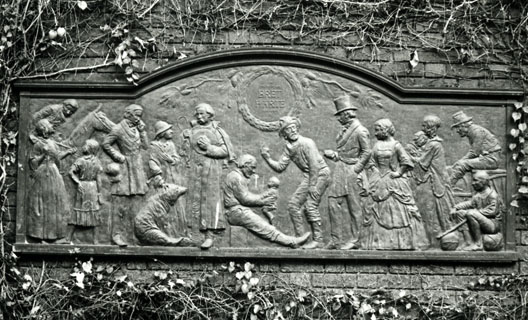
A bronze relief by Jo Mora is installed on the exterior of the building. It serves as a memorial to author and poet Bret Harte. The relief, which is 3 ft by 7 ft by 2+1/2 in, was first dedicated on August 15, 1919, as a tribute by Mora, who was a member, to fellow Bohemian Club member Harte. The relief shows fifteen characters from books by Harte. It is inscribed:
Proper left, upper corner: :J J MORA AUGUST 15, 1919 Proper left, lower edge: :L. DE ROME BRONZE FOUNDRY Top center wreath: :IN MEMORIAM BRET HARTE 1836–1902 AD followed by the founder's mark for L. De Rome. When the original building was torn down, the relief was removed. In 1934, it was reinstalled on the building that stands today.
References
;Notes
Bibliography
- Domhoff, G. William. Bohemian Grove and Other Retreats: A Study in Ruling-Class Cohesiveness, Harper & Row, 1975.
- Dulfer & Hoag. Our Society Blue Book, San Francisco, Dulfer & Hoag, 1925.
- Garnett, Porter, The Bohemian Jinks: A Treatise, 1908
- Parry, Albert. (2005.) Garretts & Pretenders: A History of Bohemianism in America, Cosimo, Inc.
- Watson, E. H. "The Bohemian Club Legacy." The English review 62.3 (1936): 289–306.
Primary sources
- Bohemian Club. Constitution, By-laws, and Rules, Officers, Committees, and Members, 1904
- Bohemian Club. Semi-centennial high jinks in the Grove, July 28, 1922. Haig Patigian, Sire.
- Bohemian Club. History, officers and committees, incorporation, constitution, by-laws and rules, former officers, members, in memoriam, 1960
- Bohemian Club. History, officers and committees, incorporation, constitution, by-laws and rules, former officers, members, in memoriam, 1962
;Archival Sources
References
- "Bohemian Club". National Center for Charitable Statistics.
- Kay, Jane. (July 6, 2009). "No retreat from uproar over Bohemian Club woods". [[San Francisco Chronicle]].
- (10 July 2011). "Bohemian Grove - men only".
- "Bohemian Club". Atlas Obscura.
- "Bohemian Grove: Where the rich and powerful go to misbehave". Washington Post.
- Garnett, 1908.
- Domhoff, 1975.
- Buchanan, Paul D.. (2002-09-02). "National Register #94001500: Brittan Party House in San Carlos, California". The Daily Journal.
- "San Carlos History".
- Buchanan, Paul D.. (2002-09-02). "Party House was synonym for fun and frolic".
- The Mark Twain Project. [http://www.marktwainproject.org/xtf/view?docId=letters/UCCL00124.xml%3Bstyle=letter Explanatory Notes regarding the letter from Samuel Langhorne Clemens to Charles Warren Stoddard, 23 Apr 1867.] Retrieved on July 26, 2009.
- 90-5183-125-0
- Interview with [[Michael Henry De Young]], 1915, reproduced at https://archive.org/stream/variedtypes00odayrich/variedtypes00odayrich_djvu.txt.
- [https://books.google.com/books?id=5fUBAAAAYAAJ&pg=PA175 ''The Elite directory for San Francisco and Oakland''], Argonaut Publishing Co., 1879, pp. 175–184.
- Bohemian Club. [https://books.google.com/books?id=PHX5AAAAIAAJ&pg=PA11 ''Constitution, By-laws, and Rules, Officers, Committees, and Members''], Bohemian Club, 1904, p. 11. [https://books.google.com/books?id=OKc_AAAAYAAJ&pg=PA11 ''Semi-centennial high jinks in the Grove'', 1922], Bohemian Club, 1922, pp. 11–22.
- Parry, 2005, [https://books.google.com/books?id=ov2dz3Pnea4C&pg=PA219 pp. 218–219.]
- Parry, 2005, [https://books.google.com/books?id=ov2dz3Pnea4C&pg=PA238 p. 238.]
- Finn, Maria. (October 9, 2010). "Keeping Reality at Bay". Wall Street Journal.
- (2012). "Jennie V. Cannon: The Untold History of the Carmel and Berkeley Art Colonies, Vol. 1". East Bay Heritage Project.
- Peter Martin Phillips, [http://libweb.sonoma.edu/regional/faculty/phillips/bohemianindex.html A Relative Advantage: Sociology of the San Francisco Bohemian Club] {{webarchive. link. (2012-08-12 , 1994.)
- "Bret Harte Memorial, (sculpture)". [[Smithsonian American Art Museum]].
This article was imported from Wikipedia and is available under the Creative Commons Attribution-ShareAlike 4.0 License. Content has been adapted to SurfDoc format. Original contributors can be found on the article history page.
Ask Mako anything about Bohemian Club — get instant answers, deeper analysis, and related topics.
Research with MakoFree with your Surf account
Create a free account to save articles, ask Mako questions, and organize your research.
Sign up freeThis content may have been generated or modified by AI. CloudSurf Software LLC is not responsible for the accuracy, completeness, or reliability of AI-generated content. Always verify important information from primary sources.
Report